
🪄 AI Summary
Heading 1
Heading 2
Heading 3
Heading 4
Heading 5
Heading 6
Lorem ipsum dolor sit amet, consectetur adipiscing elit, sed do eiusmod tempor incididunt ut labore et dolore magna aliqua. Ut enim ad minim veniam, quis nostrud exercitation ullamco laboris nisi ut aliquip ex ea commodo consequat. Duis aute irure dolor in reprehenderit in voluptate velit esse cillum dolore eu fugiat nulla pariatur.
Block quote
Ordered list
- Item 1
- Item 2
- Item 3
Unordered list
- Item A
- Item B
- Item C
Bold text
Emphasis
Superscript
Subscript
Most B2B SaaS teams treat YouTube as a content archive. They upload a webinar replay, wait six months, and wonder why it didn't generate a pipeline. A real YouTube strategy for B2B brands works differently. YouTube is the second-largest search engine on the planet, a trust-building engine, and a compounding demand-generation asset. This guide breaks down how founders, marketing heads, and growth teams at SaaS and AI/tech companies can build, execute, and scale one that actually moves buyers.
TL;DR
- YouTube is a compounding search and trust channel, not a social feed. B2B buyers research there before they ever contact sales.
- The right content mix combines thought leadership, product education, and buyer-stage SEO.
- Posting cadence matters less than topical authority and retention rate.
- Treat YouTube as the hub. Repurpose everything out to LinkedIn, email, and sales sequences.
How to Use YouTube for B2B Marketing in 2026
YouTube isn't a vanity channel anymore. 46% of B2B technology buyers purchase a product or service after viewing video content, and over 75% of Fortune 500 executives regularly watch online video. That's your buyer committee. They're already there. The core shift in 2026 is treating YouTube as a search-and-trust system, not a broadcast platform. Here's how to build that system from the ground up.
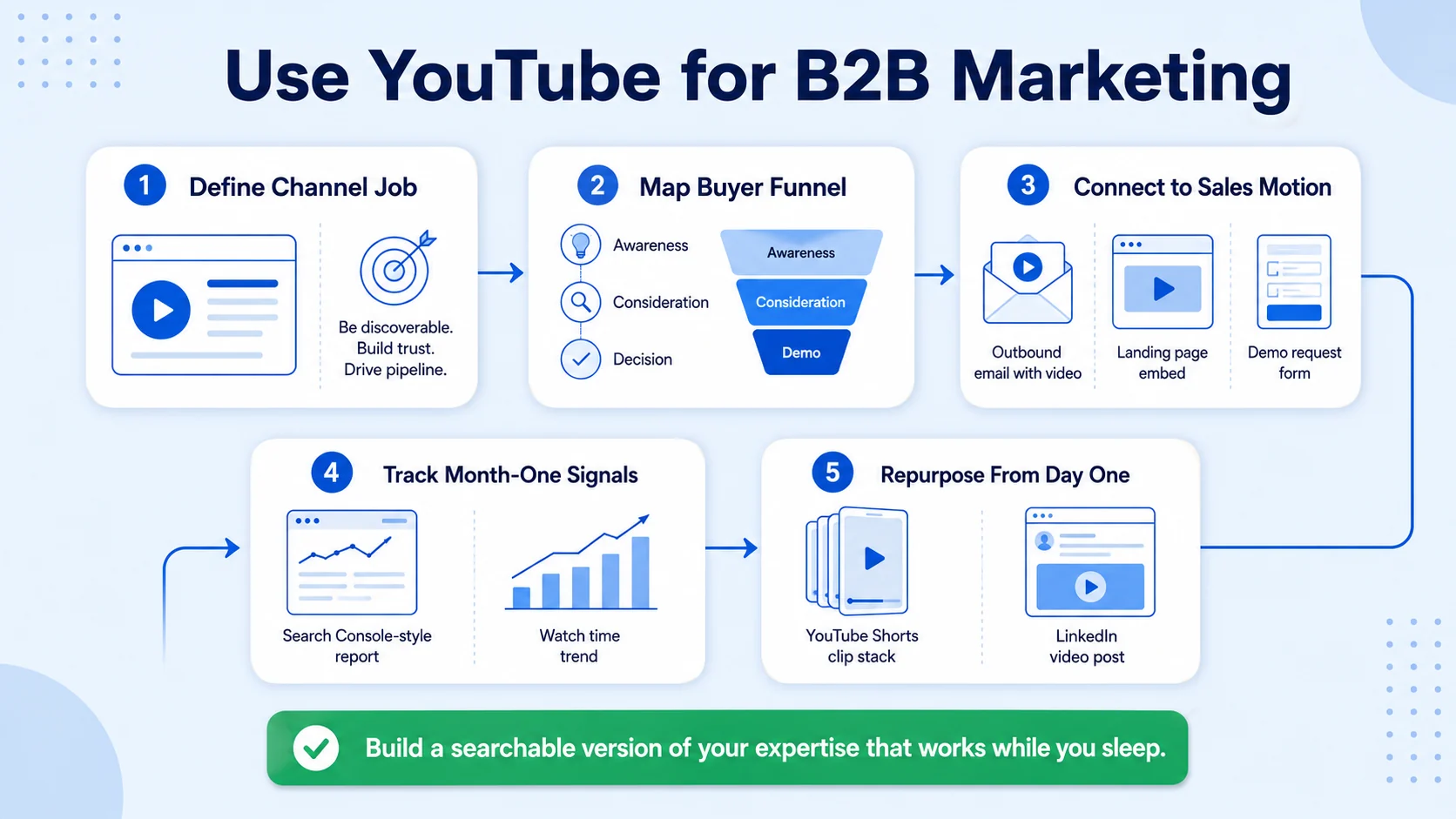
- Define your channel's one job: For most B2B SaaS brands, that job is buyer education, which means every video should answer a question your ideal customer is actively asking at some stage of their journey.
- Map content to the SaaS marketing funnel: Awareness-stage videos rank on problem-aware queries. Middle-funnel videos cover solution comparisons. Bottom-funnel videos cover product walkthroughs and customer outcomes. Each stage serves a different role in Buyer Journey Mapping.
- Connect YouTube to your sales motion: Drop relevant videos into outbound sequences, embed them on landing pages, and share clips through your sales team via LinkedIn Video Integration. Video that lives only on YouTube misses most of its pipeline potential.
- Set a measurable goal for month one: Don't aim for subscribers. Aim for watch time, click-through rate (CTR), and inbound demo requests sourced from video traffic in Google Search Console.
- Build a content repurposing system from day one: Every long-form video should produce at least three short-form clips for YouTube Shorts and LinkedIn. Our short-form video editing service is built specifically around this workflow for B2B SaaS, AI, and tech startups & teams.
93% of B2B buyers say video builds trust in purchase decisions, and 59% of senior executives prefer video over text when researching solutions. That alone is the business case for YouTube. The only question is whether your brand shows up in those searches or your competitor does.
The frame shift: YouTube isn't where you go after you have content. It's where you build a permanent, searchable version of your expertise that works for the pipeline while you sleep.
What Is a YouTube Strategy for SaaS Companies?
A YouTube strategy for B2B brands in the SaaS context is a deliberate system connecting content creation, Video SEO, and demand generation into a single repeatable engine. It's not a content calendar. It's a growth architecture. The components that separate a real strategy from random uploads:
- Channel positioning: One clear topic cluster your channel owns. For a SaaS product, that might be "RevOps for mid-market teams" or "AI automation for finance." Broad channels underperform because the algorithm now reads your entire channel as a knowledge graph, and a channel with 20 videos all on one topic ranks better for each individual keyword than a channel with 20 videos spread across 20 different topics.
- Content architecture: A mix of long-form authority videos (8–15 minutes) for search rankings and short-form clips for discovery and LinkedIn Video Integration.
- Demand generation integration: YouTube content feeds your email nurture, sales decks, and Account-Based Marketing sequences. Vidyard and Wistia both offer tools to track which prospects watched which videos, giving your sales team real buying signals.
- Measurement framework: Tracking watch time, average view duration, CTR, and pipeline-attributed revenue, not just views.
Wyzowl's 2026 report found that 83% of marketers say video has directly increased sales, and 82% say video has helped increase web traffic. For SaaS companies with longer sales cycles, YouTube works because it compounds. A video that ranks today still generates awareness and inbound demand 18 months from now, unlike paid ads that stop the moment the budget does.
Product-Led Growth companies especially benefit here. When prospects can self-educate through your YouTube content before ever touching sales, your Customer Acquisition Cost drops and demo quality rises because buyers arrive pre-sold on your value proposition.
Best YouTube Content Types for B2B Brands
Not all content performs equally in a B2B context. 58% of marketers rate video as the most effective B2B content type. But within video, format and intent determine whether a piece drives the pipeline or just watch time.
The highest-leverage play for most SaaS teams is the tutorial-to-demo pipeline. A "how to solve [problem your product solves]" video captures problem-aware buyers organically. The description and end screen drive them toward a demo. That's a full buyer journey in one asset.
Customer outcomes and results are the most persuasive proof type, at 42.7%, according to Vidico's 2026 State of Creative in Tech report surveying 230+ B2B tech marketing leaders, with customer success stories ranked as the single most convincing proof format for B2B buyers.
For AI/tech companies specifically, Thought Leadership Content from the founder or a technical lead builds the credibility that closes enterprise deals. Buyers evaluating six-figure SaaS contracts want to know who built the product and whether those people understand the problem space deeply. A founder-led video series on YouTube answers that question at scale.
Komet Media provides comprehensive from-scratch video production alongside webinar and podcast repurposing services that turn assets into a full YouTube library.
How AI/Tech Companies Grow on YouTube: The Platform-Specific Playbook
AI and tech companies have a structural advantage on YouTube that most of them don't use: they have deep product knowledge, genuine opinions on fast-moving topics, and founders who can speak with authority on problems buyers care about. Younger B2B buyers don't follow a linear path. They watch YouTube explainers, skim Reddit threads, DM creators, and only then visit your site. Your YouTube channel is often the first place a buyer forms an opinion about your brand.
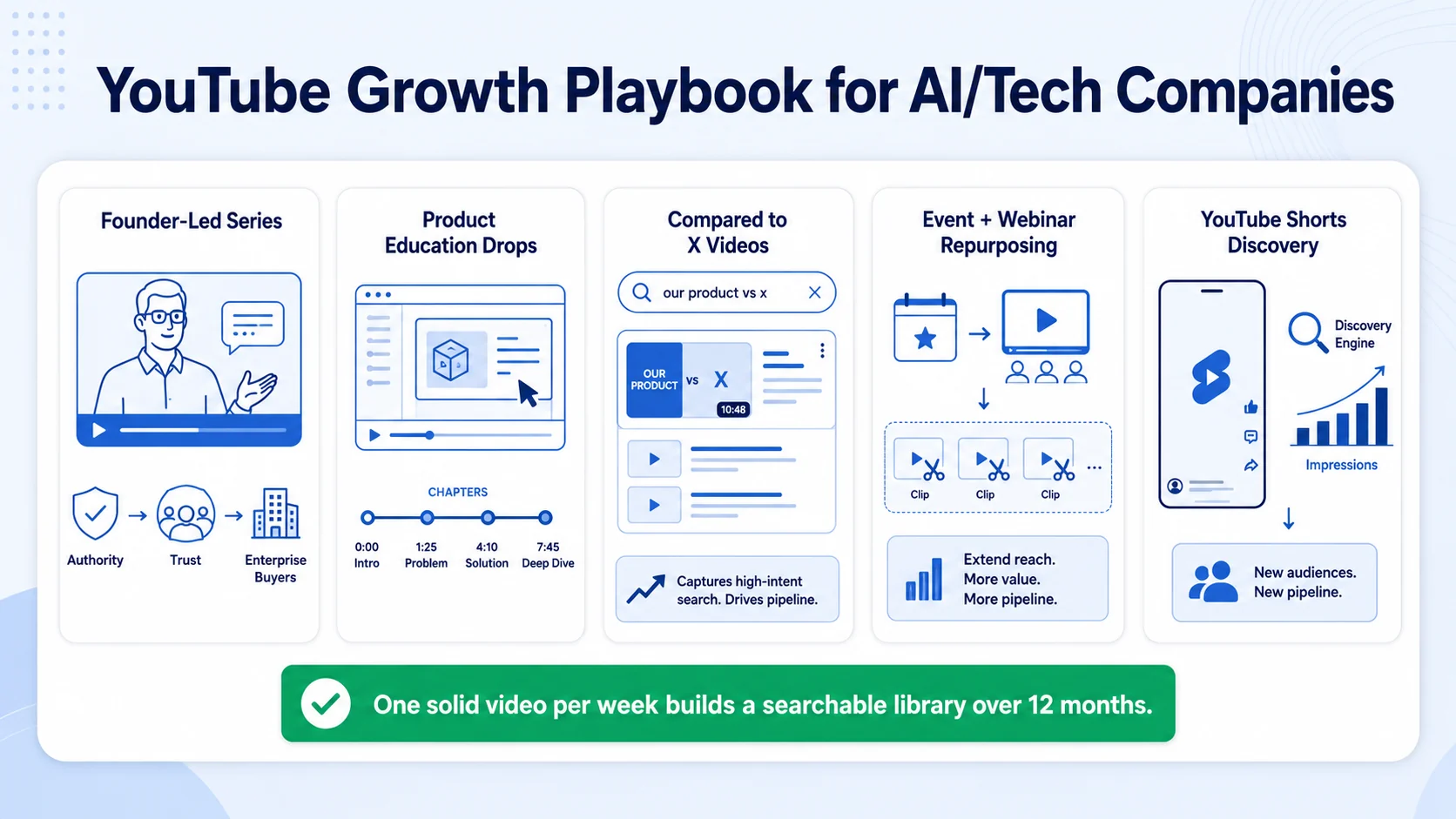
The AI/tech growth playbook on YouTube in 2026:
- Founder-led series: A weekly or biweekly 8–12 minute video where the founder or CTO takes a clear position on an industry trend. This builds the Thought Leadership Content engine that supports enterprise sales.
- Product education drops: Short, tightly edited walkthroughs of specific features. Not demo recordings. Designed for search. Use YouTube Chapters so buyers can skip to the section relevant to their role.
- "Compared to X" videos: Capture buyers actively evaluating alternatives. These rank well and convert.
- Event and webinar repurposing: Most AI/tech companies run quarterly webinars and never clip them. A single 45-minute webinar contains 6–10 standalone videos. Komet Media's workflow covers both from-scratch production and strategic event repurposing to extract maximum value.
- YouTube Shorts for discovery: The top social media marketing channels for B2B in 2025 include short-form video on YouTube, and 41% of B2B marketers say short-form drives the highest ROI of all video formats, per the LinkedIn B2B Marketing Benchmark 2025.
The compounding effect is the unlock. A tech company that publishes one solid video per week for 12 months builds a searchable library of 50+ assets that continuously surface in Google and YouTube search, feeding inbound pipeline without incremental paid spend.
YouTube vs. LinkedIn for B2B Brand Awareness: Which Is Better?
This is the wrong question, but it's worth answering precisely because so many SaaS marketing teams use it to avoid investing in YouTube entirely. For B2B specifically, LinkedIn has overtaken YouTube as the top distribution channel, with 81% of B2B teams sharing video there. LinkedIn wins on short-term reach, lead generation form infrastructure, and professional targeting. YouTube wins on search permanence, watch time depth, trust-building, and compounding returns.
According to the Content Marketing Institute, the top social media marketing channels for B2B in 2025 are YouTube, Instagram, and TikTok. The smart play isn't choosing between platforms. It's using YouTube as the production hub and LinkedIn as the distribution arm. Record once on YouTube, cut three to five clips within 48 hours, post natively to LinkedIn with a B2B frame. That's how you maximize both without doubling your production workload.
The real answer: LinkedIn amplifies to your existing network. YouTube builds an audience that doesn't know you yet. B2B pipeline needs both.
How to Build a YouTube Channel for a B2B SaaS Company From Scratch
Starting from zero is an advantage, not a liability. You get to build with intent rather than cleaning up years of inconsistent uploads.
- Name and position the channel: Use your company name plus a clear descriptor. The channel art and about section should communicate exactly who you help and what you teach.
- Define your topic cluster: Choose one core theme and 4–6 sub-topics that all ladder up to your product's value proposition. Build a 20-video keyword bank that all live within your topic cluster. This serves as your editorial calendar and reinforces topic authority across the channel.
- Record and publish your first five videos before announcing the channel: This prevents a dead channel impression on any early visitors and signals consistency to the algorithm.
- Optimize every video for Video SEO from upload one: Write a 200+ word description with your primary keyword in the first two sentences. Add Closed Captions to every video (YouTube's auto-captions are a starting point, but edited captions improve both accessibility and search indexing). Use YouTube Chapters in every video over five minutes.
- Set a publishing cadence you can sustain: One video per week is the proven floor for channel growth. A fixed publishing day helps viewers build habits, a production buffer of at least one finished video before launch prevents gaps, and a realistic quality bar means a smaller cadence with strong content beats a broken promise.
- Connect Google Search Console: After publishing, monitor which Google search queries surface your videos and double down on the intent clusters driving impressions.
- Repurpose from day one: Every long-form upload should immediately feed your short-form video editing workflow and LinkedIn distribution.
YouTube SEO Tips for SaaS and Tech Companies in 2026
YouTube SEO has changed more in the past 18 months than in the previous five years combined. The old playbook of stuffing tags and keyword-loading descriptions no longer moves rankings. YouTube ranking in 2026 is dominated by viewer satisfaction signals rather than simple metadata tricks. The algorithm looks at how long people watch, whether they interact, and whether they keep watching more videos after yours.
The current ranking factors in order of impact:
- Watch time and retention rate: In 2026, retention curves do most of the ranking work. A 12-minute video with 65% retention outranks a 12-minute video with 30% retention for almost every keyword, regardless of title optimization.
- Click-Through Rate Optimisation: The fastest way to improve rankings is to rewrite titles around search intent and design thumbnails that clearly match the promise, increasing CTR and watch time. Keep titles under 60 characters with the primary keyword in the first 30.
- Topic clustering for channel authority: The algorithm punishes broad content and rewards niche topical authority. A channel that owns one topic ranks better for every video in that topic cluster.
- AI search citation flywheel: ChatGPT, Claude, and Perplexity now cite YouTube transcripts in their answers, and videos that get cited in AI search responses see 20–40% more YouTube impressions, which feeds back into ranking. Optimize your transcripts for buyer intent questions, not just keywords.
- Closed Captions and descriptions: Edited captions improve both accessibility and the searchable text surface of your video. Write descriptions as mini-articles, not keyword lists.
- YouTube Chapters: Chapters improve watch experience, reduce drop-off, and create indexed section previews in Google search results, a direct Click-Through Rate Optimisation lever.
Because YouTube results now surface prominently inside Google search, especially for how-to and software queries, smart YouTube SEO effectively gives your B2B SaaS brand a second way to win the same search result page.
How Often Should B2B Brands Post, and What Mistakes Kill Growth?
Cadence is the most over-discussed and least-understood variable in YouTube strategy for B2B brands. The honest answer: frequency matters less than consistency and content quality per publish. 65% of B2B marketing leaders rank video among the top three most impactful content types for achieving social media goals, according to Forrester's 2025 B2B Brand and Communications Survey. Yet most B2B YouTube channels stall not because of infrequent posting but because of structural mistakes that suppress reach before the algorithm has a chance to reward good content.
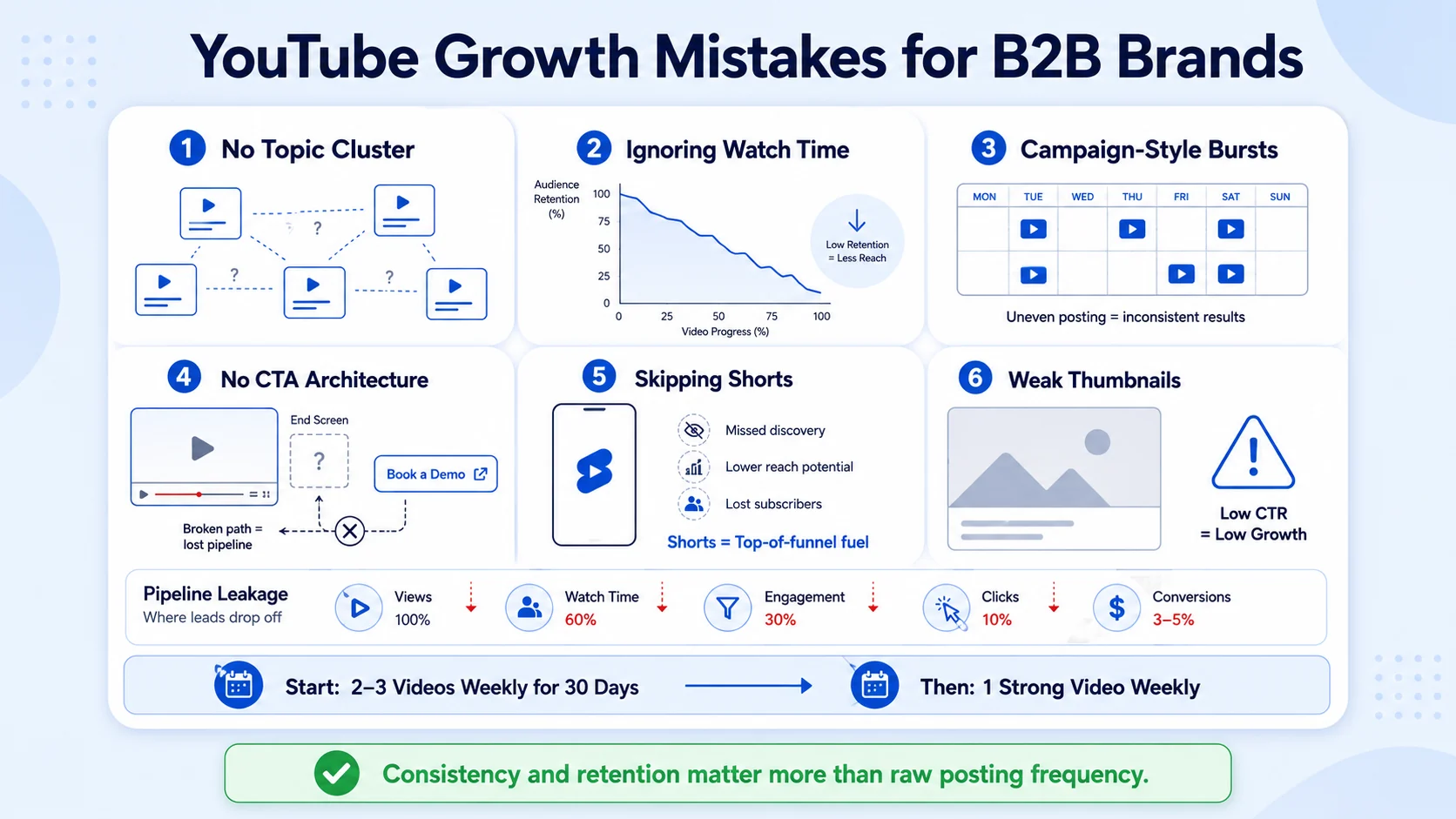
The biggest mistakes B2B brands make on YouTube:
- Posting without a topic cluster: Random videos across unrelated topics confuse the algorithm and dilute channel authority. Every video should connect to your core positioning.
- Ignoring watch time: Publishing long videos with high drop-off rates actively suppresses channel reach. A tight 7-minute video that holds 70% retention outperforms a 20-minute video that loses 60% of viewers in the first 3 minutes.
- Treating YouTube like a campaign channel: Quarterly bursts followed by months of inactivity destroy algorithmic momentum. When consistency is strong, the channel starts to feel like a dependable media property rather than a random upload folder.
- No CTAs or next-step architecture: Every video needs an end-screen CTA, a description link to a demo or landing page, and ideally a pinned comment with a relevant resource. YouTube is Demand Generation infrastructure. Treat it that way.
- Skipping short-form repurposing: Posting only long-form content while ignoring YouTube Shorts means missing the discovery surface where new audiences find your channel. Our video marketing service builds both formats into a single production pipeline.
- Thumbnails as an afterthought: Titles with brackets and parentheses earn 2.98x higher CTR. Titles with formats like "[2026 Update]" or "(Step-by-Step)" clarify what the viewer gets before they click.
On posting frequency, one high-quality, well-optimized video per week is the proven floor for SaaS channels that want to build algorithmic momentum within 90 days. For teams starting from zero, two to three videos per week for the first 30 days accelerates the topical authority signal. After that, one per week is sustainable and sufficient.
Conclusion
A strong YouTube strategy for B2B brands is a compounding asset, not a campaign. Here's what to take forward:
- YouTube builds trust with buyers who will never respond to cold outreach. The search permanence alone justifies the investment over any paid channel.
- Topic clustering and retention rate are the two non-negotiable ranking levers in 2026. Get those right before worrying about posting frequency.
- Every long-form video is a production asset. Repurpose into short clips, LinkedIn posts, email embeds, and sales sequences to multiply its pipeline value.
- Start with the content you already have or create new series from the ground up. Komet Media offers from-scratch production and repurposing to turn raw material into a pipeline-ready video system for B2B SaaS, AI, and tech startups & teams.
Frequently Asked Questions
Q1: How long does it take for a B2B YouTube channel to show results?
Most B2B channels see meaningful organic search traction between 90 and 180 days, assuming consistent publishing, strong retention, and topic clustering. Pipeline attribution typically shows up at the 6-month mark when enough content exists to cover multiple buyer-journey stages.
Q2: What video length works best for B2B YouTube content?
For search-ranking videos, 8–14 minutes is the proven range. It gives enough depth to hold retention and satisfy search intent. YouTube Shorts under 60 seconds work for discovery and top-of-funnel awareness. Both belong in a complete YouTube strategy for B2B brands.
Q3: Should a B2B SaaS company use YouTube Shorts?
Yes. Shorts drive discovery with audiences who haven't found your long-form content yet. They also feed the YouTube algorithm with fresh upload signals. Repurpose existing long-form clips rather than creating Shorts separately to keep production costs low.
Q4: How does YouTube support sales enablement for SaaS teams?
Sales reps can embed relevant YouTube videos into outbound emails, share product walkthrough clips in follow-up sequences, and use customer story videos to remove objections in late-stage deals. This turns your content library into a sales tool and reduces the burden on reps to manually explain the product.
Q5: Does YouTube integrate with Account-Based Marketing (ABM)?
Indirectly but powerfully. YouTube content surfaces to buyers through organic search and suggested video, meaning target accounts often encounter your brand through YouTube before a sales touch. Tools like Vidyard and Wistia let you gate or track video views by company, adding YouTube engagement data into your ABM signals.
Q6: Can I build a YouTube strategy if I don't have video production resources in-house?
Yes. You can start with what you already have or leverage professional help for new series. Komet Media offers from-scratch video production and content repurposing to provide a complete YouTube video system for B2B SaaS, AI, and tech startups & teams.