
🪄 AI Summary
Heading 1
Heading 2
Heading 3
Heading 4
Heading 5
Heading 6
Lorem ipsum dolor sit amet, consectetur adipiscing elit, sed do eiusmod tempor incididunt ut labore et dolore magna aliqua. Ut enim ad minim veniam, quis nostrud exercitation ullamco laboris nisi ut aliquip ex ea commodo consequat. Duis aute irure dolor in reprehenderit in voluptate velit esse cillum dolore eu fugiat nulla pariatur.
Block quote
Ordered list
- Item 1
- Item 2
- Item 3
Unordered list
- Item A
- Item B
- Item C
Bold text
Emphasis
Superscript
Subscript
Most funded startups have a content problem hiding inside a budget problem. You have product knowledge, founder thinking, webinars, demo recordings, and expert conversations sitting idle, and your buyers are scrolling past competitors who figured out how to turn that exact material into a pipeline. Short-form video is how you close that gap. This guide walks you through the exact strategy, platforms, formats, and posting cadence I use with B2B SaaS and funded tech teams at Komet Media to turn existing content into scroll-stopping assets that drive real demand. We help create content from scratch as well if some doesn't have existing content at all.
TL;DR
- LinkedIn short-form videos achieve 3x the average engagement rate of text posts, making it the highest-leverage platform for B2B pipeline.
- Content repurposing, founder-led clips, and product demos are the three short-form formats that move buyers fastest.
- Post consistency beats production perfection, 3 to 4 videos per week on LinkedIn is the right cadence for most funded teams.
- Platforms are complementary, not competing: LinkedIn converts, TikTok reaches, YouTube Shorts compounds.
How to Use Short-Form Video to Grow a Funded Startup
Most Series A and seed-stage teams I work with are sitting on months of recorded content, webinars, podcast episodes, investor Q&As, onboarding calls, and publishing none of it. That is a direct cost to the pipeline. 73% of consumers rely on short-form videos to discover new products or services , and that behavior extends to your B2B buyers. The ICP decision-maker at a mid-market SaaS company is scrolling LinkedIn between meetings. Your window to educate them is measured in seconds, not paragraphs.
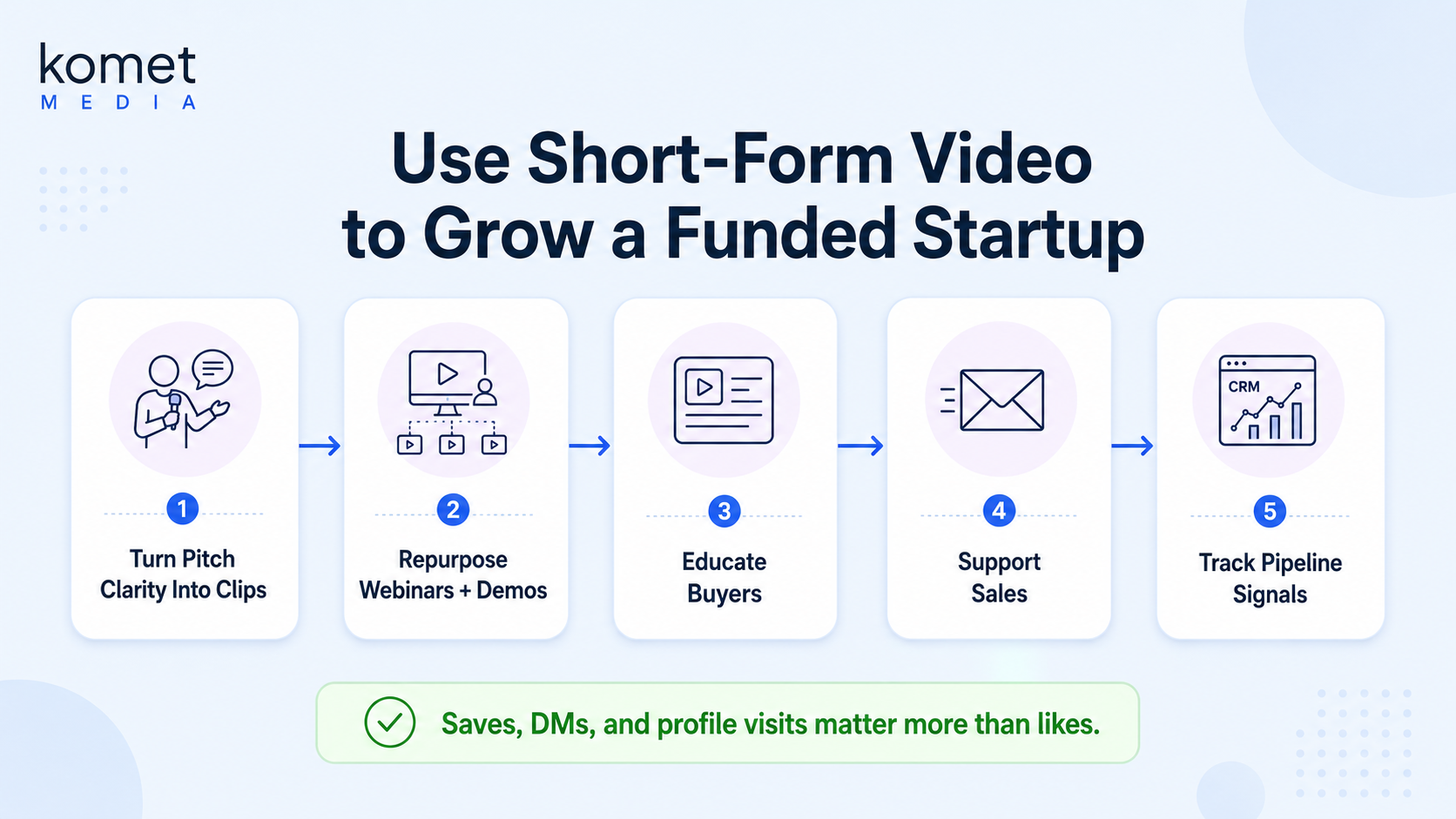
Here is how funded startups specifically use short-form video to grow:
- Turn investor pitch energy into founder clips: The same clarity you use to explain your product in a Y Combinator demo day applies directly to a 60-second LinkedIn explainer. Andreessen Horowitz-backed founders who put themselves on camera early build audience retention and organic reach simultaneously.
- Repurpose before you create: Pull two-minute clips from existing webinars and demos. Tag them with captions. Add a hook. That single podcast episode or webinar recording becomes five to seven short-form assets.
- Educate before you sell: Buyer education-first content, feature walkthroughs, use case demos, objection-handling clips, warms prospects faster than any cold sequence.
- Use video as sales enablement: B2B companies are increasingly incorporating short-form video into sales processes, with customer-facing teams using bite-sized content to engage prospects throughout the sales cycle, bridging the traditional marketing-sales divide.
- Track signal, not vanity: Saves, DMs, and profile visits from video content predict pipeline better than likes alone.
Videos under 60 seconds generate 2.5x more engagement per impression than any other content type, and marketers rank short-form video as the number one ROI format for the third consecutive year. For funded teams with limited marketing headcount, that efficiency is the argument.
Short-Form Video Strategy for Early-Stage Startups
Early-stage startups, pre-Series A or fresh off seed, have a specific advantage most don't use: founder authenticity. No brand polish, no committee approvals. Just a sharp, direct perspective that buyers trust more than corporate content.
The strategy I recommend for early-stage teams has three phases:
- Establish your POV pillar: Identify two or three positions your founding team holds in your category. These become the backbone of your content. Every video hook should express a clear stance.
- Build a content repurposing system: If you are running podcast content or webinars, those are your raw material. Clip, caption, trim, and publish. One 45-minute webinar produces eight to ten short-form clips.
- Layer in product trust content: Feature demos, use case explainers, and customer outcome clips build product-market fit signals publicly. This is founder-led marketing in practice.
The video hook is everything at this stage. 71% of viewers decide within the first few seconds whether to keep watching. Your opening line cannot be a wind-up. It needs to name a problem, challenge an assumption, or state something specific your buyer will stop scrolling to hear.
A clear majority, 73% of B2B decision-makers now prefer to watch product demo videos over reading whitepapers. For early-stage teams with a product story to tell, that preference is a direct invitation. Use it. Early-stage founders who publish consistently on LinkedIn for 90 days, even at low production quality, outperform teams running paid ads without an organic content foundation.
The goal in these early months is not to go viral. It is to build social proof with the exact buyers, investors, and partners who will shape your Series A narrative.
Best Short-Form Video Platforms for B2B Startups
Platform selection is not a matter of preference, it is a matter of where your buyer's attention is and what each algorithm rewards. For funded B2B startups, the platform stack looks like this:
YouTube works best for SEO and longevity, TikTok for reach and awareness, LinkedIn for B2B value per impression, and Instagram for product discovery. LinkedIn video viewership surged 36% year-over-year, and video creation on LinkedIn is growing at twice the rate of other post formats.
For funded B2B startups, LinkedIn is the non-negotiable first platform. Start there, then expand. LinkedIn short-form videos achieve 3x the average engagement rate of text posts, and 71% of B2B marketers now use video marketing as part of their strategy, with 73% reporting positive ROI.
For teams ready to build a full video marketing system, the three-platform approach, LinkedIn as the converter, TikTok as the reach engine, and YouTube Shorts as the compound SEO asset, is where I start.
What Kind of Short-Form Video Content Works for Startups
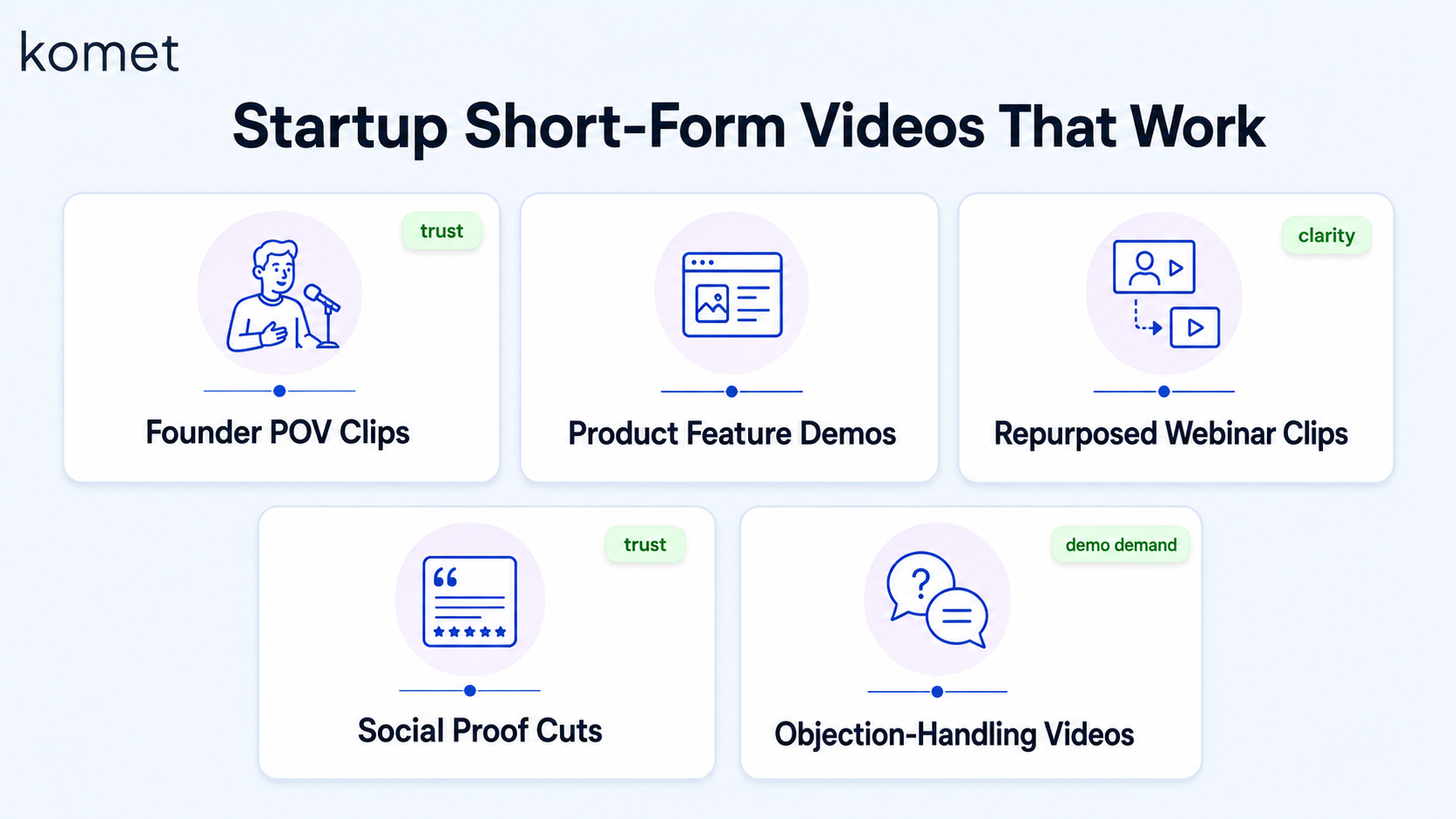
Not all short-form content performs equally for B2B buyers. These are the formats that consistently move funded startup audiences from scroll to signal:
- Founder POV clips: Unscripted, direct-to-camera takes on category problems. No production overhead, maximum trust signal. These outperform polished brand videos on LinkedIn consistently.
- Product feature demos: 45 to 90 seconds showing one specific feature solving one specific problem. Audience retention is highest when the outcome is named in the first five seconds.
- Content repurposing clips: Clipped moments from webinars, podcasts, or live events. The existing context gives these clips authority without requiring new recording sessions.
- Social proof cuts: Customer outcome moments, even informal testimonials from recorded calls, build conversion funnel trust faster than any ad.
- Objection-handling videos: Short clips that address the exact reasons prospects don't buy. These are your best sales enablement assets.
The average B2B video length has compressed from 168 seconds in 2024 to just 76 seconds in 2026, reflecting both platform algorithm changes and viewer behavior as busy professionals increasingly prefer concise, high-value content.
Short videos under 30 seconds achieve the highest completion rates, while mid-length videos of 60–90 seconds balance engagement with substantive content, making them ideal for most B2B use cases.
For scroll-stopping content, the video hook structure I use is: problem statement (first 3 seconds) + POV or tension (next 15 seconds) + resolution or CTA (final 10 seconds). That architecture applies whether the clip is a founder take or a product walkthrough.
How to Build a Short-Form Video Funnel for Investor-Backed Companies
Funded startups have a unique asset most overlook: investor traction itself is content. A Series A announcement, a revenue milestone, a team expansion, each of these is a conversion funnel entry point when packaged as short-form video.
Here is the funnel architecture I build for investor-backed B2B teams:
- Top of funnel (awareness): Founder POV clips and category education on TikTok and LinkedIn. These target cold audiences who match ICP but don't know you yet. Growth hacking on distribution, publishing on all three platforms simultaneously.
- Middle of funnel (consideration): Product demos, use case explainers, and repurposed webinar clips. Deploy on LinkedIn video and YouTube Shorts. These nurture warm audiences who have engaged with top-of-funnel content.
- Bottom of funnel (pipeline): Social proof clips, customer stories, and objection-handling content. These run closest to demo demand and work as sales enablement assets your SDR team can drop into sequences.
- Retargeting layer: Landing pages with embedded video convert at 86% higher rates than text-only equivalents, with B2B SaaS pages seeing conversion lifts exceeding 100% in controlled testing. Build video into your retargeting landing pages, not just social feeds.
- Measurement: Track saves, DM responses, demo requests attributed to video, and profile visits from video content. These lead indicators predict pipelines better than impressions.
The startups that win with video in 2026 are not the ones with the highest production budget. They are the ones with a system for consistent, specific, buyer-educated output.
Komet Media's short-form video editing service is built around this exact funnel architecture, turning existing long-form content into assets for each stage, and we help create content from scratch as well if some doesn't have existing content at all.
Short-Form Video Mistakes Startups Make
These are the patterns I see repeatedly across funded teams, and each one costs pipeline:
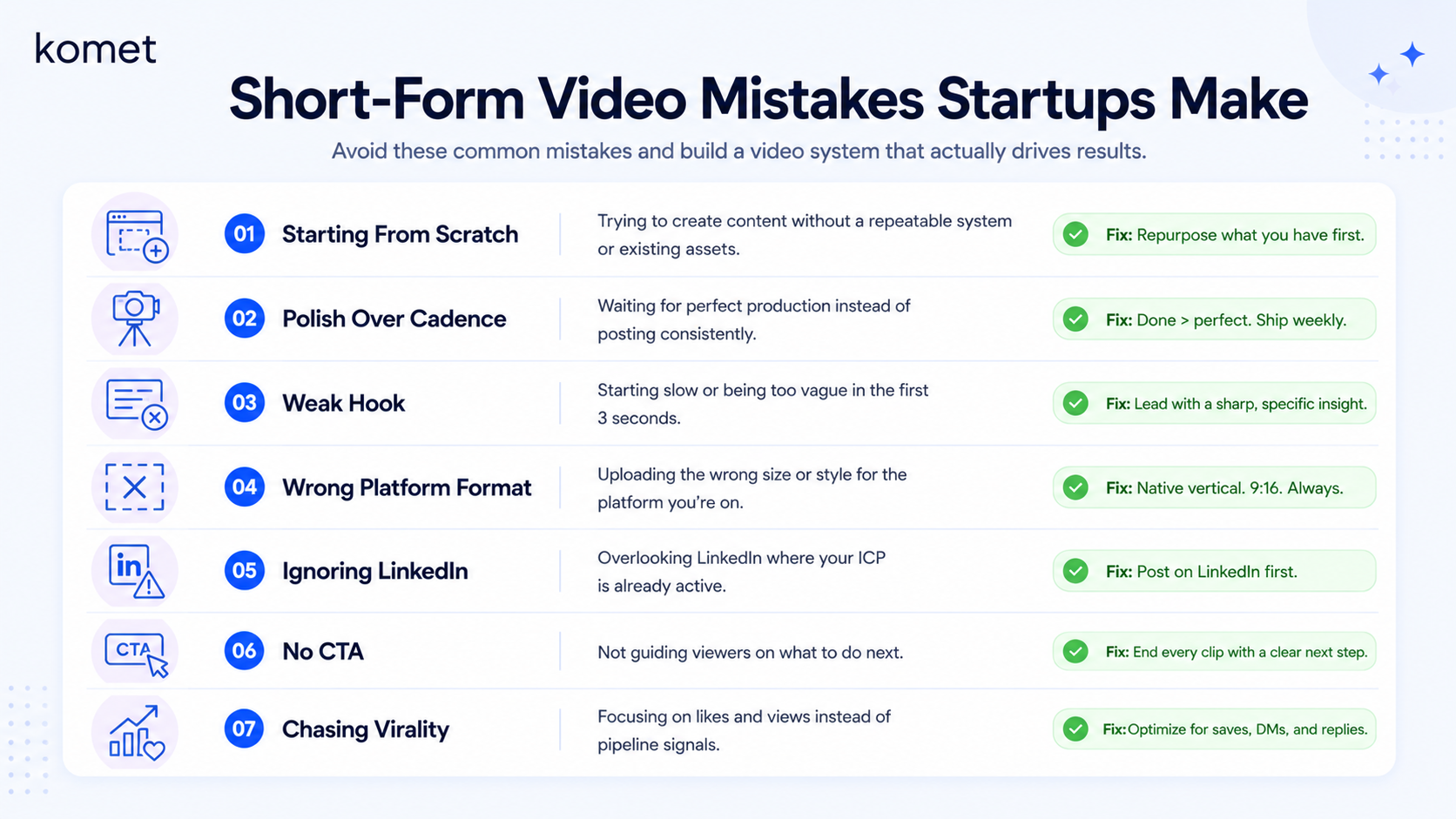
- Starting from scratch every time: The biggest efficiency failure in startup content. Your podcast episodes, event recordings, and demo calls are unedited short-form video waiting to be clipped.
- Optimizing for production quality over posting frequency: A 4K studio clip posted twice a month loses to a phone-recorded founder POV posted four times a week. Audience retention rewards consistency, not polish.
- Missing the hook: Short-form videos lasting less than 90 seconds retain a viewer rate of 50%, but only if the hook lands. Most startup videos waste the first five seconds on a logo animation or a warm-up sentence.
- Platform mismatch: Posting the same horizontal cut across every platform without reformatting for vertical. The TikTok algorithm penalizes non-native formats hard.
- Ignoring LinkedIn for video: LinkedIn is used by over 65% of B2B companies worldwide, and short-form video gets the highest engagement for B2B content. Skipping it in favor of Instagram-only is a direct miss on the platform where your buyers are making decisions.
- No CTA architecture: Publishing content without a clear next step, "book a demo," "read the full breakdown," "DM me for the template", leaves organic reach stranded without conversion.
- Chasing virality over specificity: A video that gets 500 views from your exact ICP is worth more than a video with 50,000 views from the wrong audience. Specificity drives inbound demand, not vanity metrics.
Short-Form Video vs Long-Form Video for Startup Growth
The debate between formats is mostly false. They serve different jobs in the conversion funnel, and the data supports running both.
The short-form versus long-form debate has evolved beyond simple preference into a data-driven allocation question: short-form dominates engagement and reach metrics, long-form wins on SEO value, lead generation, and audience depth, and the most effective video strategies in 2026 use both formats for complementary purposes.
The practical approach for a funded startup with a lean team: build your short-form output first, because it compounds fastest and feeds pipeline soonest. Once the system is running, layer in long-form on YouTube for search traffic and SEO value. The two reinforce each other, a long webinar becomes short clips, and short clips drive traffic back to full recordings.
Short-form video ad spending in the digital video advertising market reached $111.01 billion in 2025 , confirming where both organic and paid attention is concentrating. Funded teams that build short-form as their content foundation now will have the distribution advantage when they scale paid spend.
How Often Should a Startup Post Short-Form Video Content
Posting cadence is the question every founder and marketing head asks me, and the answer depends on the platform and where you are in your content maturity curve.
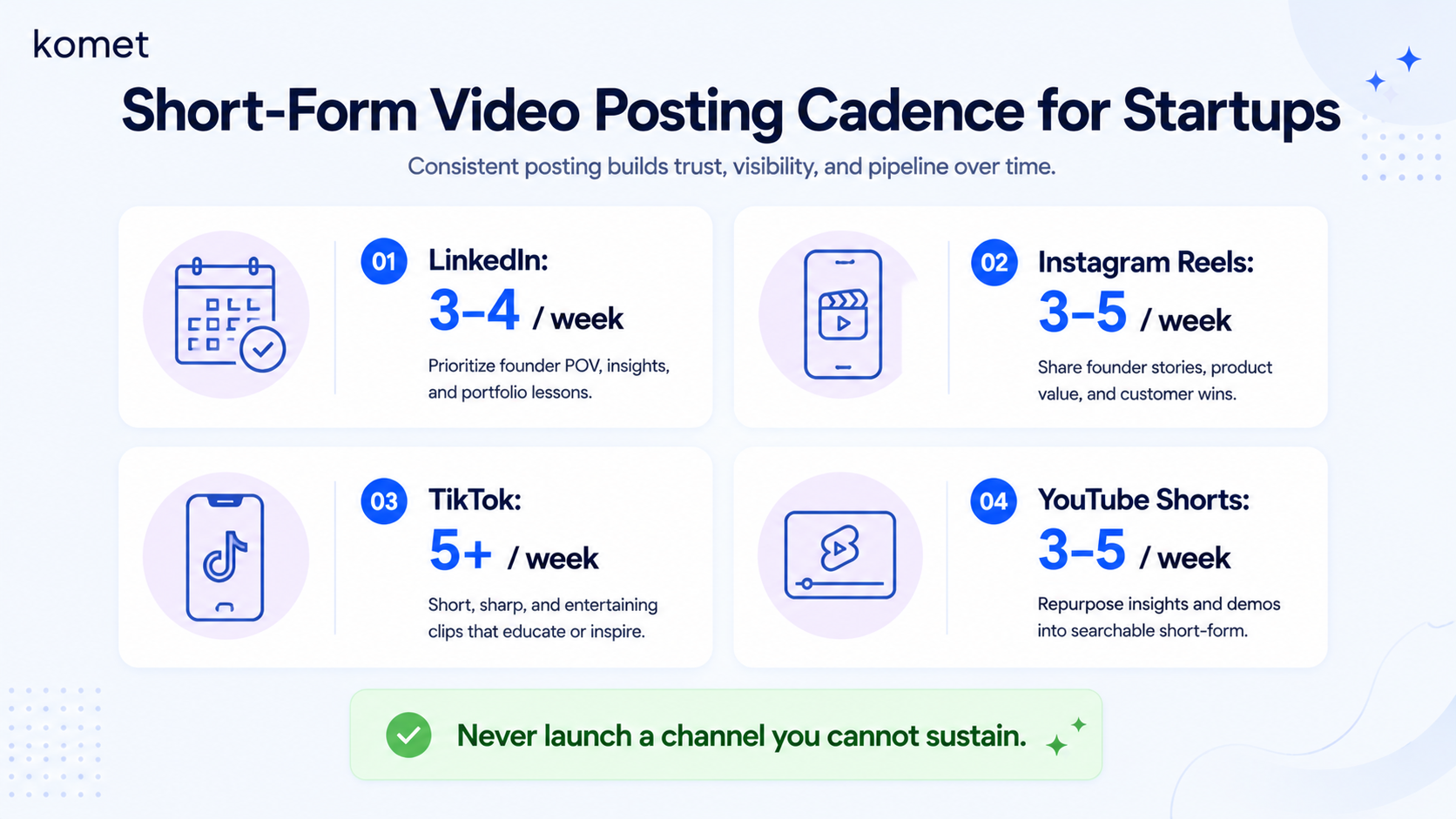
Recommended cadence by platform for funded B2B startups:
- LinkedIn: 3 to 4 videos per week. LinkedIn's optimal posting frequency sits at 3 to 4 posts per week. For video specifically, consistency in this range signals to the algorithm that you are a reliable creator, which compounds reach over time.
- Instagram Reels: 3 to 5 times per week. Instagram Reels between 60 and 90 seconds get the most engagement and views. Keep those lengths and maintain the cadence.
- TikTok: 1 to 2 videos per day for maximum TikTok algorithm reach, or a minimum of 5 per week if daily is unsustainable. TikTok rewards consistency more than other platforms, and daily posting is practically required for algorithm visibility.
- YouTube Shorts: 3 to 5 per week as a distribution layer for repurposed content.
The most important cadence principle: never launch a channel you cannot sustain. Three consistent LinkedIn videos per week for six months builds more brand awareness and inbound demand than a burst of 20 videos followed by silence.
For lean teams, the content repurposing model is the only way to hit these cadences without burning out. One monthly webinar or podcast episode can generate enough short-form clips to cover a full week of posts across every platform. That is the system I build for Komet Media clients, and it is what separates teams that sustain output from teams that go quiet after the first month.
Conclusion
Funded startups that treat short-form video as a tactical afterthought are leaving pipeline, brand awareness, and demo demand on the table.
- Start with what you have: Webinars, podcasts, and demo recordings are already short-form video, they just need to be clipped and published.
- Lead with founder-led content: Authentic POV clips outperform polished brand videos for B2B buyers in 2026.
- Prioritize LinkedIn: It is where your buyers make decisions, and short-form video gets the highest engagement there.
- Build a system, not a campaign: Consistent output at a sustainable cadence compounds faster than sporadic high-production bursts.
Ready to turn your existing content into a pipeline? Talk to Komet Media.
Frequently Asked Questions
Q1: What is the ideal length for short-form video for B2B startups?
60 to 90 seconds is the sweet spot for most B2B use cases. Under 30 seconds achieves the highest completion rates, while 60–90 seconds balances engagement with substantive content, enough to educate without losing the audience.
Q2: Which platform should a funded startup prioritize first for short-form video?
LinkedIn, without exception. LinkedIn video viewership surged 36% year-over-year , and your ICP decision-makers are already there. Build your LinkedIn presence first, then expand to TikTok and YouTube Shorts.
Q3: Does short-form video actually generate pipeline for B2B SaaS companies?
Yes, measurably. B2B companies are increasingly incorporating short-form video into sales processes, with customer-facing teams using bite-sized content to engage prospects throughout the sales cycle. Saves, DMs, and demo requests are the leading pipeline indicators to track.
Q4: How do you repurpose existing content into short-form video?
Pull high-value moments from webinars, podcast recordings, and demo calls. Add captions, trim to 60–90 seconds, reframe the hook, and publish natively on each platform. One 45-minute recording typically yields six to ten clips.
Q5: What makes a short-form video hook effective for a startup audience?
Name a specific problem in the first three seconds. 71% of viewers decide within the first few seconds whether to keep watching , so the opening line must immediately address a pain your ICP recognizes, no intros, no logos, no wind-up.
Q6: Should funded startups use the founder's face on video, or build a brand channel?
Both work, but founder-led content builds trust faster with buyers and investors at the early stages. Founder-led marketing is the highest-trust signal a startup can publish. Scale to a brand channel once the content system is running and the founder POV is established.