
🪄 AI Summary
Heading 1
Heading 2
Heading 3
Heading 4
Heading 5
Heading 6
Lorem ipsum dolor sit amet, consectetur adipiscing elit, sed do eiusmod tempor incididunt ut labore et dolore magna aliqua. Ut enim ad minim veniam, quis nostrud exercitation ullamco laboris nisi ut aliquip ex ea commodo consequat. Duis aute irure dolor in reprehenderit in voluptate velit esse cillum dolore eu fugiat nulla pariatur.
Block quote
Ordered list
- Item 1
- Item 2
- Item 3
Unordered list
- Item A
- Item B
- Item C
Bold text
Emphasis
Superscript
Subscript
If your podcast episodes are published without strong written companions, you're leaving organic traffic, buyer trust, and inbound pipeline on the table. So what are podcast show notes, exactly, and why do they matter far more than most B2B teams realize? This guide breaks down what podcast show notes are, what goes inside them, how long they should be, how they drive SEO, and how to write them in a way that actually moves buyers. Whether you're a founder, a marketing head, or running a content team, this is your complete playbook.
TL;DR
- What are podcast show notes: Written episode companions that summarize content, link resources, and guide listener action.
- They function as indexable, SEO-rich text that Google and Spotify can crawl, rank, and surface.
- Strong show notes convert skimmers into listeners and listeners into pipeline.
- Platform notes stay short (100–300 words); website versions should hit 300–1,000+ words for SEO impact.
-
What Are Podcast Show Notes, Explained for Beginners
Show notes, also known as episode descriptions, are the text posted alongside the audio content of an episode. They live directly beneath the episode title in podcast apps, and on your website as a dedicated episode page. Think of them as a written companion to your audio. They serve three jobs at once: sell the episode to someone who hasn't hit play yet, guide an existing listener to the resources you mentioned, and give search engines a structured, text-rich page they can index and rank. Audio alone does none of those three jobs.
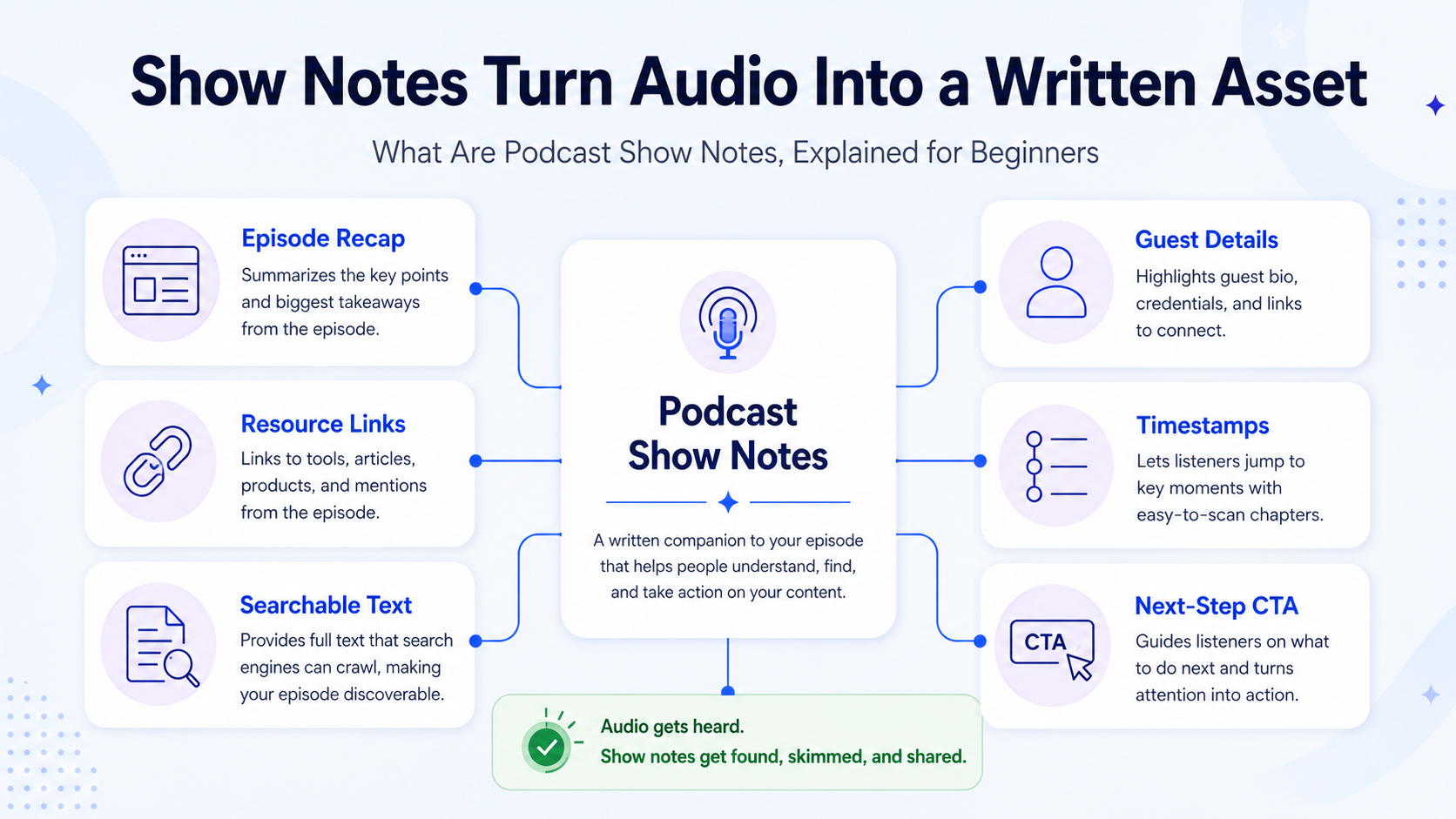
Podcast show notes are the written content that accompanies a podcast episode, all the words that live in the "description." They typically appear on podcast platforms like Apple, Spotify, and Overcast, your website, and sometimes in your newsletter or social media posts.
For B2B teams specifically, what are podcast show notes if not a sales enablement asset? Every episode your founder, executive, or subject-matter expert records is packed with product positioning, buyer education, and trust-building perspective. Show notes give that thinking a text-based format that buyers can find, skim, and share without ever committing 45 minutes to an audio file.
Podcast show notes are short written summaries that sit alongside your episodes. They usually include a recap, guest details, and links to resources mentioned. Think of them as a roadmap for your listeners and a way to make your podcast more searchable. The key distinction worth knowing early: show notes are episode-specific.
Show notes are different from your podcast description. The podcast description refers to the whole show and is a summary of your entire podcast. Show notes are specific to each individual episode. That distinction matters for SEO. Each episode's show notes page can target a unique keyword, address a unique search intent, and rank independently, compounding your organic reach one episode at a time.
How Do Podcast Show Notes Work Inside Podcast Platforms?
Show notes flow through your RSS feed and publish automatically to every directory that carries your show. When you submit your podcast to Apple Podcasts Connect or Spotify for Podcasters, the episode description field in your hosting platform becomes the show notes listeners see in-app. They'll typically show up right under each episode title in podcast apps like Apple Podcasts, Spotify, and others.
The platform version of show notes is character-limited. Most major apps truncate after the first two to three lines before expanding on a tap. This means your first sentence carries enormous weight, it either earns the tap or loses the listener. Your hook, your primary topic, and your guest name all need to appear before that truncation point.
Major podcast directories now employ advanced algorithms that analyze episode content, descriptions, and listener engagement patterns to determine rankings. These algorithms go beyond simple keyword matching, evaluating factors such as content quality, listening completion rates, and audience retention metrics. This is why treating show notes as a simple admin task is a strategic error. When 40% of listeners find shows through in-app or web search , the metadata in your episode description is part of your discovery infrastructure.
There is also a separate, more powerful version: the show notes page published on your own website. This is where the real SEO work happens. Unlike the RSS feed version, your website page has no character cap and can carry a full transcript, structured headers, timestamps with chapter markers, a guest biography, resource links, and a call to action. Search engines crawl this page independently and can rank it for queries entirely separate from your podcast directory presence.
Every episode deserves a standalone page: embedded player, transcript, key takeaways, and FAQ schema. That page architecture earns backlinks and lets you funnel visitors to high-intent service pages, extending your content marketing beyond the episode itself.
What Should You Include in Podcast Show Notes?
The right elements depend on your episode format, but the following components belong in every B2B episode's show notes:
- Episode hook (1–3 sentences): The single most important thing your listener will learn or the sharpest question the episode answers. The first sentence will probably be the only one a casual listener reads, so make sure it's catchy enough to draw them in and make them want to read more or click to listen.
- Episode summary (100–200 words): Summarize your episode in a way that makes readers want to listen. Make it clear how the episode can benefit listeners or help them solve a problem. Try to keep this section between 100 and 200 words.
- Timestamps and chapter markers: Outline the main points of your episode and include timestamps to make it easy for the reader to navigate. Timestamps also carry keyword value, each topic label is indexable text.
- Guest biography: Try to keep it under 75 words and highlight their accomplishments. You can also link to their social media, LinkedIn, website, and books.
- Resource links: You can include links to any quotes, data, articles, or other material you referenced in your episode. This gives credit to the sources you mentioned and builds your credibility.
- Call to action: Every episode needs to point your listener to a clear, valuable next step. A generic "Subscribe to our podcast" is okay, but a B2B audience wants more. They respond to CTAs that offer tangible, professional value. Your call-to-action should feel like the next logical step after listening to the episode.
- Transcript or transcript link: This is your heaviest SEO asset. Full coverage below.
- Internal links: Link to related episodes or relevant content on your site to keep listeners in your ecosystem and build internal link equity.
Why Do Podcasters Write Show Notes for Every Episode?
The short answer: audio is invisible to search engines. Google can't "hear" your audio, but it reads your text. When you add keyword-rich show notes, you make your episodes discoverable in search results. But the reasons go further than search. Show notes are searchable. Unlike your audio, search engines can read and index your show notes. Every episode page becomes a potential entry point for new listeners finding you through Google. Show notes are navigable. Listeners use them to jump to specific sections, find resources mentioned, and decide whether to invest time in an episode.
Show notes are shareable. When someone wants to recommend a specific episode, they share the show notes page, not an audio file. For B2B teams, there is a fourth reason that compounds all three: show notes are the bridge between podcast content and pipeline. At Komet Media, I see this constantly with SaaS and funded tech clients. A founder records a sharp 40-minute conversation about product positioning. Without show notes, that conversation lives and dies inside the audio. With properly written, keyword-optimized show notes, published on a standalone episode page with a transcript, a guest bio, and a strategic CTA, that same conversation drives organic traffic for 18 months, educates buyers before the demo call, and links back to high-intent service pages.
When potential guests see that you promote people and businesses in your show notes, they are more likely to agree to be on your podcast. As a podcast host, this small gesture can help you book more podcast guests and get more opportunities for cross-promotion. Not everyone hits play right away. Show notes act as your pre-sale pitch. When they're done right, they turn skimmers into subscribers and listeners into leads.
Podcast Show Notes vs Episode Description: What Is the Difference?
This distinction trips up a lot of teams. Here is a clear comparison:
For episodes that are best suited to attracting new listeners through search traffic, use SEO-friendly long-form podcast show notes published on your website. For episodes that are designed for established listeners, short-form show notes providing simple information will be sufficient.
Most podcast hosting platforms publish your episode description into the RSS feed, which populates every directory. Your website episode page is separate, and that is where you build the full show notes experience.
Think of your show notes not as a simple summary, but as a standalone blog post for each episode. By creating detailed, well-structured content that accompanies your audio, you provide a rich, indexable resource that search algorithms can crawl, understand, and rank, dramatically expanding your digital footprint beyond podcast directories.
One more distinction worth noting: your overall podcast description (written once for the show as a whole) covers your show's premise, format, and audience. Episode-specific show notes address a single conversation with its own hook, timestamps, guests, and links. Never use the same text for both.
How Long Should Podcast Show Notes Be?
Length depends on where the notes live and what job they need to do. For platforms like Apple Podcasts and Spotify, aim for 100–200 words. If you're publishing on a website, you can expand them up to 1,000 words to include more details and better optimize for search engines. Factors like episode complexity, platform guidelines, and audience needs will determine the ideal length.
For a full picture:
Current research indicates that top-ranking podcast-related pages average 1,500–2,500 words in 2025. Aim for comprehensive coverage of your episode's topics, typically resulting in this range of high-quality content. The key is depth and value, not just hitting a word count target.
The fastest path to the upper end of that range is including a full episode transcript on your show notes page. A 45-minute episode transcribes to roughly 7,000–9,000 words of indexable content, far more SEO fuel than any summary could generate.
A good length is 300–600 words, which balances readability and SEO. Shorter notes work for quick episodes, while longer notes suit deep-dive interviews. Adjust the length to match the style of your show.
The practical rule for B2B shows: never publish fewer than 300 words on a website episode page. The episode description inside the app can stay lean, but your website page should always give Google enough text to understand, index, and rank the episode for its target topic.
Do Podcast Show Notes Help with SEO? (Yes, Here's How)
This is the question that matters most to growth teams and marketing heads. The answer is direct: yes, and significantly. Show notes transform that invisible audio stream into a text-based asset that search engines can actually crawl, index, and rank. If you start treating each show notes page like a dedicated landing page, every episode you publish becomes a long-term engine for attracting your ideal B2B audience through organic search.
According to Lower Street's 2025 podcast SEO tips, podcasts with optimized show notes see up to 20% more organic traffic by targeting long-tail keywords.
The SEO mechanics work at multiple levels simultaneously:
- Keyword coverage: Your show notes are your opportunity to rank for the topics you discuss. Think about what someone would type into Google to find this content. Those phrases should appear in your show notes, not stuffed artificially, but woven into your descriptions naturally.
- Transcript as keyword depth: If there's one non-negotiable for blowing up your podcast's SEO footprint, it's including a full episode transcript. A well-written summary is great for user experience, but the transcript is what gives search engines a mountain of text to crawl and analyze. A transcript allows every single word spoken in your episode to be indexed by Google.
- Backlink building: Guest-appear on cross-industry shows, syndicate quotes to journalists, and pitch data-backed stories. Each do-follow backlink not only elevates domain authority but also drives referral subscriptions.
- Internal linking: Link to other episodes covering similar topics. This keeps listeners engaged with your archive and improves internal site structure for SEO.
- AI discoverability: AI tools like ChatGPT, Claude, and Perplexity are increasingly serving as "zero-click" search engines. When someone asks "What should I include in podcast show notes?", well-structured content with clear headers, bullet points, and direct answers is more likely to get pulled. This is why clear headers, bullet-pointed content, and clear topic overviews are important.
For B2B SaaS and funded tech companies, this SEO advantage compounds. Each podcast episode becomes a standalone page that can rank for buyer-intent queries. A founder's conversation about pricing strategy can surface in search when a prospect types "how to price B2B SaaS." The show notes page, not the audio, does that work.
How to Write Podcast Show Notes That Actually Get Read
Writing strong show notes is a repeatable process, not a talent exercise. Follow this sequence for every episode:
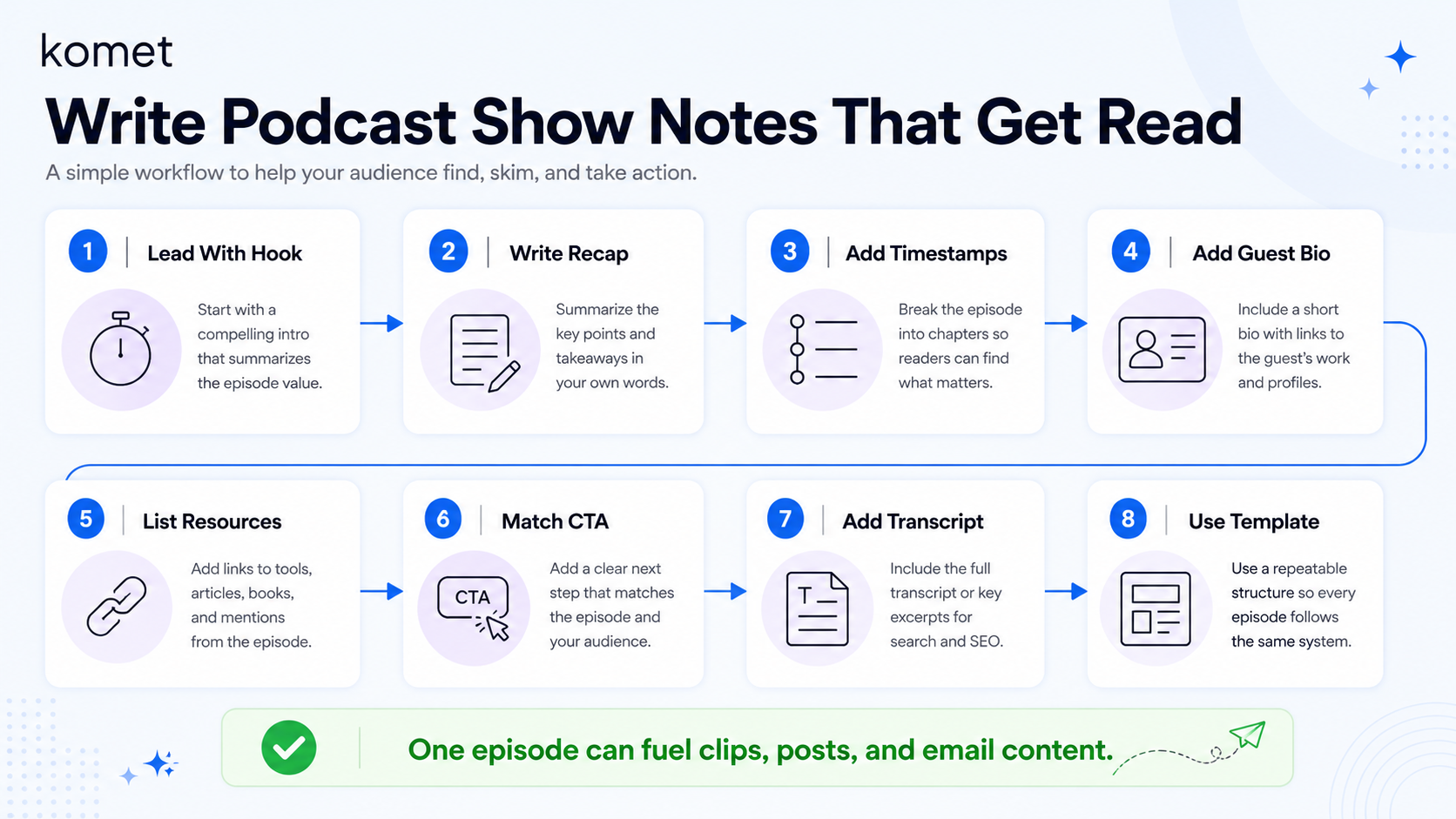
- Lead with a hook: Open with the sharpest question, the most counterintuitive claim, or the most tangible outcome the episode delivers. This is your in-app preview text and your web page headline moment.
- Write a 100–200 word summary: Cover what the episode addresses, who it is for, and what the listener will walk away knowing. Place your primary keyword naturally inside the first 100 words.
- Add timestamps: Timestamps categorise your podcast content into bite-sized, searchable sections. Searchability is crucial for podcast SEO. Not only do timestamps improve listeners' usability, but when included in show notes, they also help your show become more discoverable in podcast players.
- Include a guest bio (for interview episodes): Keep it under 75 words. Link to their LinkedIn, company, and any resource they mention.
- List all resource links: Every tool, report, article, or product referenced in the episode earns a hyperlink with descriptive anchor text.
- Write your CTA: Match it to the episode's specific topic. If you want buyers to experience what professional podcast show notes look like at scale, link to the relevant next step, not a generic homepage.
- Add or link to the full transcript: Embed it on the same page or link to a podcast transcription page to maximize indexable content.
- Apply a consistent template: Regular, well-formatted notes build trust and make your podcast feel professional.
For the repurposing layer: the smartest B2B podcasters treat their show notes like a content goldmine. That story-driven summary, those hard-hitting quotes, the key takeaways, they're all ready to be repurposed. Pull clips for short-form video, quotes for LinkedIn, and key stats for email sequences. One episode, executed well, becomes eight to twelve distinct content assets.
At Komet Media's podcast marketing service, this is the exact system we build for SaaS founders and growth teams, turning each recorded conversation into a pipeline-supporting content engine, not just an audio file that disappears into a directory.
Conclusion
Podcast show notes are not an admin task, they are a strategic growth asset.
- They transform invisible audio into indexable, rankable, shareable text that works long after the episode is published.
- Strong show notes drive inbound discovery through Google, Apple Podcasts, Spotify, and AI search tools simultaneously.
- Every B2B episode you publish without a proper show notes page is an organic traffic and buyer education opportunity left behind.
- Use a consistent show notes template, include timestamps and transcripts, and match every CTA to the episode's specific topic.
Build the system once. Let it compound.
Frequently Asked Questions
1) What are podcast show notes vs a podcast transcript?
Show notes are a curated written companion to your episode, including a summary, timestamps, guest bio, and resource links. A transcript is a verbatim record of everything spoken. Both serve SEO, but show notes guide listener action while transcripts maximize keyword depth and indexability. Including both on a single episode page is the strongest SEO setup.
2) Do podcast show notes help small or new podcasts rank on Google?
Yes, especially for long-tail and niche queries where competition is low. Show notes make your content discoverable on Google and podcast directories. By adding keywords, links, and detailed summaries, you give search engines more to index. This can drive new listeners who may never have found your show otherwise. Consistent, keyword-optimized notes compound over time.
3) How often should podcast show notes be updated after publishing?
Regular updates can help maintain and improve your search rankings. Consider revisiting your show notes every 6–12 months to refresh content, update statistics, add new insights, and ensure all information remains relevant and accurate. Updating older episodes that already get traffic is especially high-leverage.
4) Can I use AI to write podcast show notes?
Use AI for structure or first drafts, but always humanize your tone and CTA. AI tools can generate a solid first pass from a transcript, but generic output will miss your brand voice, your buyer's specific language, and the strategic CTA that connects the episode to your pipeline. Treat AI as a starting point, not the final product.
5) Should podcast show notes be different for each platform?
Your in-app episode description (the version in the RSS feed) should be a tight 100–200 word hook with your primary keyword front-loaded. Your website episode page should be the full, long-form version with timestamps, transcript, resource links, and a targeted CTA. Use the platform version to earn the click; use the website version to earn the conversion.
6) Where do podcast show notes appear in Apple Podcasts and Spotify?
Show notes are the written content that accompanies a podcast episode. They typically appear on podcast platforms like Apple, Spotify, and Overcast, your website, and sometimes in your newsletter or social media posts. In-app, they sit directly beneath the episode title and are visible before a listener hits play, making them critical for the conversion from browser to listener.