
🪄 AI Summary
Heading 1
Heading 2
Heading 3
Heading 4
Heading 5
Heading 6
Lorem ipsum dolor sit amet, consectetur adipiscing elit, sed do eiusmod tempor incididunt ut labore et dolore magna aliqua. Ut enim ad minim veniam, quis nostrud exercitation ullamco laboris nisi ut aliquip ex ea commodo consequat. Duis aute irure dolor in reprehenderit in voluptate velit esse cillum dolore eu fugiat nulla pariatur.
Block quote
Ordered list
- Item 1
- Item 2
- Item 3
Unordered list
- Item A
- Item B
- Item C
Bold text
Emphasis
Superscript
Subscript
Most B2B founders understand that video builds pipelines. What stops them isn't the strategy, it's the camera. Stiff delivery, wrong lighting, no repurposing system. The result: valuable founder knowledge sits locked inside long recordings that never become distributed. This guide gives you concrete tips for better founder videos on camera in 2026, drawn from what I see working every day at Komet Media with funded SaaS and AI teams who need their video presence to convert, not just exist.
TL;DR
- On-camera confidence comes from preparation and environment, not personality.
- Camera height, lighting, and audio make or break perceived authority before you say a word.
- A teleprompter used correctly removes filler words without removing authenticity.
- One recording session should produce 8 to 12 short-form clips through a disciplined repurposing system.
Why Founder-Led Video Is a Pipeline Asset in 2026
The case for getting on camera is no longer about vanity metrics.
78% of B2B buyers prefer a message delivered via video compared to just 9% via text.
That gap matters when you're trying to convert cold LinkedIn impressions into warm pipelines.
LinkedIn video views are up 36% year-over-year in 2026, and the platform is rewarding video with real distribution.
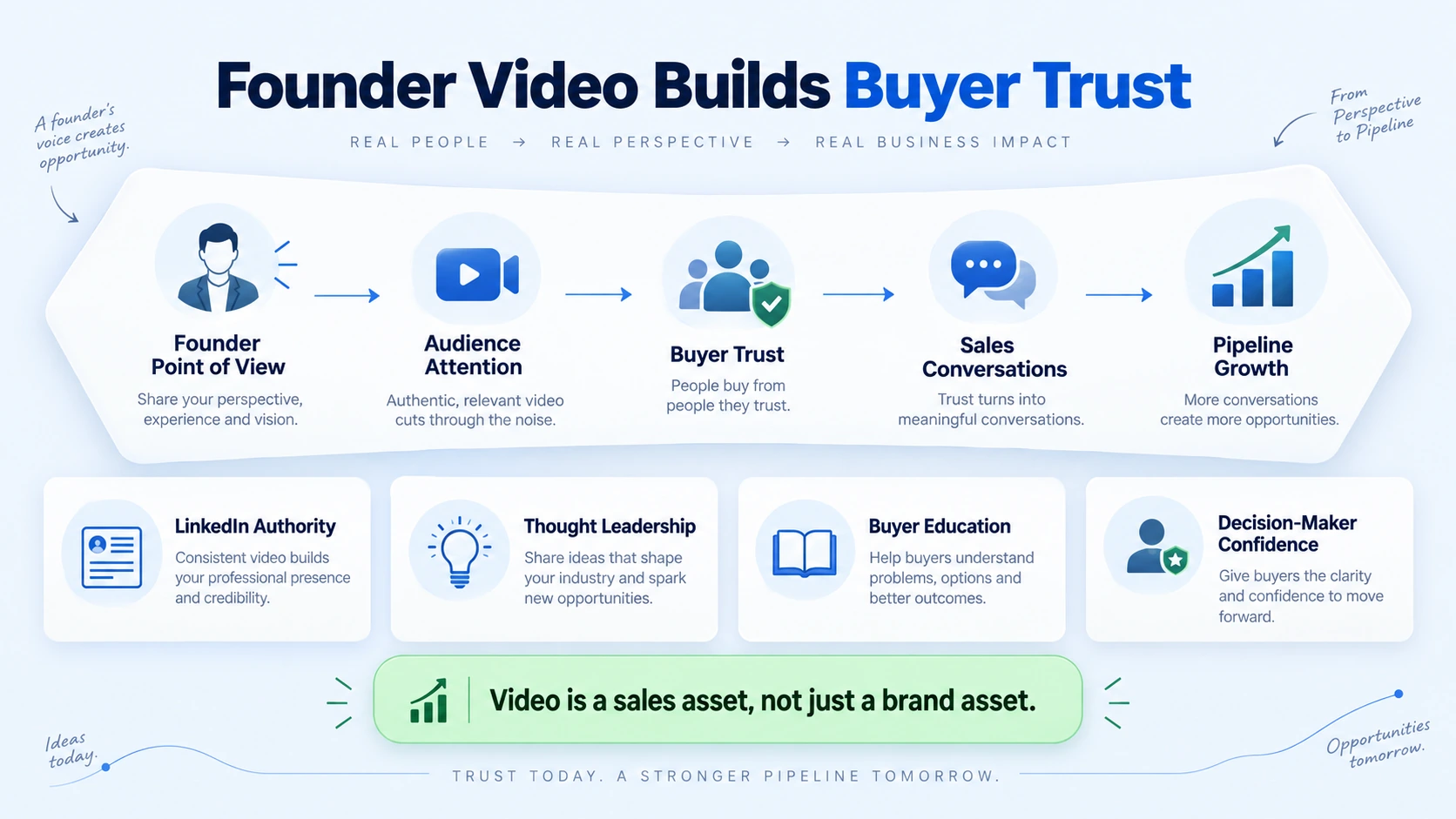
The most actionable finding in LinkedIn data remains the personal-versus-company engagement gap: posts from individual profiles receive 8x the engagement of identical content from company pages, and this gap is widening.
For B2B SaaS founders, this is a structural advantage.
In 2026, AI-generated text floods professional feeds, and buyers have grown skeptical of written B2B content. Video with a real person on camera cuts through that skepticism in a way text simply cannot.
62% of B2B marketers say LinkedIn is their most effective platform for video distribution, and the Edelman x LinkedIn Thought Leadership Impact Report revealed that 55% of decision-makers use thought leadership as part of their vetting process.
Your founder video isn't a brand exercise. It's a vetting instrument in the sales cycle.
The highest-performing executive video formats on LinkedIn all share one trait: the founder has a clear point of view and delivers it directly.
Point-of-view takes, contrarian views on common assumptions, and how-to frameworks are the top-performing content categories, tutorials are the most shared format on LinkedIn and will be saved and reshared far more than a promotional video.
If your buyer watches your video and can't describe what you believe about their problem, the video failed. Pipeline-driving founder content requires conviction, not production value.
How to Build a Camera-Ready Setup for Talking Head Videos
The environment shapes perceived authority before you say one word. Get this right first.
Camera position:
Camera position is the most overlooked variable in executive video presence. A camera below the chin communicates weakness. A camera at eye level communicates authority and connection, the virtual equivalent of a handshake.
Use a stack of books, a monitor arm, or a dedicated mount to hit eye level every time.
Lighting for your ring light setup:
- Face a window with natural light whenever possible. Daylight is free and flattering.
- If natural light isn't available, a simple ring light facing your face will do. The goal is visibility.
- Never record with a window or bright source behind you, it turns your face into a silhouette.
- Soft, diffused light from directly in front removes harsh shadows and makes you appear rested and credible.
Audio (non-negotiable):
- A lapel mic or a cardioid USB mic will transform your audio quality for under $100.
- Good lighting minimizes harsh shadows and studio-quality microphones capture the richness of your voice. You do not need to shout, just speak with clear, confident projection.
- Remove background noise. Fans, HVAC, open windows, and echo from bare walls all undermine perceived expertise.
Background and framing:
- Place yourself slightly off-center in the frame with intentional space behind you.
- A clean, simple background keeps attention on your face and message.
- Depth adds production value. A bookshelf, a plant, or a softly lit wall behind you reads better than a blank surface.
This entire setup can be achieved for under $300. Every dollar here returns more than additional editing time downstream.
The Teleprompter Technique That Doesn't Sound Robotic
Recording video content without a script often leads to rambling, filler words, and inconsistent messaging. Even experienced creators struggle to remember complex talking points when the camera starts rolling. Teleprompter apps eliminate this guesswork by keeping your script visible and synchronized with your delivery, so you can focus on performance instead of memorization.
The failure mode is easy to spot: eyes locked on text, flat monotone, zero personality. Here's how to avoid it.
- Write for speech, not for reading: Short sentences. Contractions. The way you actually talk. Start by writing scripts that sound like natural speech rather than formal writing. Read your script aloud several times before recording to identify awkward phrasing.
- Narrow your text column: By narrowing the text margins in your teleprompter app, you force the words into a slim column directly in the center of the glass. This ensures that the eyes stay aligned with the camera lens, creating the illusion of direct, unwavering eye contact.
- Treat it as a guide, not a script: The goal isn't just to read your script, it's to deliver it naturally while maintaining connection with your audience. The key is treating the prompter as a guide rather than a crutch, using it to stay on track while still injecting personality and spontaneity.
- Set scroll speed slightly slower than you think you need: Rushing the prompter causes the flat, mechanical delivery that kills authenticity.
- Pause deliberately: Natural pauses between thoughts are a feature, not a flaw. They signal confidence.
- Record a warm-up take: Do one full run-through you don't intend to use. Your second take will sound markedly more natural.
Apps worth using in 2026: Teleprompter Premium, Speeko, and Cueprompter all sync reliably with most camera setups. Your phone mounted next to your lens is enough to get started.
On-Camera Presence: How to Communicate Authority Without Feeling Stiff
Delivery is a skill. It responds to practice. These are the mechanics that matter most for B2B founder videos.
The person on camera carries the message. Their tone, pacing, posture, and presence shape how that message lands, especially when the subject matter is complex or high-stakes.
Body language signals buyers read instantly:
- Lean slightly toward the camera to signal engagement and accessibility. Keep your hands visible, they are trust indicators in human psychology.
- Sit tall but not rigid. Drop your shoulders before every take.
- Eliminate swivel. Lock your chair or stand. Movement without purpose reads as nervous energy.
Vocal delivery:
- Slow down by 15 to 20% from your natural speaking pace. What feels slow to you reads as authoritative to your viewer.
- Presence isn't volume or polish. It's clarity, control, and tone that feels natural to the speaker.
- Vary your pace and pitch deliberately, steady monotone loses audience engagement quickly.
Eye contact and authenticity:
- Look directly into the lens, not at your own image on screen. This single adjustment transforms perceived connection.
- High-production polish can actually decrease credibility if it masks the founder's personality. Eye contact and genuine facial variability are the primary drivers of perceived competence.
- If you stumble over a word, simply pause, take a breath, and start the sentence over. Your video team will seamlessly edit out the mistake. You do not have to be perfect in one continuous take.
The goal of tips for better founder videos on camera in 2026 isn't studio perfection. It's an authentic brand voice delivered with enough control that buyers feel confident in what you're selling.
The Content Repurposing Framework That Multiplies Every Recording
Most founders are sitting on a content library and don't know it.
A single 45-minute podcast episode, panel recording, or all-hands call contains enough raw material for 8 to 12 LinkedIn video clips. Almost nobody does this systematically.
That's the gap. Here's the system that closes it.
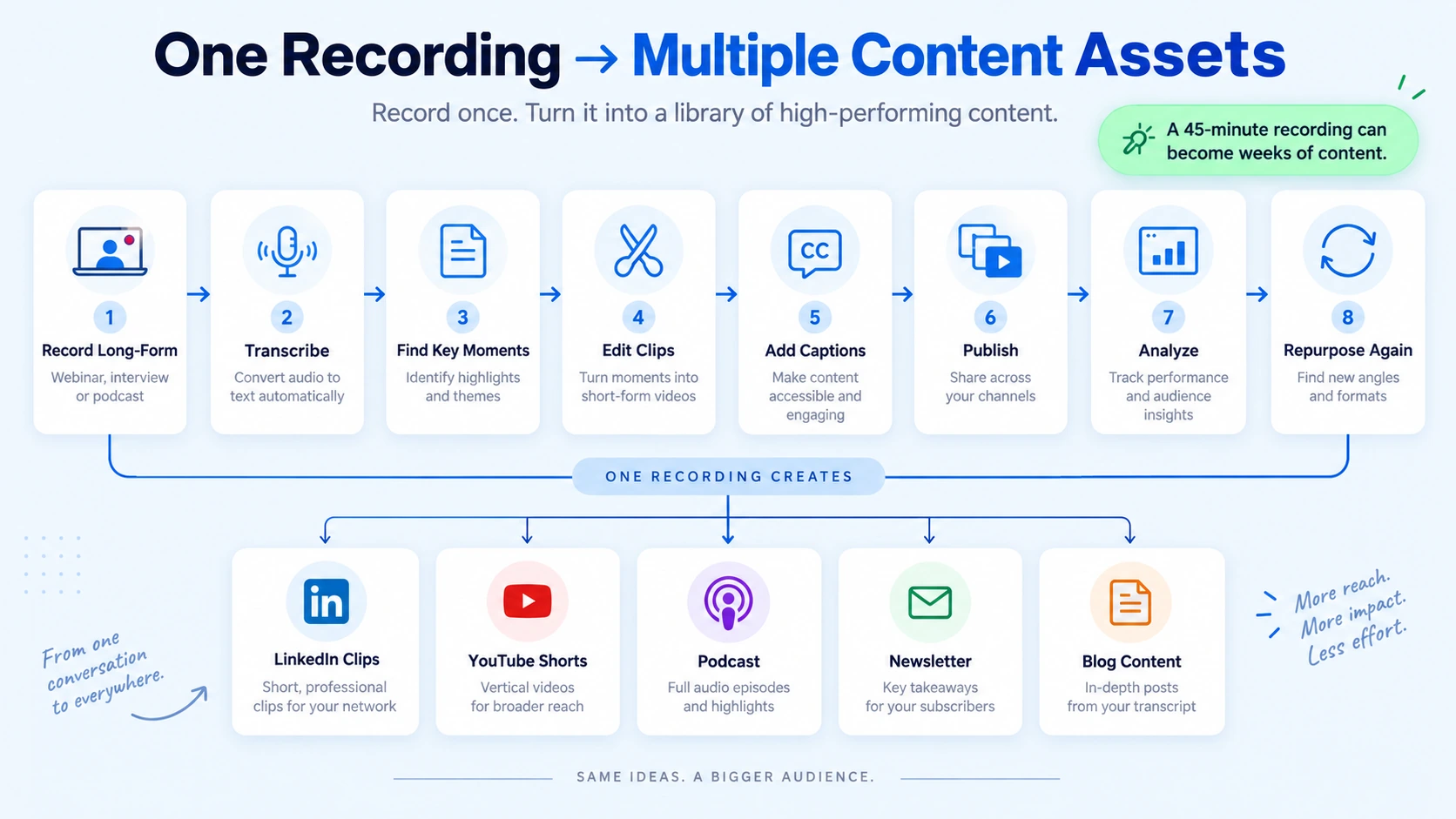
Record with repurposing in mind.
Long-form content repurposes well when each section has its own beginning, point, and conclusion. This applies whether you're recording a podcast, demo, customer education session, founder update, or webinar. Open each segment with a claim so the clip can start mid-conversation and still make sense.
The clip extraction process:
- Transcribe the full recording immediately after capturing.
- Highlight moments with a standalone hook, a clear point, and a natural endpoint.
- Find moments that already work as standalone clips, they have a hook in the first 3 seconds, deliver a clear insight or emotional moment, and leave viewers wanting more.
- Edit for platform: 30–60 seconds for LinkedIn and YouTube Shorts, 15–30 seconds for Instagram Reels.
- Burn captions. Captions are critical for short-form video success in 2026. With the majority of social media consumption happening in sound-off environments, videos without captions lose most potential viewers immediately. Beyond accessibility, captions improve watch time by keeping viewers engaged even when they cannot listen.
What one recording becomes:
- 3 to 5 short LinkedIn clips (talking head, vertical, captioned)
- 1 long-form LinkedIn video or YouTube video
- 2 to 3 YouTube Shorts
- A podcast episode if audio is clean
- Blog post or newsletter section from the transcript
A 2026 content efficiency framework notes that one long-form video can generate 30+ distinct social posts, including short clips, text posts, carousels, and quote graphics.
Most B2B SaaS teams generate a fraction of that yield from existing recordings. Our short-form video editing service is built specifically to close this gap for funded teams.
LinkedIn Video Strategy and Short-Form Distribution for B2B Teams
Getting on camera is half the job. Where and how you distribute determines whether tips for better founder videos on camera in 2026 translate into actual pipeline.
A generic "post more video" strategy fails most professionals because different roles need different content pillars. For B2B SaaS founders and executives, your video strategy should be pipeline-driven, not vanity-metric-driven.
Platform priorities for B2B founders in 2026:
Posting cadence and consistency:
- The sweet spot for short-form video in 2026 is between 30 and 60 seconds, long enough to deliver value but short enough to retain attention.
- Post a minimum of 3 founder videos per week on LinkedIn. Volume compounds authority.
- Video posts from CEOs have increased by 68% on LinkedIn over the last two years, the category is growing, and early movers in your niche build compounding advantages that are difficult to displace.
Audience engagement metrics to track (not vanity metrics):
- Watch time percentage (aim for 50%+ on LinkedIn)
- Profile visits per video post
- Inbound connection requests from ICP profiles
- DMs that reference specific video content
- Demo requests sourced from video content
Company decision-makers at director level and above contribute to 46% of total video likes and shares on LinkedIn, the right buyers are actively consuming this content. Your video marketing strategy needs to put your founder in front of them consistently. For teams running webinars or live events, every session is a short-form video production queue waiting to be processed.
Conclusion
The tips for better founder videos on camera in 2026 are actionable today, without expensive gear or a full production team. Key takeaways:
- Setup first: Camera at eye level, light in front, clean audio. Every other improvement stacks on this foundation.
- Teleprompter as guide: Write for speech, narrow the text column, treat it as a safety net, not a script to read robotically.
- Deliver with conviction: Eye contact into the lens, hands visible, pace slower than feels comfortable.
- Repurpose everything: One recording session should produce 8 to 12 clips minimum. If it doesn't, your video production workflow needs a system.
Ready to turn your founder's knowledge into a consistent short-form video pipeline? I work with Komet Media.
Frequently Asked Questions
Q1: How often should a B2B founder post videos on LinkedIn?
A minimum of three times per week builds enough consistency for the algorithm to distribute your content. Volume compounds over 90 days, most founders who post once a week see minimal traction. Start with three, batch-record weekly, and scale from there.
Q2: Do I need professional video equipment for founder-led content?
No. A modern smartphone, a ring light setup, a lapel mic under $80, and a clean background produce results that outperform expensive studio shoots with poor delivery. Environment and confidence matter more than equipment specs.
Q3: What's the biggest mistake founders make on camera?
Reading from notes off-screen or looking at their own image instead of the camera lens. Both destroy the perception of eye contact and trust. Mount your teleprompter adjacent to the lens, and practice looking into the lens as if it's the buyer's face.
Q4: How do I turn one podcast or webinar into multiple short-form clips?
Transcribe first, then identify 8 to 12 moments with a standalone hook, a single clear point, and a natural ending. Edit each clip to 30–90 seconds, add burned captions, and reframe vertically for LinkedIn and YouTube Shorts. Our short-form video editing service handles this end-to-end for SaaS teams.
Q5: Should founders use a teleprompter or speak off the cuff?
Both work. Teleprompters eliminate filler words and rambling but require practice to avoid robotic delivery. Off-the-cuff works for POV takes and reactions. For structured product explainers, demos, or buyer education videos, a teleprompter with a speech-written script almost always produces cleaner, more usable takes.
Q6: What video metrics actually indicate pipeline impact?
Track profile visits per video, DMs referencing specific video content, inbound ICP connection requests, and demo requests where the prospect mentions your content. Watch time percentage and saves are secondary signals. Vanity metrics like raw views tell you reach, not intent.