
🪄 AI Summary
Heading 1
Heading 2
Heading 3
Heading 4
Heading 5
Heading 6
Lorem ipsum dolor sit amet, consectetur adipiscing elit, sed do eiusmod tempor incididunt ut labore et dolore magna aliqua. Ut enim ad minim veniam, quis nostrud exercitation ullamco laboris nisi ut aliquip ex ea commodo consequat. Duis aute irure dolor in reprehenderit in voluptate velit esse cillum dolore eu fugiat nulla pariatur.
Block quote
Ordered list
- Item 1
- Item 2
- Item 3
Unordered list
- Item A
- Item B
- Item C
Bold text
Emphasis
Superscript
Subscript
If you run an edtech startup or lead growth at an online education platform, you already know the problem: you have great content, compelling instructors, and a product that genuinely changes learners' lives, but you can't get enough eyes on it. Short-form video for edtech companies is the clearest path from obscurity to pipeline in 2026. This guide covers what works, why it works, and exactly how to build a system around it.
TL;DR
- Videos under 60 seconds generate 2.5x more engagement per impression than any other content type.
- Microlearning, instructional design, and spaced repetition make short videos a natural fit for edtech, your content already maps to the format.
- Repurposing one webinar or course module into 8–10 clips is the highest-ROI production approach available to edtech teams.
- The biggest mistake edtech brands make: treating short video like a brand awareness play rather than a pipeline and enrollment driver.
Why Short-Form Video for Edtech Companies Outperforms Every Other Format
Edtech sits at a rare intersection: the product is content, and so is the marketing. Research shows that 83% of employees complete a 10-minute microlearning module compared to only 20–30% of traditional instructional courses, and microlearning directly combats shorter attention spans; it is easier to complete a 3-minute module than a 45-minute training session. For edtech marketers, this is the brief: buyers already prefer bite-sized learning, which means bite-sized video marketing meets them exactly where they are. The scale argument is equally hard to ignore.
YouTube Shorts alone averages over 70 billion daily views , and Instagram Reels now account for 35% of total screen time on the platform, reaching over 2 billion monthly users. The TikTok algorithm, specifically, is engineered differently from every other platform. TikTok's algorithm is engineered for discovery, not just distribution. On platforms like Instagram, your audience determines your reach. On TikTok, your content determines your audience. That is a structural advantage for edtech startups with no existing following.
The B2B SaaS case is just as strong. In 2025, short-form video, typically under 90 seconds, moved from a nice-to-have to a must-have in B2B marketing, allowing marketers to distill complex information into digestible, memorable content that captures the attention of busy executives in seconds. For corporate learning platforms, upskilling tools, and B2B edtech products, that framing is directly applicable to your buyers.
78% of users prefer to learn about a product via short-form video. For edtech companies, the product is learning, this stat is your entire distribution strategy in one number. The learner engagement data reinforces the structural fit. The microlearning revolution is real, with 93% of organizations integrating it, and short lessons under 10 minutes drive 80% completion rates in microlearning compared to far lower rates in traditional formats. Short-form video is the delivery mechanism that turns that insight into marketing action.
What Types of Short Videos Actually Work for Edtech
Not all video formats perform equally. After working with edtech and B2B teams on content repurposing, the formats that consistently drive learner engagement and student acquisition fall into six clear types:
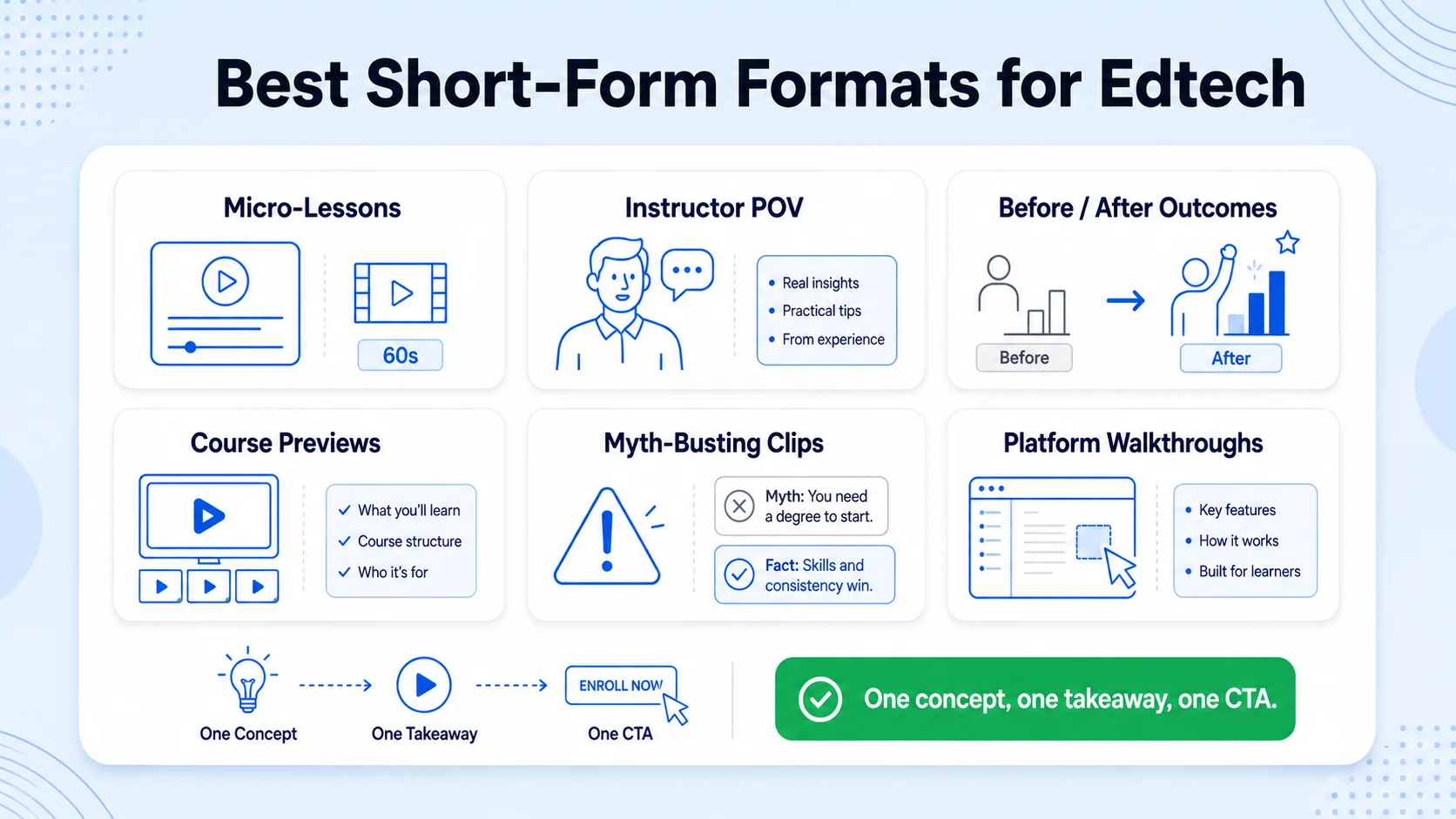
1) Micro-lessons: A single concept taught in 45–90 seconds. Think Khan Academy's visual breakdowns, compressed for Reels. One concept, one takeaway, one CTA.
Example:
2) Founder or instructor POV: The instructor speaking directly to camera about a common mistake, misconception, or counterintuitive insight. This drives social proof and platform trust simultaneously.
Example:
3) Before/after outcomes: A learner's skill gap before the course, and where they landed after. Outcome-focused, not feature-focused.
Example:
4) Course previews: Short segments that let prospective students preview course content before enrolling, low commitment, high conversion intent.
Example:
5) Myth-busting clips: "You don't need X to get Y" performs well in the edtech space because it directly addresses objections and removes friction from enrollment decisions.
Example:
6) Tool or platform walkthroughs: 60-second demos of your product interface, especially relevant for B2B edtech platforms selling to L&D teams or HR buyers.
Example:
91% of consumers watch explainer videos to learn about products or services, and many explainer videos use animation because it simplifies complex concepts. For edtech, animation and screen-recording walkthroughs are high-signal formats, they mirror the instructional design learners already trust. Canva for Education and similar tools have lowered the production barrier for motion graphics significantly.
AI-powered editing, scripting, voiceover, and generation tools have reduced the median video production cost from $4,200 to $2,500 per finished minute. The creative barrier to a consistent short-form video program is lower in 2026 than at any prior point.
How Edtech Companies Grow on TikTok and Instagram Reels
Platform strategy matters as much as content strategy. Edtech brands should approach TikTok and Reels with distinct tactics.
On TikTok: Higher education TikTok engagement rates reached 7.36% with 2.28% weekly follower growth in 2025, and Gen Z spends an average of 89 minutes per day on TikTok with 83% daily active usage. That is the most time-intensive platform for reaching prospective students. Edtech platforms that invested in TikTok educational content found organic customer acquisition costs 5–15x lower than paid TikTok or Meta campaigns for student acquisition. That figure alone justifies a dedicated organic TikTok strategy for any edtech startup watching CAC. TikTok in-feed CPM sits at approximately $9.16, roughly 38% below Meta's $14.91, making paid amplification of top-performing organic clips a high-efficiency play when you're ready to put budget behind it.
On Instagram Reels: 57% of Instagram Reels viewers discover new brands through the feature. For edtech brands targeting millennial and Gen Z learners, Reels is a primary discovery surface. Instagram's 2026 algorithm uses an "Originality Score" to detect recycled clips, reposting TikTok videos with watermarks or reusing trending content verbatim will significantly tank your reach. Platform-native creation is non-negotiable.
The core Reels engagement growth loop for edtech:
- Post a micro-lesson on a pain point your target learner already has.
- Use a text hook in the first 2 seconds that names the pain directly.
- End with a CTA that leads to a free lesson, lead magnet, or trial.
- Reply to every comment in the first 60 minutes to signal engagement to the algorithm.
- Repurpose top performers as paid Reels ads with Komet Media's Instagram marketing service for amplification.
How to Explain Complex Educational Topics in 60 Seconds or Less
This is the craft question every edtech team struggles with, and it is entirely solvable with the right instructional design framework applied to short video.
The structure that works:
- Open with the cost of not knowing: "Most people lose 6 hours a week doing X the wrong way." Name the pain before the solution.
- State the single concept: One idea, not three. Spaced repetition theory confirms that single-concept delivery improves recall, do not crowd the clip.
- Use visual proof: A screen recording, animation, or real example. Abstract claims without visuals lose attention at the 15-second mark.
- Deliver the insight in plain language: Coursera-level academic language kills retention in short video. Write for a smart 16-year-old.
- Close with a directional CTA: "Watch part 2," "Save this for later," or "Start your free trial", one action, not a menu.
Microlearning and nanolearning are compatible with adaptive and self-driven learning systems, and align well with edutainment material, supporting comprehension with captivating minigames, informative vertical videos, and virtual adventures. The principle here is that short video does not just attract learners, it is itself a learning experience when built correctly. Duolingo is the canonical example of this done at scale.
Platforms like Duolingo break down complex topics into digestible segments and now serve 74 million monthly active users with over 20 million daily active users. Their short-form content strategy mirrors the same instructional logic as their product: one concept, immediate feedback, repeat. The 60-second rule is not a creative constraint. It is an instructional design principle. One concept per clip. One action per clip. Done.
Does Short-Form Video Actually Drive Course Enrollments?
The skeptic's question deserves a direct answer: yes, with the right system behind it. Short, low-ticket courses are helping edtech platforms reduce entry friction, test willingness to pay early, and move learners more efficiently toward higher-value programs. For many platforms, micro-learning is becoming a core product layer, designed to lower entry barriers, accelerate user decision-making, and create predictable pathways to higher-value programs.
Short-form video functions as the top of that funnel, surfacing the micro-lesson or low-friction offer to cold audiences. The paid side validates this. One university restructured its TikTok campaigns around student journey stages and achieved a 29% lower CPM, a 1.9% increase in click-through rate, and a 640% increase in total clicks. Those are not brand awareness metrics, those are enrollment infrastructure metrics.
Landing pages with embedded video convert at 86% higher rates than text-only equivalents, and B2B SaaS pages with explainer videos see conversion lifts exceeding 100% in controlled testing. For edtech companies with course landing pages, adding a short-form product preview or instructor intro is the single highest-leverage page optimization available.
The enrollment flywheel short-form video enables looks like this:
- Discovery clip surfaces a pain point on TikTok or Reels.
- CTA drives traffic to a free lesson or lead magnet (host it as a podcast episode or webinar).
- Email sequence or retargeting converts warm leads into paid enrollments.
- Student outcome clips become the next round of social proof content.
Globally, the micro-learning market is projected to grow from USD 1.8 billion in 2025 to USD 6.2 billion by 2035, at a 13.5% CAGR. Edtech companies that build short-form video systems now are capturing audience share in a market that is structurally expanding.
How to Repurpose Long Educational Content Into Short-Form Videos
Repurposing is where edtech companies have a structural advantage every other industry lacks: you already produce long-form educational content at volume. Webinars, recorded courses, podcast interviews, demo calls, these are all raw material. The most efficient strategy involves repurposing one piece of long-form content (like a webinar) into multiple short video assets for different channels.
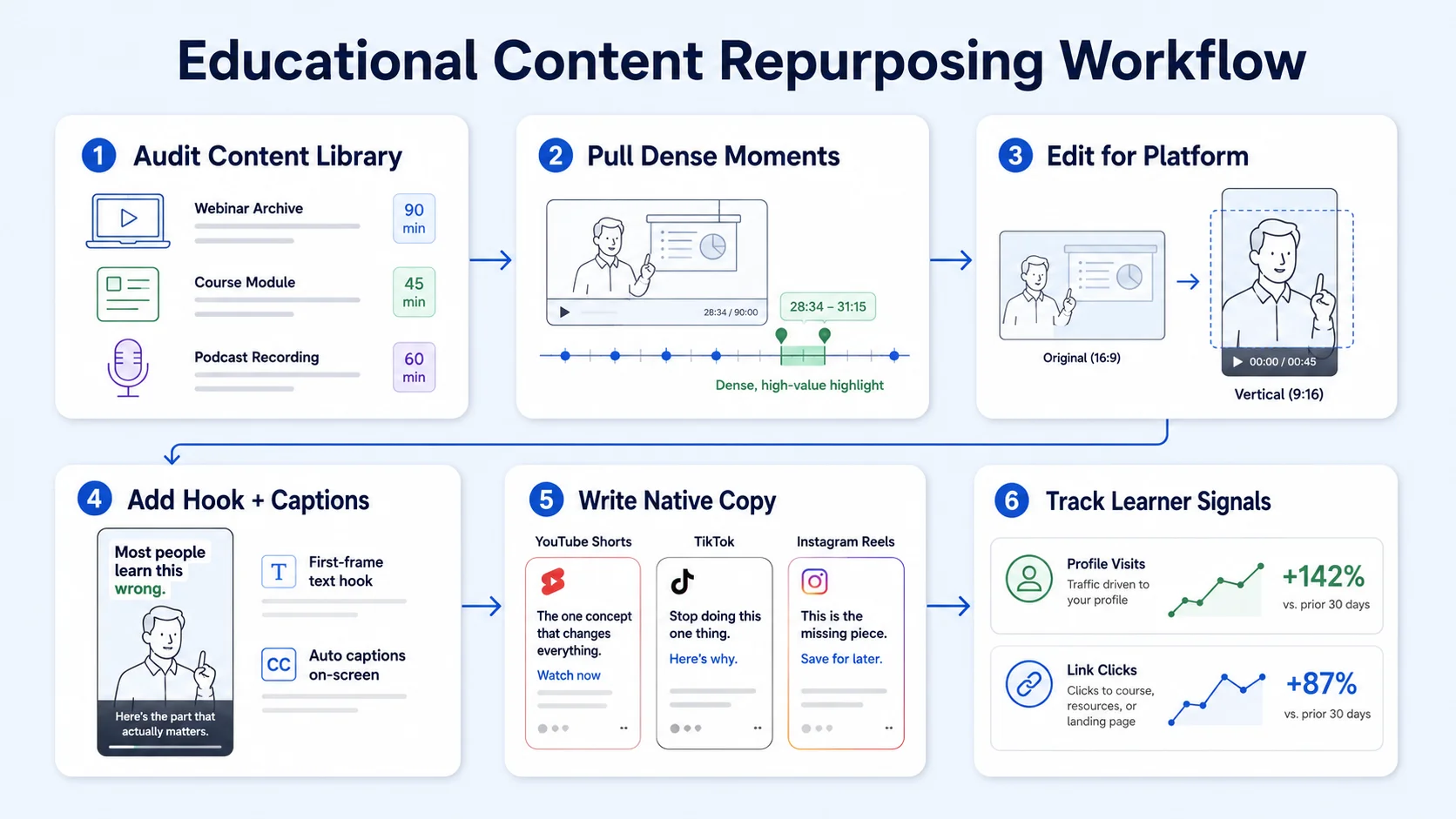
At Komet Media, the system we use for edtech clients follows a repeatable process:
- Audit your existing content library: Identify all recorded webinars, course modules, podcasts, and demos. Prioritize evergreen topics over time-sensitive ones.
- Pull the highest-density moments: Use timestamps to find the 30–90 second segments where an instructor delivers a clear insight, counterintuitive claim, or actionable takeaway.
- Edit for platform: Crop to 9:16, add captions (critical, 59% of creators use automated captions or transcripts ), add a text hook over the first frame, and remove any dead air.
- Write platform-native copy: The caption on TikTok functions differently from a YouTube Shorts description. Write each separately, with keywords relevant to your learner's search intent.
- Sequence across platforms: Publish the same asset natively on YouTube Shorts, Instagram Reels, and TikTok in the same week. Do not cross-post with watermarks.
- Track and feed back: Which clips drive profile visits, link clicks, or DMs? Pull more content from the same source material.
Instead of a single promotional push, you create a sustained campaign of valuable, bite-sized insights that appeal to different segments of your audience on their preferred platforms. Whether you are leveraging existing assets or building a new library from scratch, this systematically extends the reach of core expertise, turning one major effort into dozens of engagement opportunities.
Our short-form video editing service is built specifically for this dual workflow: edtech teams can send us raw recordings from webinars and course sessions for repurposing, or partner with us to build a custom content library from scratch, including full research and professional scripting.
Common Mistakes Edtech Companies Make with Short-Form Video
Knowing what not to do saves as much time as any tactic in this guide.
- Posting promotional content instead of educational content: Users on Instagram and TikTok are looking for entertainment, inspiration, and authentic experiences. Content that is too promotional and only aims to promote sales is often ignored or perceived negatively. Edtech brands that open every clip with a feature pitch lose the algorithm and the viewer simultaneously.
- Treating all platforms identically: TikTok is its own platform. What works on Instagram Reels may fall flat here. Aspect ratio, caption style, hook format, and audio all need platform-specific treatment.
- Stopping too early: Most accounts need 30–60 days of consistent effort before signals start compounding. Edtech teams that post 10 videos, see modest results, and pull back never reach the inflection point.
- Ignoring digital literacy signals in copy: Learners skim. If your caption requires two sentences to reach the value, rewrite the first sentence.
- Skipping captions: Non-captioned video loses a significant portion of mobile viewers who watch without sound. Captions are also a knowledge graph and SEO signal for YouTube Shorts.
- Producing without a system: One-off videos do not build an audience. A repeatable repurposing system, connected to your video marketing strategy, builds compounding reach over time.
Conclusion
Short-form video for edtech companies is not a trend to monitor, it is a system to build. The key takeaways:
- Microlearning and short-form video are structurally aligned: build content around one concept, one outcome, one CTA per clip.
- Organic TikTok and Reels can deliver student acquisition costs 5–15x lower than paid campaigns when executed with consistency.
- Whether repurposing long-form content or building a new library from scratch with professional scripting and research, a systematic video approach delivers the highest ROI for edtech teams.
- The brands winning in 2026, Duolingo, Coursera, Khan Academy, treat short video as product marketing, not just social media.
If you want a video system built for your edtech brand - whether via expert repurposing or end-to-end original content creation - Komet Media's team is here to help.
Frequently Asked Questions
Q1: How long should short-form videos be for edtech marketing?
73% of people say videos of 30 seconds to 2 minutes are most effective. For edtech, 45–90 seconds is the practical sweet spot, long enough to deliver one complete concept, short enough to hold attention through to the CTA. YouTube Shorts specifically rewards clips under 60 seconds for completion rate.
Q2: Can short-form video actually replace paid ads for student acquisition?
It can offset paid spend significantly. Edtech platforms that invested in TikTok educational content found organic customer acquisition costs 5–15x lower than paid TikTok or Meta campaigns for student acquisition. The best approach is to use organic short video to identify top-performing content, then amplify it with paid budget rather than running ads cold.
Q3: What is the best platform for edtech short-form video in 2026?
It depends on your audience. TikTok is the strongest for Gen Z learner acquisition and has 83% daily active usage among Gen Z, who spend an average of 89 minutes per day on the platform. For B2B edtech targeting L&D buyers and HR teams, LinkedIn video and YouTube Shorts deliver higher intent traffic. Most edtech brands should be active on both.
Q4: How many short videos can I get from one webinar?
From one long-form video, a structured repurposing process can generate 10 short-form videos suitable for distribution across social channels. A 45-minute webinar typically yields 8–12 clips depending on the density of the content and how many standalone concepts the presenter covers.
Q5: Does short-form video help with B2B edtech sales cycles, not just B2C enrollment?
Yes. Short-form thought leadership videos are a valuable way to build trust, credibility, and brand awareness in B2B marketing. For enterprise edtech products, clips that show platform walkthroughs, customer outcomes, and instructor credibility shorten sales cycles by doing the education work before a demo call ever happens.
Q6: What is the biggest mistake edtech companies make with short-form video?
Building without a system. Single videos do not compound. A sustained campaign of valuable, bite-sized insights that appeals to different audience segments on their preferred platforms turns one major content effort into dozens of engagement opportunities and lead magnets. Consistency and repurposing infrastructure, not one viral clip, is what drives enrollment at scale.