
🪄 AI Summary
Heading 1
Heading 2
Heading 3
Heading 4
Heading 5
Heading 6
Lorem ipsum dolor sit amet, consectetur adipiscing elit, sed do eiusmod tempor incididunt ut labore et dolore magna aliqua. Ut enim ad minim veniam, quis nostrud exercitation ullamco laboris nisi ut aliquip ex ea commodo consequat. Duis aute irure dolor in reprehenderit in voluptate velit esse cillum dolore eu fugiat nulla pariatur.
Block quote
Ordered list
- Item 1
- Item 2
- Item 3
Unordered list
- Item A
- Item B
- Item C
Bold text
Emphasis
Superscript
Subscript
Most cybersecurity brands record a sharp 45-minute conversation and let it collect dust in a feed nobody scrolls. That's a pipeline leak. Podcast repurposing for cybersecurity brands is the practice of atomising that single recording into clips, posts, blogs, and sales assets that educate buyers, build CISO trust, and keep your brand visible between product launches. This guide breaks down the full strategy, tools, and workflows you need to turn every episode into a demand-generation engine.
TL;DR
- A single cybersecurity podcast episode can generate clips, blog posts, LinkedIn carousels, email sequences, and sales enablement assets from one recording.
- Short-form video clips from podcast episodes earn up to 5x more LinkedIn engagement than static posts.
- One cybersecurity firm attributed $2.3M in new pipeline within 9 months to podcast-led relationships.
- The brands winning in 2026 treat every episode as a seed asset, not a one-time publish.
What Is Podcast Repurposing and Why Does It Matter for Cybersecurity Brands?
Cybersecurity buyers do not impulse-purchase. They research, evaluate, and trust slowly. Your podcast already captures the nuanced thinking your buyers need, but most teams publish once and abandon the asset. That is the core problem podcast repurposing for cybersecurity brands solves.
Content atomisation means taking one long-form recording and extracting every usable derivative: short clips, blog posts, LinkedIn posts, audiograms, email copy, sales battlecards, and show notes. A single episode contains enough raw material for 15 LinkedIn posts, 3 blog articles, 5 email sequences, and 10 sales enablement assets, yet most teams publish once and move on, leaving 90% of the content value untapped.
For cybersecurity brands specifically, the trust dynamics make this even more valuable. Cybersecurity buyers usually research deeply before speaking with a vendor, and a podcast gives your company a way to show expertise earlier in that journey, educating the market through useful conversations rather than relying solely on a sales call. The data backs this up.
A cybersecurity firm attributed $2.3M of new pipeline in 9 months to relationships with podcast guests. That result is not from podcast reach alone. It is from a systematic repurposing and follow-up workflow that kept those conversations visible long after the recording dropped. When 74% of listeners say a company's podcast positively influenced their opinion of the brand, your episodes stop being content marketing and become trust infrastructure. For cybersecurity brands selling into risk-averse CISOs and security-conscious procurement teams, that trust differential is the competitive moat.
This is what separates podcast repurposing for cybersecurity brands from generic content distribution. The goal is not reached. The goal is repeated, relevant contact with the right buyer, delivering threat intelligence, compliance messaging, and product thinking in formats they actually consume.
At Komet Media, I work with B2B teams to build podcasts from scratch and repurpose existing recordings. The gap is almost always the same: teams lack a full-service strategy to launch, record, and extract the signal. We handle end-to-end podcast creation and repurposing so you never leave value on the table.
How to Repurpose a Cybersecurity Podcast Episode into Blog Posts
Blog posts are the highest-leverage written derivative of any cybersecurity episode. They serve two purposes simultaneously: SEO topical authority and buyer education for prospects who prefer reading over listening.
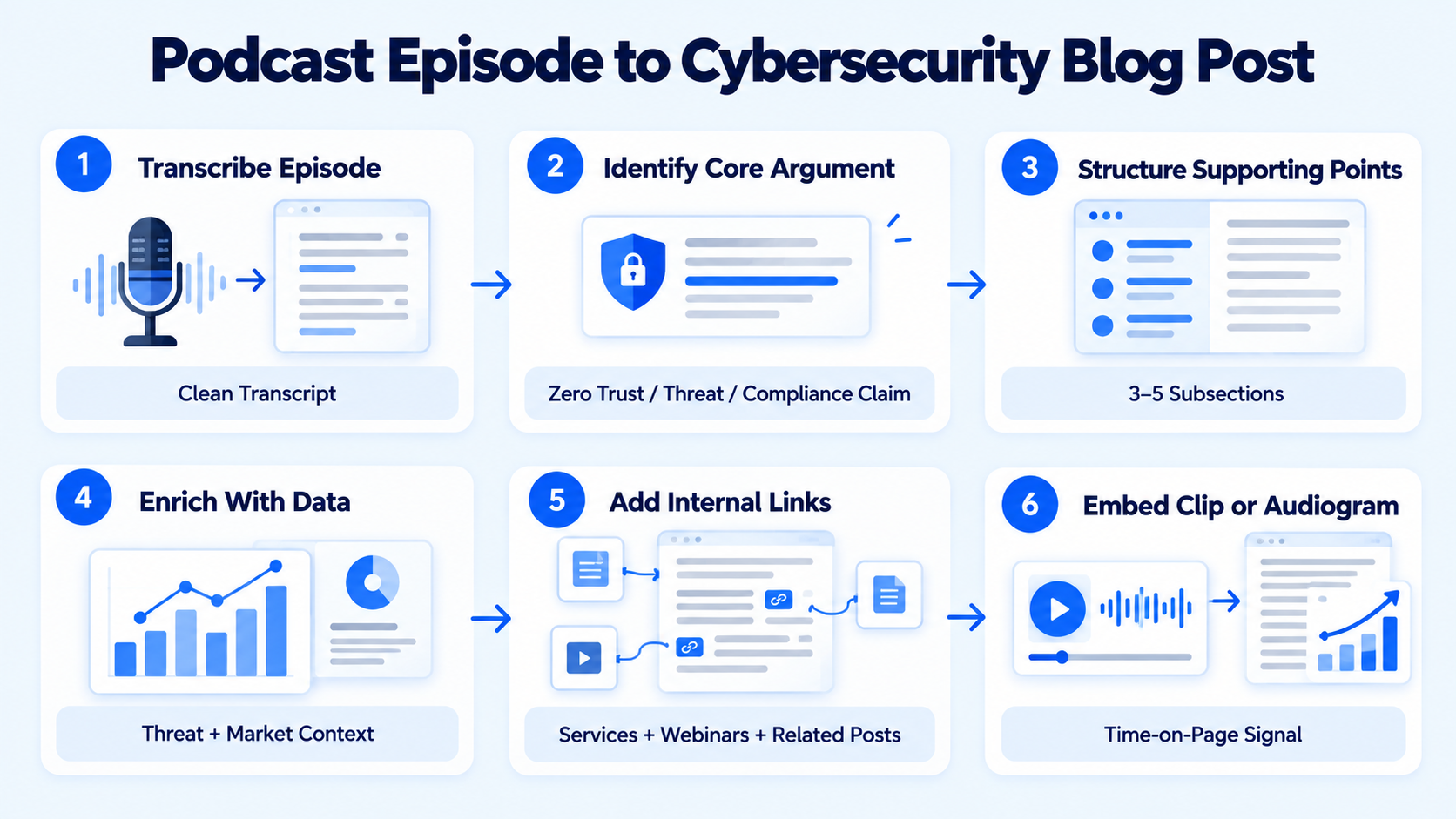
The process is straightforward when you approach it systematically:
- Transcribe the episode: Use a tool like Descript, Castmagic, or Rev to generate a clean transcript within minutes of publishing.
- Identify the core argument: Every strong cybersecurity episode has one central claim (a Zero Trust framework misconception, a threat intelligence gap, a compliance posture failure). That claim becomes your blog post thesis.
- Structure around that thesis: Pull the three to five supporting points the guest or host made. These become your subheadings.
- Enrich with data: Layer in current threat data, compliance statistics, or market context your transcript does not cover. This turns a conversation summary into a genuine resource.
- Add internal links strategically: Connect the post to your services pages, webinar recordings, or other episode-derived content.
- Publish with an embedded clip or audiogram: Embedding a short audio or video clip from the episode increases time-on-page and signals topical depth to search engines.
A 45-minute episode covering Zero Trust architecture can yield three separate blog posts: one targeting CISOs on business risk, one targeting security architects on implementation, and one targeting compliance teams on regulatory alignment. That is three pieces of evergreen content, three entry points from search, and three audience-segmented assets from a single recording.
This is information security storytelling done efficiently. You are not rewriting the same ideas. You are reframing the same expertise for different buyer roles, which is exactly how cybersecurity brand awareness compounds over time. Whether launching a new show from scratch or scaling an existing process, you can also use your podcast show notes service and podcast transcription workflow to feed this process without adding headcount.
Podcast Repurposing Strategy for B2B Cybersecurity Brands: Turning Interviews into LinkedIn Thought Leadership
LinkedIn is where cybersecurity buying decisions get socially validated. CISOs, security architects, and IT decision-makers are active on the platform, and your podcast interviews already contain the exact opinions and frameworks that drive LinkedIn engagement.
Native video earns up to 5x more engagement and is shared 20x more than any other content type on LinkedIn. LinkedIn video views grew 36% in 2025, signalling that the LinkedIn audience now expects the same content cadence it sees elsewhere. The practical workflow for turning a cybersecurity interview into LinkedIn content breaks into four asset types:
- Short-form clips (60–90 seconds): Pull the sharpest moment from the episode. A guest CISO explaining why their board finally funded zero trust. A founder articulating why 90% of security alerts are noise. Keep clips under 90 seconds for maximum completion rates; shorter videos under 15 seconds see 57% completion rates.
- Text posts with clip hooks: Write a 150-word opinion post that frames the clip. The text post surfaces in text-first feeds; the clip handles watch time.
- Quote graphics: Extract a verbatim sentence from the transcript. Drop it on a branded card. These are the easiest assets to produce and consistently strong performers for dark social sharing in security Slack communities.
- LinkedIn carousel breakdowns: Take a framework your guest explained verbally and build a 6–8-slide carousel. Native documents averaged 7.00% engagement on LinkedIn, the highest of any format tracked.
The key for cybersecurity brands is audience segmentation. A single episode on threat intelligence communication can yield one clip framed for CISOs (business risk angle), one for security analysts (technical angle), and one for sales teams (objection-handling angle). Three different posts from one interview. Three different LinkedIn segments reached.
Komet Media's short-form video editing service is built for exactly this workflow. We pull the moments that will stop a scroll, caption them for silent autoplay, and format them for the LinkedIn video feed.
How Do Cybersecurity Companies Use Podcasts to Generate Pipeline?
The pipeline mechanic is specific. Most teams think about podcast ROI as download counts. The real pipeline model works differently. One cybersecurity firm targeting Fortune 500 CISOs systematically invited 24 target account executives as guests, converting 7 into active opportunities through strategic follow-up sequences, with an average deal size of $328K.
That is the strategic guest model: your podcast is a no-pressure access point into accounts that would never take a cold demo call. You invite the CISO to discuss a topic they care about. The conversation builds genuine rapport. The repurposed clip featuring their insight gives them LinkedIn visibility. The follow-up is warm because the relationship is real.
Beyond guest strategy, repurposed content supports pipeline in three additional ways:
- Buyer education at scale: Sales-cycle-relevant clips get shared in deal rooms. When a prospect shares your founder's 90-second clip on Zero Trust with their security committee, that is asynchronous selling your team did not have to do.
- Demo demand from organic reach: 72% of brands report lead generation as a direct benefit of their podcast. Short-form repurposed clips extend that benefit to audiences who never subscribed to the feed.
- Inbound from search: Blog posts derived from episodes rank for long-tail information security queries. A CISO searching "how to communicate cybersecurity risk to the board" finds your 1,200-word post that links to your services page.
In 2025, 91% of marketers planned to maintain or expand their podcast and audio content investments, which means the category is getting more competitive. The brands that repurpose aggressively will own the attention that single-publish brands leave behind.
Explore how Komet Media's podcast marketing service connects full-service podcast production from scratch to a complete demand-generation workflow.
How to Build a Content Calendar from a Single Cybersecurity Podcast Episode
One episode is not one piece of content. It is a content calendar for a full week if your workflow is right. Here is how to build it:
The cybersecurity-specific consideration is buyer role segmentation. Tag every asset with the role it speaks to: CISO, security architect, compliance lead, or procurement. Your CRM and social scheduling tool can then track which segments engage with which assets, giving your sales team intent data without running a paid campaign.
AI made it cheap to produce content, and now every cybersecurity vendor sounds the same; the answer is not more AI, it is the human layer: real stories, congruent brand moves, and community. A calendar built from a genuine expert conversation will always outperform a calendar built from AI-generated filler.
Pair this calendar discipline with Komet Media's end-to-end podcast creation and production workflow to ensure your show is launched seamlessly and every episode is captured in a format that makes downstream repurposing cleaner and faster.
Tools for Repurposing Cybersecurity Podcast Audio into Written and Video Content
You do not need a large stack. You need the right tools for the two core workflows: audio to text, and long-form to short-form video.
Transcription and written content tools: Castmagic is designed specifically for podcasters and focuses on written content output: transcripts, show notes, blog posts, social captions, email newsletters, and LinkedIn posts, all generated from the audio file. Descript transcribes podcasts and videos into fully editable text, then lets you edit the audio and video itself by deleting or rearranging that text: delete a sentence in the transcript and it cuts the corresponding clip automatically.
Short-form video clipping tools: Opus Clip is purpose-built for taking long-form video and automatically generating short-form clips optimised for LinkedIn, YouTube Shorts, TikTok, and Reels, and its AI scores each potential clip on a virality metric for how likely it is to drive engagement.
Riverside.fm records high-quality video and audio locally, then offers an AI clip finder with virality scoring, auto-transcription, captions, and direct social media publishing, starting from $15/month.
Start with a transcription tool and one AI clipping tool, then nail that workflow before adding blog posts, email sequences, and LinkedIn carousels. Buying every tool before your process is proven is where repurposing programs stall.
For cybersecurity brands that want human editorial judgment layered over these tools, Komet Media's video editing services handle the clip selection, captioning, and format optimisation so your team can focus on the subject matter expertise.
How to Turn Your Cybersecurity Podcast into a Thought Leadership Strategy
Podcast repurposing for cybersecurity brands becomes a thought leadership strategy when it is designed around topical authority, not just content output. Topical authority means your brand is the entity that search engines and AI assistants associate with specific cybersecurity concepts.
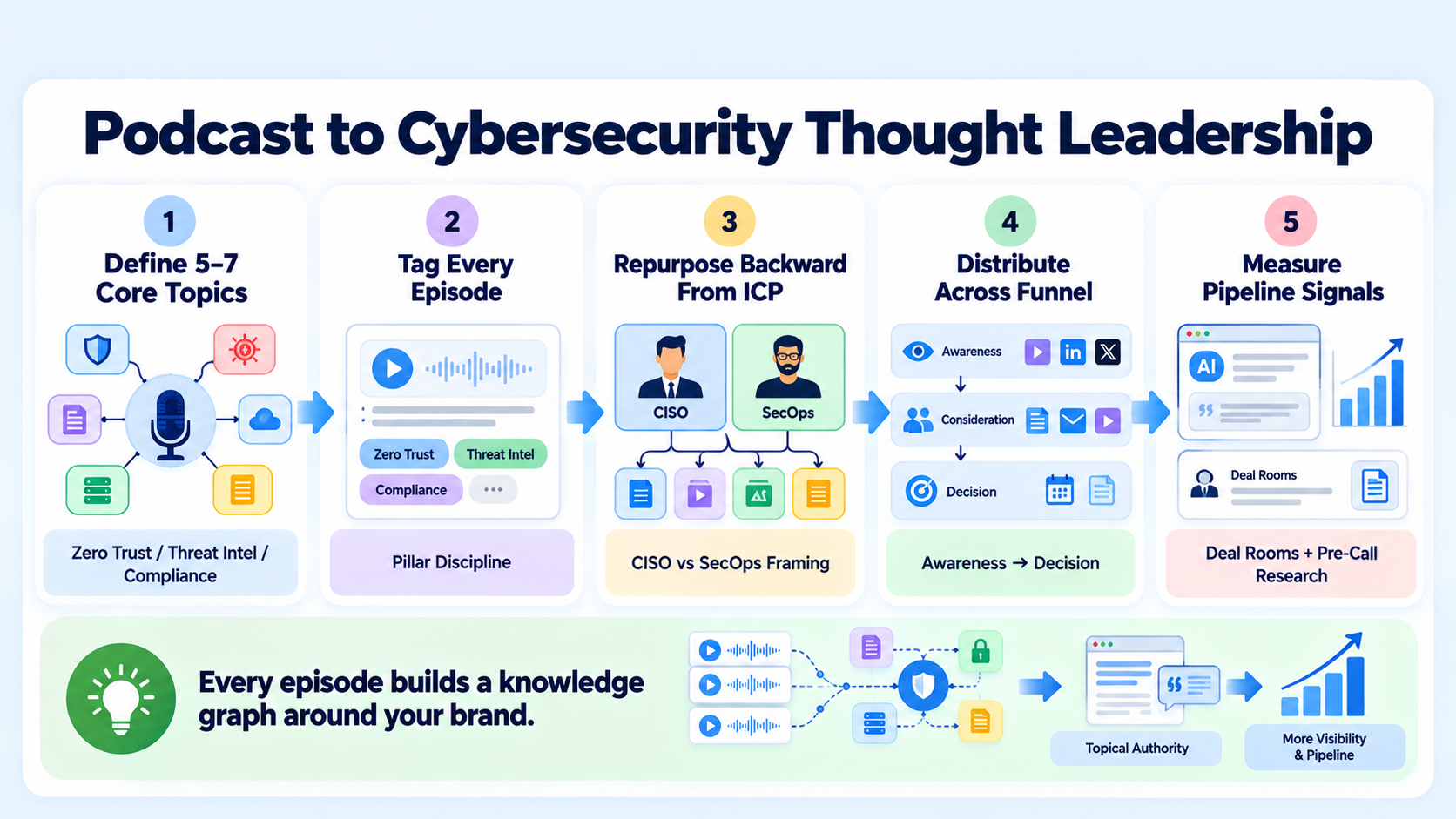
The structure works like this:
- Define your 5–7 core topics: Zero Trust, threat intelligence communication, CISO board reporting, compliance posture, dark web awareness content. These become the pillars every episode maps to.
- Tag every episode to a pillar: This forces editorial discipline and builds a content cluster over time. Every pillar should eventually have 4–6 pieces of content: the episode, the blog post, a LinkedIn series, a clips collection, and a case study.
- Repurpose backward from your ICP: A CISO audience requires different framing than a security operations team. Route each repurposed asset to the right role.
- Distribute across the full funnel: Short clips drive awareness. Blog posts handle consideration. Case study posts and sales enablement clips support the decision.
- Measure by pipeline signals, not vanity metrics: Track which clips appear in deal rooms, which blog posts appear in pre-call research, and which episodes guests reference when they become customers.
With 40% of B2B buyers now using AI assistants to research solutions, staying informed helps you optimize your content for how prospects actually search. When your podcast-derived content is structured around clear topics and entities, it becomes the source AI assistants cite, not your competitors.
75% of B2B decision-makers say thought leadership led them to research a product or service they had never previously considered, which is precisely why cybersecurity brands with a systematic podcast repurposing strategy for B2B generate inbound demand that cold outreach never could.
This is the end state: every episode builds a knowledge graph around your brand, one clip, one post, and one blog at a time.
Conclusion
Podcast repurposing for cybersecurity brands is not a content tactic. It is a pipeline strategy.
Key takeaways:
- Every episode contains enough material for a full week's content calendar across clips, posts, blogs, and sales assets.
- LinkedIn short-form clips from episodes earn 5x more engagement than static posts and support both awareness and deal-room selling.
- The brands winning in 2026 treat their podcast as a seed asset and repurpose every layer deliberately.
- Tools like Descript, Castmagic, and Opus Clip remove the manual friction; human editorial judgment ensures the right moments surface.
Whether you want to launch a brand new podcast from scratch or maximize the value of your existing recordings, reach out to Komet Media to build a complete creation and repurposing engine around your brand.
Frequently Asked Questions
Q1: What is podcast repurposing for cybersecurity brands?
It is the process of taking a recorded cybersecurity podcast episode and extracting multiple content formats from it: short video clips, blog posts, LinkedIn posts, audiograms, email copy, and sales assets. The goal is to extend the reach and pipeline value of a single recording across every channel your buyers use.
Q2: How many assets can one cybersecurity podcast episode produce?
A single 45-minute episode can realistically produce 8–12 assets: 2–3 short video clips, 1–2 blog posts, 3–4 LinkedIn posts, 1 email newsletter section, and 1–2 sales enablement clips. The exact output depends on how topic-rich the conversation is and how systematically your team executes.
Q3: Which platforms should cybersecurity brands prioritise for repurposed podcast content?
LinkedIn is the primary platform for B2B cybersecurity content. YouTube Shorts supports discoverability. Your own blog handles SEO and buyer education. Email nurtures existing contacts. Dark social channels, including private Slack groups and community forums, are where security practitioners share content between peers.
Q4: How does podcast repurposing support CISO audience targeting?
CISOs consume content asynchronously and across multiple formats. Short clips shared in deal rooms, blog posts found via search, and LinkedIn carousels seen between meetings all create repeated contact with the same buyer. Repurposing ensures your message reaches them in whatever format they happen to be using that day.
Q5: How long does it take to build a podcast repurposing workflow?
A lean workflow using Descript or Castmagic for transcription and Opus Clip for short-form video can be operational within one week. The bottleneck is usually editorial: deciding which moments to clip and how to frame each asset for the right buyer role. That is where a specialist team shortens the timeline significantly.
Q6: Is podcast repurposing for cybersecurity brands different from general B2B repurposing?
Yes. Cybersecurity buyers are more risk-averse, more technically literate, and more resistant to overtly promotional content. Effective podcast repurposing for cybersecurity brands prioritises education over promotion, uses precise technical language, and segments assets by buyer role (CISO, analyst, compliance lead) rather than broadcasting a single message to everyone.