
🪄 AI Summary
Heading 1
Heading 2
Heading 3
Heading 4
Heading 5
Heading 6
Lorem ipsum dolor sit amet, consectetur adipiscing elit, sed do eiusmod tempor incididunt ut labore et dolore magna aliqua. Ut enim ad minim veniam, quis nostrud exercitation ullamco laboris nisi ut aliquip ex ea commodo consequat. Duis aute irure dolor in reprehenderit in voluptate velit esse cillum dolore eu fugiat nulla pariatur.
Block quote
Ordered list
- Item 1
- Item 2
- Item 3
Unordered list
- Item A
- Item B
- Item C
Bold text
Emphasis
Superscript
Subscript
I run Komet Media, a B2B video growth agency. Every week, a founder or marketing head asks me the same thing: "Which platform should we actually be on?" The wrong answer costs months. This guide gives you the real breakdown of Reels vs Shorts vs TikTok for B2B in 2026, covering engagement data, audience demographics, content fit, and how to repurpose a single video across all three without rebuilding it from scratch. No fluff, just the decision framework your team needs.
TL;DR
- YouTube Shorts is the best long-term B2B bet: search-driven, evergreen content shelf life, highest engagement rate at 5.91%.
- Instagram Reels delivers the widest raw reach (30.81% average reach rate) and warms buyers already inside Meta's ecosystem.
- TikTok builds top-of-funnel brand awareness fast, especially with millennial decision-makers, but converts slower.
- Repurpose one video for all three rather than choosing just one platform.
Which Short-Form Video Platform Works Best for B2B Marketing?
No single platform wins for every B2B use case. The right answer depends on your funnel stage, content type, and buyer profile. Here is how the three stack up on metrics that matter to B2B teams.
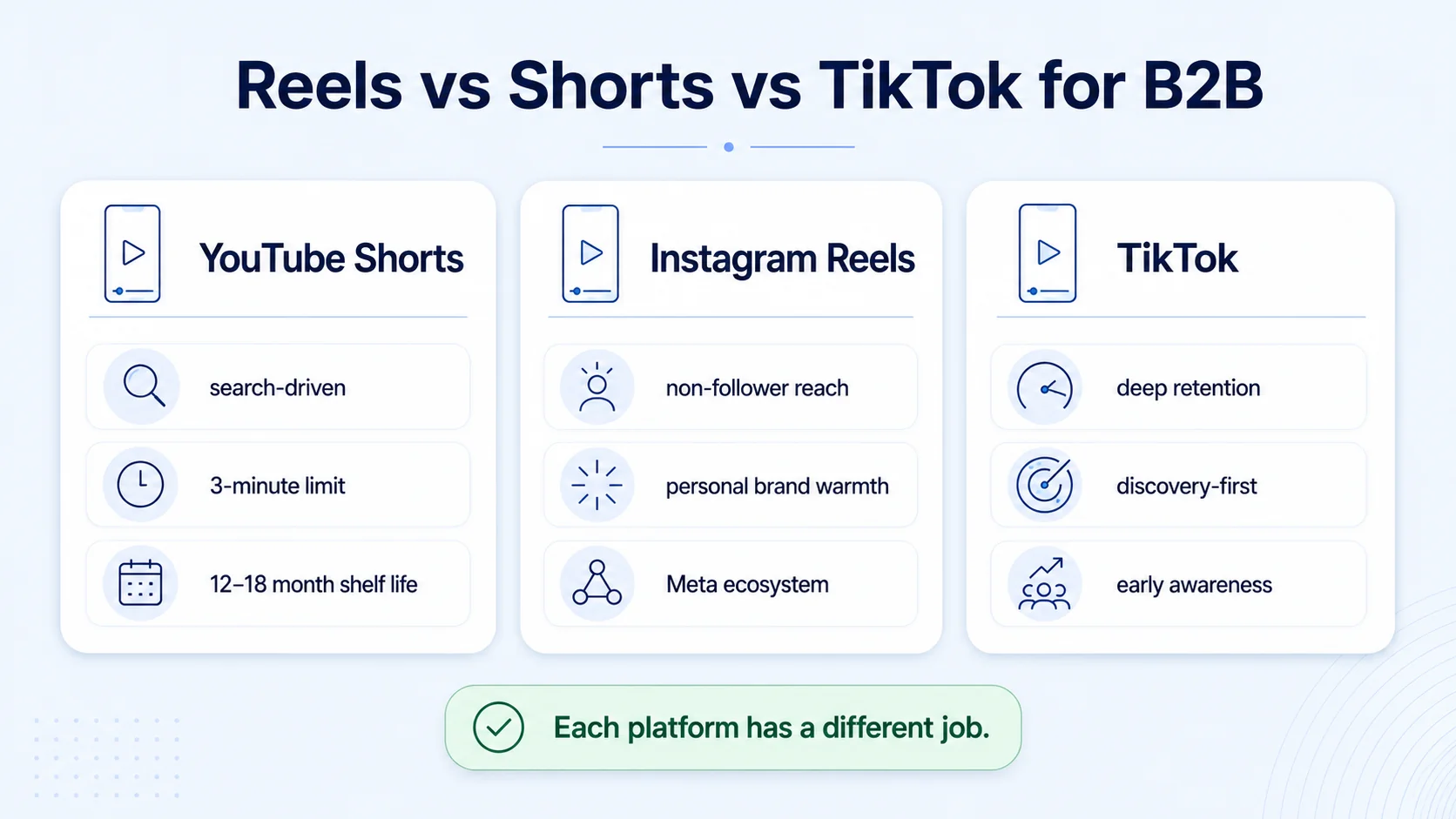
YouTube Shorts leads engagement at 5.91%, with 200 billion daily views and 2 billion monthly users, outperforming TikTok and Reels on average engagement rate. That number matters for B2B because engagement on Shorts is tied to search intent, not entertainment impulse. Its integration with long-form YouTube creates a unique discovery-to-depth funnel no other platform can match.
Instagram Reels commands a 30.81% average reach rate, more than double that of carousels or image posts. For B2B teams already running content inside Meta Business Suite, Reels amplifies that existing presence with minimal incremental effort. TikTok maintains roughly 1.9 billion monthly active users globally and the deepest session depth of any social platform.
Depth of session matters for B2B: a buyer who watches three of your product explainer clips in one sitting is warmer than one who scrolled past a LinkedIn post. YouTube Shorts works well for B2B and educational content, helping brands establish credibility that translates into long-term opportunities. For SaaS teams whose product requires education before purchase, that credibility compounding effect is exactly what pipeline needs.
Reels vs Shorts vs TikTok for B2B 2026: Platform-by-Platform Breakdown
YouTube Shorts
The maximum duration increased to 3 minutes in October 2024, and 74% of Shorts views come from non-subscribers, making it a powerful discovery engine for new audiences. For B2B SaaS teams, this is critical: your demo explainer or founder reaches people who have never heard of your product through YouTube's search infrastructure. YouTube Shorts generates $0.50 to $3.00 per 1,000 views, and educational clips compound in search for 12 to 18 months after posting. No other short-form format gives you that shelf life. A Reel from six months ago is buried. A Short on "how to reduce SaaS churn" is still ranking.
Instagram Reels
Instagram Reels reach rate averages 30.81%, more than 2x higher than carousels, image posts, and Stories, with 55% of Reels views coming from non-followers. For B2B brands doing founder-led growth, that non-follower reach is organic distribution most paid campaigns cannot replicate. Instagram Reels is the strongest channel for personal brand warmth, but only if your core audience skews under 45. For enterprise B2B, it is a secondary amplifier, not a primary pipeline driver. That framing is useful: use Reels to build trust and recognition, not to book demos directly.
TikTok
TikTok holds 78% of viewers through a video, YouTube Shorts retains 73%, and Reels keeps 65%. Retention rate is a proxy for message delivery: when your product education clip reaches a buyer on TikTok, more of them actually finish it. TikTok disrupts traditional B2B targeting because it pushes discovery over targeting. Instead of painstakingly segmenting audiences, the algorithm serves your content to users who have shown interest in related topics.
Is TikTok Worth It for B2B Companies in 2026?
Yes, with one important qualifier: it is a brand-awareness and trust-building channel, not a direct-response channel. The ROI path is longer, but the audience reality has shifted sharply. TikTok's user distribution shows the 25–34 age group has become the dominant demographic, with 23.6% male and 16.7% female, making it the largest segment on the platform. That is your buyer. The decision-makers who authorize six-figure software contracts do not exist only on LinkedIn. They are on TikTok with their guard down, consuming content they chose, from people they like.
A deal finalised on 22 January 2026 created TikTok USDS Joint Venture LLC, with Oracle, Silver Lake, and MGX holding an 80.1% majority stake, with ByteDance retaining 19.9%. This provides stability for businesses that had been cautious about investing in TikTok marketing while the platform's future in the US was uncertain. The regulatory risk that kept many B2B teams off TikTok is now materially reduced.
TikTok excels at brand building in ways that surprise B2B marketers. The platform's algorithm helps you reach people who wouldn't normally encounter your brand through traditional channels, which is particularly valuable for companies trying to break into new markets or reach younger decision-makers.
For B2B SaaS specifically: use TikTok to surface founder thinking, product myths debunked, and "day in the life of your buyer" content. Avoid hard-selling. The content that builds the pipeline on TikTok is the content that makes your ICP say, "This brand gets my problem." TikTok is not replacing LinkedIn in your stack. It is filling the gap between the moment a buyer first hears about a problem and the moment they search for a solution.
How to Use Instagram Reels for B2B Lead Generation
Reels is the most underutilised B2B lead generation asset inside the Meta ecosystem, precisely because most B2B teams treat it as entertainment and not as a conversion tool. LinkedIn video is underused relative to its performance, and its algorithm heavily favours native video, making it a competitive advantage for early adopters. The same early-mover principle applies to Instagram Reels for B2B: most competitors are still posting static graphics, leaving organic reach on the table.
Here is how to actually use Reels for pipeline:
- Lead with a problem statement: Open the first two seconds with a pain your ICP recognises immediately. Algorithm retention starts at the second one.
- Demonstrate product thinking, not product features: Show how your team thinks about the problem, not just what your software does. Trust precedes demos.
- Close with a soft CTA: "Follow for more" or "Link in bio to see how we do it" outperforms hard CTAs. Reels viewers are in discovery mode, not buying mode.
- Boost with Meta targeting: Brands can combine organic growth with Meta ad campaigns, amplifying visibility and reach seamlessly. A Reel that performs organically can be amplified to a job-title-targeted paid audience at low CPM.
- Track profile visits and link-in-bio clicks as the leading indicators, not just views.
The ideal Instagram content mix in 2026 is 60–70% Reels, 20–30% carousels, and 10% static images. If your current mix is the inverse of that, you are working against the algorithm.
YouTube Shorts vs Instagram Reels for B2B: Which Gets More Reach?
Raw reach and qualified reach are different things, and B2B teams need to track both. Here is the honest comparison.
YouTube Shorts wins on qualified reach for B2B because the search layer means someone watching your clip already has intent. YouTube Shorts emphasizes watch time and retention, and Shorts are ideal for building a content funnel where short videos guide viewers to longer, more informative content, creating trust and authority over time.
Instagram Reels wins on volume and speed of awareness. If your goal is getting your founder's face in front of 10,000 new potential buyers in two weeks, Reels moves faster. If your goal is educating a buyer who searched "how to reduce SaaS onboarding time," Shorts reaches them with intent attached.
For most B2B SaaS teams, the right answer is: Shorts for SEO and evergreen education, Reels for brand reach and founder visibility. These are not competing strategies; they are complementary pipeline assets.
How to Repurpose One Video for Reels, Shorts, and TikTok
This is where most B2B teams waste time, rebuilding content from scratch per platform instead of running a disciplined content repurposing workflow. At Komet Media, we turn one long-form asset into a full cross-platform short-form system. Here is the exact process.
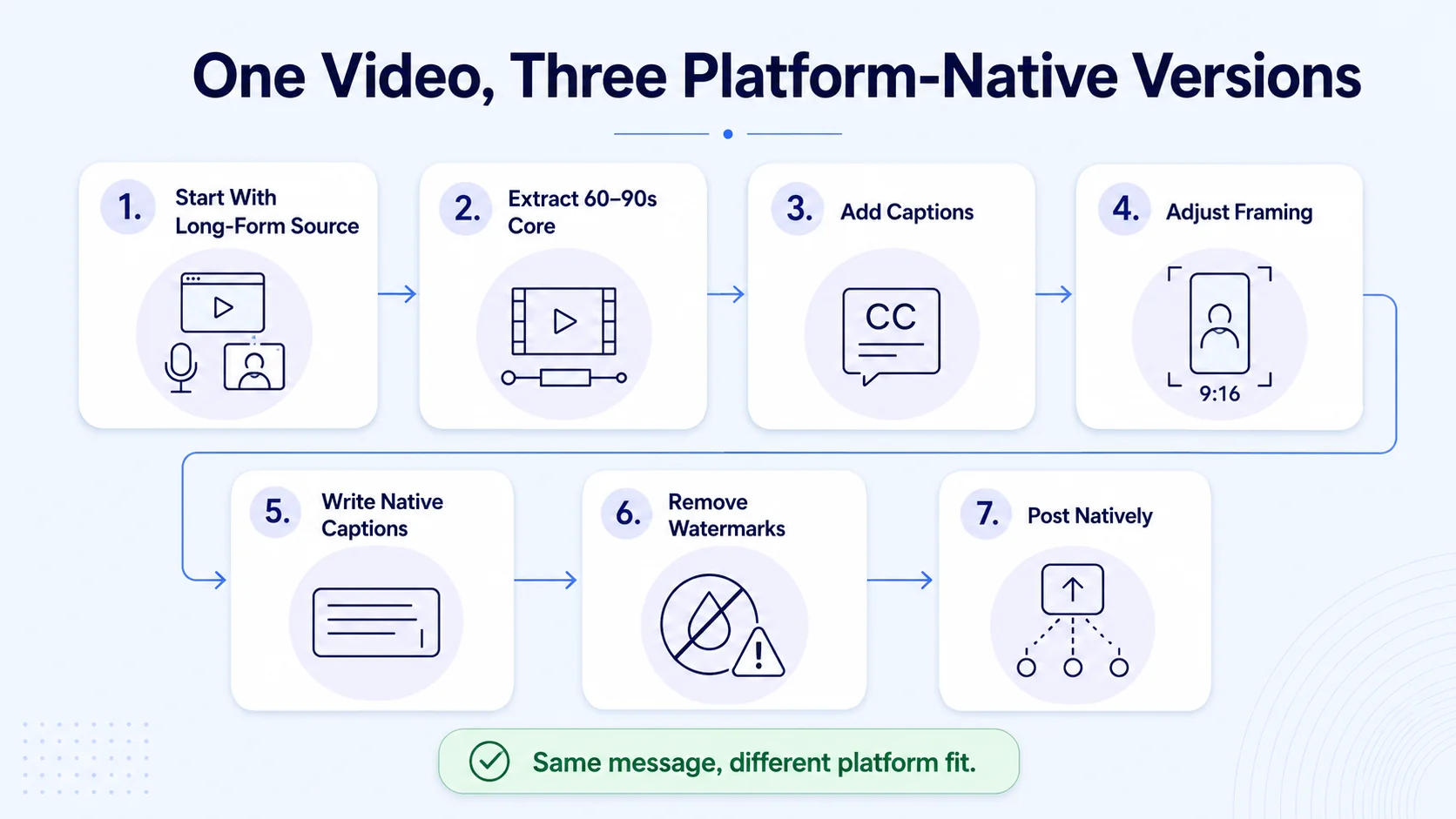
- Start with a long-form source: A webinar, podcast episode, recorded demo call, or founder interview. This is your raw material.
- Extract the highest-value 60–90 seconds: Identify the moment where the speaker makes the clearest, most useful point. That is your clip core.
- Edit for platform-native format: Add captions on all three (mandatory: 85% of LinkedIn video is watched without sound , and the same applies to short-form). Trim the hook to land in the first two seconds.
- Adjust framing per platform: LinkedIn rewards 4:5 aspect ratio and professional tone. YouTube Shorts rewards 9:16 and search-optimised titles. Instagram Reels rewards high visual quality and casual energy.
- Write platform-native captions: TikTok copy is conversational and direct. Short descriptions should include searchable keywords. Reels captions lead with the hook.
- Remove TikTok watermarks before cross-posting. Platforms penalise watermarked content in their algorithms.
- Post natively on each platform: Do not cross-post via third-party tools that reduce quality. Upload the tailored version directly.
Brands publishing 3 to 5 short-form videos per week see significantly higher engagement growth than those posting daily on all platforms simultaneously. Volume is not the lever. Frequency consistency and platform fit are.
Our short-form video editing services and video marketing services are built specifically around this repurposing workflow for B2B teams who want content that moves the pipeline, not just accumulates views.
Conclusion
- YouTube Shorts is the highest-leverage B2B platform in 2026 for evergreen, search-driven buyer education with a 5.91% engagement rate and content that compounds for 12–18 months.
- Instagram Reels delivers the widest organic reach (30.81%) and is the right vehicle for founder-led brand warmth and top-of-funnel visibility.
- TikTok is no longer optional for B2B teams selling to millennial buyers, the platform's dominant demographic, but treat it as a brand awareness channel, not a direct-response channel.
- The highest-ROI move is repurposing one strong long-form asset into platform-native versions for all three rather than starting from scratch on each.
If your team has webinars, demos, or podcast episodes sitting unused, those are already a short-form content library waiting to be activated. See how Komet Media builds that system for B2B teams.
Frequently Asked Questions
Q1: Which platform should a B2B SaaS startup prioritise first?
Start with YouTube Shorts if you have educational content and want long-term compounding reach. Start with Instagram Reels if you need fast brand visibility and already have a Meta presence. TikTok is best added third, once you have a content rhythm established on the other two platforms.
Q2: Can B2B brands actually get ROI from TikTok in 2026?
Yes, but the ROI path is indirect. TikTok builds brand awareness and decision-maker familiarity, which shortens sales cycles when buyers reach your sales team already knowing who you are. A well-executed TikTok presence can establish thought leadership and brand recognition months before your sales team makes contact.
Q3: What type of B2B content performs best on TikTok versus Reels?
On TikTok, raw founder takes, myth-busting clips, and "here's what nobody tells you about [problem]" formats outperform polished production. On Reels, visually clean, caption-heavy product moments and social proof clips with strong hooks work best. Authenticity wins on TikTok; polish wins on Reels.
Q4: Do I need a different video for each platform, or can I reuse the same one?
You need the same core clip edited differently per platform. Same message, different framing, aspect ratio, caption style, and hook pacing. Posting identical files cross-platform consistently underperforms platform-native edits. The time investment is 20–30 minutes per clip, not starting over.
Q5: How long should B2B short-form videos be in 2026?
Videos under 90 seconds retain approximately 50% of viewers on average. For B2B specifically, 45–75 seconds is the sweet spot: long enough to deliver one clear idea, short enough to hold attention through completion. YouTube Shorts now allows up to 3 minutes, but B2B clips beyond 90 seconds see steep retention drop-off.
Q6: Is LinkedIn video better than Reels, Shorts, or TikTok for B2B?
LinkedIn video deserves a place in every B2B stack. Native LinkedIn video gets 5x more engagement than text-only posts, and video uploads on LinkedIn increased 34% year-over-year. The audience quality is unmatched for B2B decision-maker targeting, but raw reach is smaller. Use LinkedIn video alongside Shorts and Reels, not instead of them.