
🪄 AI Summary
Heading 1
Heading 2
Heading 3
Heading 4
Heading 5
Heading 6
Lorem ipsum dolor sit amet, consectetur adipiscing elit, sed do eiusmod tempor incididunt ut labore et dolore magna aliqua. Ut enim ad minim veniam, quis nostrud exercitation ullamco laboris nisi ut aliquip ex ea commodo consequat. Duis aute irure dolor in reprehenderit in voluptate velit esse cillum dolore eu fugiat nulla pariatur.
Block quote
Ordered list
- Item 1
- Item 2
- Item 3
Unordered list
- Item A
- Item B
- Item C
Bold text
Emphasis
Superscript
Subscript
Your buyers are watching on their phones. Your content team is still exporting in 16:9. That gap is costing you reach, watch time, and pipeline. The debate over vertical vs horizontal video for B2B channels is no longer philosophical, it's a production decision with measurable consequences on every platform your buyers use. Here's what the data says and exactly how to make the call.
TL;DR
- Vertical (9:16) wins on LinkedIn feed, YouTube Shorts, Instagram Reels, and TikTok for Business, anywhere mobile-first scrolling happens.
- Horizontal (16:9) still owns webinars, product demos, YouTube long-form, and website embeds.
- Vertical videos see 80–100% higher completion rates on mobile compared to horizontal.
- The smart move in 2026: produce both from a single shoot.
Why Most B2B Brands Still Default to Horizontal Video
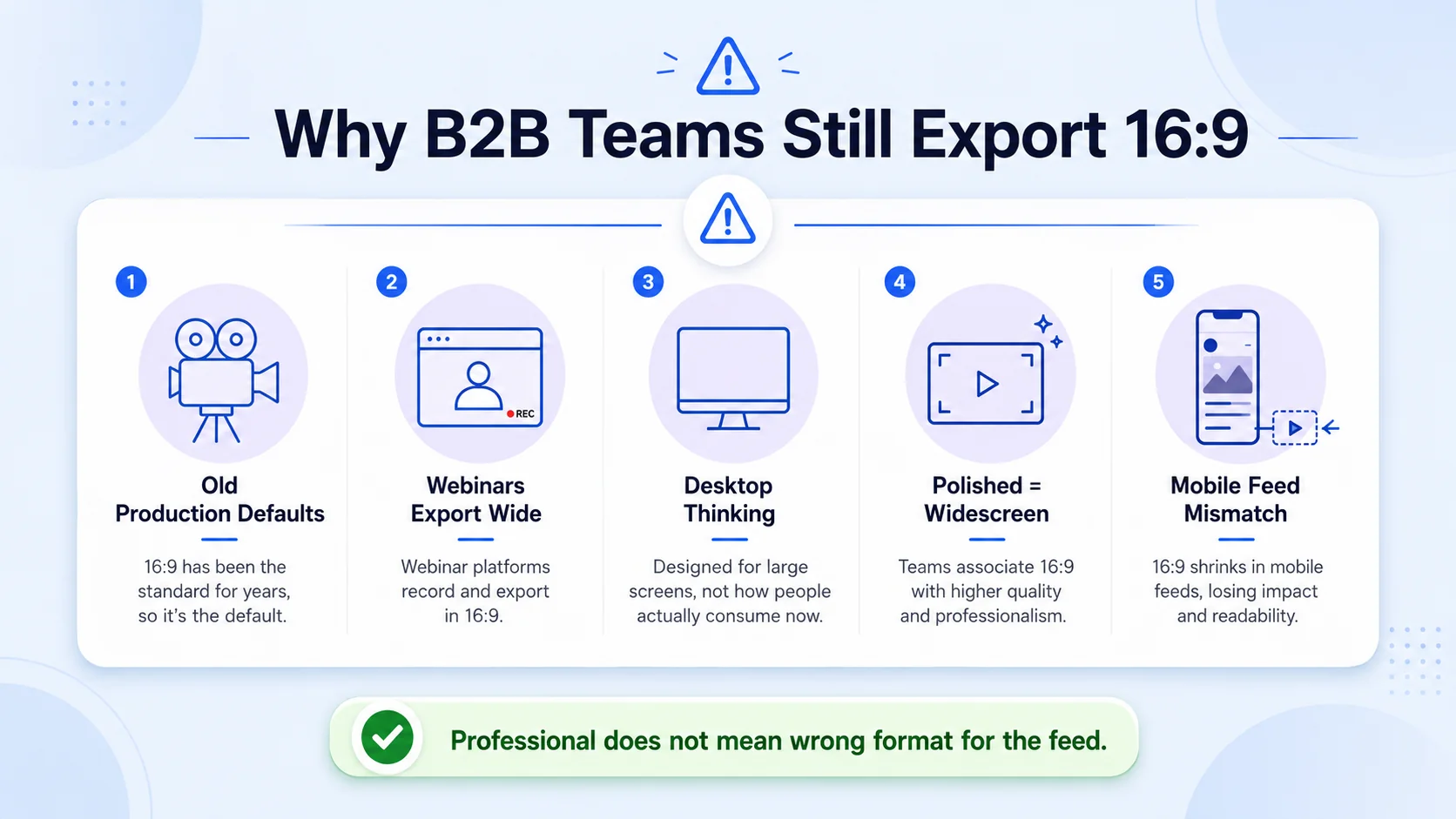
The honest answer is inertia. Horizontal video was built for conference rooms, broadcast TV, and desktop screens, and B2B marketing spent two decades optimizing for exactly that context. Webinars stream at 16:9. Zoom recordings export at 16:9. Demo videos live on YouTube at 16:9. The widescreen format became synonymous with "professional." Presentations, webinars, and training videos viewed on desktops still favor 16:9 formats. YouTube tutorials, reviews, and explainer videos benefit from a wider view that supports in-depth storytelling. Horizontal video delivers a sense of professionalism often preferred in B2B and educational contexts. That preference isn't wrong, it's just incomplete. The problem is that most B2B teams never updated their production defaults when mobile consumption took over the feed.
LinkedIn's own research shows that 91% of members watch videos on mobile devices, at least part of the time, and 57% of all engagement with LinkedIn content takes place on mobile. When you ship a 16:9 video into a mobile-first feed, it renders small, competes for less screen real estate, and gets outrun by vertical content that fills the entire display. If your audience primarily uses smartphones and you deliver horizontal content, you're asking them to turn their device, creating friction.
The second reason B2B brands stick with horizontal: the conflation of "polished" with "landscape." Horizontal framing does carry a widescreen authority signal. But that signal matters far less than whether the buyer stops scrolling in the first two seconds. Format fit drives attention. Attention drives pipeline. Production polish is secondary to placement compatibility.
The average B2B video length has compressed from 168 seconds in 2024 to just 76 seconds in 2026, reflecting both platform algorithm changes and viewer behaviour, busy professionals increasingly prefer concise, high-value content over lengthy explanations. Horizontal long-form isn't dead. It's just not the only tool anymore.
Vertical vs Horizontal Video for B2B Channels: The Platform-by-Platform Breakdown
Format choice is really a platform decision. Here is where each orientation wins:
LinkedIn now strongly encourages vertical (9:16) and square (1:1) formats for mobile optimization, moving away from the previously standard landscape (16:9) format. For LinkedIn ads specifically, supported aspect ratios include 16:9 horizontal (640x360p to 1920x1080p), square 1:1 (360x360p to 1920x1920p), vertical 4:5 (360x450p to 1080x1350p), and vertical 9:16 (360x640p to 1080x1920p).
Instagram Stories, Reels, TikTok, and YouTube Shorts prioritize vertical content and reward it with higher visibility. YouTube, websites, and LinkedIn still favor horizontal video, especially for long-form or educational content.
One nuance worth flagging for LinkedIn specifically: the 1:1 square ratio at 1080x1080 pixels fills vertical space on mobile while maintaining a balanced appearance on desktop, making it a strong hedge when you are unsure of the split between mobile and desktop viewers.
Engagement Rate Benchmarks: Does Vertical Video Actually Work for B2B?
This is where B2B skeptics need hard numbers, not vibes. The data is consistent. Vertical videos generate 58% more engagement on mobile devices than horizontal videos. That is not a rounding error, it is a structural advantage driven by screen real estate.
Vertical videos yield a 130% higher engagement rate than horizontal videos, and the reason is simple: they fill the entire screen. No black bars, no wasted space, no cognitive load from deciding whether to rotate your phone. The visual real estate is maximized and the experience feels native to the platform.
For paid distribution, vertical video ads perform 13.6% better on cost-per-view than horizontal on mobile, according to Snapchat Business data. From a buyer behavior standpoint, 81% of B2B buyers say they trust video more than text-based content, and 74% prefer short, straightforward videos that highlight immediate value. Short-form vertical content is the clearest match for both of those preferences simultaneously.
Videos under 60 seconds generate 2.5x more engagement per impression than any other content type, and marketers rank short-form video as the number one ROI format for the third consecutive year. Industry studies consistently show that vertical video generates higher completion rates and stronger engagement compared to horizontal formats, especially on platforms like LinkedIn and YouTube Shorts.
The one caveat for B2B: horizontal often converts better for detailed content, meaning long-form demos and comparison pages on your website still perform well in widescreen. Vertical wins the feed. Horizontal wins the funnel's deeper stages.
How to Decide Video Orientation for Your B2B Content Production Pipeline
Vertical vs horizontal video for B2B channels is not a brand debate, it is a workflow question. Here is how I approach it with clients at Komet Media:
- Identify the distribution channel first: Where is this video going? If it lives in a social feed (LinkedIn, Instagram Reels, YouTube Shorts), vertical or square is the default. If it is a demo on your website or a webinar recording, horizontal holds.
- Plan your shoot for both orientations simultaneously: Frame your subject centered with enough head and shoulder room. This creates a safe zone that works cropped to 1:1 or 9:16 without losing key visuals. Keep all text, logos, and captions inside the safe zone, the central 1080x1080 px area, to prevent cropping on smaller screens.
- Export two master files: One 16:9 for YouTube, website, and presentations. One 9:16 (or 1:1) for LinkedIn, Reels, and Shorts.
- Add captions to every vertical asset: Over 80% of LinkedIn video views happen with sound off on mobile. Always add burned-in captions or upload an SRT file to ensure your message reaches viewers scrolling silently.
- Check safe zone guidelines before publishing: Text, CTAs, and product names must sit in the center third of the frame on vertical exports to survive cropping across different display contexts.
- Test and iterate by platform: Track watch-through rate, not just views. A lower view count with a 70% watch-through beats a high view count at 10%.
This workflow is the foundation of a scalable content repurposing workflow, one shoot, multiple aspect ratios, maximum distribution reach.
Vertical Video Mistakes B2B Marketers Make (And How to Fix Them)
Even when B2B teams commit to verticals, execution errors kill performance. These are the most common failures:
- Cropping horizontal footage into vertical: Compressing a 16:9 webinar into 9:16 by letterboxing it is not vertical video, it is a thumbnail surrounded by black bars. It looks broken on mobile and signals low production effort. If you filmed a vertical interview on a phone, don't force it into a widescreen format. If you have a widescreen webinar recording, consider cropping a center cut for LinkedIn feed use.
- Ignoring captions: Up to 80% of social video is watched without sound. Adding captions ensures accessibility and improves engagement.
- Starting too slow: The first 3–10 seconds are crucial. Capture attention immediately with a punchy hook, a surprising statistic, a question, or a strong visual.
- Making vertical content feel like a shrunken webinar: Vertical video demands tight framing, direct address, and a single clear idea per clip. It is not a format for 12-slide presentations.
- Skipping mobile preview before publishing: Preview uploads on both desktop and mobile before publishing. LinkedIn's feed automatically adjusts layout based on your video's aspect ratio.
- Treating vertical as low-priority "bonus" content: The data does not support that hierarchy. Vertical is where most of your buyers' attention actually lives.
One additional mistake specific to B2B SaaS teams: treating founder or executive video as a horizontal-only format because it "needs to look polished." Talking-head videos from executives and practitioners consistently outperform polished brand videos on LinkedIn. Customer testimonials, quick tactical tips, and behind-the-scenes product demos also drive strong engagement and downstream conversions. Vertical talking-head content from your founder is one of the highest-ROI assets you can produce.
Is Vertical Video Worth It for B2B Channels? Building the Business Case
If you are running a B2B SaaS or funded startup and still asking whether vertical is "worth it," here is the direct answer: your buyers have already answered for you with their behavior. 94% of users hold their phones upright. That is not a trend, it is the default human behavior on a mobile device. Every horizontal video sent into a vertical feed is working against the physics of how people hold their phones.
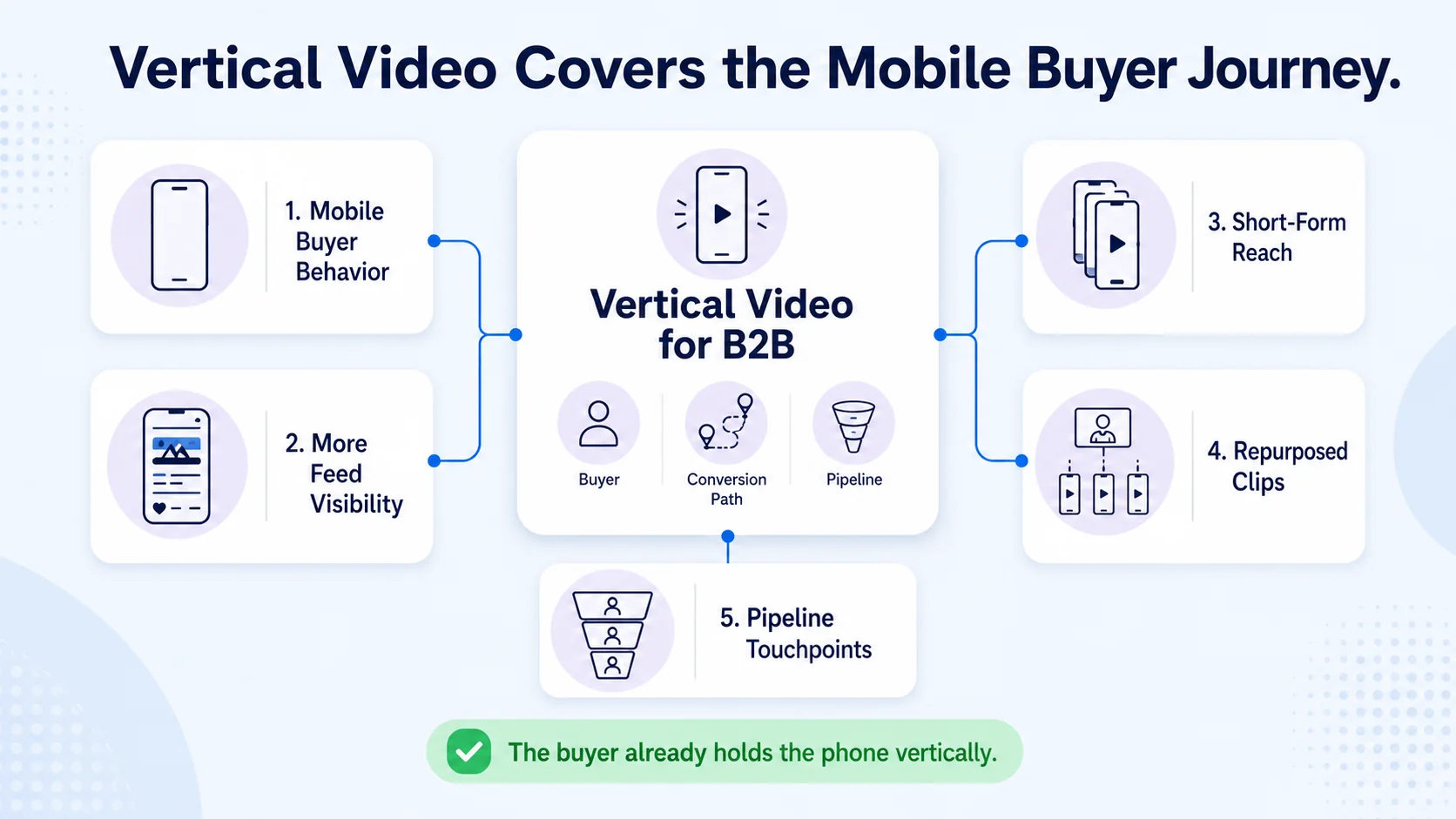
In 2026, 91% of all businesses use video as a marketing tool, up from 86% in 2025. Among B2B companies, the adoption rate stands at 84%. Adoption is table stakes. Format optimization is the actual competitive edge. From a demand generation standpoint, landing pages with embedded video convert at 86% higher rates than text-only equivalents, and B2B SaaS pages with explainer videos see conversion lifts exceeding 100% in controlled testing. That applies regardless of format. But for top-of-funnel visibility, where vertical video lives, vertical video is emerging as one of the most effective tools in the B2B marketer's toolkit, especially as more professionals consume content on mobile-first platforms like LinkedIn, YouTube Shorts, and Instagram Reels.
For teams running short-form video as part of a broader vertical vs horizontal video for B2B channels strategy, the ROI math is simple: a single podcast episode, webinar, or product demo repurposed into four to six vertical clips extends reach across every short-form surface your buyers are already scrolling.
Don't start from scratch, turn webinars, whitepapers, and conference presentations into vertical video highlights. Video content on LinkedIn increased by 53% in 2025 , and that volume is largely being driven by vertical and square-format content. The teams shipping vertically are compounding their visibility. The ones still exporting only in 16:9 are ceding that surface entirely.
The question for B2B growth teams is not whether vertical video works. It is whether your current production pipeline is structured to produce both formats without doubling your cost or timeline. That is a video production pipeline problem, and it is a solvable one.
Conclusion
- Vertical video for B2B channels is not a consumer trend that leaked into professional content. It is the dominant format on every mobile-first surface your buyers use daily.
- Horizontal remains essential for demos, webinars, and website embeds, the deeper, conversion-stage content.
- The winning workflow in 2026 produces both from a single shoot, with captions, safe zone compliance, and platform-specific exports built into the process.
- If your team is only shipping 16:9, you are not covering the full buyer journey. Fix the pipeline, not just the format.
Ready to build a content repurposing system that ships both formats at scale? Book a call with us.
Frequently Asked Questions
Q1: What is the right video aspect ratio for LinkedIn B2B content in 2026?
LinkedIn now strongly encourages vertical 9:16 and square 1:1 formats for mobile optimization. For feed posts, 1:1 is the safest cross-device choice. Use 9:16 when targeting mobile-only placements. Reserve 16:9 for webinar clips or content also distributed on YouTube.
Q2: Does vertical video work for thought leadership content?
Yes, and it outperforms polished brand video on LinkedIn specifically. Founder-led and executive-led video content humanizes your brand and builds trust at the highest level. To create thought leadership videos that drive inbound pipeline, focus on educational, non-promotional perspectives on industry challenges. Vertical framing makes those clips feel direct and personal.
Q3: How long should a B2B vertical video be?
Aim for 15–60 seconds. Professionals are more likely to engage when content is quick to consume. For LinkedIn organic thought leadership, 60 to 120 seconds performs well, long enough to deliver value but short enough to retain professional audiences.
Q4: Can I repurpose a webinar recording into vertical video for B2B channels?
Yes, but do not simply letterbox it. Extract the strongest 45–90 second moments, reframe around the speaker using a center crop, add captions, and export at 9:16 or 1:1. Repurposing long-form content is a core best practice, turning webinars, whitepapers, and conference presentations into vertical video highlights rather than uploading raw recordings.
Q5: What are safe zone guidelines for vertical B2B video?
Keep all text, logos, and captions inside the safe zone, the central 1080x1080 px area, to prevent cropping on smaller screens. For 9:16 exports, all critical visuals and CTAs should occupy the central third of the frame vertically. Anything near the top or bottom edge risks being cut off by UI overlays on mobile.
Q6: Is horizontal video obsolete for B2B marketing?
No. The rise of verticals does not mean landscape is obsolete. Horizontal videos remain indispensable for immersive storytelling and professional quality. Product demos, webinars, case study films, and website hero videos all perform best in widescreen. The frame for vertical vs horizontal video for B2B channels is not either/or, it is matching orientation to context, platform, and stage of the buyer journey.