
🪄 AI Summary
Heading 1
Heading 2
Heading 3
Heading 4
Heading 5
Heading 6
Lorem ipsum dolor sit amet, consectetur adipiscing elit, sed do eiusmod tempor incididunt ut labore et dolore magna aliqua. Ut enim ad minim veniam, quis nostrud exercitation ullamco laboris nisi ut aliquip ex ea commodo consequat. Duis aute irure dolor in reprehenderit in voluptate velit esse cillum dolore eu fugiat nulla pariatur.
Block quote
Ordered list
- Item 1
- Item 2
- Item 3
Unordered list
- Item A
- Item B
- Item C
Bold text
Emphasis
Superscript
Subscript
If you run marketing for a SaaS company or funded AI startup, B2B video marketing trends for 2026 are not a "nice to know" topic. They are a pipeline conversation. Buyers are watching more videos than ever before. Algorithms reward it. AI tools have lowered the production floor. And the teams shipping consistent video—whether creating fresh content from scratch or repurposing existing recordings—are compounding visibility while everyone else debates whether to start. This guide covers every major trend, what the data actually says, and exactly what to do with it.
TL;DR
- 91% of businesses now use video as a marketing tool in 2026.
- Short-form and LinkedIn-native video are the highest-ROI formats for B2B demand generation.
- Webinar repurposing is the fastest way to build a content library without adding shoot days.
- AI accelerates production; human-led creative direction still determines whether buyers trust you.
What Are the Biggest B2B Video Marketing Trends for 2026?
Video is the highest-performing content format across adoption, engagement, conversion, and retention metrics. What has changed in 2026 is the speed at which AI tools are reshaping production workflows, the emergence of LinkedIn as the dominant B2B video channel, and the rising bar for what counts as "good ROI."
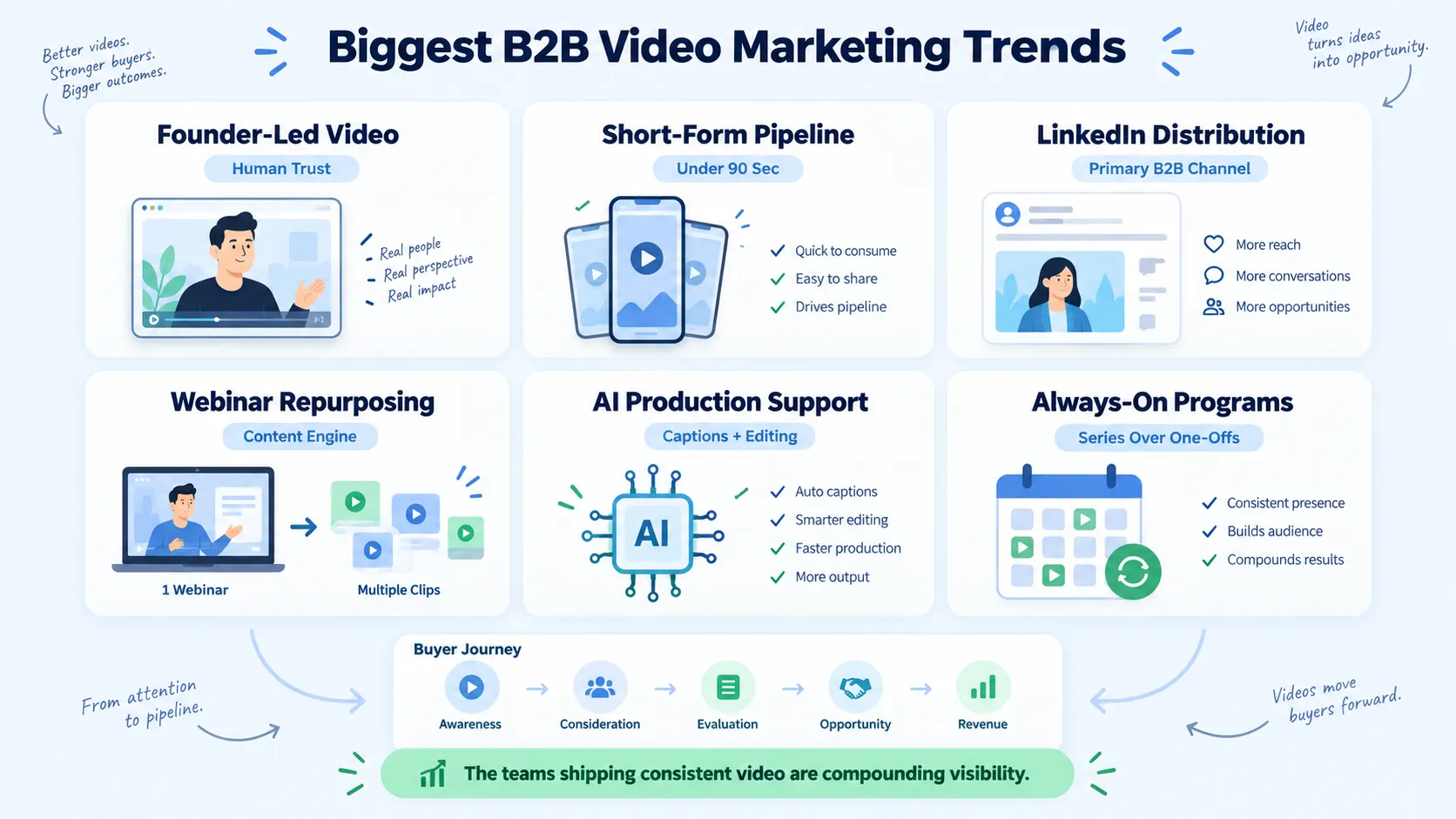
Here are the six defining shifts:
- Founder-led and human-first video: Synthetic media and AI avatars risk undermining trust in high-stakes B2B decision-making. Authentic, human-led content remains the gold standard.
- Short-form as a pipeline channel: Short-form video is now the most leveraged content format and the highest-ROI channel. In 2025, 104% more marketers named it their most valuable channel compared to 2024, and it is where investment is growing fastest for 2026.
- LinkedIn as the primary distribution layer: For B2B specifically, LinkedIn has overtaken YouTube as the top distribution channel, with 81% of B2B teams sharing video there.
- Webinar repurposing as a content engine: Across the B2B industry, there has been a massive transition from singular-event thinking to viewing webinars as content machines, understood as the best route to produce enough material to fuel a lasting, comprehensive content strategy.
- AI in production: 63% of video marketers have used AI tools to help create or edit videos, up from 51% the prior year. AI now supports scripting, storyboarding, editing, and captioning, though the strongest results still pair AI speed with human creative direction.
- Always-on programs over one-off campaigns: Organizations now prioritize ongoing, program-level video strategies over "one-and-done" projects. Micro-content series create bingeable educational content across the buyer's journey, maintaining engagement during extended evaluation periods.
At Komet Media, this is precisely the model we build for SaaS and AI teams: a repeatable system that produces original video content from scratch—from concept and scriptwriting to final production—or turns existing product knowledge, demos, and founder thinking into short-form assets that educate buyers at every stage of the funnel. You can see exactly how we approach this at Komet Media's video marketing services.
B2B Video Marketing Statistics and Benchmarks 2026
The numbers are unambiguous. Here is what the data says across the four metrics that matter most to growth and pipeline teams.
Wyzowl's 2026 report found that 83% of marketers report that video has directly increased sales. In parallel, 82% say video has helped increase web traffic. Landing pages with embedded video see up to 86% higher conversion rates than those without.
Key benchmark for SaaS teams: Companies using video in their marketing see an average increase of 38% in lead generation. B2B videos with clear calls-to-action generate 42% higher conversion rates than those without. 89% of marketers plan to maintain or increase video spend in 2026 , confirming this is not a passing priority. For B2B SaaS and funded AI teams, the question is not whether to invest in video, it is whether your current output matches the competitive pace.
What Video Formats Work Best for B2B Companies in 2026?
Format choice is a strategic decision, not a production preference. Different formats serve different stages of the buyer journey.
Short-form video (under 90 seconds): Short-form content remains king, with videos under 90 seconds holding viewer attention at a solid 50% retention rate. In a world of skim readers and mobile-first browsing, brevity wins. The most successful short videos get to the point quickly, prioritize visual storytelling, and offer one clear takeaway.
Mid-length explainer and product videos (60–90 seconds): Short videos under 30 seconds achieve the highest completion rates but may lack depth for complex product explanations. Mid-length videos in the 60–90 second range balance engagement with substantive content, making them ideal for most B2B use cases.
Webinars: Webinars remain one of the highest-ROI video formats for B2B marketing. Unlike passive video content, webinars create synchronous engagement, build relationships, and generate qualified leads at scale. According to ON24's 2025 Webinar Benchmarks Report, the average webinar achieves a 57% registration-to-attendance conversion rate.
Customer testimonial and social proof videos: These reduce objections at the bottom of the funnel faster than any written case study. A buyer watching a peer describe a real outcome in 60 seconds converts faster than one reading a PDF.
Thought leadership clips from founders and executives: Future growth on LinkedIn will be fueled by video-first personal branding and thought leadership series. B2B brands that empower internal voices, not just the marketing team, to speak through video will unlock new layers of trust and reach.
Our short-form video editing service is built specifically around this format mix: we take what your team already knows and package it into the exact clips that move buyers through evaluation.
How to Use Short-Form Video for B2B Lead Generation in 2026
Short-form video is the dominant format for capturing attention. These concise, mobile-first videos excel at introducing a problem and establishing brand expertise in seconds. The execution is what separates teams generating pipeline from teams generating views. Follow this process:
- Start with a real sales question. Pull the three most common objections your SDRs hear. Each one is a 60-second video script waiting to be written.
- Lead with the insight, not the brand. Open with the buyer's problem or a counterintuitive truth. The first three seconds determine whether anyone watches.
- Add captions. An A/B test found 16% higher reach and a 26% drop in CTA clicks without captions. Most LinkedIn users scroll silent.
- Distribute natively on LinkedIn. LinkedIn remains an unrivaled channel for B2B video distribution, with video posts shared 20x more than text-based content.
- Use a clear CTA that matches the funnel stage. Top-of-funnel clips drive profile follows or email sign-ups. Demo-stage clips drive direct calendar bookings.
- Measure pipeline, not just views. Track which clips generate demo requests, not which ones generate impressions. That is the number that goes into your pipeline report.
On average, B2B video content shortens the sales cycle by 23%.
For a SaaS team running a 90-day enterprise cycle, that is meaningful compression. For more on building a lead generation system around video, explore Komet Media's webinar repurposing service.
Best Practices for B2B Video Marketing on LinkedIn in 2026
LinkedIn is where B2B video marketing trends for 2026 are most visibly playing out. 93% of B2B marketers use LinkedIn for content marketing, and LinkedIn video watch time grew 36% year over year. 41% of B2B ad dollars now go to LinkedIn , and organic video performance reinforces why. Here is what actually works:
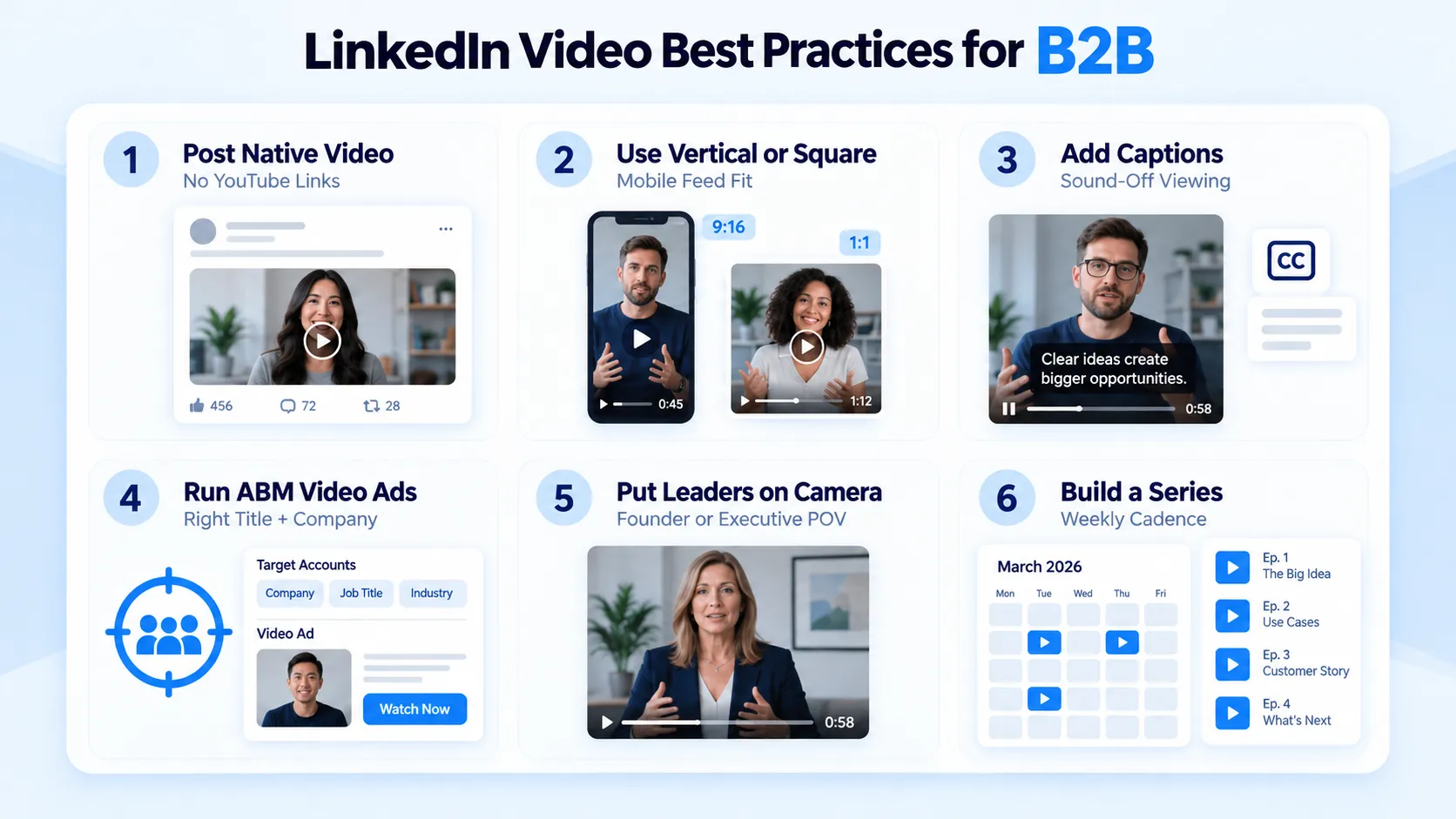
- Post native video, not YouTube links. LinkedIn's algorithm suppresses external links. Native uploads get meaningfully more reach.
- Keep it vertical or square for mobile. Most LinkedIn users access the platform from mobile devices, so videos must be mobile-friendly.
- Include captions always. Not everyone watches with sound, so captions are necessary.
- Use LinkedIn Video Ads for ABM targeting. 58% of B2B marketers have integrated video into their account-based marketing strategies. LinkedIn's targeting precision makes it the strongest channel for serving account-specific video to the right title at the right company.
- Let the founder or executive speak on camera. Buyer trusts compounds when a face is attached to a point of view. A polished brand video from a logo generates far less pipeline than a direct-to-camera clip from the CEO explaining a real problem.
- Build series, not one-offs. Teams using AI produce up to 11x more content per month , which means your competitors are increasing output. A single monthly episode is no longer competitive. Aim for a weekly cadence built around repurposed source material.
For teams that want LinkedIn video handled properly, our video advertising service covers both organic and paid LinkedIn video strategy.
How Are B2B Companies Using AI in Video Marketing?
The AI video generator market is worth close to $1 billion in 2026 and is growing fast. But B2B teams that use it well are doing something specific: they are deploying AI for speed in the middle of production while keeping human judgment at the brief and the final cut. According to Wistia's research, daily video producers are 58% more likely to use AI. The primary use cases are script drafts, subtitle generation, repurposing long-form into short-form, and asset tagging. Where AI is genuinely useful for SaaS and AI startup video teams:
- Transcription and clip identification: AI finds the best 60-second segments inside a 45-minute webinar recording.
- Caption and subtitle generation: Automates what used to take hours of manual sync work.
- Script drafting: AI-personalized video ads achieve 6–7% click-through rates compared to a 2% benchmark. AI-assisted scripts get to that level faster.
- Format conversion: Vertical reframes, aspect ratio exports, and platform-specific formatting from a single source file.
Where AI still fails B2B teams:
- Messaging strategy and positioning
- On-camera delivery and founder credibility
- Final creative review for accuracy and brand voice
In Vidico's 2026 State of Creative in Tech report, B2B tech marketing leaders identified final copy as the area where they least want AI making decisions. The teams winning with AI are using it as a production accelerant, not a replacement for strategic thinking.
At Komet Media, we pair AI-assisted workflows with human creative direction across full end-to-end production—whether scripting and filming new videos from scratch or repurposing existing podcast recordings and product demos into a full month of short-form assets. See how the podcast production workflow fits into this system.
Conclusion
The B2B video marketing trends for 2026 point in one direction: teams that build video systems win, and teams that treat video as a one-off project stall. Here are the four things to act on:
- Shift to short-form first. 60–90 second clips on LinkedIn drive more pipeline per dollar than almost any other content format right now.
- Combine new creation with repurposing. Produce original short-form concepts from scratch while extracting 20+ clips from every webinar, demo, and podcast episode to maximize output.
- Put a founder or executive on camera. Buyer trust is personal. No brand video replaces a human point of view.
- Measure video's pipeline impact. Demo requests, not impressions, are the number that matters.
Talk to the Komet Media team to build a complete video system featuring original video creation and content repurposing.
Frequently Asked Questions
Q1: How is B2B video marketing changing in 2026?
The shift is from isolated video projects to always-on content programs. Video consistently outperforms static formats in engagement and recall, and always-on video content compounds over time, improving performance across paid, organic, and sales-enablement channels. The biggest operational change is using AI to scale production without losing human-led messaging.
Q2: What video length performs best for B2B audiences?
Short videos under 30 seconds achieve the highest completion rates but may lack depth for complex product explanations. Mid-length videos in the 60–90 second range balance engagement with substantive content, making them ideal for most B2B use cases. For YouTube and deep-dive content, 5–10 minutes performs well for watch time and SEO.
Q3: How do B2B SaaS teams use webinar repurposing effectively?
A single 60-minute webinar recording contains enough insights to fuel a LinkedIn presence for an entire month. The process involves pulling key insights, generating short clips, and formatting each asset for the specific platform it will live on. Most teams skip this step entirely, leaving their best content locked in a recording library.
Q4: Is LinkedIn still the best platform for B2B video in 2026?
Yes. LinkedIn delivers the strongest results for B2B video, with an average engagement rate of 5.1–6% compared to 2–3% for static image posts and roughly 5x the engagement of non-video posts. For account-based marketing and direct targeting of buying committees, no platform comes close.
Q5: What video formats drive the most pipeline for B2B companies?
Short-form clips, explainer videos, customer testimonial videos, and founder-led thought leadership series consistently outperform long-form promotional content. 73% of B2B buyers say video is their preferred way to learn about a product or solution, and 65% of executives visit a vendor website after viewing their video. The format matters less than the specificity of the message.
Q6: How much of B2B video production should use AI tools?
63% of video marketers use AI video tools, up from 51% in 2025. The practical split for most B2B teams: use AI for transcription, clip identification, subtitle generation, and format conversion. Keep briefing, on-camera delivery, final editing decisions, and CTA copy firmly in human hands. AI speeds the machine; humans protect the message.