
🪄 AI Summary
Heading 1
Heading 2
Heading 3
Heading 4
Heading 5
Heading 6
Lorem ipsum dolor sit amet, consectetur adipiscing elit, sed do eiusmod tempor incididunt ut labore et dolore magna aliqua. Ut enim ad minim veniam, quis nostrud exercitation ullamco laboris nisi ut aliquip ex ea commodo consequat. Duis aute irure dolor in reprehenderit in voluptate velit esse cillum dolore eu fugiat nulla pariatur.
Block quote
Ordered list
- Item 1
- Item 2
- Item 3
Unordered list
- Item A
- Item B
- Item C
Bold text
Emphasis
Superscript
Subscript
Every SaaS, AI, and tech startup marketing team eventually asks: how many videos should a SaaS brand post weekly? The honest answer is that there is no single magic number, but there is a strategic framework. Post too little and the algorithm ignores you. Post too much without a system and quality collapses. This guide breaks down the right cadence by platform, team stage, and goal, with data to back every recommendation. Use it to build a video publishing frequency your team can actually sustain.
TL;DR
- Early-stage SaaS, AI, and tech startups (no content library): 3–5 short-form videos per week across LinkedIn and YouTube Shorts is a sustainable starting point.
- Scaling teams: 5–9 videos weekly is achievable through a mix of from-scratch video production and content repurposing workflows from webinars, demos, and podcasts.
- Platform sweet spots: 2–3 per week on LinkedIn, 2–3 per week on YouTube (long-form + Shorts), 1 per week on YouTube long-form minimum.
- Quality beats volume every time, a consistent cadence of strong videos always outperforms a flood of filler.
How Many Videos Should a SaaS Brand Post Weekly, The Honest Answer
The question of how many videos should a SaaS brand post weekly does not have a universal answer, but the data gives a clear directional range. For most B2B SaaS, AI, and tech startup teams, 3 to 7 videos per week across all platforms combined is the target zone, broken down by channel, not treated as a single cross-platform number. Here is the platform-by-platform breakdown:
The optimal LinkedIn company page posting frequency is 3–5 times per week, with posting more than once daily decreasing per-post engagement. Consistency matters more than volume, 3 high-quality posts per week outperforms 7 mediocre ones.
For YouTube, channels that average 12 or more uploads per month had 4.1 times the median monthly view-growth rate, and the pattern was consistent across all five cadence tiers, median view and subscriber growth rose at each step up in upload frequency. That data includes Shorts, which makes it actionable for SaaS teams repurposing existing content.
The key insight: most early-stage B2B SaaS, AI, and tech startup teams try to post everywhere at once and burn out within six weeks. Pick two platforms, build a cadence that survives a busy quarter, then scale. Start with a posting frequency you can maintain and increase it as you become more comfortable and able, always analyzing your results to optimize brand growth and engagement.
SaaS Video Content Frequency Best Practices by Team Stage
The right video cadence depends heavily on where your team sits in its growth arc. Here is what works at each stage.
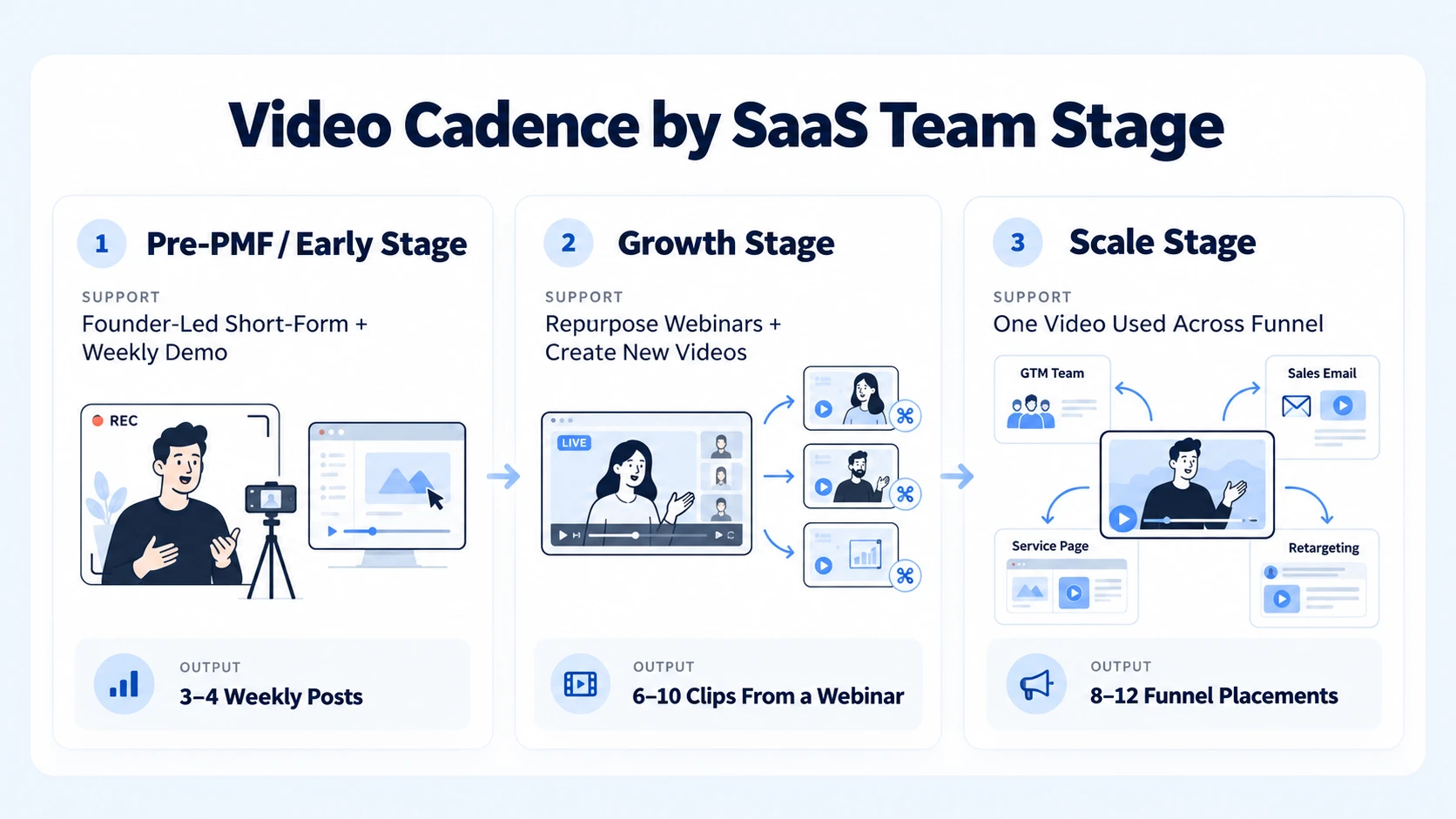
Pre-PMF or early-stage (0–12 months of content): You likely have no repurposable library yet. Focus on founder-led short-form, a weekly long-form demo or explainer on YouTube, cut into 2–3 LinkedIn clips. That gives you 3–4 total posts per week without requiring a production team.
Growth-stage (active demos, webinars, podcasts running or building from scratch): Teams at this stage benefit from combining from-scratch production (scripting, recording guidance, and full post-production) with content repurposing. Repurposing webinars, podcasts, and demos extracts pipeline value from assets you already have, while from-scratch videos let you target specific positioning gaps or launches. A single 60-minute webinar can yield 6–10 short clips, complementing net-new scripted videos.
Scale-stage (full GTM team, content ops in place): At this point, one good video can appear in 8 to 12 places across your funnel, in sales emails, on service pages, in-app, on social, and in ad retargeting sequences. Your video frequency question becomes an operational one, not a creative one.
Regardless of stage, the goal is to build a content calendar anchored to pipeline events: upcoming product launches, quarterly campaigns, and sales enablement cycles. Tie video topics directly to the questions your sales team hears on every demo call, that is the fastest path from content velocity to pipeline contribution.
What Is the Ideal Video Posting Schedule for SaaS Marketing?
The ideal SaaS video content schedule is not one that maximizes output, it is one that aligns publishing frequency with the buyer journey and your team's actual bandwidth. Here is a working weekly template:
- Monday: LinkedIn short-form clip (founder insight or product tip, 60–90 seconds)
- Tuesday: YouTube Shorts (repurposed from previous webinar or demo)
- Wednesday: LinkedIn short-form clip (customer outcome, stat, or POV)
- Thursday: YouTube long-form (demo walkthrough, explainer, or thought leadership, 8–15 minutes)
- Friday: LinkedIn short-form clip or YouTube Shorts (repurposed from Thursday's long-form)
That is 5 posts across two platforms, sustainable for a team of one video editor and one content strategist.
Businesses that post 3–5 times per week often see stronger engagement and faster growth compared to irregular posting. The right social media posting frequency depends on the platform and your audience, but maintaining a steady schedule matters more than hitting a magic number.
For LinkedIn specifically, LinkedIn reported 154 billion video views in 2024 and viewership up 36%, with video impressions rising 73.39% and views up 52.17%, making video a format worth prioritizing. That data signals that LinkedIn's algorithm is actively rewarding video, a consistent 2–3x per week schedule compounds over time in ways that sporadic bursts cannot.
Tools like Hootsuite, Vidyard, and Wistia help SaaS teams manage their content calendar, track engagement rate benchmarks, and connect video performance to pipeline data. Build the schedule in a shared content calendar before you build the content, scheduling constraints reveal capacity gaps before they become missed weeks.
Does Posting More Videos Help SaaS Brand Growth, Or Is There a Ceiling?
More volume helps, but only up to the point where quality holds. This is the most misunderstood dimension of video publishing frequency. VidIQ's analysis of over 5 million YouTube channels found that creators uploading 12 or more times per month gain 66% more subscribers and 53% more views than those posting only 1–3 times monthly. This data quantifies the algorithm's preference for consistency, channels that publish frequently receive more algorithmic distribution, which compounds into faster growth over time. But the ceiling matters. Content quality should always take precedence over the sheer number of posts.
A SaaS brand that posts 10 low-effort clips per week, talking head with no editing, no hook, no clear takeaway, will see engagement rate collapse within 4–6 weeks as the algorithm learns that audiences skip the content. The practical ceiling for most B2B SaaS, AI, and tech startup teams without a dedicated video partner is 5–7 videos per week total across all platforms, because beyond that point, production quality starts degrading unless you have full-service support covering both from-scratch creation (scripting to editing) and a content repurposing workflow. The question to ask before you increase frequency: "Does this additional video teach the buyer something, or does it just fill the slot?" Vanity metrics will mislead you. Total views look great in a board deck and tell you almost nothing about pipeline health.
Demand generation and pipeline contribution are the real metrics, not post count. The other risk of overposting is audience fatigue on LinkedIn, where the hook-insight-CTA formula is becoming very saturated, and since people often come to LinkedIn expecting more professional or distinct content, seeing the same patterns they see elsewhere may reduce engagement.
How to Build a SaaS Video Content Calendar That Actually Works
A SaaS video content calendar is not a spreadsheet of post dates, it is a system that connects content velocity to revenue goals. Here is how to build one that runs without burning out your team.
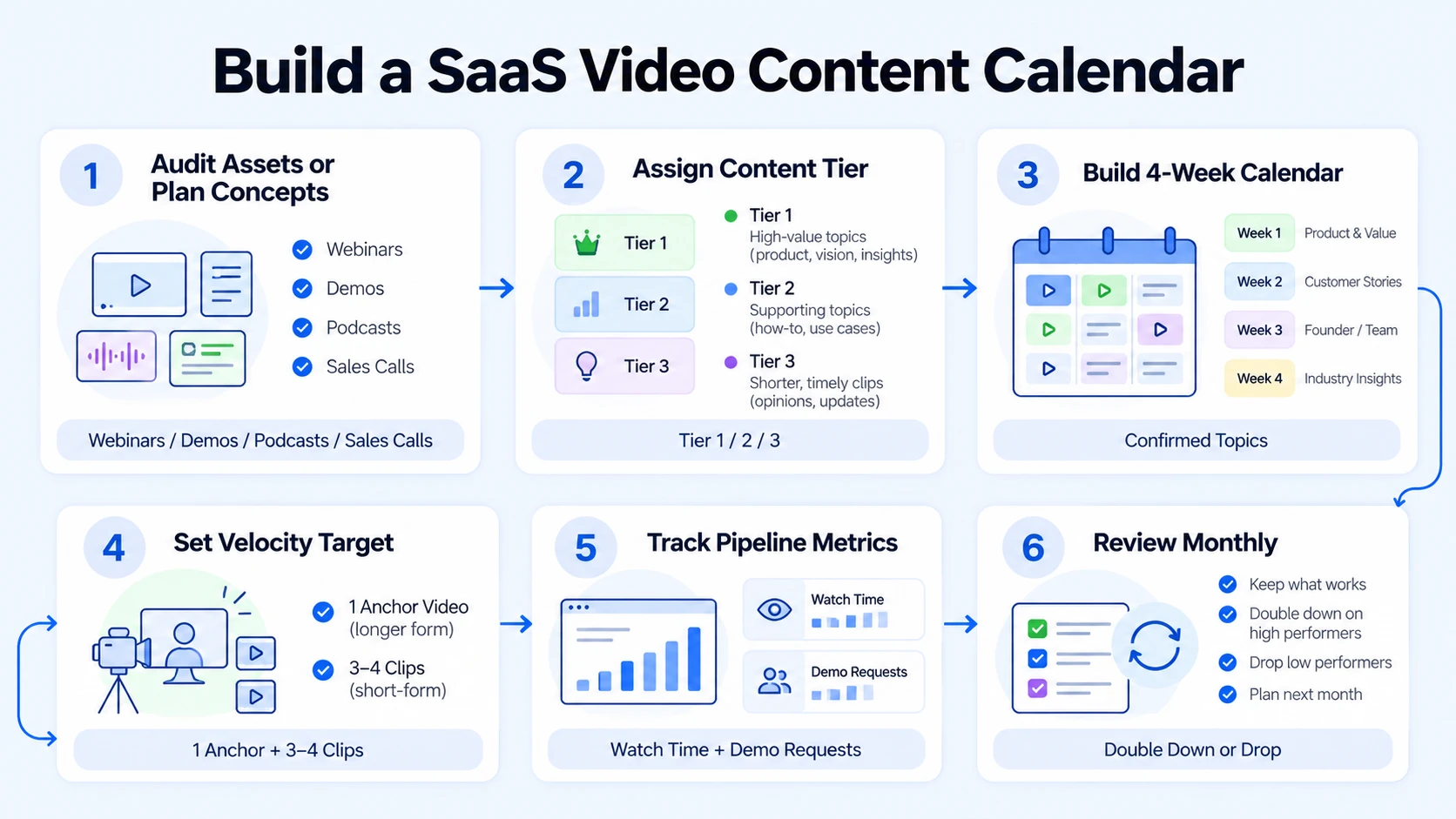
- Audit existing assets or plan new video concepts. List every webinar, demo recording, podcast episode, and sales call, or identify core buyer topics to build from scratch. Combining net-new scripted videos with repurposed content allows B2B SaaS, AI, and tech startup marketing teams to stay consistent across every platform without overextending their internal bandwidth.
- Assign a content tier to each asset. Tier 1: long-form YouTube anchors (demos, webinars, thought leadership). Tier 2: LinkedIn short-form clips repurposed from Tier 1. Tier 3: YouTube Shorts from Tier 2.
- Build a 4-week rolling calendar. Plan 4 weeks ahead with confirmed topics, not vague intentions. Tie at least 40% of video topics to active pipeline conversations and sales enablement needs.
- Set a content velocity target. Most B2B SaaS, AI, and tech startup teams can sustain 1 new Tier 1 piece per week and 3–4 derivative short-form pieces from it. That hits the 4–5 posts per week target with a single production session.
- Track pipeline-linked metrics weekly. Watch time, demo requests from video CTAs, and inbound mentions tied to video topics are more useful than raw view counts. Tools like Vidyard and Wistia connect video engagement to CRM data directly.
- Review and adjust monthly. Drop formats that show declining engagement, double down on topics that generate demo requests or inbound DMs.
Track engagement metrics like watch time, conversions, and retention, pairing them with funnel analytics to see which videos drive the most leads and customer sign-ups.
SaaS Content Marketing Video Cadence, Why Buyers Expect Consistency, Not Campaigns
The most damaging mistake SaaS teams make is treating video like a campaign, burst output before a launch, then silence for six weeks. Buyers do not buy on your launch schedule. Buyers typically don't engage with sellers until they're about 70% of the way through their buying journey, and B2B buyers now encounter 15 to 20 touchpoints before converting. A consistent video cadence is what builds those touchpoints passively, without a sales rep involved.
Today's B2B buyers research independently long before a sales conversation, and 67% of B2B buyers now prefer a rep-free buying experience, per Gartner's March 2026 sales survey. That means your video library is doing sales work around the clock, but only if it is large enough and fresh enough to show up when buyers are searching.
This is the real argument for consistent video publishing frequency: not algorithm games, but buyer accessibility. A founder who posts 3 LinkedIn videos per week builds a searchable archive of trust signals. A SaaS brand that publishes 1 YouTube explainer per week owns the "how does this work" question for every prospect who searches it before booking a demo.
According to Forrester's 2026 predictions for B2B marketing leaders, buyer trust will be the defining variable in B2B competition over the next 18 months. Video is the fastest trust-building format available, which means its ROI advantage isn't just about views, it's about compressing sales cycles.
If you're a founder or marketing lead at a B2B SaaS, AI, or tech startup building this from scratch, Komet Media's video marketing services handle both end-to-end from-scratch video creation (scripting, recording guidance, post-production) and repurposing existing webinars, podcasts, and demos into a consistent pipeline without requiring a full in-house team. The short-form video editing service supports teams with existing content as well as those needing turn-key production.
The bottom line: Consistency at 3–5 videos per week beats sporadic volume at 10+ every time. Buyers remember brands that show up every week. They forget brands that launch and go quiet.
Conclusion
Here is what the data and practice confirm about how many videos should a SaaS brand post weekly:
- 3–5 videos per week across two platforms is the sustainable target for most B2B SaaS, AI, and tech startup teams, regardless of stage.
- Combine from-scratch production and repurposing: scripted videos address targeted buyer queries while repurposing webinars, demos, or podcasts multiplies output efficiently.
- LinkedIn at 2–3x per week and YouTube at 1–2x per week (long-form) plus 2–3 Shorts covers the B2B buyer journey most efficiently.
- Consistency beats campaigns, a buyer who sees your brand weekly is far more likely to book a demo than one who encounters a launch burst once per quarter.
Build the system, set a cadence you can hold, and measure it against pipeline, not views.
Frequently Asked Questions
Q1: How many videos should a SaaS brand post weekly if we're just starting out?
Start with 3 per week: one LinkedIn short-form founder clip, one LinkedIn product tip, and one YouTube video (demo or explainer). That is a sustainable floor that builds an audience without requiring a full content team. Scale once the cadence is stable and quality is consistent.
Q2: Does posting more videos on LinkedIn actually increase pipeline for SaaS brands?
Yes, when the content is buyer-relevant. LinkedIn video posts average a 5.60% engagement rate according to Socialinsider's 2025 benchmarks, and executive-led thought leadership consistently outperforms company page posts. The key is pairing frequency with topics your buyers actively search: product use cases, competitor comparisons, and implementation outcomes.
Q3: How often should a SaaS startup post on YouTube to grow the channel?
Post at minimum once per week in long-form and 2–3 times per week via Shorts. VidIQ's analysis of 5 million channels confirms that uploading 12 or more times per month generates 66% more subscribers than posting 1–3 times monthly. For B2B SaaS, YouTube functions primarily as a demand-generation and trust-building channel, not a direct lead channel.
Q4: What happens if a SaaS brand posts too many videos without a clear strategy?
Audience fatigue sets in and engagement rate drops. LinkedIn's algorithm de-prioritizes accounts that generate low engagement per post. More critically, your buyers start to tune out if every video feels like filler. The ceiling for most SaaS teams without a content repurposing workflow is 5–7 posts per week, beyond that, quality typically degrades.
Q5: How does content repurposing help SaaS teams hit a weekly video cadence?
A single 60-minute webinar or podcast episode can produce 6–10 short clips, a long-form YouTube video, and multiple LinkedIn posts. When combined with from-scratch production—where video concepts are researched, scripted, and edited end-to-end—B2B SaaS, AI, and tech startup teams can maintain a high-volume, high-quality publishing cadence regardless of whether they have a pre-existing content library.
Q6: Should a SaaS founder post videos personally, or only through the company page?
Both, but personal posts outperform company pages significantly on LinkedIn. Employee-shared posts outperform brand posts by 5–10x in engagement. Founder-led video content builds the kind of product trust and thought leadership that drives inbound demo requests. Start with the founder's personal profile and use the company page to amplify, not originate.