🪄 AI Summary
Heading 1
Heading 2
Heading 3
Heading 4
Heading 5
Heading 6
Lorem ipsum dolor sit amet, consectetur adipiscing elit, sed do eiusmod tempor incididunt ut labore et dolore magna aliqua. Ut enim ad minim veniam, quis nostrud exercitation ullamco laboris nisi ut aliquip ex ea commodo consequat. Duis aute irure dolor in reprehenderit in voluptate velit esse cillum dolore eu fugiat nulla pariatur.
Block quote
Ordered list
- Item 1
- Item 2
- Item 3
Unordered list
- Item A
- Item B
- Item C
Bold text
Emphasis
Superscript
Subscript
If you're a founder or CEO who posts on LinkedIn and wonders why your reach isn't converting into pipeline, the answer is almost always the same: you're playing by 2023 rules on a 2026 platform. Understanding LinkedIn Algorithm and Reach isn't optional anymore. It's the difference between building trust with buyers and investors at scale versus talking to your existing connections in a loop. This guide breaks down exactly how the algorithm works today, what changed, and what founders at serious B2B companies should do about it.
TL;DR
- Views are down 50%, engagement down 25%, and follower growth down 59% according to the Algorithm InSights 2025 report.
- The algorithm now rewards dwell time, topic authority, and comment quality, not likes or engagement bait.
- Personal profiles massively outperform company pages; founder-led content is the primary lever for organic reach.
- Post Tuesdays–Thursdays between 8–11 AM for maximum early-window amplification.
How Does the LinkedIn Algorithm Work in 2026?
LinkedIn's ranking system shifted from rewarding viral reach to what they call "Depth and Authority." Understanding that shift is the first step to working with the algorithm rather than against it. Here's the distribution sequence every post goes through:
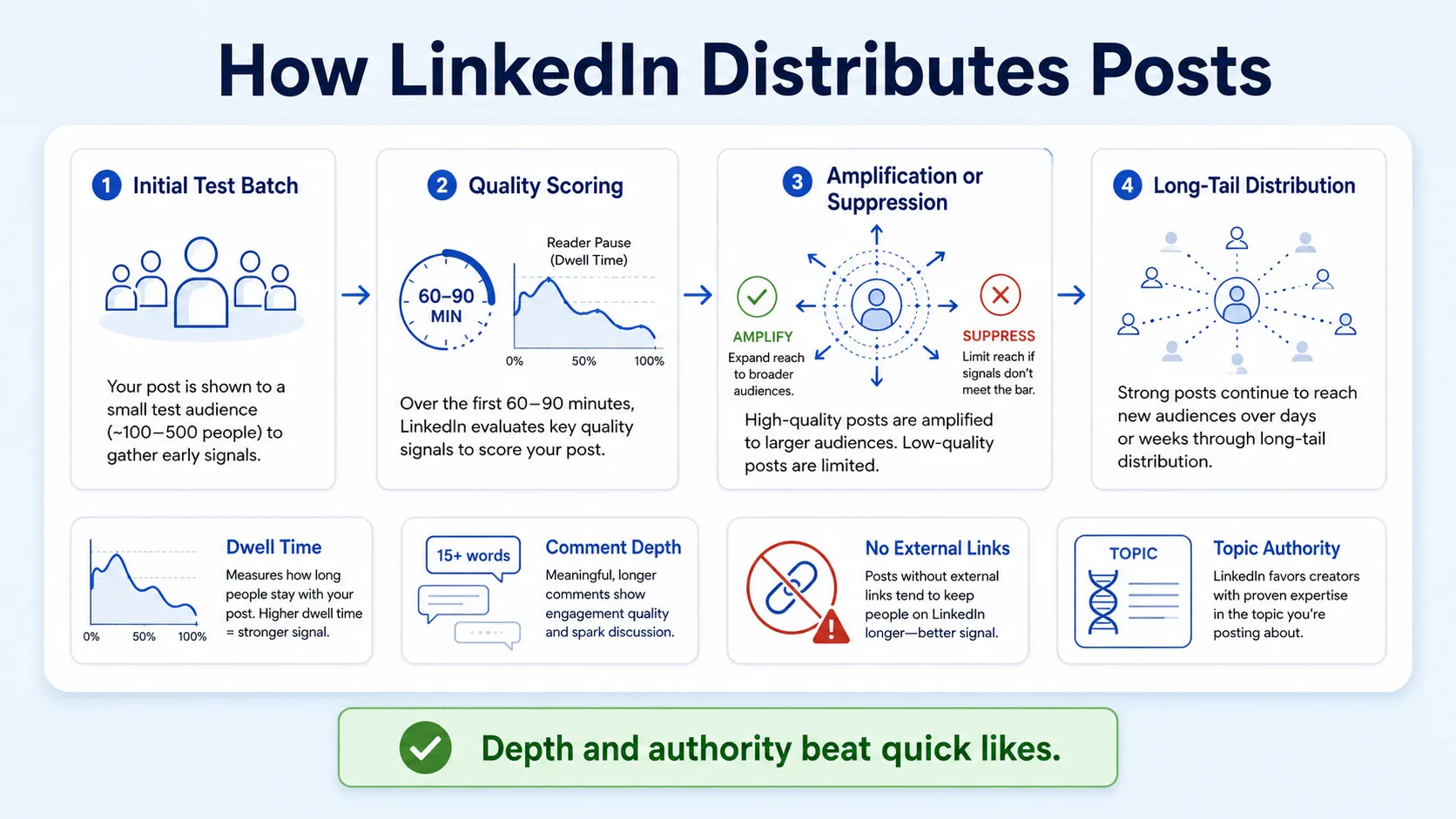
- Initial test batch: When you publish, LinkedIn shows it to roughly 5–10% of your connections and followers, then watches what happens in the first 60 to 90 minutes.
- Quality scoring: The algorithm evaluates three core signals: initial engagement quality within the first 60 minutes, sustained dwell time measuring how long users actually read, and creator authority.
- Amplification or suppression: If the initial group engages, LinkedIn expands reach to a larger audience. This cycle repeats. Posts that get strong early engagement can reach 5 to 10 times more people than posts that start slow.
- Long-tail distribution: In mid-2025, LinkedIn confirmed it now shows posts 2–3 weeks old if they're more relevant to a user's professional interests, meaning high-value evergreen posts continue reaching people well after they are published.
The signals that matter most right now:
- Dwell time: The algorithm measures how long people actually engage with your content. A post someone reads for 30 seconds outperforms one with 50 quick likes.
- Comment depth: Comments of 15+ words are twice as effective as shorter ones, and posts with 3+ comment exchanges between different participants receive 5.2× amplification.
- External links: Posts with links to external websites see approximately 60% less reach than identical posts without links, and the "link in first comment" workaround is also penalized as of early 2026.
- Topic authority: The algorithm identifies your "topic DNA" and distributes content based on demonstrated expertise rather than network size.
In August 2025, LinkedIn's engineering team revealed they implemented large language models to surface useful content. The algorithm got smarter at understanding context and matches posts to users' interests with increasing accuracy.
Why Is My LinkedIn Reach So Low as a Founder?
If your reach has collapsed, you're not alone and you're not doing everything wrong. The platform was fundamentally restructured. Average LinkedIn reach is down 34% in 2026. But the causes behind low founder reach are specific and fixable:
Posting as a company page instead of a personal profile: According to the Algorithm InSights 2025 Report, which analyzed 1.8 million posts, organic posts by company pages now reach only 1.6% of followers and account for just 1–2% of LinkedIn feeds, down from 7% in 2021. Personal profiles get on average 70% more organic reach than company pages.
Using engagement bait: LinkedIn's algorithm is getting better at detecting engagement bait like "Comment YES if you agree!" and prioritizes meaningful conversations instead. Posts that bait clicks instead of saying something real are getting less reach, not more.
Posting without topic consistency: Post about one topic consistently and LinkedIn recognizes your expertise. Post about everything and the algorithm cannot categorize you. Pick your niche and own it completely.
Relying on text-only posts: Text-only posts, once the backbone of executive presence on LinkedIn, are seeing significant decline. Text-only content dropped by 41% in usage year-over-year and engagement for text-only posts is down nearly 18%.
Generic AI-style content: LinkedIn's algorithm can now detect obvious AI-generated content patterns including generic language, lack of specific details, and template-like structure. Posts flagged as "low-effort AI" get reduced reach.
The deeper issue is that many founders treat LinkedIn like a broadcast channel. The algorithm treats it like a professional conversation. Those two approaches produce very different results.
What Type of LinkedIn Content Gets the Most Reach?
Format is a major variable in LinkedIn Algorithm and Reach. Here's what the data shows for 2026:
Document posts (PDF carousels) are hitting 6.60% engagement rates, the highest of any LinkedIn format.
The reason: carousels force dwell time. Each slide someone swipes is a signal the algorithm reads as sustained interest. Short-form vertical video under 60 seconds with captions performs strongly because it mirrors native behavior on mobile. The key is uploading video directly to LinkedIn rather than linking to YouTube. In late 2025, LinkedIn added Saves and Sends to post analytics. This is LinkedIn telling us what it values.
Content worth saving and sharing privately signals genuine professional value. Design carousels and frameworks with that in mind. Posts with original POVs, industry insights, or actionable advice are now more likely to reach larger audiences. For a founder, that means: your client pricing conversation last week, the hiring mistake you corrected, the counterintuitive lesson from your last product launch. Specific, lived-in, first-person content beats polished brand content every time.
At Komet Media, we build exactly this kind of content system for B2B founders, turning real conversations and existing long-form content into a steady stream of video and carousel assets that build trust with the right buyers.
Why Do Some LinkedIn Posts Go Viral and Others Don't?
Virality on LinkedIn in 2026 is less about luck and more about engineering the right conditions in the critical first window. LinkedIn organic reach is driven less by who you know and more by how long people stop, read, and respond in a post's first 90 minutes. The algorithm tests every post on a small slice of your network, then expands or kills it on early quality signals, dwell time and substantive comments, not likes.
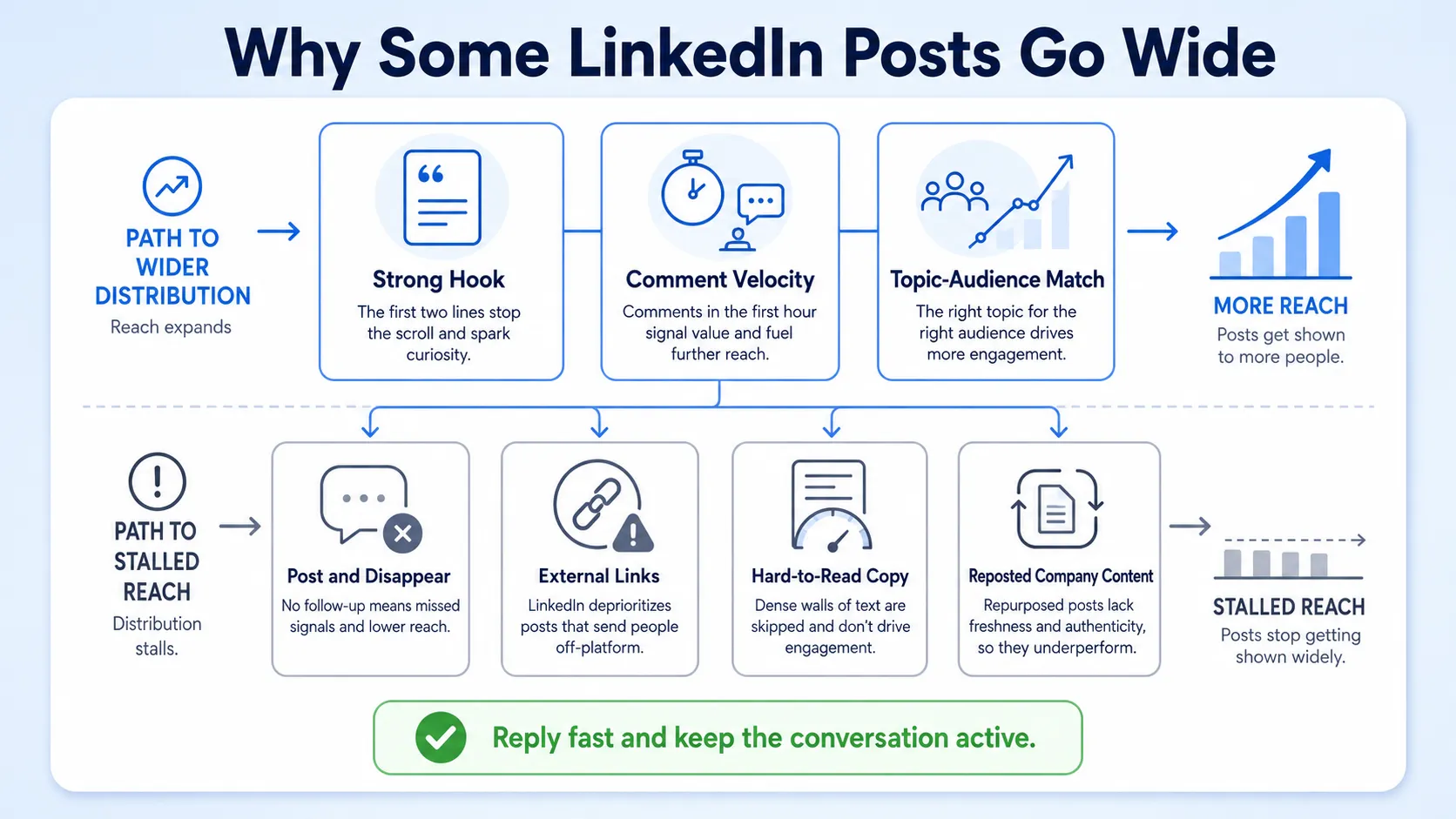
Posts that go wide share three characteristics:
- Strong hook: The first two sentences determine whether anyone reads the rest of your post. With reach down across the board, you can't afford weak openings. Start with a specific result or surprising insight.
- Comment velocity: Posts with fewer but deeper comment threads reached 3.2 times more people and drove eight times more profile visits. Reply to every substantive comment in the first hour to keep the thread active and signal conversation depth to the algorithm.
- Topic-audience match: A user's activity on LinkedIn, including interests, hashtags they follow, and posts they interact with, has a major impact on the types of posts they'll see. This member activity helps LinkedIn's algorithm ensure they're pushing your post to people who are likely to have something meaningful to comment on it.
What kills posts before they take off:
- Posting and disappearing (no comment responses in the first hour)
- External links in the post body
- Readability above a 10th-grade reading level, which produces 35% less reach
- Reposting a company page article instead of writing natively
Our short-form video editing service is built specifically to create the kind of native, high-dwell content that performs in this environment, not repurposed ads, but real founder content designed for LinkedIn distribution.
LinkedIn Algorithm Changes Founders Need to Know in 2026
The platform has made several structural changes that permanently alter the rules of organic reach. These aren't minor tweaks. In March 2026, LinkedIn's Authenticity Update escalated the crackdown, officially killing engagement bait, automation pods, external link spam, and reducing polls to a negligible 0.07% engagement rate. The platform now uses AI classification to determine whether posts contain genuine knowledge, whether authors are qualified to speak on the topic, and whether engagement is "meaningful" rather than superficial.
Key changes that directly affect founder strategy:
- Automated engagement is dead: LinkedIn now explicitly acknowledges automated engagement patterns and reduces the visibility of comments made through automation tools. Engagement pods built on automation are a liability, not an asset.
- Post longevity is real: Content now circulates for days, even weeks. The old "24-hour lifespan" rule is dead. Posts that spark ongoing conversation stay visible much longer.
- Executive interactions carry extra weight: Executives' interactions with company content receive 3.5× more algorithmic weight. A CEO commenting on a team member's post amplifies it significantly more than a like from a standard connection.
- Topic consistency is now essential: In 2026, the platform rewards its most active creators and subject-matter experts. If you consistently post about a particular topic, LinkedIn is more likely to recognize your authority and boost your content.
This shift is actually beneficial for founders and people building B2B personal brands. You don't need to talk to 10,000 or 100,000 people. You need to talk to the right 100 people. Qualified reach over vanity reach is the new standard.
How to Increase LinkedIn Post Reach Organically as a CEO
Improving LinkedIn Algorithm and Reach doesn't require more posts. It requires better-engineered ones, distributed with more strategic intent. Here's the operating system:
Profile foundation first:
- Enable LinkedIn Creator Mode. When enabled, Creator Mode replaces the "Connect" button with "Follow," which accelerates audience growth.
- Connections are limited to 30,000 on LinkedIn, but followers have no cap.
- Rewrite your headline to communicate content focus, not just job title.
- Pick three to four content pillars that match your actual expertise and ICP.
Post construction:
- Open with a specific result, tension, or counterintuitive claim.
- Write below a 10th-grade reading level. Short sentences. No jargon.
- Use carousels for frameworks, native video for POV, text for stories.
- Never put external links in the post body.
Post-publish behavior (the most neglected lever):
- Be available to respond to comments within 60–90 minutes of posting.
- Leave five substantive comments per day on posts from people in your target audience. At this cadence, the compounding profile visibility from commenting alone meaningfully accelerates reach beyond what posting alone would achieve.
Team amplification:
- Employees' combined networks are about 12 times larger than a company's own following. A coordinated comment and reshare from two or three team members in the first hour can make the difference between a post dying and a post distributing.
- Rotate formats to avoid the 20% reach suppression that comes from posting the same format consecutively.
Explore our video marketing services to see how we help founders build this content engine without adding hours to their week.
Best Posting Times on LinkedIn for Maximum Reach in 2026
Timing is not the most important variable in LinkedIn Algorithm and Reach, but it is the easiest one to get right. According to SocialPilot's analysis of 683,000+ posts, the best time to post on LinkedIn is between 10 AM to 12 PM and 1 PM to 4 PM on Tuesday, Wednesday, and Thursday for optimal reach and engagement in 2026.
For founders targeting C-suite decision-makers specifically, the timing data diverges from general advice: C-suite executives and VPs have different LinkedIn habits than individual contributors. C-suite leaders (CEO, CTO, CFO) are most active at 7–8 AM and 6–7 PM. They check LinkedIn before and after the workday, not during it.
Posting frequency by role:
Posting more than once per day is generally not worth it. LinkedIn's algorithm tends to suppress your second post if the first one is still gaining traction. Space content at least 18 to 24 hours apart. According to SocialPilot's analysis of over 683,000 posts, roughly 80% of all LinkedIn engagement occurs during traditional business hours (9 AM to 5 PM), with the 10 AM to 12 PM slot acting as the peak catalyst for daily activity.
One additional note: LinkedIn's April 2026 algorithm update placed even more emphasis on comment velocity in the first 60 minutes, making timing more important than ever for maximizing that initial engagement window. If you post when your audience is asleep, no timing trick recovers that lost window.
Our podcast editing and video editing services are designed to produce batches of LinkedIn-ready assets in advance, so you're always posting into the right window, never scrambling.
How to Grow Your LinkedIn Audience as a Startup CEO
Audience growth and reach growth are different problems. Reach is about each post. Audience growth is about your cumulative trust signal over time. The brands seeing the most organic success in 2026 are the ones empowering founders, leaders, and employees to be visible while the company page supports from the background.
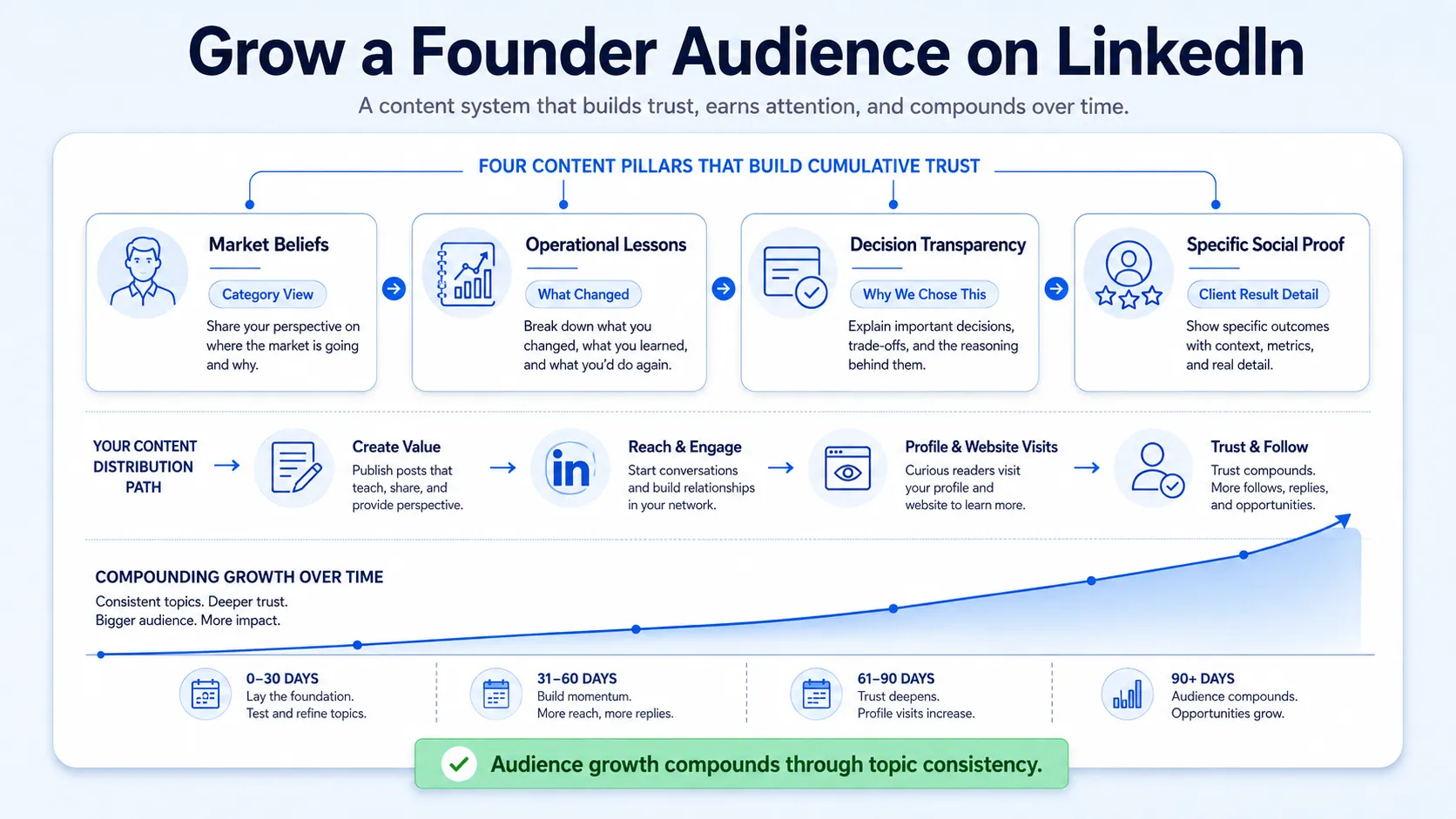
The CEO content framework that compounds:
- Market beliefs: Share your actual view on where your category is going. Not generic industry commentary.
- Operational lessons: What you got wrong last quarter and what you changed. Specific beats are polished.
- Decision transparency: The hiring call, the pricing pivot, the partnership you declined. Buyers trust founders who show their reasoning.
- Social proof through specificity: Results your clients got, with enough detail that readers see themselves in the outcome.
LinkedIn's 2026 guidance says nearly six in ten buyers discover new brands through creator content, about two-thirds use creator perspectives to evaluate options, and nearly half visit a vendor website after engaging with it. That is not a vanity metric. That is a pipeline signal.
Most B2B founders who post three times per week at reasonable quality see meaningful reach growth within 60–90 days. The compounding effect of topic consistency, comment engagement, and content format rotation builds an audience that the algorithm actively routes relevant content to.
Research by the Content Marketing Institute (2025) shows that thematically linked content published in logical progression receives 62% more cumulative engagement than the same content published randomly. That is the case for a content system over a content calendar.
If you want to see how we build that system for founders and executives, visit Komet Media's services or connect with us directly via the contact page.
Conclusion
Understanding LinkedIn Algorithm and Reach in 2026 comes down to four things:
- Post from your personal profile. The company page gap is too large to ignore.
- Earn dwell time and substantive comments. Likes are noise; depth is signal.
- Stay in your lane. Topic consistency builds the authority the algorithm rewards.
- Treat the first 90 minutes as the make-or-break window. Post at the right time, then respond immediately.
The founders winning on LinkedIn right now are not posting more. They're posting with more precision, more specificity, and a more genuine point of view. That is the entire game.
Frequently Asked Questions
Q1: Does LinkedIn still show posts to people outside my network?
Yes. LinkedIn won't push your post out to random users, but their activity, including interests, hashtags they follow, and posts they interact with, has a major impact on the types of posts they'll see. Strong early engagement from your network triggers distribution to relevant second and third-degree connections.
Q2: Is LinkedIn Creator Mode worth turning on for a B2B founder?
Based on data from 2025–2026, the algorithmic benefit of Creator Mode is real but modest. It won't transform a struggling account into a viral success, but it provides incremental advantages that compound with consistent content quality. The follower model and newsletter access make it worth enabling.
Q3: How many times per week should a CEO post on LinkedIn?
1–2 posts per week is the minimum to maintain visibility for executives and occasional posters. 3–5 posts per week is the optimal range for most professionals, providing consistent presence without audience fatigue. Quality always takes priority over volume.
Q4: Do hashtags still matter for LinkedIn reach in 2026?
Hashtags carry less weight than they did in prior years as the algorithm relies more on semantic content analysis than tag classification. Research hashtag follower counts before selecting. Topics with 10,000–500,000 followers typically offer the best balance of reach and relevance. Use two to three targeted hashtags per post, not ten.
Q5: Why does a post with fewer likes sometimes outperform one with more?
The algorithm measures how long people actually engage with content. A post someone reads for 30 seconds outperforms one with 50 quick likes. The system now detects "click bounces," where people click but leave immediately, and deprioritizes that content. Depth beats breadth.
Q6: Can I repurpose a podcast or webinar into LinkedIn content that performs?
Absolutely. Native video clips under 90 seconds, carousel summaries of key frameworks, and text posts built from specific quotes or decisions from the episode all perform well. LinkedIn's algorithm has increased distribution weighting for native formats, text-only posts, carousels uploaded as documents, and short-form native video. Repurposing existing conversations into LinkedIn-native assets is one of the highest-ROI content moves a founder can make. Our podcast production and content repurposing work is built exactly for this.