
🪄 AI Summary
Heading 1
Heading 2
Heading 3
Heading 4
Heading 5
Heading 6
Lorem ipsum dolor sit amet, consectetur adipiscing elit, sed do eiusmod tempor incididunt ut labore et dolore magna aliqua. Ut enim ad minim veniam, quis nostrud exercitation ullamco laboris nisi ut aliquip ex ea commodo consequat. Duis aute irure dolor in reprehenderit in voluptate velit esse cillum dolore eu fugiat nulla pariatur.
Block quote
Ordered list
- Item 1
- Item 2
- Item 3
Unordered list
- Item A
- Item B
- Item C
Bold text
Emphasis
Superscript
Subscript
Most B2B teams treating Instagram Reels as a branding afterthought are leaving a real pipeline on the table. The Instagram Reels algorithm and reach explained correctly looks nothing like what most marketers assume: it's not about follower count, posting frequency, or hashtag stacks. It's a multi-signal AI engine that decides, in real time, whether your content earns distribution to thousands of non-followers or quietly disappears. This guide breaks down exactly how it works in 2026 and what to do about it.
TL;DR
- Watch time and DM shares are the two most-weighted ranking signals, not likes.
- The algorithm runs a cold-start test on every new Reel before expanding distribution.
- Original, niche-consistent content gets rewarded; watermarked reposts get penalized.
- Posting time matters for the first 30–60 minutes, which sets your distribution ceiling.
How Does the Instagram Reels Algorithm Work in 2026?
Instagram does not run on one algorithm. It uses various algorithms and thousands of signals to deliver different content across Feed, Stories, Explore, and Reels. Each surface has its own ranking logic, so optimizing for one does not guarantee reach on another. Instagram uses separate AI systems for Reels versus Feed versus Stories. For Reels, the top ranking signals are: DM shares (most heavily weighted), watch completion, saves, comments, story shares, and likes (weakest).
The biggest change in 2026: DM shares are now the most heavily weighted signal, surpassing saves, comments, and likes. For B2B teams, this means content that makes a buyer think "I need to send this to my head of product" is more algorithmically valuable than content that simply gets a double-tap. The four factors that feed the Reels ranking system:
- User behavior: Which Reels a viewer has liked, shared, saved, and commented on previously.
- History with the posting account: Whether the viewer and creator have interacted before, giving the algorithm a stronger match signal.
- Reel details: Visuals, audio, and how popular the content already is.
- Posting account details: While popularity and followers factor in, the algorithm tries to give everyone a shot.
Keyword-rich captions now outperform hashtag-heavy strategies as Instagram shifts toward SEO and interest-based recommendations. For founders and SaaS marketers, writing captions that mirror the exact language buyers use to describe your product category is now a direct reach lever.
Instagram rewards original, niche-consistent content while demoting reposts, watermarked videos, and near-duplicate content. Repurposing a TikTok with the TikTok watermark intact will hurt your reach before a single person watches it. Original content receives 40–60% more distribution than reposts, and accounts posting 10 or more reposts within 30 days get excluded from recommendations entirely.
What Factors Affect Instagram Reels Distribution? The Cold-Start Model
Every Reel you post enters a testing phase before Instagram commits to wider distribution. Instagram's 2026 Reels algorithm prioritizes shares, watch time, and originality. DM sends now matter more than likes for non-follower reach. Reels go through a cold-start testing phase, where early watch time and engagement determine whether Instagram expands distribution.
The three-phase distribution sequence works like this:
- Phase 1 (first hour): Instagram shows your Reel to a small portion of your followers and some non-followers who might be interested based on their past behavior.
- Phase 2 (strong engagement triggers expansion): Instagram pushes it to more people, including the broader Reels feed and Explore page.
- Phase 3 and beyond: Your Reel can reach millions who don't follow you. Good Reels continue getting views for days, weeks, or even months after posting.
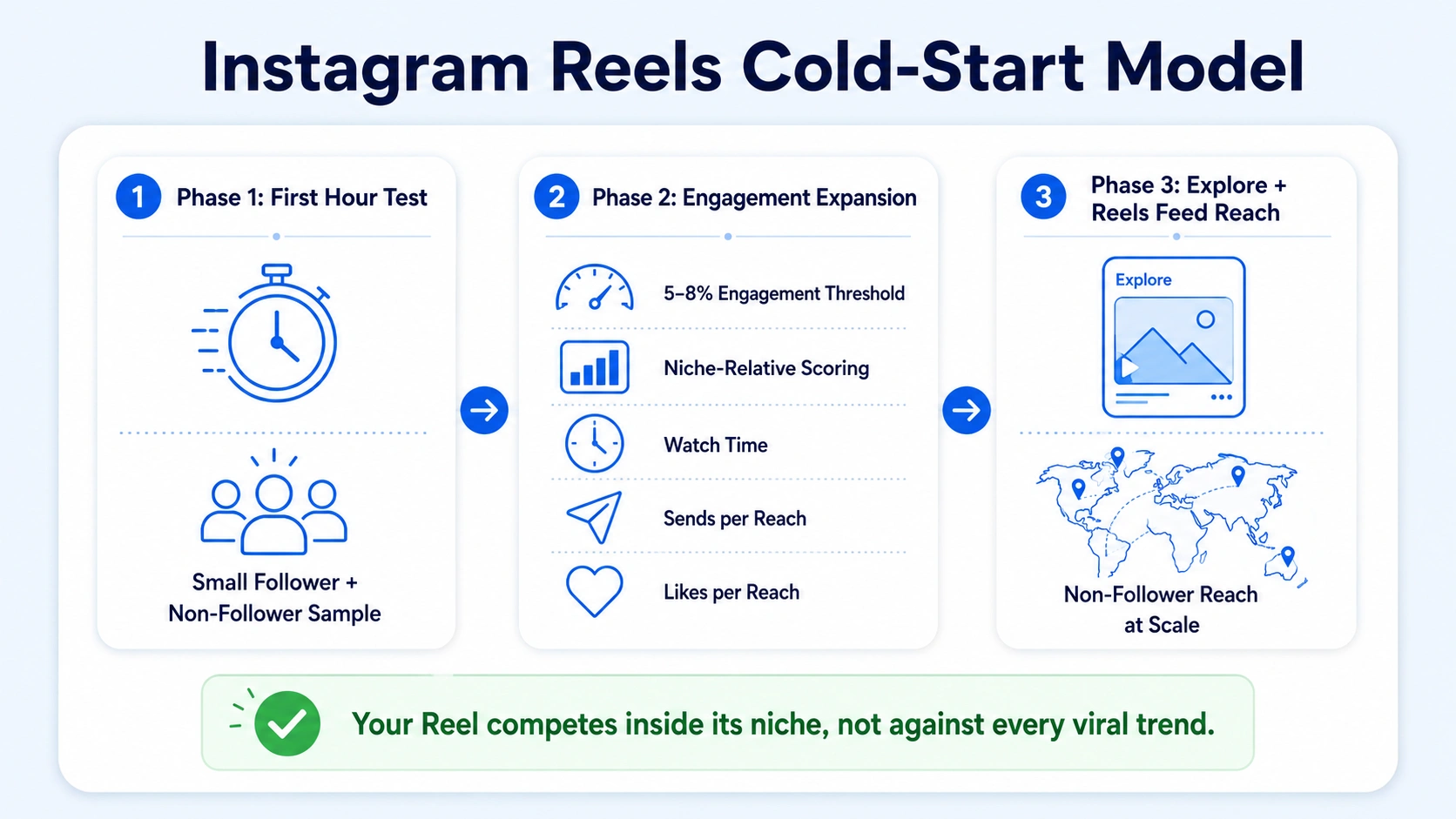
The algorithm tests Reels with a small group first, then expands distribution if engagement exceeds roughly 5–8%. That threshold is niche-relative. Instagram compares your Reel's performance against similar content in your niche, not a flat number. A cooking Reel competes against cooking Reels. A finance explainer competes against finance explainers.
For B2B SaaS teams, this means a product explainer Reel is being scored against other product explainer Reels, not against a viral dance video. Your bar for clearing the cold-start test is achievable if the content is genuinely useful to the right slice of viewers. The three most important signals confirmed by Instagram head Adam Mosseri are watch time, sends per reach (DM shares), and likes per reach. Watch time is the #1 ranking factor for Reels distribution, confirmed publicly by Adam Mosseri in January 2025.
Why Are My Reels Not Getting Views? Common Distribution Killers
Low reach on Reels almost always traces back to one of five causes. Before you blame the algorithm, check these first:
- Weak hook: Reels with 60%+ three-second hold rates outperform weak holds by 5–10x in total reach. If viewers bail in the first three seconds, the cold-start test fails immediately.
- Watermarked or recycled content: Instagram's Originality Score detects recycled clips, TikTok reposts with watermarks, and duplicate content. A low originality score means significantly reduced reach.
- Wrong length for your audience: A 15–30 second Reel achieves an average 5.8% engagement rate; Reels longer than 90 seconds drop to 3.2%. Start short, then extend only when your Insights confirm viewers are staying.
- Poor posting timing: Posting time matters because recency is a ranking factor. A post that gets strong engagement within the first 60 minutes has a much higher chance of being pushed to non-followers through Explore and suggested content.
- Inconsistent niche signaling: If your last five Reels covered completely unrelated topics, the algorithm has no strong audience model to test your content against.
Most creators are still optimizing for outdated ranking signals. What drove reach in 2024 or even 2025 may no longer move the needle today.
At Komet Media, we specialize in helping B2B SaaS, AI, and tech startups & teams scale through video. The fix we apply first is almost always the hook. A product demo that opens with a conclusion ("Here's how we cut onboarding time in half") consistently outperforms one that spends five seconds on a logo reveal.
Why Did My Reel Go Viral and Then Stop Getting Views?
This is the most common question B2B founders ask after an early win stalls. The answer is structural, not random. Reels do not distribute linearly. They distribute in waves. Once each distribution wave completes, Instagram evaluates whether engagement in that wave justifies expanding to the next. If a Reel burned fast with a non-niche audience, the engagement rate on subsequent waves may not clear the threshold, and Instagram stops expanding.
Four specific reasons a Reel plateaus after an early spike:
- Audience mismatch on wave one: If your Reel was picked up by a broad audience that watched but did not save or share, the quality signal weakens on the next wave.
- No DM shares sustaining the signal: DM shares are the most heavily weighted signal for distribution. A Reel that gets likes but no DM sends runs out of fuel.
- Completion rate drops on longer tail: As a Reel ages, it reaches less-targeted viewers. If completion drops below the niche threshold, distribution narrows.
- Account inconsistency: Instagram evaluates your overall engagement patterns. Accounts with consistently high engagement rates across recent posts are more likely to be surfaced. A single viral Reel surrounded by weak posts does not build compounding reach.
The B2B implication: a systematic video content strategy that Komet Media builds for B2B SaaS, AI, and tech startups & teams—combining original content creation from scratch with repurposing across webinars, podcasts, and demos—produces the consistent posting cadence that sustains algorithmic momentum, rather than chasing one-off viral moments.
Does Posting Time Affect the Instagram Reels Algorithm?
Yes, but not in the way most people think. Posting time does not change how the algorithm ranks your content. It changes how quickly that content accumulates the early engagement the algorithm uses to decide whether to expand distribution. Instagram's algorithm in 2026 prioritizes recency as a strong ranking signal. Posting during your specific audience's active hours, visible in Instagram Insights, is more important than following generic benchmarks. Early engagement within the first 30 minutes to 2 hours can dramatically impact long-term distribution.
General peak windows based on aggregated data:
- Weekday mornings (6–9 AM local): Commute and pre-work scroll window.
- Lunch (11 AM–1 PM): Consistent mid-week engagement spike.
- Evening (7–9 PM): Highest overall engagement window for consumer and B2B audiences.
- Saturday mid-morning (10–11 AM) and evening (7–9 PM): Strong weekend windows.
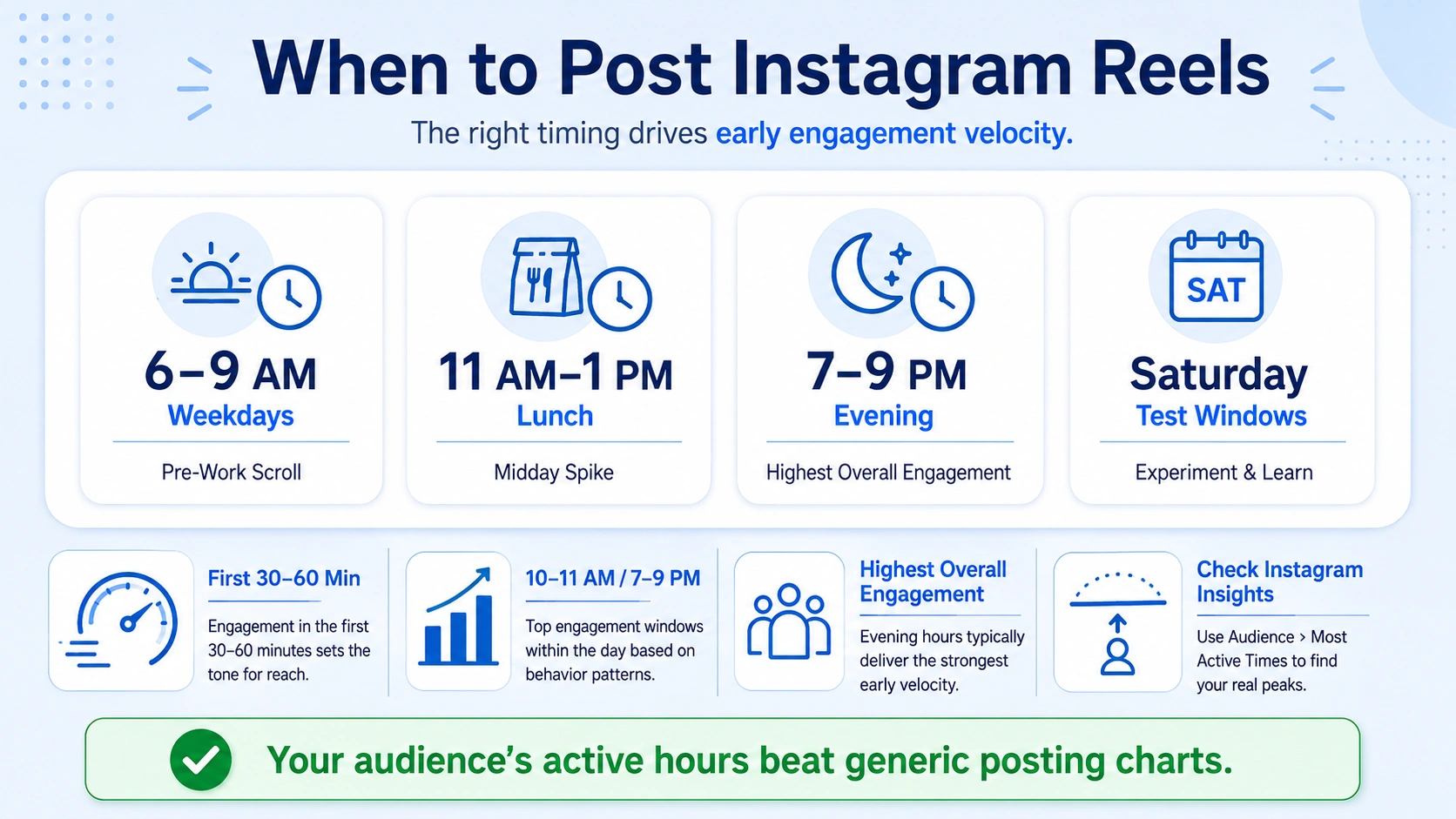
Instagram's algorithm gives your Reel a narrow window to prove itself. In the first 24 hours after posting, the platform watches how quickly people engage. Strong early traction signals quality, which triggers broader distribution.
For B2B teams targeting US-based buyers, the first 30–60 minutes of early engagement velocity tell Instagram whether to widen distribution to non-followers. A strong start compounds; a flat start caps the Reel. Check your audience's active hours in Instagram Insights before building any posting schedule. Your specific audience data always overrides industry averages.
How to Get Your Reels Shown to Non-Followers: Trial Reels and Explore Strategy
This is the core growth question for any B2B account trying to reach buyers it does not already follow. Two mechanisms drive non-follower reach: the Explore page and Instagram Trial Reels.
Explore page distribution follows a gated sequence. If your followers engage heavily with a post within the first hour, Instagram tests it with a small Explore audience. If that test audience also engages, distribution expands. You cannot shortcut this sequence.
Trial Reels offer a different path entirely. When you post a Trial Reel, Instagram distributes it only to non-followers. You appear in front of people who don't know you yet and get to introduce yourself and invite relevant followers into your content or brand. When you post a Trial Reel, Instagram distributes it to a non-follower audience first. Your existing followers do not see it at all during the 72-hour testing window unless you choose to release it to them.
The 72-hour window is a fixed evaluation period. The clock starts the moment you publish and it does not pause if you change settings. The practical value for B2B teams: use Trial Reels to test new hooks, formats, or topic angles with cold audiences before committing them to your main feed.
Trial Reels let you test hooks, topics, and formats without risking your engagement rate. A Reel that bombs lowers your average engagement metrics, which can reduce distribution on future posts. Trial Reels remove that risk. For teams running Instagram growth at scale, this is a systematic A/B testing mechanism built directly into the platform.
Best Practices for Instagram Reels to Maximize Reach in 2026
Instagram Reels algorithm and reach explained through concrete tactics:
- Hook in three seconds: Open with the conclusion, a counterintuitive claim, or a specific outcome. Viewers who do not stop scrolling in three seconds dramatically increase your completion rate.
- Optimize for DM shareability: Create content a viewer would send to a specific colleague. A product stat, a contrarian take on a common SaaS mistake, or a founder insight works far better for DM shares than polished brand content.
- Keep originals under 90 seconds where possible: Reels between 60 and 90 seconds deliver the highest overall engagement rates. Socialinsider's 2025 benchmarks show that medium-length Reels outperform both ultra-short clips and videos over 2 minutes.
- Use keyword-rich captions: Keywords in captions and profiles are now more effective for discovery than hashtags, which no longer support follows.
- Post consistently at niche-relevant frequency: Mid-size accounts (10K–100K followers) should aim for 4–5 Reels per week, with a mix of educational, entertaining, and promotional content.
- Use trending audio early: Use trending audio within 24–72 hours of its rise to ride the algorithm's audio-interest signals before they saturate.
- Shoot natively in 9:16 vertical format: Never upload horizontal or square video reformatted to vertical. Native format signals platform-first content and scores higher on Instagram's originality detection.
- Repurpose strategically, not lazily: Turning a webinar clip or podcast excerpt into a Reel is excellent. Reuploading a TikTok with a competitor's watermark is a reach penalty. The content repurposing approach matters as much as the content itself.
Instagram Reels drive 2x higher visibility than other post types , but only when the underlying content clears the algorithm's cold-start threshold.
For B2B SaaS, AI, and tech startups & teams working with Komet Media to create Reels from scratch or by repurposing content from podcast episodes and webinar recordings, the execution layer—tight editing, a strong hook, and the right caption structure—is what determines whether the algorithm distributes it or buries it.
Conclusion
The Instagram Reels algorithm and reach explained simply: it is an AI system built to surface content that earns DM shares, high watch completion, and niche-consistent engagement. For B2B teams, that means:
- Watch time and DM shares decide distribution, not likes or follower count.
- The cold-start test runs within the first hour; posting time matters because it determines how fast that test accumulates signal.
- Originality is non-negotiable; reposts and watermarked content are penalized before organic reach has a chance.
- Trial Reels give you a risk-free mechanism to test hooks and formats with cold audiences before committing to your main feed.
Treat every Reel as a content asset with a measurable reach outcome, not a social media checkbox.
Frequently Asked Questions
Q1: What is the single most important Instagram Reels ranking signal in 2026?
DM shares are the single most heavily weighted signal in 2026, surpassing saves, comments, and likes. Create content that makes viewers want to send it to a specific person. For B2B teams, that means sharp product insights, counterintuitive takes, and specific data points.
Q2: How long should my Reels be for maximum reach?
Reels between 60 and 90 seconds deliver the highest overall engagement rates. For newer accounts in growth mode, starting at 15–30 seconds maximizes completion rate and clears the cold-start test threshold faster. Extend length only when your Insights confirm viewers are staying to the end.
Q3: Do hashtags still matter for Instagram Reels reach in 2026?
Hashtags have significantly less impact than they once did. Keywords in captions and profiles are now more effective for discovery than hashtags, which no longer support follows. Focus your caption writing on mirroring the language your target audience uses to describe the problem your product solves.
Q4: How does Instagram decide who sees your Reels if you have a small account?
While popularity and followers factor in, the Instagram algorithm tries to give everyone a shot. Reels generate more impressions for accounts with fewer than 50K followers. For newer and mid-sized accounts, Reels offer the fastest path to exposure. Content quality and engagement rate per view matter more than raw account size.
Q5: Can I repurpose TikTok videos as Instagram Reels?
You can repurpose the underlying content, but not the TikTok export. Instagram rewards original, niche-consistent content while demoting reposts, watermarked videos, and near-duplicate content. Re-edit the source footage natively for Instagram rather than uploading a watermarked TikTok file.
Q6: How often should a B2B brand post Reels to maintain algorithmic momentum?
Mid-size accounts (10K–100K followers) should target 4–5 Reels per week, with a mix of educational, entertaining, and promotional content. Consistency across weeks matters more than high-volume bursts. Three strong Reels per week will outperform seven rushed ones by a significant margin.