
🪄 AI Summary
Heading 1
Heading 2
Heading 3
Heading 4
Heading 5
Heading 6
Lorem ipsum dolor sit amet, consectetur adipiscing elit, sed do eiusmod tempor incididunt ut labore et dolore magna aliqua. Ut enim ad minim veniam, quis nostrud exercitation ullamco laboris nisi ut aliquip ex ea commodo consequat. Duis aute irure dolor in reprehenderit in voluptate velit esse cillum dolore eu fugiat nulla pariatur.
Block quote
Ordered list
- Item 1
- Item 2
- Item 3
Unordered list
- Item A
- Item B
- Item C
Bold text
Emphasis
Superscript
Subscript
An Instagram growth playbook for founders and CEOs is mostly a time-management plan. You already have opinions, customer conversations and a view of the market. What you lack is hours. The playbook below shows how to turn one recording session a week into a steady stream of Reels, carousels and Stories, without becoming a full-time creator and without paying for followers that never buy.
Quick Answer: Instagram Growth for Founders and CEOs
The Instagram growth playbook for founders and CEOs in short: record once a week, cut eight to twelve pieces, post three to four times weekly, reply yourself, and judge by conversations, not followers.
Why Founders Should Consider Instagram at All
Founder-led content works because people buy from people, and a founder is the most credible voice a young company has. Instagram adds something LinkedIn does not: it reaches people who are not connected to you. Reels are the format the platform uses to show content to non-followers, and Meta's CEO said in September 2025 that Instagram had passed 3 billion monthly active users.
That scale does not mean every founder should be there. It makes sense if your buyers, candidates or investors use the platform, if your product or point of view can be explained in short visual clips, and if you can commit to a steady rhythm for at least a quarter. It makes less sense if you cannot spare one recording session a week, or if you are unwilling to talk about your work in public.
The limit is worth stating plainly: Instagram will not fix a weak product or an unclear message. It amplifies a point of view you already hold.
Decide What the Instagram Account Is For
Pick one primary goal for the first quarter and let it shape every post.
Trying to serve all four at once produces a scattered account, and a focused Instagram growth playbook for founders and CEOs avoids that. Choose one, add a second later.
Set Up Your Founder Instagram Profile in One Afternoon
- Handle and name: use your name or a close variant so people can find you.
- Bio: your role, the problem you solve and who you help, in plain words.
- Link: one page that matches the account goal.
- Highlights: your story, your product, customer proof and one for your best Reels.
- Pinned posts: your clearest three: an intro, a point of view and a proof.
Use a real photo with a clear face. Founders who hide behind a logo lose the main advantage of the format.
Instagram Formats and the Jobs They Do
The case for mixing formats is in the benchmarks. Socialinsider's 2026 report, using 2025 data, found average engagement rates of 0.55% for carousels, 0.52% for Reels and 0.37% for images. The rate counts likes and comments over followers, so it misses saves and shares, and the report shows engagement fell about 24% year over year. Use it to rank formats, not to set a goal.
In a Buffer study of more than 27 million posts from 273,000 accounts, accounts with 5,000 to 10,000 followers saw carousels earn about 12% more engagement than Reels, while Reels reached about 39% more people. For a founder, that suggests Reels for finding new people and carousels for rewarding the ones who stay.
From Zero to Your First 10,000 Instagram Followers
Treat the number as a rough milestone, not a promise. Growth depends on niche, consistency and the quality of ideas. Socialinsider's data shows brand accounts with 1,000 to 5,000 followers grew their audiences about 22% on average in 2025, against roughly 11% for accounts with 100,000 to 1 million, so growth is faster from a small base and slows as you scale.
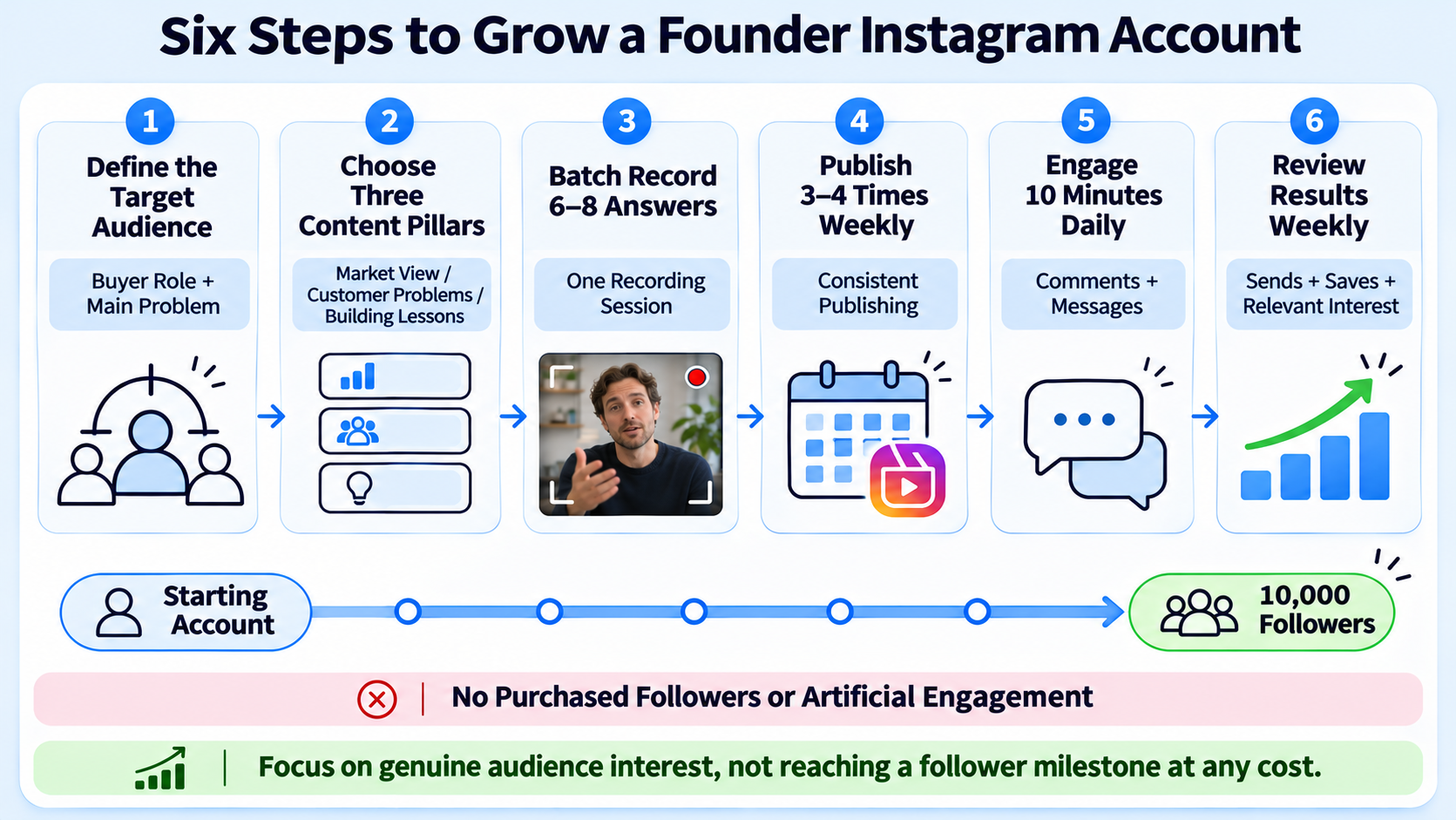
The steps, in order:
- Define the audience. Write down who you want to reach, their job and their problem.
- Choose three pillars. For example: your market view, your customers' problems, and how you build.
- Record in batches. One session, six to eight short answers, in the same clothes and setting if you want the clips to look consistent.
- Publish on a schedule. Three to four posts a week is a realistic target. Buffer's analysis of about 2.1 million feed posts found about 12% higher reach per post for accounts posting three to five times a week than those posting once or twice, with the caveats that it is correlational and quality probably matters more.
- Engage for ten minutes a day. Reply to comments, answer messages and comment thoughtfully on accounts your buyers follow.
- Review weekly. Keep what drew sends and saves, drop what did not.
Do not buy followers. Instagram said in 2018 that accounts using third-party apps to inflate their popularity may see their experience affected. A purchased audience will not become customers, investors or candidates.
Turn One Recording Into Eight to Twelve Instagram Pieces
This is the part that makes the plan workable on a real schedule. Record a thirty to sixty minute conversation, either with a host, a colleague or an interviewer. Then:
- Mark the strongest moments: a clear opinion, a story, a surprising answer.
- Cut four to six short clips, each answering one question.
- Turn one section into a carousel, with one idea per slide.
- Pull two or three quotes for Story frames or quote cards.
- Adapt the best clip for LinkedIn and YouTube Shorts.
The exact count depends on the recording, but eight to twelve assets from an hour is a reasonable expectation for a conversation with distinct topics. Fewer if the conversation is a single narrative. If you want help with this step, video editing for founders and CEOs covers how an editor handles it.
Repurposing across platforms is normal. Wistia's 2026 State of Video report found that among teams repurposing video into social clips, 67% post to LinkedIn, 49% to Instagram and 41% to YouTube, and 76% adjust aspect ratio per platform. It is survey data from Wistia's audience, so treat it as a description of practice.
What the Instagram Algorithm Rewards
Instagram's head Adam Mosseri said in January 2025 that watch time, likes and sends are the top three ranking signals, with likes weighted slightly more for existing followers and sends slightly more for non-followers. In May 2026 he again pointed to engagement rates and the value of sends for reaching people outside your audience.
For a founder, the practical lessons are:
- Start with the point. A long introduction loses viewers before the idea lands.
- Make it sendable. Ask: would someone forward this to a colleague? A checklist, a hard-won lesson or a clear take is more sendable than an announcement.
- Keep topics tight. Likes and sends from the right people matter more than from anyone.
Instagram Content Ideas for Founders Who Dislike Social Media
Many founders say they have nothing to say. They do. Use these prompts:
- The most common question a customer asked this month, and your answer.
- A decision you made that others in your category get wrong.
- A lesson from a failed experiment.
- What you look for when you hire for a key role.
- A myth in your industry and the evidence against it.
- What your product does not do, and who should not buy it.
- A short walk through your weekly metrics routine, without sharing private numbers.
Keep confidential information out. Customer names, unreleased roadmap items and non-public financial figures need written approval first. If you have investors or a board, check any comments about fundraising or performance with counsel before posting.
A Weekly Instagram Rhythm That Fits a Founder's Calendar
The plan below assumes about two hours of founder time a week, with an editor or marketer handling the rest.
What can shrink: the daily engagement, to three days a week, if the calendar is tight. What must not be skipped: the recording session and the Monday review. Without the first there is nothing to publish, and without the second the program never improves.
What to Say on Camera for Instagram
Founders often ask how to sound natural. Three habits help more than any script.
Answer one question per clip. Write the question first, then answer it as if explaining to a smart colleague outside your field. If the answer needs three minutes, it is two clips.
State the conclusion first. Say what you think, then why. This helps retention and makes the clip easier for an editor to cut.
Use specifics. A named problem, a real constraint or a concrete decision is more credible than a general principle. If a claim relies on data, name the source in the caption.
Do not memorize. Rehearsed delivery tends to read as stiff. Bullet-point notes and a few practice takes are enough, and an editor will remove false starts.
Equipment and Setup for Founder Instagram Video
You do not need a studio. A recent phone, a window or a soft light source, a quiet room and a lavalier or shotgun microphone cover most needs. Audio matters more than video: viewers tolerate an average image but leave when sound is poor. Keep the framing consistent so clips look like they belong together, and record in vertical for Reels while keeping a horizontal copy for other uses if you also publish to YouTube or LinkedIn.
Working With an Editor Without Losing Your Voice
Handing production to an editor does not mean handing over the opinions. A workable split:
- You decide: the topics, the stance, what is off limits.
- The editor decides: clip boundaries, captions, pacing, covers and formats.
- You approve: each batch before it goes out, using a short checklist for accuracy and tone.
Give the editor a one-page brief covering your audience, pillars, three accounts whose style you like and three you do not, and a list of words and claims to avoid. For a template, see our guide to writing a video editing brief. A brief saves rounds of revision and keeps the account consistent as the volume grows.
Instagram and LinkedIn: Use Both
LinkedIn is the home of professional networking and sales conversations. Instagram is better at reaching people who do not yet know you. A founder who records once and adapts for both platforms gets more from the same hour.
The Edelman and LinkedIn 2025 B2B Thought Leadership Impact Report says hidden buyers, who influence a deal without signing it, consume thought leadership as actively as target buyers. That finding is about B2B vendors, but the logic carries over: the people who shape a decision about your company are watching your content too, including colleagues, advisors and partners.
If LinkedIn is your priority, our page on LinkedIn video editing for founders is the better starting point, and the same recordings can feed both.
Prompts and Scripts for Founder Reels
A founder rarely needs a full script. A good prompt gets a natural answer. Try these.
- "What is the most common mistake you see in your industry?" Answer in three sentences.
- "What would you tell a founder starting in your space today?" Give one rule and one reason.
- "What changed your mind in the past year?" This produces honest, specific content.
- "What is a question customers ask that you wish they would not need to?" It reveals product and market gaps.
- "What do you look for when you hire for your first sales or product role?"
- "What did you try that did not work, and what did it teach you?"
For each answer, ask the founder to open with the conclusion, add one example and stop. Thirty to sixty seconds is usually enough. If the answer runs long, an editor can turn it into a carousel or two shorter clips.
A Sample 30-Day Plan for a Founder
This plan assumes about two hours of founder time a week. It is an illustration, not a benchmark.
After four weeks, review which topics drew sends, saves and messages. Set month two around those topics and cut the weakest. The plan is deliberately modest so a busy founder can keep it going.
Handling Criticism and Negative Comments
Public content invites disagreement. Prepare in advance.
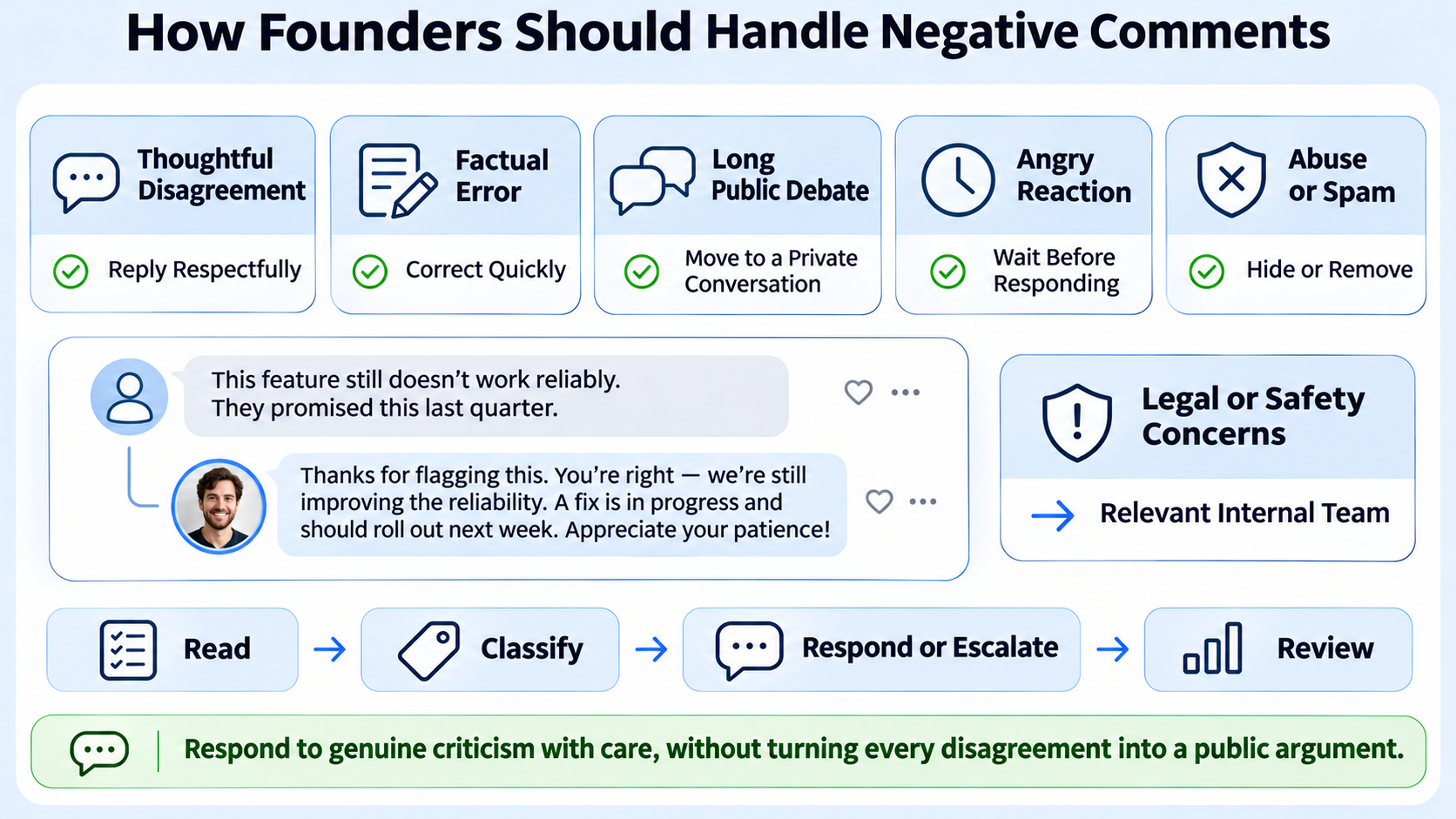
- Separate critique from abuse. A thoughtful disagreement deserves a short, respectful reply. Abuse and spam can be hidden or removed using the platform's tools.
- Correct errors quickly. If someone points out a mistake, thank them, fix the post if you can and note the correction.
- Do not debate at length in public. Offer to continue in a direct message or call if the person is a customer or a prospect.
- Avoid replying in anger. Wait an hour and draft a response.
- Escalate legal or safety concerns to your counsel or the right team.
Pick one person, if not you, to monitor comments in the first hour, and give them guidance on tone.
Privacy and Personal Safety for Founders
Founder accounts attract attention. Review these points before you publish.
- Location details. Avoid showing your home, daily routine or real-time location.
- Family and personal details. Decide in advance what you share and what you do not.
- Account security. Use two-factor authentication, a unique password and limited access for anyone who helps.
- Confidential information. Check backgrounds for whiteboards, screens and documents.
- Phone and email. Keep the public contact route separate from your personal one.
Agree these rules with anyone who edits or publishes for you.
The Repurposing Workflow in Detail
Here is the full path from recording to published pieces, as a founder would experience it.
- Prepare. Write the questions or prompts. Choose a quiet room and check audio.
- Record. One session, with a short break. Aim for several complete answers.
- Hand off. Upload the file to a shared folder with a short note on priorities.
- Mark moments. An editor or marketer lists the strongest segments with timestamps.
- Cut. The editor produces clips, captions and covers, and a carousel from the best framework.
- Review. You approve the batch in one pass using a checklist: accuracy, tone and confidentiality.
- Publish. The batch is scheduled across the week, with a note on Stories.
- Learn. After a week, look at sends, saves and messages, and feed lessons into the next recording.
If you need new material and have no archive, an editor or strategist can also plan topics and a recording outline, which turns the process into a from-scratch workflow.
How to Measure Instagram Growth for Founders
Use several signals together because attribution is imperfect.
- Awareness: views, retention, profile visits from non-followers.
- Engagement: sends, saves, replies and substantive comments.
- Commercial: messages from buyers, demo requests, intros, hiring applications and mentions in sales calls.
Keep a short log of every time someone says "I saw your post". Review it monthly. After twelve weeks you should be able to say which topic, format and hook produced real conversations.
Common Mistakes in an Instagram Growth Playbook for Founders and CEOs
- Waiting for polished content. A clear thought with clean audio beats a studio production.
- Delegating the voice entirely. An editor can cut, caption and publish, but the opinions must be yours.
- Ignoring messages. Replies are where relationships begin.
- Posting in bursts. Three weeks of daily posts followed by silence teaches the platform and your audience very little.
- Measuring by followers. Track conversations and outcomes tied to your goal.
- Mixing personal and business content without a plan. A few personal moments build trust, but the account still needs a clear purpose.
Conclusion: Instagram Growth for Founders and CEOs
The Instagram growth playbook for founders and CEOs comes down to a small number of repeatable habits: one clear goal, one weekly recording, a handful of formats, a daily ten-minute engagement routine and a weekly review. The founders who keep it going are not the most polished. They are the ones who make it easy to continue. Start with a ninety-day test of your own Instagram growth playbook for founders and CEOs, measure honestly and keep what works.
FAQs on Instagram Growth for Founders and CEOs
What is an Instagram growth playbook for founders and CEOs?
It is a plan that covers goals, formats, recording routine, publishing cadence, engagement and measurement, built for executives who have limited time and want content tied to business outcomes.
How much does it cost?
Cost depends on content volume, production difficulty, turnaround and whether publishing and distribution are included. Komet Media's typical working range for ongoing engagements is roughly $2,500 to $5,000, with final pricing based on scope.
How often should a founder post?
Three to four times a week is a realistic target for most founders. Consistency matters more than volume.
How long does it take to see results?
With an Instagram growth playbook for founders and CEOs, expect eight to twelve weeks of steady publishing before judging. No timeline or result is guaranteed.
What deliverables should we expect from a partner?
Edited Reels, carousels, captions, exports for each platform, a content calendar, publishing support and a regular performance review.
Should I hire a freelancer or an agency?
A freelancer can handle edits. An agency suits founders who want recording guidance, repurposing, distribution and review in one place. See freelance editor versus agency for B2B.
Should I run this in house or outsource it?
Keep the opinions and customer knowledge with you. Outsource the editing, formatting and scheduling so they do not eat your week.
How does Komet Media help founders and CEOs?
Komet Media creates founder content from scratch and repurposes existing recordings into Reels, carousels and LinkedIn assets, then handles distribution and reporting for founders, CEOs and technology executives.