
How to Choose a Podcast: Step-by-Step Guide
Learning how to choose a podcast is a business decision when you are a founder, a fund partner, or a marketing lead. You may be picking shows to learn from, shows to appear on as a guest, or shows to sponsor. Each job needs different evidence. Whether you are using existing assets or starting from scratch, this guide gives you a decision process, scorecards for each job, red flags, and the metrics that tell you whether the choice paid off.
Quick answer
Decide the job first: learning, guesting, or sponsoring. Then score each show on audience fit, content quality, consistency, format, and evidence of reach. Test two or three episodes before you commit your time or budget.
Why this decision needs a process
Anyone asking how to choose a podcast is picking from a very large field, because podcasts are no longer a niche channel. Edison Research's 2026 Infinite Dial, as reported by Tubefilter, found that 80% of Americans surveyed have either listened to or watched a podcast, and 57% have done both. The survey covers Americans aged 12 and older, so it is a general-population figure, not a B2B one.
Video has changed where people meet shows. YouTube says its podcast content reaches one billion monthly active users. A show you consider may live mainly on YouTube, mainly in audio apps, or across both.
There is also a buyer-influence angle. In LinkedIn's 2026 Global B2B Marketing Outlook, 56% of B2B buyers who use creators relied on creator input in the final buying stage to confirm recommendations. The report comes from a YouGov survey of 1,299 B2B marketers in the USA, UK, France, Germany, and India, fielded in January and February 2026. It is LinkedIn's own research, and it measures marketers, so treat the buyer figure as directional.
In my experience, most bad podcast choices come from skipping the first question: what is this decision for?
Step 1: Decide the job the podcast has to do
The same show can be a great learning source and a poor sponsorship choice. Write the job down before you open a podcast app.
How to choose a podcast in 7 steps
This is the process I would hand to a busy marketing lead. It takes about two hours per shortlist.
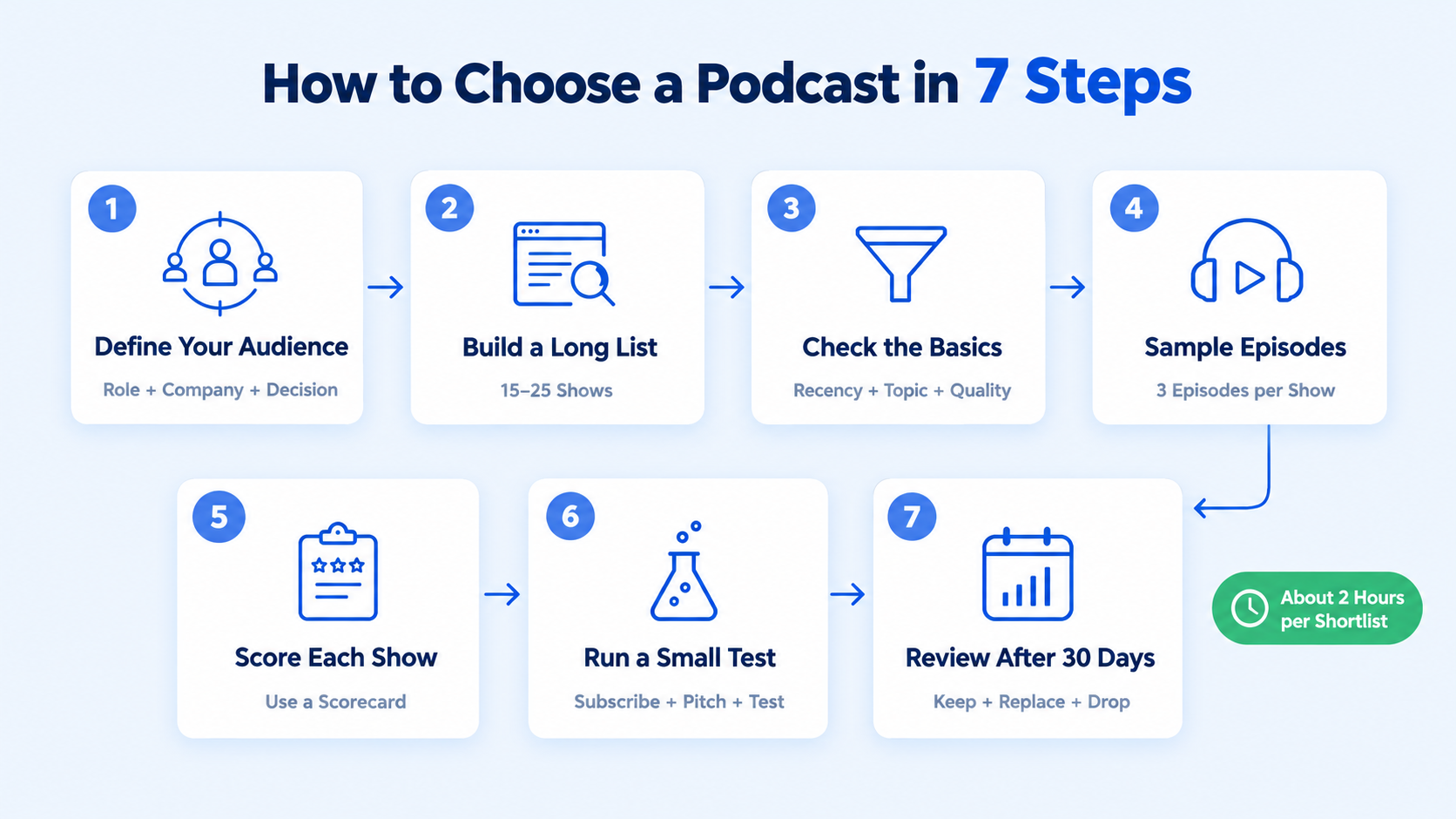
- Define the audience you need. Name the role, company type, and decision. "Seed-stage founders in fintech" is usable. "Business people" is not.
- Build a long list of 15 to 25 shows. Pull from search, recommendations from peers, guest lists of shows you already trust, and YouTube search.
- Cut to eight by checking the basics. Remove shows that have not been published recently, shows with unclear topics, and shows with poor audio or video quality.
- Sample three episodes per show. Pick one recent episode, one popular episode, and one that fits your topic. Listen or watch for at least ten minutes of each.
- Score each show. Use the scorecard in the next section.
- Run one low-risk test. Subscribe for a month, apply one idea, send a short guest pitch, or request audience data for a sponsorship.
- Review after 30 days. Keep, replace, or drop the show.
Scorecard for each job
Use a 1 to 5 scale. Weight the criteria that matter most for your job.
If a show scores under 3 on audience fit, drop it regardless of the total. A well-made show for the wrong audience still wastes your time.
Choosing a podcast to learn from
When the goal is learning, I care less about popularity and more about whether the host asks good follow-up questions. A strong show makes you think differently within the first ten minutes.
Look for these signals:
- Episodes that contain specific examples, not only general opinions
- Hosts who challenge guests instead of reading from a list
- A clear structure that respects your time
- Show notes or transcripts that let you revisit key ideas
- A visible point of view that does not disappear in sponsor reads
A short routine helps. Subscribe to no more than five shows at a time, and drop one before adding another. Otherwise the list becomes a backlog.
Choosing a podcast as a guest
For founders, executives, and fund partners, a guest appearance is a distribution decision. You are borrowing someone else's audience, so the audience matters more than the host's reputation.
Use this checklist before you pitch:
- Read the show description and recent guest list. Do the guests look like peers?
- Watch the full episode of a recent guest. Does the host let the guest make a point?
- Check whether the show publishes clips, since clips extend your reach after the episode.
- Prepare one specific idea you can explain in two minutes.
- Ask the host what the audience wants to learn, not only what the host wants to ask.
The Komet guides on finding podcast guests and being a podcast guest cover the pitching side in more detail. A related article asks whether podcast guests get paid, which helps you set expectations.
A pattern we often see: guests who bring a ready-to-use clip idea get more value from the same episode, because the host and the guest can distribute the moment together.
Choosing a podcast to sponsor or partner with
Sponsorship is where the process for how to choose a podcast needs the most discipline, because money is involved. Ask for evidence, and be willing to walk away.

Questions to ask the host or network:
- Who is the intended listener, and how do you know?
- How many episodes have you published in the past six months?
- Where do episodes appear: audio apps, YouTube, social clips, newsletter?
- What does a typical sponsor read or integration look like?
- Can I speak with a recent sponsor?
- What reporting will you share after the campaign?
Red flags for sponsorship:
- The host cannot describe the audience beyond a broad category
- Download or view claims come with no definition
- Publishing has been irregular for months
- Sponsor reads sound identical across unrelated brands
- The host refuses to share any performance reporting
Komet's podcast advertising service exists for teams that want help planning and measuring this kind of spend. Do not pay for placement until you can explain what result you expect and how you will measure it.
How to choose a podcast for each B2B audience
The right criteria change with the buyer. The table below shows what I would weigh most for each group.
Three practical rules follow from the table:
- A smaller show with the right audience can beat a larger show with a general audience.
- A show that repeats the same guest type may be a closed loop, so check for new voices.
- A show with consistent clips on LinkedIn, YouTube, or Instagram gives your appearance a second life.
A hypothetical walk-through
This example is hypothetical and does not describe a Komet Media client. A seed-stage AI company wants to reach heads of data at mid-market firms. The marketing lead knows how to choose a podcast for guest appearances only in a general sense, so the team builds a longer list and tests it.
- They list 20 shows from search, peer recommendations, and guest lists.
- They cut to eight by removing inactive and off-topic shows.
- They sample three episodes per show and score audience fit and host quality.
- They pitch the top three, each with a specific two-minute idea.
- They track profile visits, inbound messages, and clip performance for 60 days.
The lesson is not the specific outcome, which I will not invent. It is the shape of the process: a larger list, a clear cut, a test, and a review. Teams that skip the review tend to repeat weak choices.
Audio, video, or both
Format affects reach and how you can reuse the content.
If you plan to reuse the episode, video helps. Our overview of what a video podcast is explains the format and why it supports clip distribution.
Red flags that apply to every job
- No publishing for several weeks without explanation
- Unclear topic or constantly shifting format
- Guests who are all from one company or network
- Audio problems that make episodes hard to follow
- Excessive ad load that interrupts the content
- Exaggerated reach claims with no definition
- Hosts who do not prepare
How to measure whether the choice worked
Match the metric to the job. Attribution is imperfect, so use several signals and avoid reading one number as proof.
For a wider view of video and podcast measurement, see video KPIs B2B teams should track.
When it makes sense to start your own show
Some teams reach a point where choosing shows is not enough. They have expertise and a point of view, and the best shows in their category do not cover their angle. If that is you, start with the audience promise, then build the production and distribution system.
Komet Media supports this with podcast marketing, podcast production, and B2B podcast repurposing. Komet helps build your podcast content library from scratch—handling strategy, scripting, and production—or by repurposing existing footage. The principle is simple: deliberate editing creates the asset, and distribution gives it a chance to produce business value.
Conclusion
The best answer to how to choose a podcast depends on the job you give it. Learning, guesting, and sponsoring all use the same discipline: define the audience, sample real episodes, score the show, and run a small test before you commit. Do that, and the shows you keep will earn their place.
FAQ
1. How to choose a podcast if I am new to the format?
Start with one clear goal: learning, guesting, or sponsoring. Build a short list of shows for your audience, sample three episodes of each, and keep the two or three that give you something specific to use.
2. How many episodes should I sample before I decide?
Three is a practical minimum: one recent, one popular, and one on your topic. Listen or watch long enough to judge the host and the depth, usually at least ten minutes each.
3. What does it cost to sponsor a podcast?
Prices vary widely by audience, format, and reach, and I do not have a reliable public benchmark to quote. Ask each show for a rate card and for evidence of audience fit. At Komet Media, our typical retainers run from roughly $2,500 to $5,000 for production and distribution work, which is a separate cost from paid placement.
4. How long should I test a show before judging it?
Give a learning subscription for about 30 days. Give a sponsorship or guest appearance 60 to 90 days, because buyer decisions often take longer than one episode cycle.
5. What should I look for in a show's production quality?
Clear audio, stable video if there is video, a tidy structure, and a consistent publishing rhythm. Poor audio makes even good ideas hard to follow, and that limits what clips can do later.
6. Should a founder pick audio-only or video podcasts?
Both can work. Video helps when you want clips and YouTube reach, and audio-only works for focused listening. Choose by the audience you want to reach and how you plan to reuse the episode.
7. Should a company manage podcast guests internally or use an agency?
Internal teams usually know the topic and the buyer best. An agency helps most with show research, pitch preparation, editing, and turning the appearance into clips and posts.
8. Does Komet Media help with podcast strategy and distribution?
Yes. We work with B2B SaaS, AI-Native, venture, and private equity teams on full-service podcast production and distribution—whether you have existing recordings or are building a content library from scratch. If you want to talk through your plan, you can book a call.

