
🪄 AI Summary
Heading 1
Heading 2
Heading 3
Heading 4
Heading 5
Heading 6
Lorem ipsum dolor sit amet, consectetur adipiscing elit, sed do eiusmod tempor incididunt ut labore et dolore magna aliqua. Ut enim ad minim veniam, quis nostrud exercitation ullamco laboris nisi ut aliquip ex ea commodo consequat. Duis aute irure dolor in reprehenderit in voluptate velit esse cillum dolore eu fugiat nulla pariatur.
Block quote
Ordered list
- Item 1
- Item 2
- Item 3
Unordered list
- Item A
- Item B
- Item C
Bold text
Emphasis
Superscript
Subscript
If you've been producing webinars, founder interviews, or product demos and wondering why they're not building awareness, this is your answer. A video podcast is the format that closes the gap between long-form content and genuine audience growth. Understanding what is a video podcast, how it works, and why it matters for B2B teams is the first step to turning content you already have into a pipeline asset.
TL;DR
- A video podcast is a recorded show distributed as both video and audio across platforms like YouTube, Spotify, and Apple Podcasts.
- It lets B2B teams repurpose one long-form recording into clips, show notes, transcripts, and social assets.
- About 27% of U.S. consumers watched video podcasts weekly by Fall 2025, led by Gen Z and Millennials.
- Video adds discoverability through search, social sharing, and algorithm-driven recommendations that audio alone cannot capture.
What Is a Video Podcast? Definition and Examples
A video podcast is a regularly published show recorded on camera and distributed simultaneously as a video file and a traditional audio podcast. Viewers can watch it on YouTube or Spotify; listeners can pull it through an RSS feed into Apple Podcasts or any other podcast app. Same episode, two formats, one production workflow.
The core format is a talking head setup: one or two hosts on camera, sometimes joined by remote guests. Think of it as a structured conversation captured on video and packaged with show notes, episode chapters, and a transcript for discoverability.
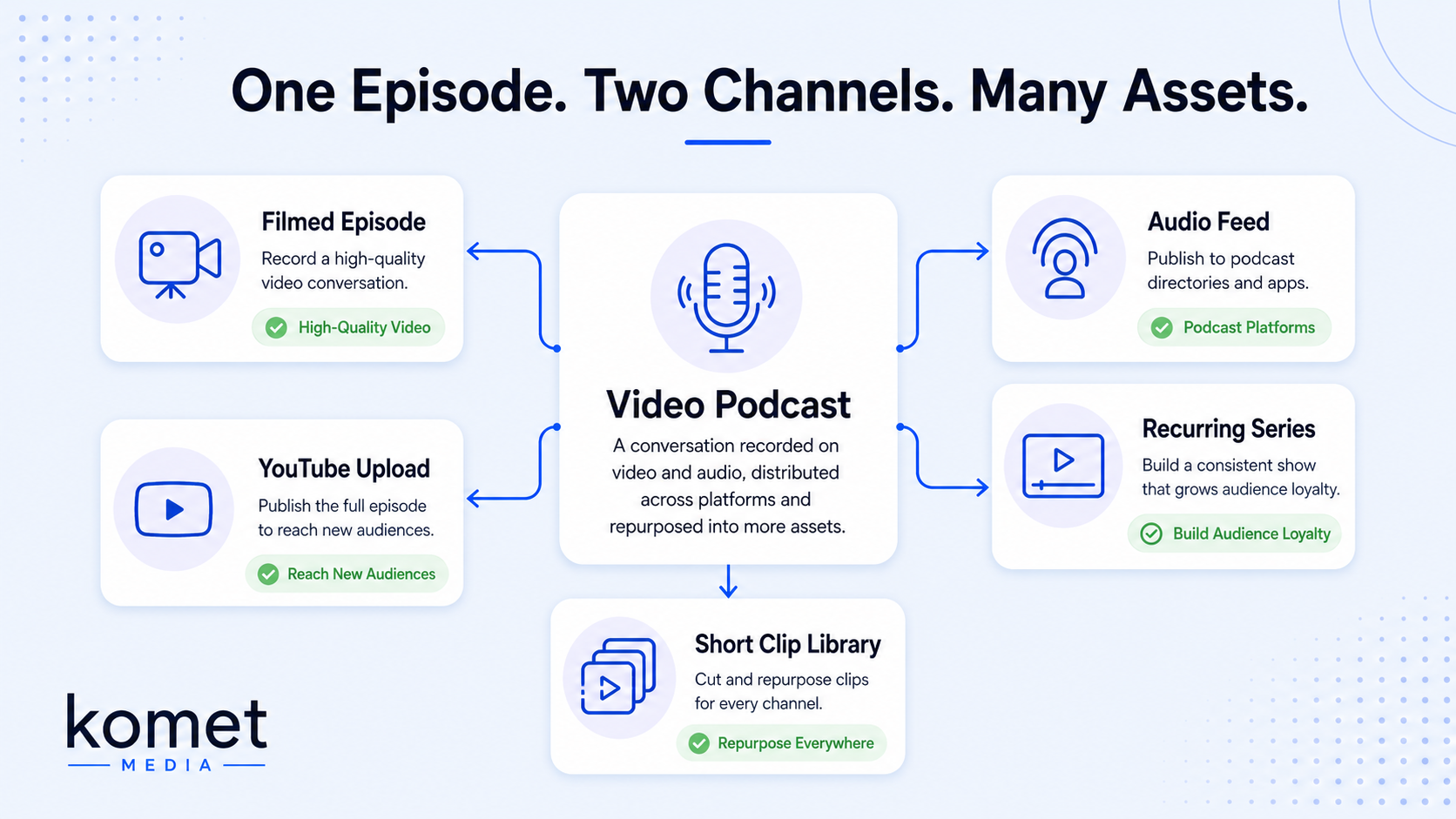
What makes a podcast a video podcast comes down to three criteria:
- The episode is filmed with at least one camera (webcam, mirrorless, or smartphone)
- The video version is publicly distributed, not just a recording stored internally
- The show publishes on a recurring schedule, making it an actual series rather than a one-off video
Real examples by category:
- B2B SaaS: "Marketing Against the Grain" (HubSpot) — A founder-led show discussing marketing trends.
- Thought leadership: "HBR IdeaCast" (Harvard Business Review) — Featuring industry leaders and deep dives into business strategy.
- Product education: "The SaaS Revolution Show" (SaaStock) — Focusing on tactical insights for building and scaling SaaS products.
- Panel discussions: "The Compound and Friends" (The Compound) — A recurring panel discussing finance and market trends.
In 2020, video podcasts made up 18% of all podcast content; by 2025, they account for 36%. The format has moved from creator-led media into B2B content strategy, and for good reason. A single filmed episode can become a YouTube video, five LinkedIn clips, show notes, a transcript, and a highlight reel. That's the content repurposing leverage that serious teams are after. If you want to see how this system works in practice, Komet Media's podcast production service is built specifically for that workflow.
How Does a Video Podcast Work?
A video podcast follows a predictable production loop: record, edit, distribute, and repurpose. Here's the process from raw footage to published episode:
- Record: Host and guests film the conversation using a camera and dedicated microphone. Remote episodes use tools like Riverside.fm, which records each participant locally for studio-quality audio and video regardless of connection speed.
- Edit: Raw footage is trimmed, color-corrected, and audio-balanced in editing software like Descript or a dedicated video editor. Show notes and episode chapters are drafted during this stage.
- Export: The episode is exported as a video file (MP4) and a separate audio file (MP3).
- Host: The video is uploaded to YouTube. The audio file is uploaded to a podcast hosting platform, which generates the RSS feed that syndicates to Spotify, Apple Podcasts, and other directories.
- Distribute: The RSS feed automatically pushes the audio episode to all connected podcast apps. The video lives natively on YouTube and Spotify.
- Repurpose: Short clips (30–90 seconds) are cut from the full episode and published to LinkedIn, Instagram Reels, and YouTube Shorts to drive discovery back to the full episode.
Audio and video are captured locally on each participant's device during remote recording, which preserves high quality regardless of internet stability.
Tools like Descript go further: you can make text edits that automatically adjust the corresponding audio and video segments, almost like editing a Word document.
The repurposing step is where the ROI compounds. Podcasts that post clips to TikTok, YouTube Shorts, or Instagram Reels see an average growth rate of 65% in audience reach.
For B2B teams, those clips also become sales enablement assets that can be shared in outbound sequences or embedded in proposals.
Video Podcast vs Audio Podcast: Key Differences
Both formats use the same RSS-based distribution backbone. The difference is what you distribute through it, and how that shapes growth, discoverability, and content value.
The Podcast Download Fall 2025 Report found that 1 in 2 podcast consumers say they prefer actively watching podcasts with videos, up from 28% in 2022. But audio is far from dead: the vast majority (92%) of podcast consumers continue to choose to listen, even when a video option is available.
The practical read for B2B teams: video adds a second growth loop on top of audio distribution. Video creates a different growth loop entirely; on YouTube, episodes can be discovered through search, suggested videos, channel subscriptions, browse features, and short-form clips that pull new viewers into the long-form asset.
Audio builds depth with existing subscribers; video builds width by finding new ones.
What Equipment Do You Need for a Video Podcast?
You don't need a broadcast studio. You need four categories of gear working together: camera, microphone, lighting, and software.
Camera:
- Beginner: A quality webcam like the Logitech Brio 4K gives you 4K resolution at a low entry price.
- Webcams suit beginners and live streamers well.
- Intermediate: A mirrorless or DSLR camera. DSLRs and mirrorless cameras offer the best image quality and are the standard for creators who want a cinematic look.
- Budget option: Your iPhone. Modern smartphones shoot 4K at multiple frame rates and are a legitimate starting point.
Microphone: Audio quality is perhaps more important for video podcasters than visual appearance. A poor-sounding video loses viewers faster than a slightly soft image. The Shure MV7 is a reliable beginner-to-intermediate pick: it's reliable, forgiving in untreated rooms, and looks good on camera without needing a complicated setup. XLR mics paired with an audio interface give you the most control at the professional level.
Lighting: "Good lighting plays a huge factor in video recordings," according to expert David Chatziliadis. A ring light or a two-point key-and-fill setup costing under $100 will dramatically improve your image quality before you upgrade any other gear.
Software:
- Recording: Riverside.fm for remote guests, OBS for in-person or screen recording
- Editing: Descript for text-based video editing, or a professional editor for polished output
- Distribution: A podcast hosting platform like Transistor or Buzzsprout plus a YouTube channel
If managing this stack in-house isn't realistic, Komet Media's video editing services handle production so your team stays focused on recording the content.
Is YouTube a Video Podcast Platform? And Where Else Should You Publish?
Yes. YouTube is currently the dominant platform for video podcast discovery. YouTube remains the dominant platform for video podcast discovery in 2026, with billions of monthly users and increasingly podcast-friendly features including free unlimited hosting, ad monetization, memberships, live streaming, and Shorts integration for clips.
Beyond YouTube, here's how the main platforms compare:
As of February 2025, Spotify's content library includes over 330,000 video podcasts, up from 100,000 in 2023. That growth signals how seriously Spotify is treating video as a native format, not an afterthought.
For B2B teams, the priority stack is: YouTube first for discovery and SEO, Spotify for creator retention and listener engagement, and a dedicated podcast hosting platform to handle RSS distribution to every other directory.
45% of weekly podcast consumers who listened to a new podcast in the past six months started listening to their latest podcast on YouTube, which means YouTube isn't just a video platform, it's the primary podcast discovery engine.
For teams focused on podcast marketing and pipeline, publishing to YouTube is non-negotiable.
How to Start a Video Podcast: A Practical System for B2B Teams
Starting right means building a system, not just recording an episode. Here's the production framework we recommend at Komet Media:
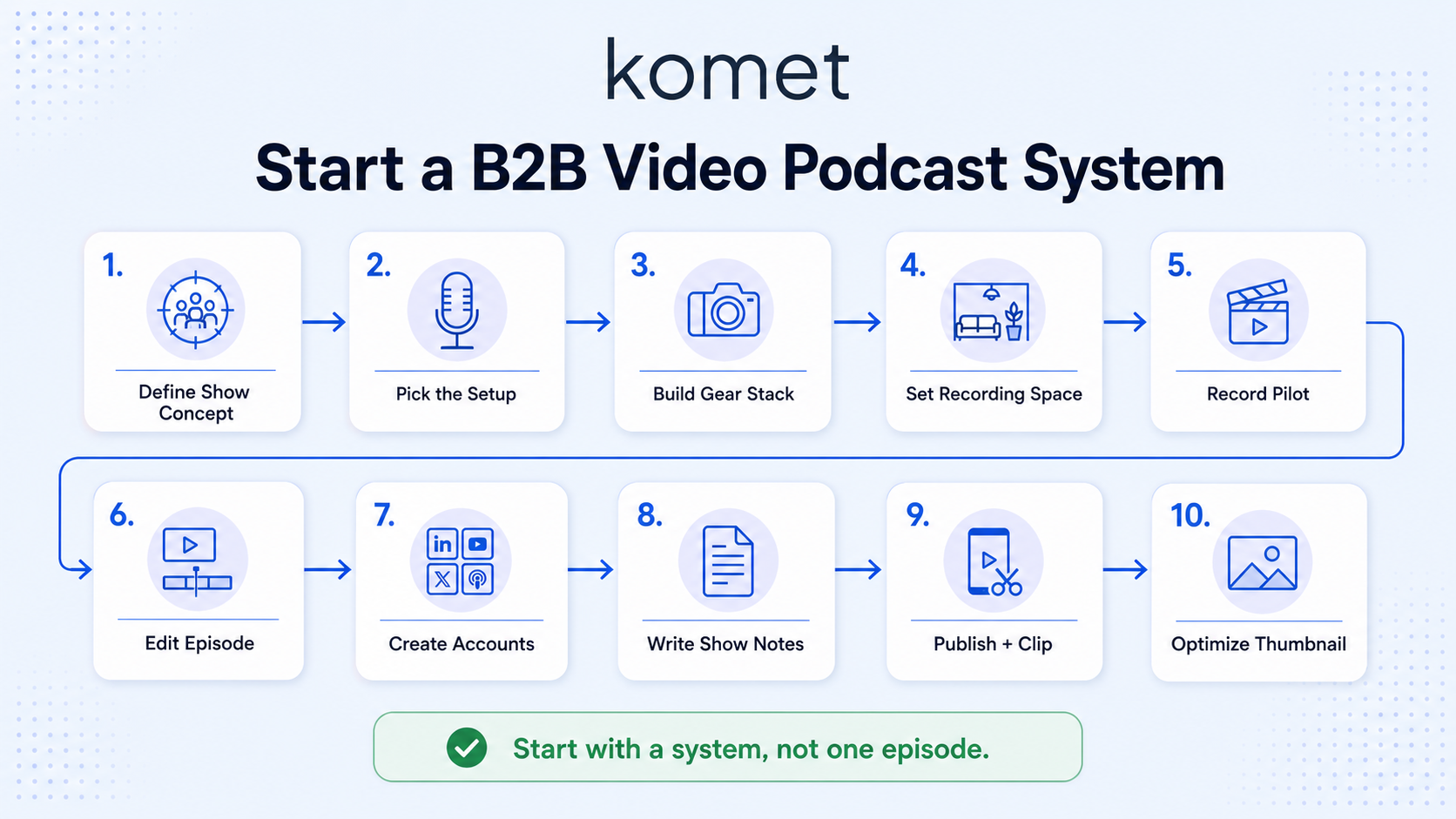
- Define your show concept: Choose one specific audience (e.g., "Series B SaaS founders scaling go-to-market") and one core value per episode. Vague shows with broad audiences grow slowly.
- Pick your format: Talking head solo, interview, or co-hosted panel. Interview shows are the most scalable for B2B because guests bring their own audiences.
- Build your gear stack: Start with what you have (smartphone + USB mic), commit to upgrading audio first, then camera.
- Set up your recording environment: A quiet room, treated walls, a ring light, and a clean background. This costs less than $200 and makes a professional difference.
- Record your pilot episode: Treat it as a test, not a launch. Use it to identify audio issues, camera angles, and editing needs before you commit to publishing.
- Edit and produce: Cut filler words, balance audio levels, add a branded intro, and export both video and audio versions.
- Create your distribution accounts: Set up a YouTube channel, a Spotify for Creators account, and a podcast hosting platform like Transistor or Buzzsprout.
- Write show notes and episode chapters: These are critical for video SEO and for making your content indexable. Komet Media's show notes service handles this if you'd rather stay focused on recording.
- Publish and clip: Upload the full episode, then cut 3–5 short clips for LinkedIn and social. 58% of podcast discovery now comes from short-form video content, the clips aren't optional.
- Optimize thumbnails: Thumbnail optimization directly affects click-through rate on YouTube. Use bold text, a clear face, and high contrast.
1 in 4 new podcast launches now includes video as a built-in feature from episode one, meaning the market expectation has shifted. Starting audio-only and "adding video later" is harder than building the video habit from the start.
For B2B teams that already have webinars, demos, or founder Q&As recorded, this process becomes faster: repurposing existing content into a podcast format is often the fastest path to launch.
Conclusion
A video podcast is the highest-leverage content format for B2B teams in 2026 because it produces one long-form asset that distributes everywhere and repurposes into dozens of short-form clips.
Key takeaways:
- Video podcasts live across platforms: YouTube for discovery, Spotify for engagement, RSS for audio reach.
- Equipment doesn't need to be expensive: Audio quality matters more than camera quality at the start.
- Repurposing is where the real ROI lives: Each episode should produce 5–10 derivative assets.
- B2B teams with existing content have a head start: Webinars, demos, and founder interviews are already raw podcast material.
Ready to build a show from your existing content? Talk to the Komet Media team about turning your long-form library into a video podcast system.
Frequently Asked Questions
Q1: What is a video podcast, exactly?
A video podcast is a regularly published show recorded on camera and distributed as both a video file (on YouTube or Spotify) and an audio file through an RSS feed. It follows the same episodic structure as a traditional audio podcast but adds a visual layer for platforms that support it.
Q2: Do I need expensive equipment to start a video podcast?
No. A smartphone with 4K capability and a USB microphone is a legitimate starting point. You don't need a massive budget to get started, with affordable and accessible equipment, anyone can launch a video podcast from home or a small studio. Prioritise audio quality first; camera upgrades can come later.
Q3: Is YouTube considered a video podcast platform?
Yes. The 2025 Podcast Landscape Study by Sounds Profitable found that 40% of podcast consumers report YouTube as their primary podcast app. YouTube's search-driven discovery makes it the most effective platform for reaching new audiences with your show.
Q4: How is a video podcast different from a webinar or a YouTube video?
A video podcast is episodic and published on a recurring schedule, distributed via RSS to podcast apps as well as video platforms. A webinar is typically a one-off event. A standard YouTube video has no audio-podcast counterpart and isn't structured as a series with show notes and episode chapters.
Q5: Can I turn my existing webinars or demos into a video podcast?
Yes, and it's one of the fastest paths to launch. Existing long-form recordings (webinars, demos, founder interviews) can be edited, branded, and structured into a podcast series without recording anything new. This is exactly the content repurposing workflow Komet Media builds for B2B teams at kometmedia.com/services.
Q6: How do I get my video podcast discovered?
YouTube acts as an entertainment search engine, and 45% of weekly podcast consumers who started listening to a new podcast in the past six months found it first on YouTube. Publish to YouTube with optimised titles and thumbnails, cut short-form clips for social platforms, and write keyword-rich show notes to support podcast SEO across directories.