
How to Start a Podcast Script: Step-by-Step Guide
Most podcasts don't fail because the host has nothing to say. They fail because there's no structure. Knowing how to start a podcast script is the difference between a confident, focused episode and 40 minutes of rambling. Whether you're a founder, marketing lead, or growth team building a B2B content engine, a solid script is your first real production asset. This guide breaks it down step by step, format choices, writing mechanics, and repurposing angles included.
TL;DR
- A podcast script needs a hook, intro, main segments, transitions, and a clear call to action.
- Hybrid scripts (fully written intro/outro, outlined body) work best for most B2B podcasters.
- Write for the ear: short sentences, contractions, conversational language.
- Every episode is a content asset; repurpose it into short-form video clips or let Komet Media build your scripts and production from scratch.
How to Write a Podcast Script for Beginners: Start With Format
Before you write a single word, decide which script format matches your show. The wrong format causes more problems than no script at all. As of March 2026, there are 4.6 million podcasts worldwide, which means standing out comes down to consistency and delivery, both of which your format choice directly controls. There are three formats worth knowing:
- Full script: Every word is written out. Ideal for highly technical B2B content, solo explainer episodes, or compliance-heavy topics where precision matters.
- Outline script: Bullet points and talking points only. Works well for confident speakers and loose interview formats where conversation flows naturally.
- Hybrid script: Combines scripted segments with outlined ones to balance structure and spontaneity. The intro, outro, sponsor reads, and key transitions are fully scripted, while main segments such as guest discussions are more loosely outlined.
For most B2B founders and SaaS marketing teams just getting started, hybrid is the right call. You get professional-sounding bookends without locking yourself into reading word-for-word during the meat of the episode.
Once you've locked the format, you can build the structure around it.
What Should I Include in a Podcast Script?
A good podcast script should open with a clear hook, move through a simple structure, and sound like something a real person would say out loud. The core structure is: a hook (the first 1 to 3 lines that tell listeners why this episode is worth their time), an intro (who you are, what the show is, and what this episode covers), main talking points (core ideas, examples, stories, or questions), transitions (short lines that move the listener from one section to the next), and a closing (a quick recap and one clear call to action).
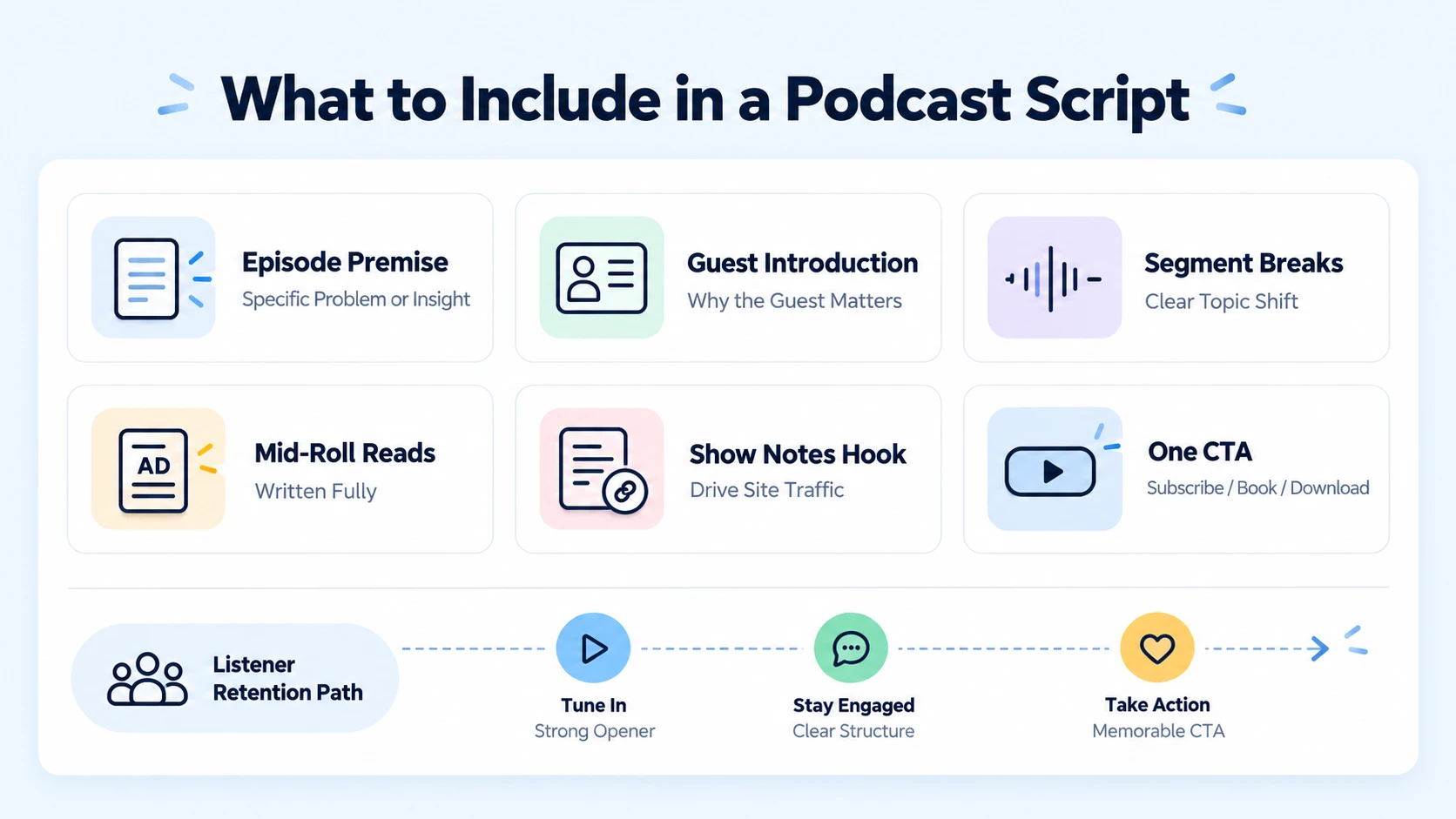
Beyond structure, every script needs these functional elements:
- Episode premise: One sentence that states the specific problem or insight this episode addresses.
- Guest introduction: If it's an interview format, introduce your guest and explain why they're there and why the listener should care, then wrap up by naming yourself and your show.
- Segment breaks: Clear verbal or musical cues that signal a topic shift.
- Sponsor or mid-roll reads: Written out fully, even in a hybrid script, so delivery is consistent.
- Show notes hooks: Tease the written companion content to drive traffic back to your site (our podcast show notes service handles this for teams that don't want to write them manually).
- Call to action (CTA): One specific ask, subscribe, book a call, download a resource. One CTA, not four.
70% of podcast listeners hear entire episodes , which means if your structure holds, your message lands. Earn that retention with a tight episode outline before you write a single full sentence.
Podcast Script Template Step by Step: A Working Framework
Here's a practical template framework you can adapt for your first episode. Fill in each block before you write prose.
Block 1: Hook (0:00–0:30)
- Open with a provocative question, counterintuitive stat, or bold claim.
- Keep it to 10–15 seconds maximum so it won't get skipped with the +30 skip setting on most podcast players.
Block 2: Intro (0:30–1:30)
- Name the show, name yourself, state what the episode covers.
- Your introduction sets the stage by sharing what the episode covers and why it matters. Skip the tired "Hi, I'm [name] and welcome to…" format and instead say what listeners gain by staying tuned.
Block 3: Main Segments (1:30–25:00)
- Break your main ideas into 2–4 parts, estimate how long each part will take, plan smooth transitions between segments, and add 10–15% extra time for natural talking.
- Each segment = one core idea with one example or story.
Block 4: Transition Lines
- Write these out fully. Example: "Okay, we've covered the problem, now let's talk about what actually fixes it."
- Well-placed transitions make your podcast scripting sound smooth. Transitions can be as simple as music fades, sound effects, or a verbal cue to shift topics.
Block 5: Outro and CTA (final 2 minutes)
- Recap the three key takeaways in one sentence each.
- The outro is just as important as the intro, it's where you summarise key points, thank guests if applicable, and include a call to action encouraging listeners to subscribe, leave reviews, or follow you on social media.
For B2B teams, that CTA should point to a demo, a resource, or a next episode. Not a generic "leave a review." Know what pipeline action you want to drive.
How to Write a Podcast Intro Script That Hooks Listeners
The intro is the highest-leverage section of any episode. Around 58% of Americans aged 12 and older consumed a podcast in the past month in 2026, representing an estimated 167 million monthly U.S. podcast consumers, every one of them makes a keep-or-skip decision in the first 60 seconds.
A strong intro hook follows one of three patterns:
- The Problem Frame: "If you've ever started recording and had no idea what to say next, this episode fixes that."
- The Bold Claim: "Most podcast intros waste the first 45 seconds. Here's how to start in the first five."
- The Outcome Promise: "By the end of this episode, you'll have a working script template you can use today."
Podcast scripts should sound conversational, not academic. Employ short sentences, contractions, and natural phrasing. Reading your draft aloud is crucial, if a sentence feels awkward or difficult to say, rework it. Structural rules for your intro:
- State the episode's core promise within the first 30 seconds.
- Name yourself and your show after the hook, not before it.
- If you have a guest, tease their most interesting insight before you introduce their title.
- End the intro with a forward bridge: "Let's get into it."
For founder-led B2B podcasts specifically, the intro is also where you establish authority. Don't bury your positioning, connect the episode topic to the specific problem your buyers face. That's what makes podcast content function as sales enablement, not just branded audio.
Podcast Script vs. Outline: Which Is Better for B2B Podcasters?
This is the most common question I hear from SaaS founders and marketing leads starting their first show. The honest answer: neither is universally better. The right choice depends on your delivery confidence and your content type. Not everyone needs to be fully scripted to deliver a compelling podcast, but intros and outros are most often scripted. That's the practical middle ground most experienced hosts land on.
Here's how to choose:
The deeper issue isn't script vs. outline. It's preparation vs. improvisation. Instead of a full-blown script, think of your podcast episode as a roadmap. Brainstorm your talking points and craft out the transitions. This loose structure keeps you on track while allowing room for spontaneous detours.
For B2B teams at Komet Media, we see the highest content ROI when podcast audio gets repurposed immediately after recording. Whether you need full end-to-end scriptwriting and production from scratch or prefer working from existing recordings, a structured episode produces cleaner clips, tighter show notes, and sharper short-form video cuts. If you're using our podcast production services, the script becomes the brief for the entire downstream content workflow.
How to Write a Podcast Script That Doesn't Sound Robotic
This is where most first-time podcasters struggle. They write a great script and then read it in a flat, lifeless monotone. The fix is in how you write, not just how you deliver. Use short sentences of about 15–20 words. Write like you're talking, using contractions like "don't," "can't," "won't," and conversational connectors like "so," "well," "now." Five concrete techniques to write for the spoken word format:
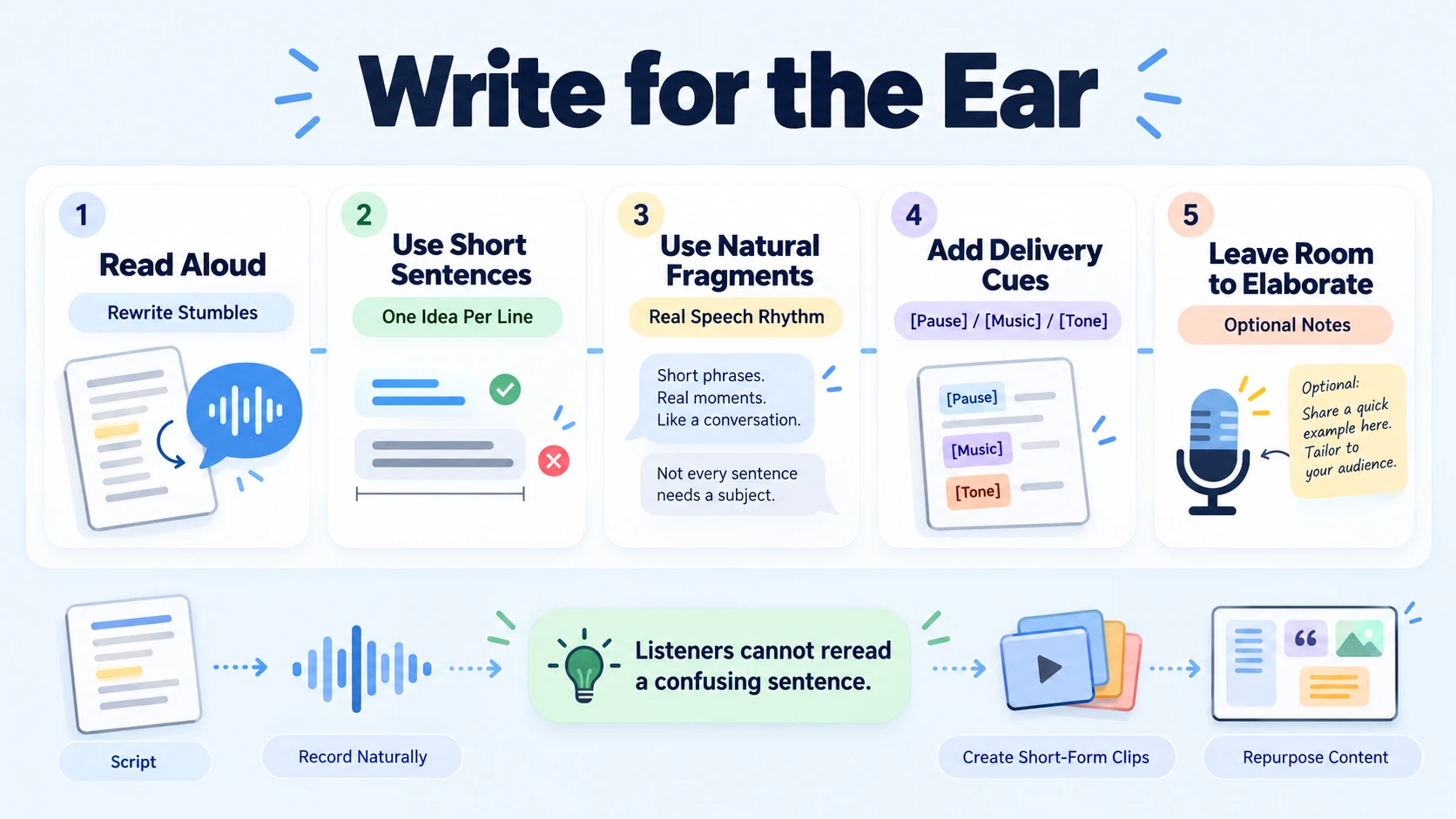
- Read every draft aloud before recording. If you stumble on a sentence, rewrite it. Stumbling on paper means stumbling on a mic.
- Use incomplete sentences intentionally. Real speech includes them. "Here's the thing." "Let me explain."
- Add delivery cues in brackets. Scripts are tools for pacing and delivery. Including subtle notes for pauses, tone shifts, or sound effects, a note like "[pause for effect]" or "[insert transition music]" can significantly enhance the flow.
- Write one idea per sentence. Two ideas in one sentence almost always creates a run-on when spoken.
- Build in spontaneity. Even the most detailed script should accommodate spontaneity. Include bullet points or optional notes for moments where you might elaborate on a point, share a personal anecdote, or interact with a co-host.
The broader audio storytelling principle: listeners can't reread a confusing sentence. Every line has to land on first listen. That constraint forces clarity, which is actually a feature. A script that sounds natural when spoken tends to be sharper and more direct than one written to be read silently.
After recording, the same discipline that makes a script sound natural also makes it easier to repurpose. Clean delivery equals cleaner clips. If you're turning episodes into short-form video, visit Komet Media's short-form video editing service to see how a scripted episode becomes a content library.
Conclusion
Knowing how to start a podcast script is a production decision as much as a creative one. Get the format, structure, and writing mechanics right from episode one and every piece of downstream content, clips, show notes, transcripts, gets easier to produce.
Key takeaways:
- Hybrid scripts work for most B2B podcasters: fully written intros/outros, outlined body segments.
- Hook listeners in the first 30 seconds. Your intro is your highest-leverage asset.
- Write for the ear: short sentences, contractions, delivery cues.
- Every scripted episode is a repurposable content system, treat it like one from day one.
Explore Komet Media's full from-scratch scriptwriting, podcast editing, and podcast marketing services to turn your episodes into a pipeline.
Frequently Asked Questions
Q1: How long should a podcast script be?
Script length follows episode length. A 30-minute episode runs roughly 4,500–5,000 words when fully scripted (speaking pace is approximately 130–150 words per minute). For a hybrid script, your written sections (intro, outro, transitions) will total 600–900 words, with outlined bullet points covering the rest.
Q2: What's the best recording software for a scripted podcast?
Audacity is free and handles multi-track recording well for solo shows. Adobe Audition gives more editing control for teams producing higher-volume content. Both work with any podcast hosting platform, including Buzzsprout and Anchor FM (now Spotify for Podcasters).
Q3: How do I write a podcast script for an interview format?
Fully script your intro, guest introduction, and outro. For the interview itself, write 8–12 prepared questions with one follow-up prompt under each. Leave the questions flexible enough to follow the conversation, your script is a safety net, not a straitjacket.
Q4: What's the difference between show notes and a podcast script?
A script guides your recording. Show notes are the written companion published alongside the episode on your podcast hosting platform and website. Show notes drive SEO, link to resources mentioned on air, and give listeners a reason to visit your site. Both matter, they serve different stages of listener engagement.
Q5: How do I use a podcast script for content repurposing?
Your script is the source document for every downstream asset: short-form video clips, social captions, blog posts, email snippets, and LinkedIn carousels. Pull the three sharpest lines from each episode and brief your video editor with those exact timestamps. That's how a single 30-minute episode becomes 10 pieces of content.
Q6: Do I need a full script if I'm already an experienced speaker?
No, but you still need a structured outline with a fully written intro hook and CTA. Experience reduces reliance on word-for-word scripting, but it doesn't eliminate the need for a planned narrative arc. The hook and the CTA are the two sections where winging it consistently costs you listener retention and conversion.

