
How to Find Podcast Guests: Step-by-Step Guide
If your podcast is sitting on empty guest slots, it's not a reach problem, it's a system problem. Knowing how to find podcast guests strategically is what separates shows that build pipeline from shows that just fill airtime. 75% of B2B decision-makers now listen to podcasts, with 51% listening daily, meaning your guest list is also your prospecting list. This guide gives you a repeatable process for finding, vetting, and booking the right guests, whether you're episode one or episode one hundred.
TL;DR
- Define your ideal guest avatar before searching any platform or database.
- Use specialized platforms like PodMatch, Matchmaker.fm, and Podchaser alongside LinkedIn for targeted prospecting.
- Outreach quality beats outreach volume, personalising every pitch.
- Treat each booked guest as a relationship asset, not just an episode slot.
How to Find Podcast Guests for Your Show: Start With the Avatar
Most hosts jump straight to Google or a platform and search for "marketing experts." That's where the guest quality falls apart. Before you open any tool, you need to define your ideal guest avatar with the same rigor a sales team applies to an ICP.
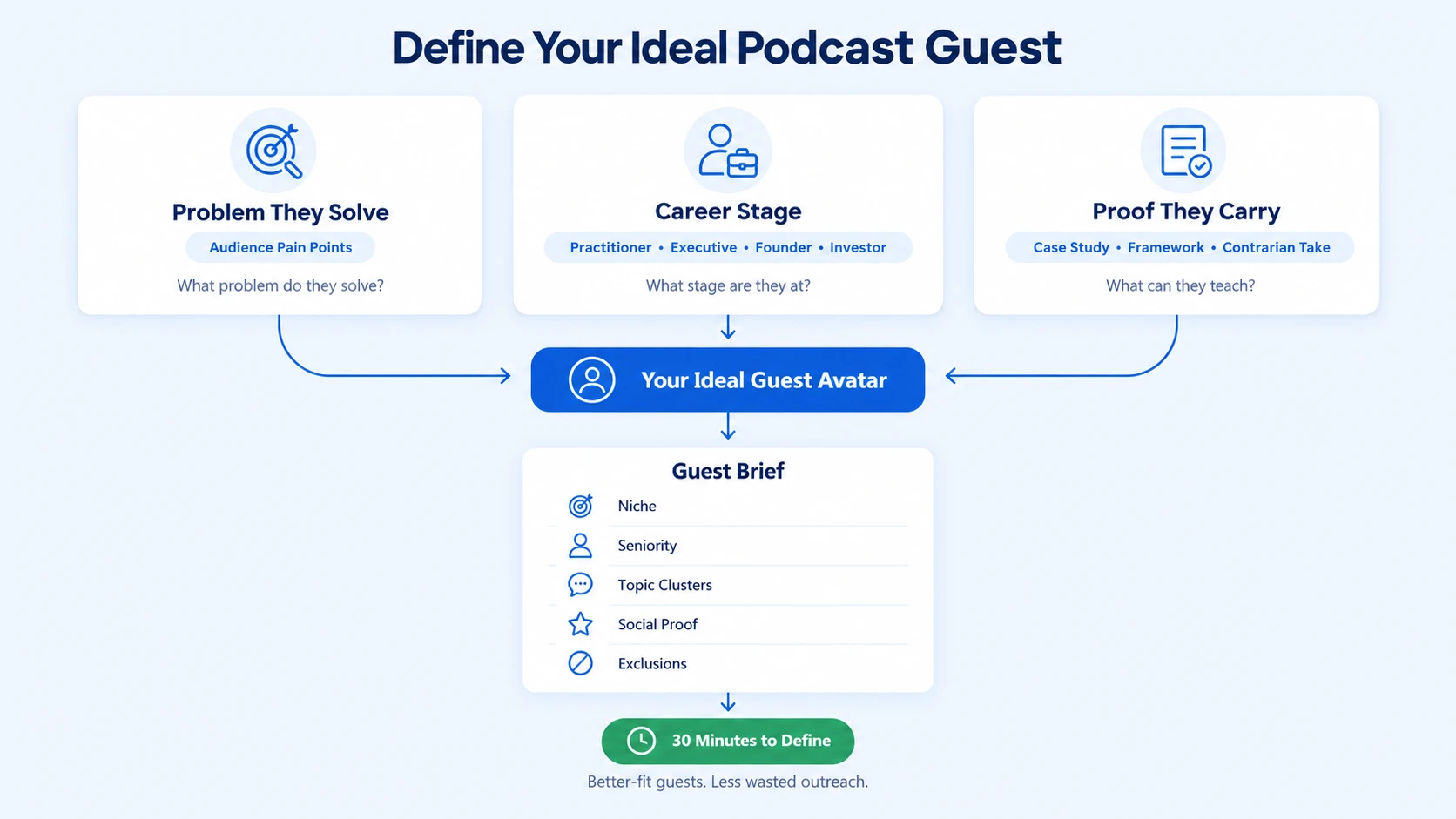
Ask three questions:
- What problem do they solve that your audience is actively trying to understand?
- What stage are they at, practitioner, executive, founder, investor?
- What proof do they carry, a case study, a framework, a contrarian take your audience hasn't heard?
For B2B SaaS and tech shows, the best guests are people who sit one or two steps ahead of your listeners. They've built what your audience is building, sold into the buyers your audience is trying to close, or failed at exactly what your audience is attempting. That specificity is what makes an episode shareable.
Once the avatar is clear, build a simple one-page brief: niche, seniority level, topic clusters you need covered, social proof indicators (active LinkedIn, speaking credits, published work), and any exclusions (direct competitors, guests who've saturated your specific niche). This brief becomes your filter for every source you search.
Guest booking strategy breaks down when hosts skip this step. They end up with guests who are generically credentialed but don't serve the audience's actual next question. A tight avatar takes 30 minutes to build and saves you hours of bad-fit outreach.
At Komet Media, I work with B2B teams that use their podcast as a sales touchpoint. The avatar exercise isn't optional for those teams, it's the foundation of their guest booking workflow.
What Are the Best Platforms to Find Podcast Guests?
Once your avatar is defined, platforms do the heavy lifting. Here's a direct comparison of the major options in 2026:
PodMatch works like a dating app for podcasters, using an algorithm to match hosts with compatible guests based on topics, audience size, and goals, with plans ranging from $6 to $64/month. Podchaser functions as a search engine for podcasts and guests: you can look up shows in your niche, see who they've interviewed, and build your own shortlist of potential guests.
These platforms work best when your show has a clear niche, you pre-qualify guests carefully, and you avoid template pitches. For B2B shows specifically, I'd prioritize Podchaser for research (it reveals which guests are already touring podcast circuits in your space) and PodMatch for volume booking when your pipeline needs filling fast. Matchmaker.fm suits shows doing manual, relationship-led outreach.
How to Find Podcast Guests on LinkedIn (Without Feeling Like Spam)
LinkedIn is the highest-signal channel for B2B podcast guest prospecting, and the most abused one. Done wrong, it reads as cold recruiting. Done right, it's relationship-led outreach that guests actually appreciate. Here's the prospecting process I use:
- Search by role and keyword: Use LinkedIn's People search with filters for title (e.g. "Head of Revenue," "Founder," "VP Product"), industry, and company size. Add a keyword matching your topic cluster.
- Check content activity: Look at their last 30 days of posts. Active creators who already share their thinking are 3x easier to book, they understand the value of visibility.
- Find the mutual hook: Look for a shared connection, a post they published that you can reference genuinely, or a topic where their stated view connects to your episode arc.
- Send a connection request with a note under 300 characters: State who you are, name the show, and tease a specific reason you want them, not "I love your work" but "Your framework on usage-based pricing is exactly what my SaaS audience is wrestling with right now."
- Follow up in DMs after connection: Keep the first DM to two sentences and a clear ask. Attach a simple one-pager about the show (episode count, format, audience profile).
- Move to email for logistics: Once they express interest, shift to email for scheduling.
Niche expertise mapping is the secret here. The more specifically you can name what you want them to speak to, the more a potential guest feels their time is worth giving. Vague asks get archived. Specific asks get replies.
For podcast production and outreach support, having a media kit ready to attach to LinkedIn DMs lifts reply rates significantly.
How to Book Guests for a New Podcast with No Audience
This is the question I get most from early-stage B2B podcast hosts: "Why would anyone come on my show if I have 40 listeners?" The answer is that most valuable guests, especially in B2B, don't come on shows for the audience size. They come for the content asset, the relationship, and the positioning.
Here's how to find podcast guests when you're just starting out:
- Lead with the content value: Tell the guest they'll walk away with a short-form video clip of their best insight, shareable on LinkedIn. That asset has more immediate value than 5,000 downloads.
- Start in your second-degree network: In a Buzzsprout survey of 200+ podcasters, 69.7% said their last three guests came from their personal network, and 28% from referrals from past guests. Your network is your first booking engine.
- Use speaker bureau overflow: Speakers registered on bureaus often take smaller shows to build clip libraries between major keynotes.
- Attend Podcast Movement or similar events and meet potential guests in person. The warm relationship removes the cold-pitch friction entirely.
- Offer a guest media kit back to them: After recording, send polished clips via your short-form video editing workflow. Guests who get great content from you refer their peers without being asked.
A B2B podcast with 200 listeners that books your target account's VP of Engineering is a pipeline call, not a media placement. Audience size is the wrong metric for early-stage B2B shows. The mutual value proposition for a new show is clear: you give them thought leadership content and a focused conversation; they give you their expertise and reach. Frame it that way from the first outreach.
How to Reach Out to Potential Podcast Guests: The Outreach Framework
Cold email sequences and DM templates fail for one reason: they're obviously templates. The guest booking outreach that works is specific, short, and makes the ask unmistakably clear. Here's a cold email sequence that converts for B2B podcasts:
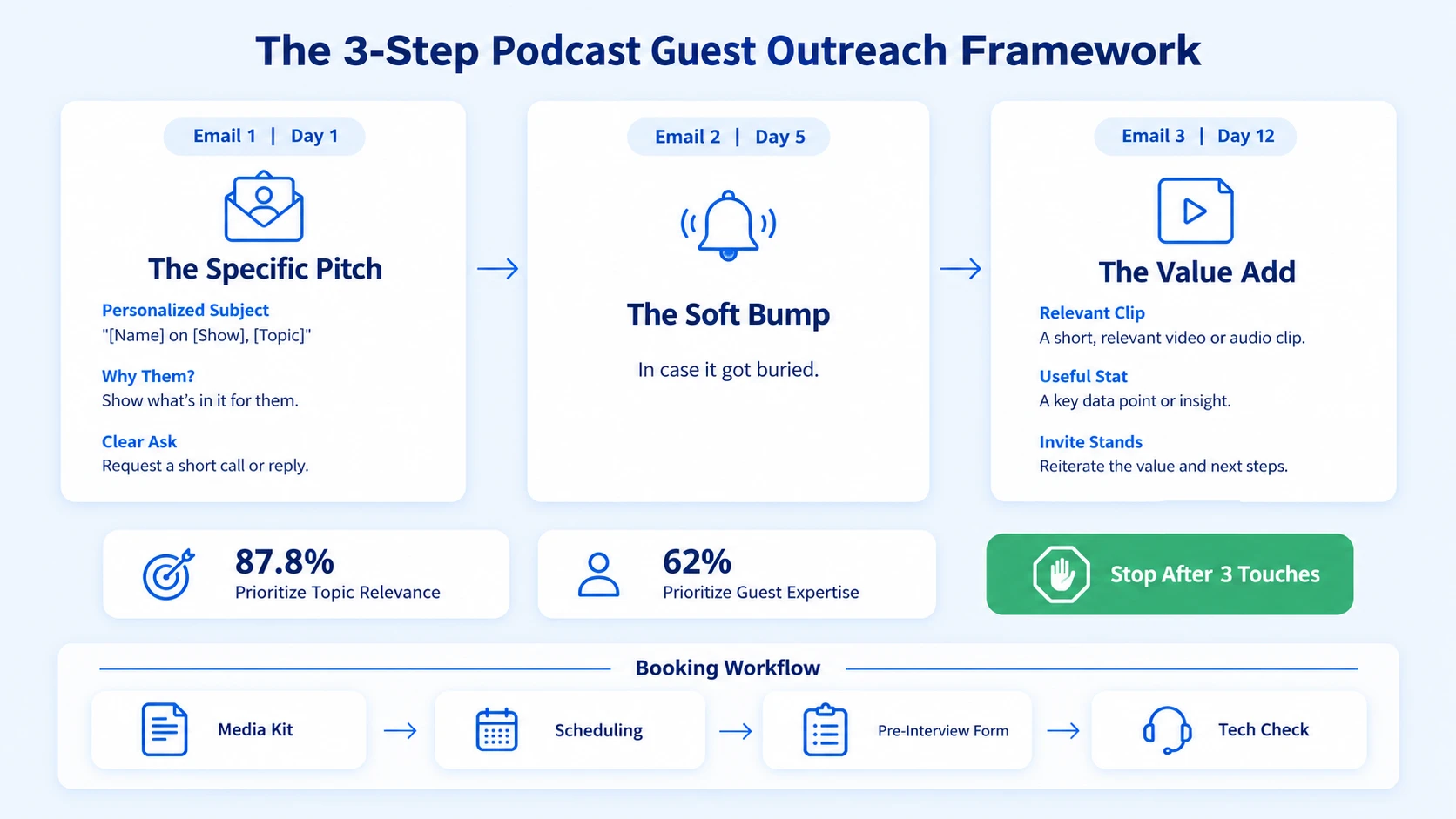
Email 1 (Day 1), The Specific Pitch:
Subject: [Their Name] on [Show Name], [specific topic]
Two sentences establishing who you are and the show. One sentence naming exactly why you're reaching out to them specifically (not the category, the person). One sentence with the ask and a scheduling link.
Email 2 (Day 5), The Soft Bump:
One sentence. "Wanted to surface this in case it got buried."
Email 3 (Day 12), The Value Add:
Share a clip or stat from a recent episode relevant to their work. "Thought this was relevant to what you're building, my invite stands."
Stop at three. Chasing after three touches damages authority positioning.
In a survey of 200+ podcasters, 87.8% said topic relevance is the most important factor when deciding whether to book a guest, and 62% cited guest expertise as the second most important factor. Your outreach subject line and opening sentence must nail those two things immediately.
A strong guest media kit sent with the initial email (one page: show overview, audience demographics, episode examples, past guests) reduces the friction of a yes. Pair this with a booking confirmation workflow, automated scheduling, pre-interview questionnaire, tech check reminder, and you signal professionalism before the recording even starts.
For teams building podcast marketing systems, the outreach template lives inside a CRM so every follow-up is tracked and no warm lead goes cold.
How to Vet Guests and Protect Your Show's Quality
Knowing how to find podcast guests is only half the job. Vetting the guest before the booking confirmation protects your audience alignment and show reputation. A bad-fit guest doesn't just produce a weak episode, it signals to future guests (and listeners) what bar you hold.
The guest vetting process covers four areas:
- Audience alignment: Does this person's knowledge map to the specific next question your listeners are asking? Check their LinkedIn content and prior podcast appearances on Podchaser for topic fit.
- Communication quality: Watch or listen to one prior interview. Is their speaking style clear and direct? Can they give a crisp answer without 90 seconds of preamble?
- Social proof indicators: Published writing, speaking credits, notable company affiliations, or a LinkedIn following in the relevant niche all signal that others have already vetted them.
- Conflict of interest: Are they a direct competitor to your show sponsor or a company in your portfolio? Flag before booking, not after.
Run a pre-interview preparation framework: send questions 48 hours in advance (not a script, a direction), confirm tech setup, and include a one-paragraph brief on your audience. Guests who are well-prepped deliver sharper insights and better clips.
The average guest-to-client conversion rate on B2B podcasts is 10%, and one company converted 48% of strategically selected podcast guests from target accounts into pipeline opportunities. That number only holds when the guest is genuinely a fit, not just a credentialed name.
After recording, repurpose every episode into short-form clips through your podcast editing workflow and share them with the guest. That single action generates referrals to your next best guest without any additional outreach.
Conclusion
Knowing how to find podcast guests is a system, not a one-time search.
- Define a specific guest avatar before opening any platform or sending any email.
- Use Podchaser, PodMatch, and LinkedIn as your core prospecting stack.
- Outreach quality beats volume, one specific pitch outperforms ten generic ones.
- Vetting and post-episode delivery (clips, show notes) is what builds a referral engine that compounds over time.
A podcast with the right guests becomes a pipeline asset. Build the system once, run it consistently, and your show fills itself.
Frequently Asked Questions
Q1: How long does it typically take to book a podcast guest?
For warm outreach through your network, bookings happen within a week. Cold outreach via platforms like PodMatch or LinkedIn typically takes two to three weeks from first contact to confirmed recording. Build a rolling 30-day pipeline so you're never scrambling.
Q2: Should I pay podcast guests to appear on my show?
Rarely. Most credible B2B guests don't expect payment, they appear for the thought leadership asset and visibility. Payment is more common in high-follower consumer shows or when booking celebrity speakers. Offering a polished short-form clip post-recording is a stronger incentive than cash.
Q3: What is a guest media kit and do I need one?
A guest media kit is a one-page document covering your show's format, episode count, audience profile, past notable guests, and what the guest will walk away with. For B2B shows, it's not optional, it removes friction and signals you run a professional operation.
Q4: How many guests should a new B2B podcast book per month?
Two to four per month is a sustainable pace for most B2B shows. Consistency beats volume. Referrals from past guests account for 28% of new bookings , so quality early guests build your pipeline automatically over time.
Q5: What's the difference between Podmatch and Matchmaker.fm?
Matchmaker.fm is best for solo speakers wanting a simple, algorithm-driven matching service, while PodMatch is best for hosts who want an automated and algorithmic approach to booking. PodMatch offers more granular filtering; Matchmaker.fm has a larger raw database.
Q6: Can podcast guests also become sales prospects?
Yes, and for B2B shows this is a primary use case. A cybersecurity firm attributed $2.3M of new pipeline in 9 months to relationships with podcast guests. Booking target-account executives as guests opens a conversation that cold outreach cannot.

