
How to Be a Podcast Guest: Step-by-Step Guide
Knowing how to be a podcast guest is one of the highest-leverage moves a B2B founder or executive can make right now. 83% of senior executives listen to a podcast in a given week, and they are twice as likely to consume at least 5 hours per week. That means your ideal buyer is already in the feed, the question is whether your voice is there when they tune in. This guide walks you through the full process: finding the right shows, building your pitch assets, landing bookings, and turning every appearance into a pipeline.
TL;DR
- Build a polished one-sheet and media kit before you pitch a single show.
- Target fit first: topic relevance outweighs audience size every time.
- Keep your pitch under 200 words, name a specific episode angle, and follow up once.
- Repurpose every appearance into short-form clips to multiply your reach post-episode.
How to Find Podcasts to Be a Guest On
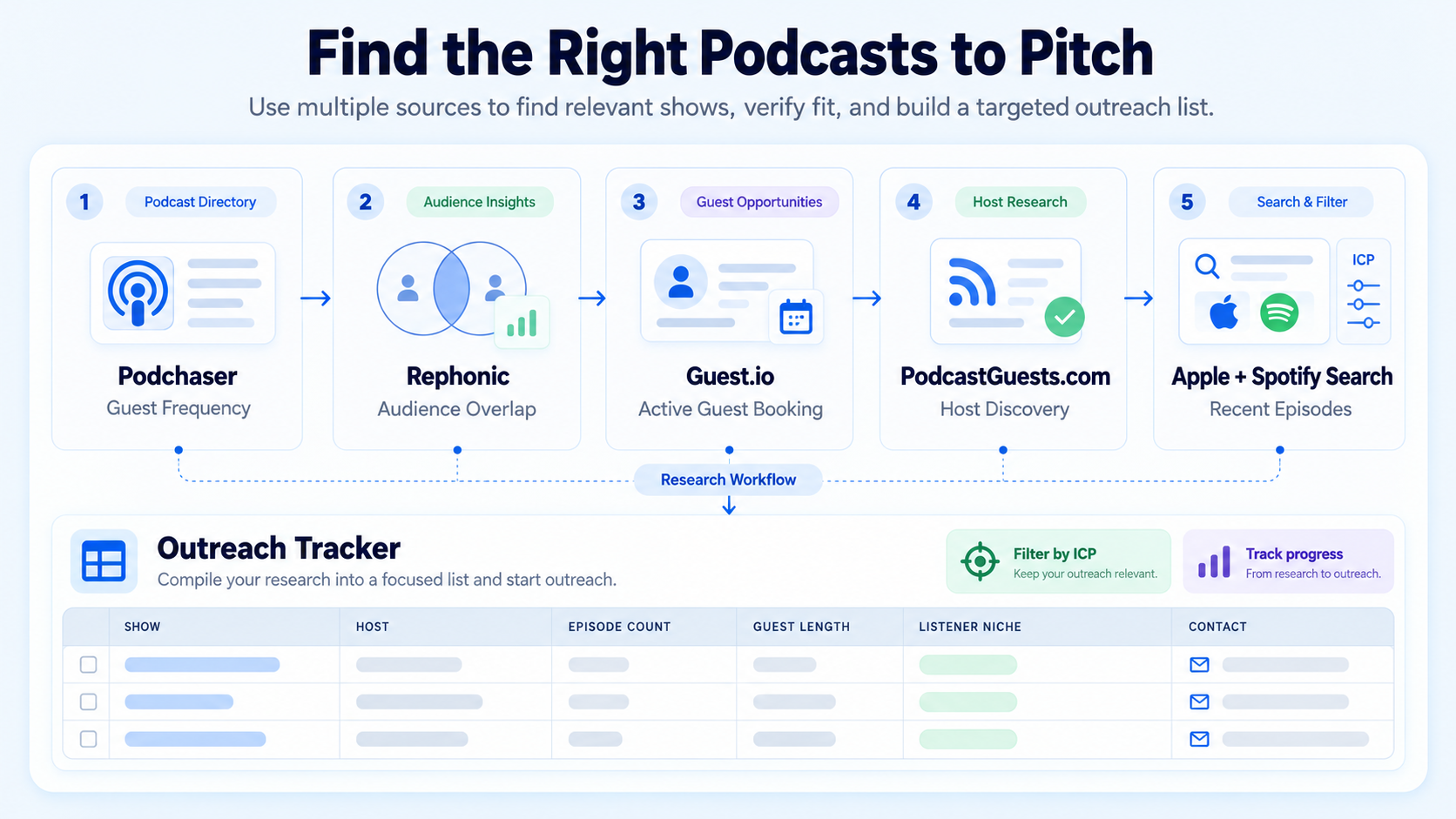
Before you learn how to be a podcast guest, you need a targeted shortlist of shows. Volume is not the goal. Fit is. Start with the directories that index guest-friendly shows:
- Podchaser: Browse by category, audience size, and guest frequency. Filter for shows that consistently host guests in your space.
- Rephonic: Gives you audience overlap data, so you can see which shows share listeners with shows you have already appeared on.
- Guest.io and PodcastGuests.com: Matching platforms built specifically for guest booking. Hosts on these platforms are actively looking.
- Apple Podcasts and Spotify for Podcasters: Search your topic, sort by recent episodes, and manually check whether the RSS feed shows a pattern of regular guest appearances.
- Podchaser's "also appeared on" feature: A cold-start shortcut that maps your peers' guest footprints to surface relevant shows fast.
Roughly 478,000 podcasts have released at least one new episode in the last 90 days, according to the Podcast Index 2026, and 167 million Americans (58% of the 12+ population) listen to podcasts monthly. That is a large enough ecosystem to find shows with exactly your buyer profile, but focused enough that a targeted pitch strategy beats mass outreach.
Build a tracker with at minimum: show name, host name, episode count, average guest episode length, listener niche, and direct contact details. 87.8% of hosts state that topic relevance is the number one factor when they decide to book a guest (Buzzsprout Podcast Guest Survey, 2026). If your discovery process does not prioritize relevance, the most well-written pitch in the world will not save you.
Prioritize shows where your ICP (ideal customer profile) is the audience. A SaaS founder speaking about go-to-market strategy should be on shows for revenue leaders and growth teams, not general entrepreneurship shows with diffuse demographics.
What Podcast Hosts Look For in a Guest
Understanding host psychology before you pitch is what separates serious guests from noise. Podcast hosts want guests who bring something new to the conversation, offering original thought leadership or expert insights that align with the podcast's focus. They don't need another generalist, they need someone who can go deep on a topic their audience cares about. Here is what moves the decision:
- Specific angle, not a resume: The modern pitch is not a resume; it is a value proposition for the listener. 63% of podcast hosts prefer pitches that suggest a specific episode concept over a general introduction of the guest.
- Audience alignment: A key factor for podcast hosts is whether the guest's message will resonate with their audience. You need to explain how your insights will benefit their listeners, which requires actually understanding who listens to the show.
- Proof of delivery: Hosts want evidence you can hold a conversation, not just answer questions. Links to prior audio appearances, webinars, or recorded talks function as audition tapes.
- No friction: Unlike short-form media interviews, podcasts need guests who can engage in deeper, more casual conversations that hold a listener's attention. A 30-second sound-bite expert is not necessarily a good podcast guest.
76% of businesses launch podcasts explicitly for thought leadership purposes, and 65% of shows treat the guest as the thought leader. That framing is an advantage for you: hosts are not looking for debate partners, they are looking for credible voices they can hand their audience trust to. Show them you can fill that role.
How to Build Your Media Kit and One-Sheet
Your media kit is the asset that does the convincing after your pitch email opens the door. A podcast guest one-sheet is a one-page profile designed to make life easier for podcast hosts, like a scouting report covering your best topics, your brand, your story, and a snapshot of what you would be like in front of the mic. A guest media kit is a one-to-two page document that gives a host everything needed to book you: your positioning line, bio, talking points, social proof, audience fit paragraph, logistics, contact details, and a current headshot. If you don't have these assets yet, Komet Media builds custom guest media kits and one-sheets from scratch to establish your authority immediately.
Build your one-sheet in this order:
- Positioning line: One sentence naming who you help and what changes for them. This is the first thing a host reads.
- Short bio (third person): Your bio should explain who you help, what makes your perspective unique, and why you're qualified to speak on your topics. Keep it focused and easy to read, and write it in the third person so podcast hosts can use it to introduce you.
- Talking points framed as episode titles: Think of these not as a list of subjects you could talk about, but as potential episode titles. Offer conversation starters that promise a clear outcome or spark curiosity.
- Professional headshot: High-resolution, on-brand, no blurry selfies.
- Past appearances and social proof: Links to prior guest spots, press mentions, or a short video clip.
- Contact information and booking link: Past two pages, hosts stop reading. Keep it tight.
Once built, host your kit at a permanent URL. Drop that link, not an attachment, into your pitch email.
How to Pitch Yourself as a Podcast Guest (With an Email That Gets Accepted)
Mastering how to be a podcast guest comes down to the pitch email. Most pitches fail fast because they create a negative gap between expectations and reality. When a host opens your email, they have expectations about what makes a good guest, and when your pitch falls short, they hit delete without a second thought. For leaders looking to outsource this process, Komet Media designs tailored outreach strategies and handles end-to-end guest booking from scratch.
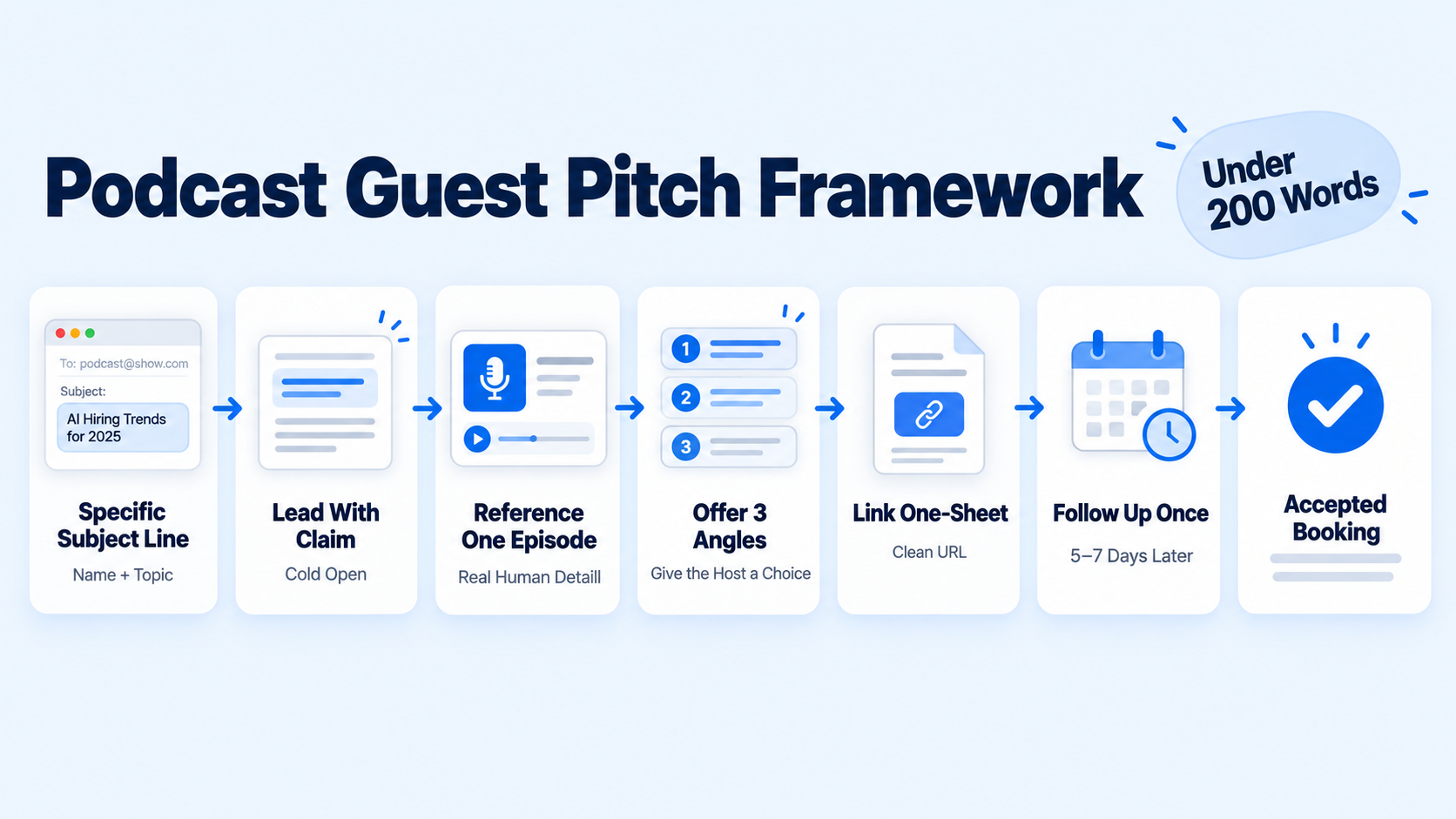
Follow this structure:
- Subject line: Clear and specific. "Guest pitch: [Your name] on [Specific topic]" outperforms vague openers. Research indicates that 47% of email recipients decide whether to open or ignore an email based solely on the subject line, and personalized subject lines achieve up to 26–46% higher open rates than generic ones.
- First line is the claim: The first line of your email is your cold open, one sentence, no throat-clearing, that states the claim you would make on the show. Not your title. Not your company. The claim.
- Reference a specific episode: Name it, and say what it made you think. In an era of AI, human connection is the premium. Don't just mention an episode, mention how it changed your thinking. Hosts can spot a "summary-bot" pitch instantly. Demonstrate that you understand their mission.
- Offer three episode angles: Three is the right number because it lets the host pick, which converts your email from a request into a choice. It demonstrates range without making you look scattered.
- Link to your one-sheet: One clean URL, not an attachment.
- Keep it under 200 words: Hosts are busy people. They don't have time to read a long, rambling email about your entire life story. A successful podcast pitch should be short, ideally under 200 words, and clearly explain why you'd be a great guest.
Follow up once, 5–7 days later. One line. Then move on.
What to Prepare Before Appearing on a Podcast
Getting booked is the start. Delivering a tight, quotable episode is what builds your reputation as a guest worth recommending.
Audio setup matters more than most guests realize. Use a condenser microphone (not your laptop mic or earbuds), apply basic acoustic treatment by recording in a carpeted room or away from hard reflective walls, and test your setup with a short recording before every interview.
Interview preparation checklist:
- Listen to two or three recent episodes of the show to understand the host's rhythm, vocabulary, and what questions they tend to close with
- Prepare three to five stories that each have a specific number or outcome in them, these become shareable clips
- Know your talking points well enough to deliver them without notes; reading kills conversational flow
- Have your best one-liner version of your positioning ready for when the host asks "tell us about yourself"
- Confirm the format: length, video or audio-only, live or recorded, whether show notes will be published
The show notes and transcript matter for your SEO footprint too. A well-crafted guest appearance with detailed podcast show notes means your name and topic are indexable content, not just audio. If the host doesn't publish detailed notes, you can create your own version for your own site.
Every minute of strong interview content can become a short-form clip, a LinkedIn post, a quote card, or an email newsletter feature, if you plan for it before you record.
Common Podcast Guest Mistakes (And How to Avoid Them)
Even experienced speakers make errors that undercut their appearances. Here is what to avoid:
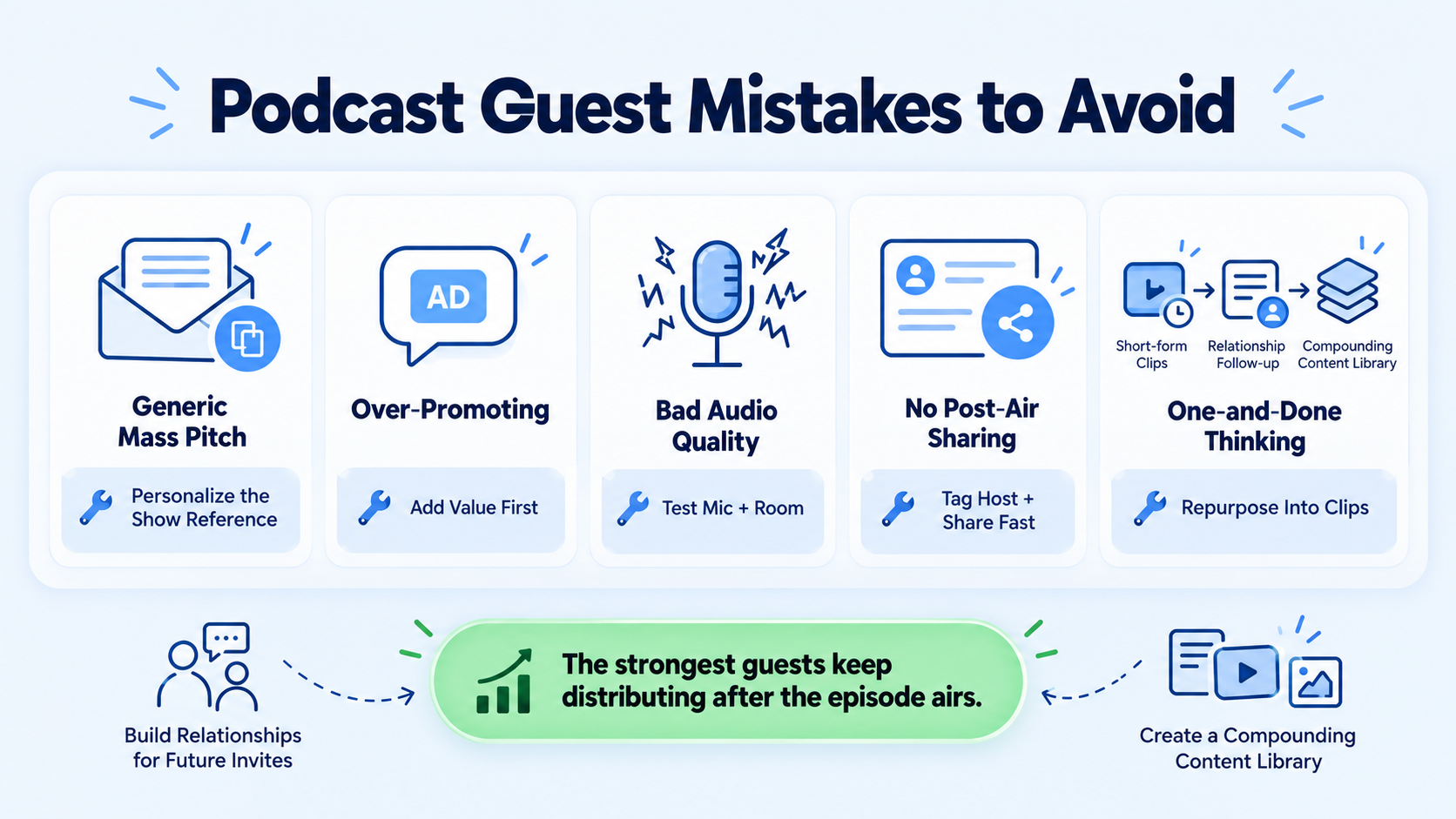
- Mass pitching with a generic email: Sending generic, mass emails is the number one mistake and an instant deal-breaker. Hosts can spot a copy-and-pasted email from a mile away. Vague greetings like "Hi there" signal that you haven't bothered to learn even the most basic details.
- Over-promoting during the episode: Mention your work when it adds context, not as the punchline to every answer. Listeners disengage when a guest sounds like an ad.
- Ignoring audio quality: Appearing on a show with echo, background noise, or low gain signals to the host that you didn't prepare. It also makes your clips unusable.
- Not sharing the episode post-air: After the episode airs, share it, tag the show, and send the host a note about which part you thought worked best. Hosts get almost no feedback on their own work, and a guest who gives them some becomes a guest they recommend.
- Treating it as one-and-done: The real value of knowing how to be a podcast guest is in the compounding effect. Each appearance builds your credibility for the next, and your clips become a content library that shortens future sales cycles.
The last point is where most B2B guests leave serious value on the table. A single 45-minute interview can produce 8–12 short-form clips ready for LinkedIn and social, but only if someone edits them. That is where a focused short-form video editing workflow pays for itself in amplified reach. If you want to understand how to turn every guest appearance into a full distribution system, explore Komet Media's video marketing services or connect directly.
68% of B2B podcast listeners say they trust companies featured on podcasts more than brands they see advertised anywhere else. The guest who shows up prepared, sounds sharp, and then distributes the content aggressively is the one who converts that trust into pipeline.
Conclusion
Here is what this guide comes down to:
- Build your one-sheet and media kit before you pitch a single show, and host both at a permanent URL.
- Target shows by ICP audience fit, not download count, and personalize every pitch with a specific episode reference and three concrete angles.
- Treat audio quality and interview preparation as non-negotiable, your clips are only as good as the source recording.
- Repurpose every appearance into short-form content immediately after it airs to extend the reach of each episode across multiple channels.
The Komet Media podcast covers exactly how B2B teams can build this kind of distribution system around video and audio content.
Frequently Asked Questions
Q1: How long should a podcast guest pitch email be?
A successful podcast pitch should be short, ideally under 200 words, and clearly explain why you would be a great guest. Lead with the specific claim you would make on the show, reference a real episode, offer three angle options, and link to your one-sheet. Nothing else.
Q2: What tools can I use for podcast guest booking?
Start with Podchaser, Rephonic, Guest.io, and PodcastGuests.com for finding and vetting shows. These platforms let you filter by niche, audience size, and guest frequency. For pitching at scale, a simple CRM or Airtable tracker keeps your outreach organized. Alternatively, Komet Media offers full-service, from-scratch podcast booking management—building your media kit, developing target lists, crafting personalized pitches, and managing show logistics end-to-end.
Q3: Do I need a condenser microphone to be a podcast guest?
A condenser microphone is the clearest upgrade you can make to audio quality. A USB condenser mic in a carpeted room will outperform any laptop mic or wireless earbuds. Basic acoustic treatment, recording away from hard surfaces, removes echo that editing cannot fully fix.
Q4: How do I find the right podcasts in my niche?
87.8% of hosts state that topic relevance is the number one factor when they decide to book a guest. Use Podchaser and Rephonic to filter by category and audience overlap. Then manually listen to two to three episodes of any show before pitching to verify that the audience matches your ICP.
Q5: How soon after an episode airs should I share it?
Share it the day it goes live. Tag the host and show across LinkedIn and any other channels where your buyers are active. After the episode airs, tag the show and send the host a note about which part you thought worked best.
This builds the relationship for future appearances and referrals to other hosts.
Q6: How do I turn a single podcast appearance into more content?
Every recorded interview is a content asset. Extract the sharpest two to three minute segments as standalone short-form clips, pull key quotes for LinkedIn posts, and publish a written version as a blog post or newsletter. If you want a system for doing this at volume, Komet Media's content repurposing services are built exactly for this use case.

