
🪄 AI Summary
Heading 1
Heading 2
Heading 3
Heading 4
Heading 5
Heading 6
Lorem ipsum dolor sit amet, consectetur adipiscing elit, sed do eiusmod tempor incididunt ut labore et dolore magna aliqua. Ut enim ad minim veniam, quis nostrud exercitation ullamco laboris nisi ut aliquip ex ea commodo consequat. Duis aute irure dolor in reprehenderit in voluptate velit esse cillum dolore eu fugiat nulla pariatur.
Block quote
Ordered list
- Item 1
- Item 2
- Item 3
Unordered list
- Item A
- Item B
- Item C
Bold text
Emphasis
Superscript
Subscript
Most PE firms are sitting on a goldmine of untapped content, partner insights, portfolio stories, thesis-driven market views, and converting none of it into the video assets that actually build institutional trust and drive deal flow. Private equity finally found some footing in 2025, deal and exit values surged, but for many general partners, fundraising remained a grind. In a market where LPs are more selective than ever, video marketing is the edge most firms aren't using. This playbook tells you exactly how to change that.
TL;DR
- 82% of marketers say video marketing has given them a good ROI, PE firms leaving it on the table are losing ground to those who aren't.
- The highest-ROI formats for PE are partner thought leadership clips, LP update videos, and portfolio company spotlights.
- LinkedIn is the primary distribution channel; short-form content seeds trust before the pitch ever happens.
- Most firms fail not from lack of ideas but from lack of a repeatable video system.
Why Private Equity Firms Can No Longer Ignore Video Marketing
The fundraising market has structurally changed. Fundraising remains difficult for most managers, with capital concentrated among the largest firms, and allocators are shifting focus, prioritizing managers with higher DPI, faster distributions, and specialist strategies.
In that environment, brand differentiation is no longer optional, it is a capital formation tool. Transparency has become a vital differentiator in GP-LP relationships. Limited partners need detailed information about portfolio assets; they look beyond standardized quarterly reports and want immediate access to operational metrics.
Video is the fastest, most scalable way to deliver that transparency without scheduling another call. The numbers behind video marketing in 2026 make the case plainly. Viewers retain 95% of a message when they see it in a video, compared to only 10% when reading text, a 9.5x improvement in message retention that makes video indispensable for communicating complex ideas.
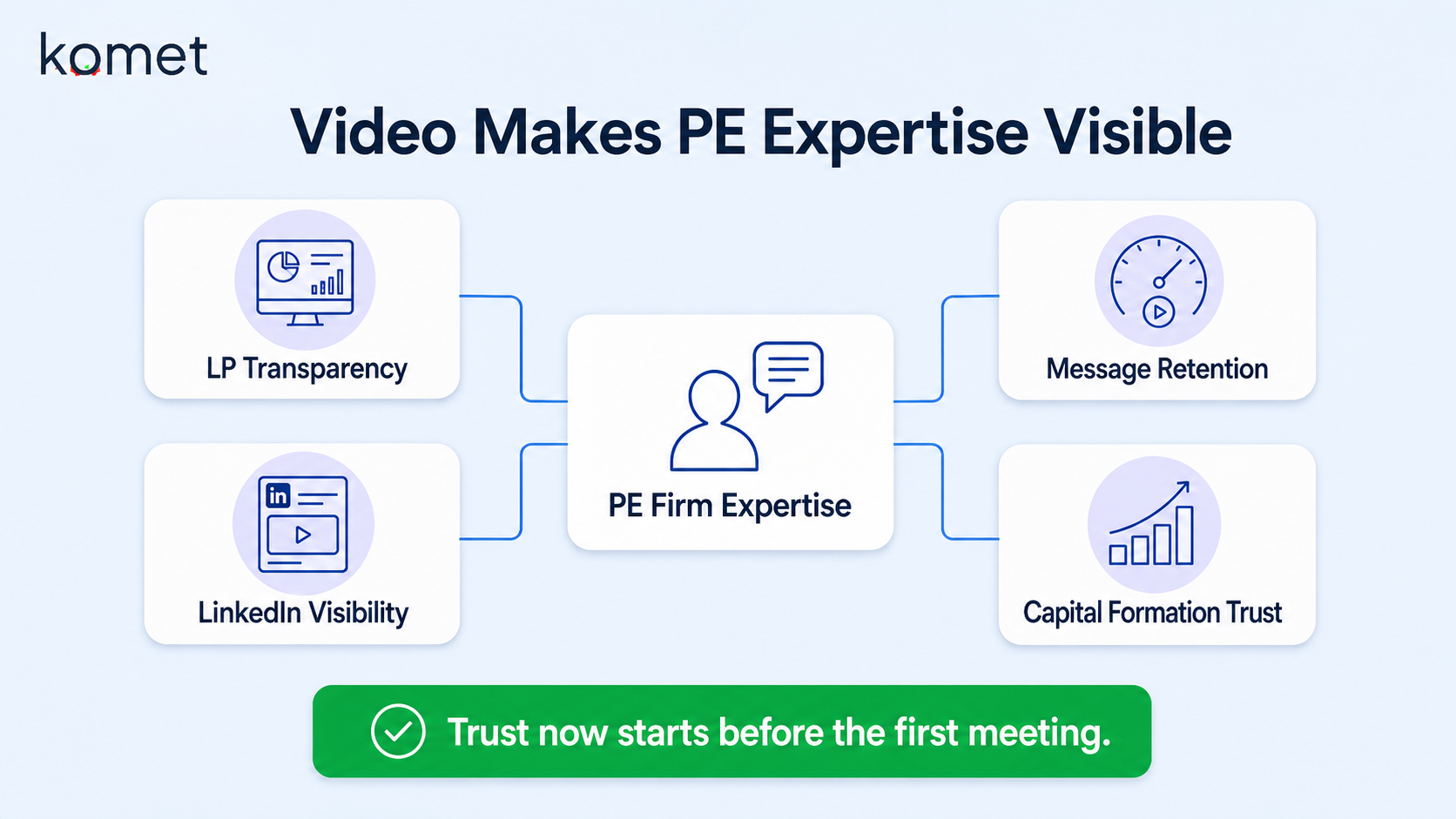
For a PE firm explaining a nuanced investment thesis to a prospective LP, that gap in retention is the difference between a committed check and a polite pass. In a notable shift, 70% of video marketers now use LinkedIn, making it the most widely used platform for video marketing in 2025, and LinkedIn is where PE decision-makers, family offices, and institutional allocators actually spend professional time. The platform has become a primary trust-building surface for fund managers.
GPs who entered the non-institutional fundraising market found they had to ramp up their investor relations content output to reach a much broader, more disparate non-institutional investor base. Video is the most efficient content format to serve that scaled-up demand without proportionally scaling the team.
The firms winning capital in 2026 treat brand and digital communication not as a marketing nice-to-have but as capital infrastructure. A partner with 200 LinkedIn followers and zero video presence is invisible to the LPs who vet managers digitally before ever taking a meeting. A 60-second thesis clip changes that overnight.
For Komet Media clients, the starting point is always the same: identify the high-signal content the firm is already producing, IC memos, LP letters, portfolio reviews, and build a video system that converts it into assets that work around the clock.
Video Marketing Strategies for Private Equity Firms That Actually Move the Needle
Strategy without structure produces sporadic content that builds no momentum. PE firms need a systematic approach, not one-off videos produced before fundraise season. The foundational frame: every video asset should serve one of three business functions, trust building, deal sourcing, or LP engagement. Map every format to one of these, and you will never produce content without purpose.
- Trust-building content positions partners as sector experts. Short-form clips distilling market views, deal thesis breakdowns, and sector outlooks build the institutional credibility that LPs verify before committing capital. This is LinkedIn thought leadership in video form, not a brand film, not a glossy reel.
- Deal sourcing content targets founders, operators, and management consulting intermediaries. Short videos communicating what the firm buys, how they work with management teams, and what operational value they bring differentiate a firm in a competitive deal flow pipeline where every sponsor looks the same on paper.
- LP engagement content replaces or supplements the standard quarterly update. A three-minute video from a managing partner with portfolio highlights communicates more warmth, transparency, and confidence than a 20-page PDF that LPs skim in 90 seconds.
The content marketing strategy that ties these together is content repurposing. Every 45-minute GP keynote at a conference contains at least six short-form clips. Every quarterly LP letter contains two partner-to-camera talking points. Marketers today create content by using screen recorders or webinar recordings, repurposing them into various formats for cost-effective and authentic content.
The distribution layer is equally important. Podcast production and video go hand in hand, a long-form audio conversation with a portfolio CEO can be clipped into LinkedIn shorts, a YouTube channel piece, and an LP newsletter embedded in a single production session. That is how serious firms build content velocity without proportional cost.
What Types of Videos Work Best for PE Fund Marketing
Not all video formats deliver equal results in private equity. The format determines the audience, the trust signal, and the placement in the deal flow pipeline.
Most video marketers believe videos between 30 seconds and 2 minutes are most effective , and that holds true for top-of-funnel PE content. But for LP-facing updates and strategy explainers, longer formats are appropriate, the audience is committed and the content is substantive.
91% of consumers say video quality impacts their trust in a brand, making professional-quality production important even when creating authentic, less-polished content. For PE firms where institutional trust is the entire product, this is non-negotiable. A shaky iPhone video from a managing partner carries a signal you cannot afford to send.
The single most underused format in PE video marketing marketing is the portfolio company spotlight. It demonstrates operational credibility, validates the investment thesis, and gives prospective LPs third-party proof points without the firm saying a word about its own track record.
Short-form video content optimized for LinkedIn and distributed via short-form video editing systems works because it meets allocators in their existing scroll behavior rather than demanding they navigate to a website or download a document.
How to Create Compelling LP Pitch Videos for Private Equity
The LP pitch video is the highest-leverage format in the PE video toolkit. Done right, it works as a pre-meeting primer, a post-meeting reinforcement asset, and a fundraise leave-behind that keeps the firm top of mind between formal touchpoints.
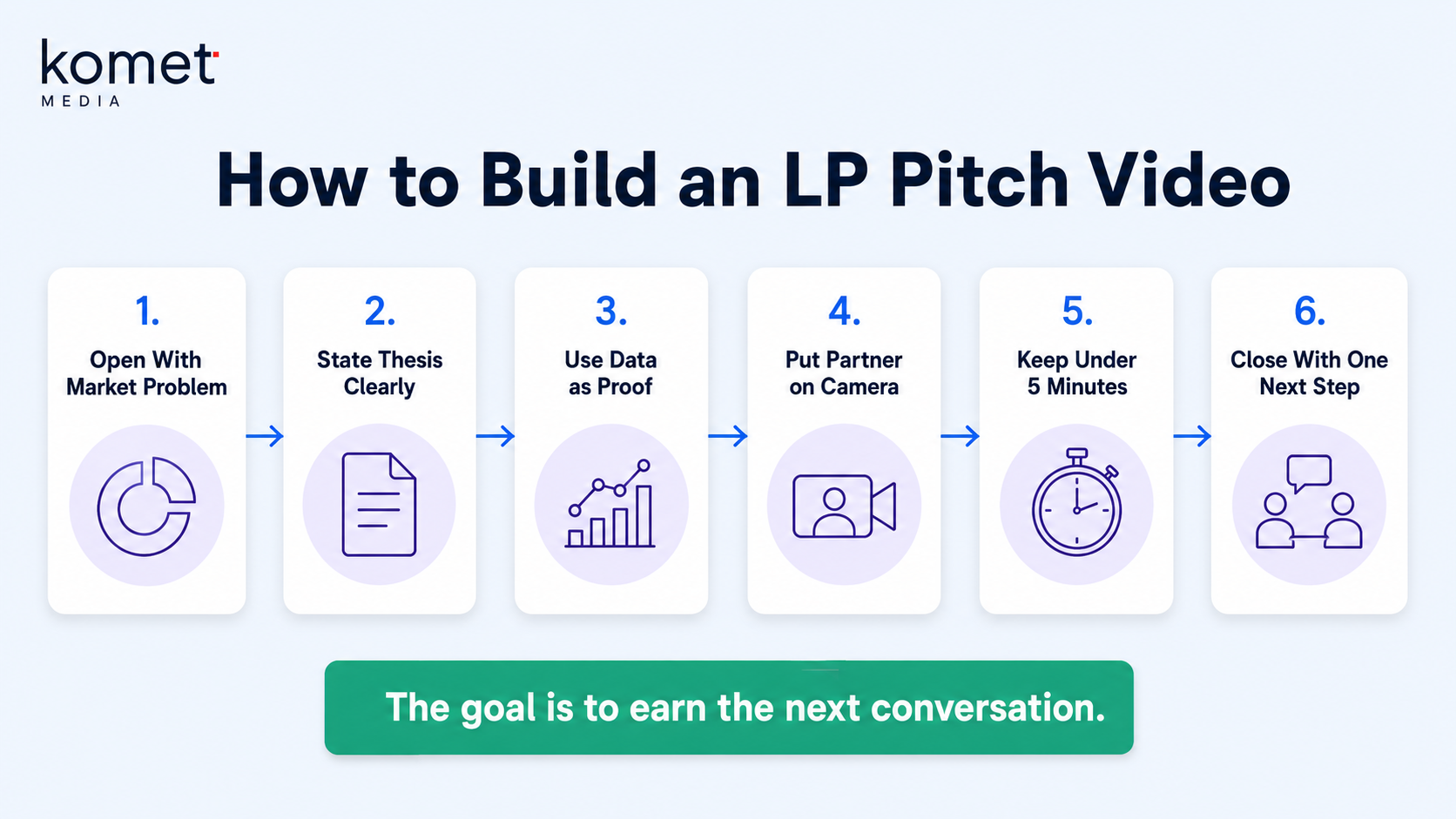
Here is how to build one that works:
- Lead with the problem, not the firm. Open with the market inefficiency or opportunity you're solving. LPs hear "we've built a differentiated platform" in every pitch. They rarely hear a crisp articulation of why capital is being misdeployed in a specific sector right now.
- State the thesis in one sentence. If the investment thesis takes more than one sentence to state, it is not clear enough for a video. Distill it first, then script around it.
- Let the data do the credibility work. Reference specific portfolio metrics, sector outcomes, or operational improvements, not as a track record recitation, but as evidence the thesis has been validated.
- Put a partner on camera. The top traits consumers report as important for engaging video content are authenticity and AI-driven personalization, followed closely by clear messaging and storyline. A partner speaking directly to the camera, without a teleprompter cadence, communicates authenticity that a produced brand film cannot replicate.
- Keep it under five minutes. This is a trust-building tool, not an information dump. The goal is to earn the next conversation, not replace it.
- Close with a single, clear next step. Request a call, direct to a data room, or prompt a follow-up meeting. Ambiguity at the end of a pitch video is a conversion killer.
Taking the best of your communications and expanding on their content in video makes it much easier for people to digest the information you're providing. The LP pitch video is the best application of this principle, it transforms the static PPM narrative into something that carries voice, conviction, and human presence.
Video Content Strategy for Private Equity Investor Relations
LP investor relations is where most PE firms have the highest immediate ROI from video marketing, and where almost none are executing systematically. LPs care about one key metric more than anything else: Distributions to Paid-In capital (DPI). McKinsey's 2025 proprietary survey shows 2.5 times as many LPs ranked DPI as a "most critical" performance metric compared to three years ago.
Video content doesn't change the DPI number, but it dramatically changes how that number is communicated, contextualized, and trusted. A quarterly video update from the managing partner, even three minutes long, does what no PDF can: it delivers tone, context, and confidence. It lets LPs hear how a GP is thinking, not just what they are reporting. That qualitative signal matters enormously in an environment where mounting evidence shows investors are increasingly looking at how fast sponsors have returned capital in prior funds, and sponsors with successful fundraises have both higher net IRR and DPI in prior vintages.
An effective IR video content strategy for PE firms includes:
- Monthly or quarterly partner update videos tied to fund performance, portfolio highlights, and macro context (3–5 minutes, distributed via LP portal and email)
- Portfolio company CEO spotlight videos demonstrating operational momentum (2–3 minutes, shareable externally on LinkedIn)
- Annual meeting video supplements that recap key themes and decisions for LPs who couldn't attend
- New investment announcement clips that frame each acquisition within the fund thesis
The distribution layer matters as much as the content. LP portals, secure email platforms, and LinkedIn all serve different audiences and intimacy levels. Public-facing content builds awareness with prospective LPs. Portal-hosted content serves the existing base with a higher level of detail and confidentiality.
Integrating video into HubSpot CRM and tracking via Google Analytics 4 allows IR teams to see exactly which LPs are watching which assets, and for how long. That behavioral data transforms LP outreach from scheduled touchpoints into responsive, signal-driven communication.
What Mistakes Do Private Equity Firms Make With Video Marketing
The gap between firms doing video well and firms doing it poorly is rarely budget. It is almost always strategic intent and execution discipline.
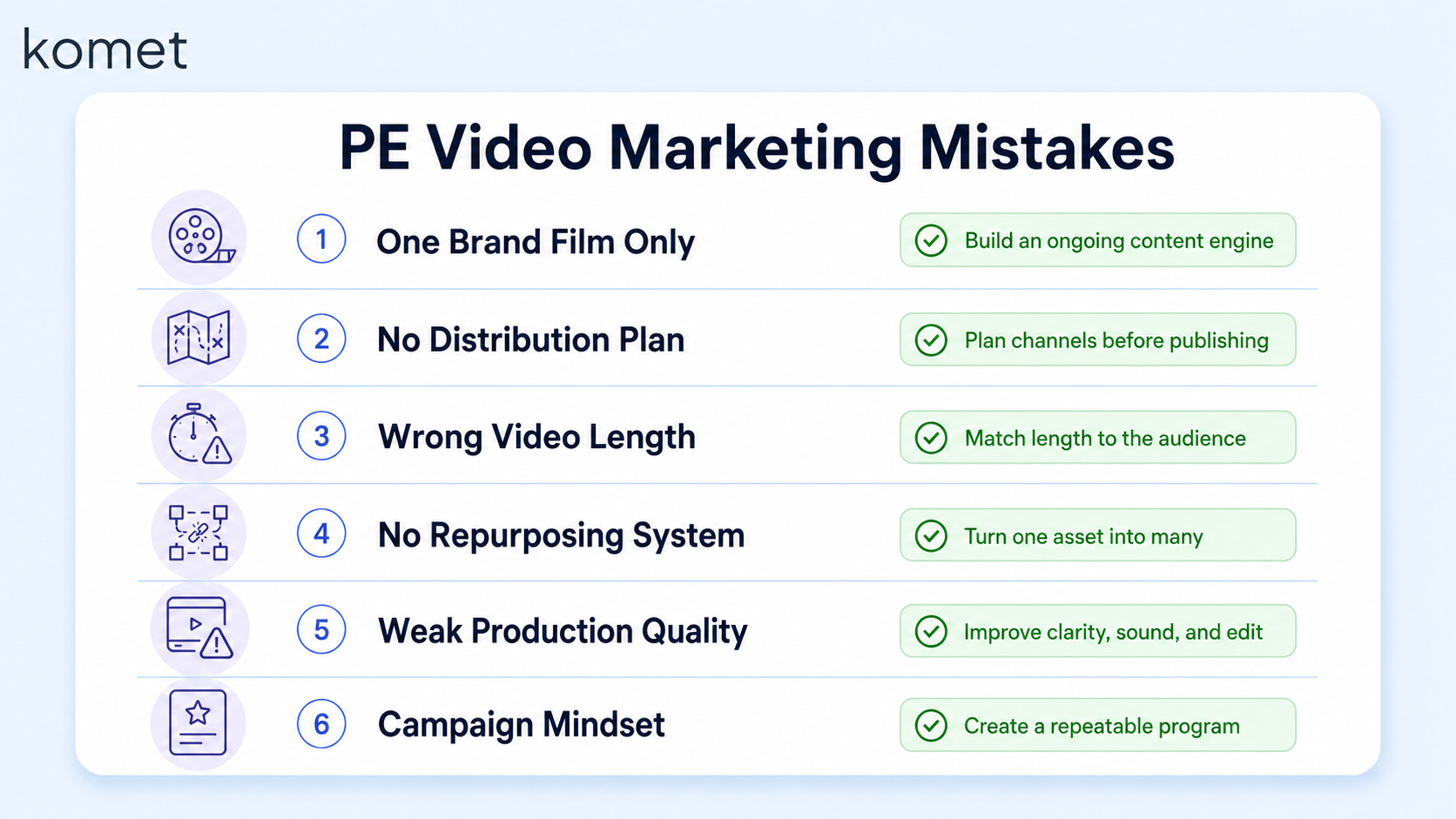
Mistake 1: Producing a brand film and calling it a strategy. The self-promotional overview video is the least effective format a PE firm can produce. These videos often miss the mark, the messaging is self-promotional, the production is too long, and the content becomes outdated the moment someone on-camera leaves the firm. It consumes the entire video budget and produces one asset with a six-month shelf life.
Mistake 2: No distribution plan. A video published once to a firm's website and never shared again generates zero compounding value. The video editing services component is only 30% of the equation; the other 70% is systematic distribution across LinkedIn, email, the LP portal, and YouTube channel optimization.
Mistake 3: Wrong length for the audience. 71% believe videos between 30 seconds and 2 minutes are most effective, but "shortest" is not always "best," especially for consideration-stage content. LP update videos and thesis explainers require more time; awareness clips for deal sourcing require less.
Mistake 4: No content repurposing system. Producing net-new video for every touchpoint is expensive and unsustainable. The highest-ROI approach is building a repurposing engine: one long-form webinar or podcast episode becomes six LinkedIn clips, two LP email embeds, and one YouTube asset.
Mistake 5: Skipping the due diligence process on production quality. 87% of consumers say video quality significantly influences their trust in a brand. A PE firm managing institutional capital cannot afford production that signals anything less than precision and professionalism.
Mistake 6: Treating video as a campaign, not a system. Episodic effort produces episodic results. The firms compounding brand authority are posting consistently, not perfectly, across LinkedIn thought leadership, portfolio stories, and partner insights on a regular cadence.
How Video Marketing Helps Private Equity Firms Raise Capital Faster
The connection between video content and faster capital formation is not theoretical. It operates through a specific mechanism: pre-meeting trust acceleration. Fundraising remains difficult for most managers, with capital concentrated among the largest firms.
For a mid-market or emerging manager trying to break into an allocator's shortlist, the first interaction is rarely a formal meeting, it is a digital search. An LP who searches a firm's partners and finds a library of clear, credible video content arrives at the first meeting already warmed, already familiar, and already partway through the due diligence process. 85% of video marketers say video has helped them generate leads, and 83% say video has directly increased sales. Translated to PE context: video content shortens the qualification cycle and accelerates the LP conviction timeline.
The B2B demand generation mechanics work like this. A managing partner publishes a 90-second thesis clip on LinkedIn. A family office allocator sees it, connects, and downloads a fund overview. That is a deal flow pipeline interaction that begins entirely through video, no cold call, no conference, no introduction required. 93% of video marketers say video has helped them increase brand authority awareness. For PE firms where reputation and authority are the primary trust signals evaluated by institutional LPs, that outcome directly translates to fundraising velocity.
The webinar and events format also deserves dedicated attention. A live GP-led webinar on sector thesis, recorded and repurposed into short clips, produces both an immediate LP engagement moment and a long-tail content asset that continues generating inbound awareness for 12–18 months after the original broadcast.
Capital concentration among the top PE brands is accelerating. The firms building video systems today are compounding brand authority that will be nearly impossible to replicate in three years.
Conclusion
The private equity firms raising capital consistently in 2026 are not just outperforming on DPI, they are outperforming on visibility, trust, and digital presence. Video marketing is the system that makes expertise legible to the LPs, founders, and operators who matter most.
Key takeaways:
- Partner thought leadership clips and LP update videos deliver the highest ROI with the lowest complexity.
- LinkedIn is the primary distribution channel for external-facing PE video content.
- Repurposing existing long-form content (webinars, podcasts, conference keynotes) is the most cost-efficient path to content velocity.
- Video is not a campaign, it is a compounding trust system that gets more valuable the longer it runs.
Ready to build yours? Talk to Komet Media about a video system built for serious PE firms.
Frequently Asked Questions
Q1: How often should a private equity firm post video content on LinkedIn?
Consistency beats frequency. Two to three short-form videos per week, tied to partner insights or portfolio updates, build more compounding authority than a burst of ten clips before a fundraiser. The algorithm rewards regular cadence, and LPs notice the consistency.
Q2: What is the ideal length for an LP pitch video?
Keep it under five minutes. Three to four minutes is the sweet spot: enough time to communicate thesis, team, and track record signals, short enough to watch in a single sitting. A video over eight minutes is a pitch deck, not a trust asset.
Q3: Should PE firms use short-form video or long-form video for LinkedIn?
Both, with different jobs. 71% of video marketers believe videos between 30 seconds and 2 minutes are most effective for top-of-funnel awareness. Short-form clips build reach and familiarity; longer thought leadership pieces (5–10 minutes on YouTube) handle depth and conviction for LPs already in the pipeline.
Q4: Can video content help with deal sourcing, not just fundraising?
Yes, and it is one of the most underused applications. Founder-facing content that clearly communicates what a firm acquires, how they work with management teams, and what operational value they bring positions the firm inside the deal flow pipeline before any intermediary makes an introduction.
Q5: How does Komet Media approach video for PE firms specifically?
They build video systems, not one-off productions. That means identifying the content a firm already generates (partner insights, quarterly letters, conference presentations), turning it into a repeatable short-form and long-form video asset pipeline, and distributing it across LinkedIn, YouTube, and LP-facing channels for maximum trust and visibility leverage. See the full service overview here.
Q6: What is the biggest ROI driver in PE video marketing?
Partner visibility on LinkedIn. A managing partner or sector head publishing consistent, thesis-driven video clips builds a personal brand that becomes the firm's most credible trust signal. It is the fastest way to move from unknown to shortlisted in an allocator's mind, and it costs far less than a conference sponsorship that disappears in 48 hours.