
🪄 AI Summary
Heading 1
Heading 2
Heading 3
Heading 4
Heading 5
Heading 6
Lorem ipsum dolor sit amet, consectetur adipiscing elit, sed do eiusmod tempor incididunt ut labore et dolore magna aliqua. Ut enim ad minim veniam, quis nostrud exercitation ullamco laboris nisi ut aliquip ex ea commodo consequat. Duis aute irure dolor in reprehenderit in voluptate velit esse cillum dolore eu fugiat nulla pariatur.
Block quote
Ordered list
- Item 1
- Item 2
- Item 3
Unordered list
- Item A
- Item B
- Item C
Bold text
Emphasis
Superscript
Subscript
Most founders have the ideas. They've had the conversations, won the deals, and learned the hard lessons. What they don't have is a system for turning that knowledge into consistent visibility. A well-structured Founder POV Video Series on LinkedIn fixes exactly that, putting your perspective in front of the buyers, investors, and candidates who need to see it before they ever reach out.
TL;DR
- A Founder POV Video Series on LinkedIn is a recurring short-form video format where you share your direct perspective on business, industry, and decisions.
- LinkedIn native video posts generate a 5.60% engagement rate, outperforming text by a wide margin.
- Post 2–4 times per week with a clear series theme, tight hooks, and captions to maximize organic reach.
- The goal is not content for content's sake. It is a trust system that compounds over time.
What Is a Founder POV Video Series on LinkedIn?
A Founder POV Video Series on LinkedIn is a structured, recurring video content format where you, the founder or executive, speak directly to camera about a defined set of topics relevant to your buyers, peers, or market. It is not a random collection of clips. It is a themed, branded series with a consistent format, consistent cadence, and a specific audience in mind.
The "POV" label matters. This is not a product demo, a company announcement, or a corporate talking-head reel. It is your perspective, spoken in your voice, on topics where your experience gives you standing to take a position. Think: what you've learned closing enterprise deals, how you made a hard hiring decision, or why the conventional wisdom in your industry is wrong.
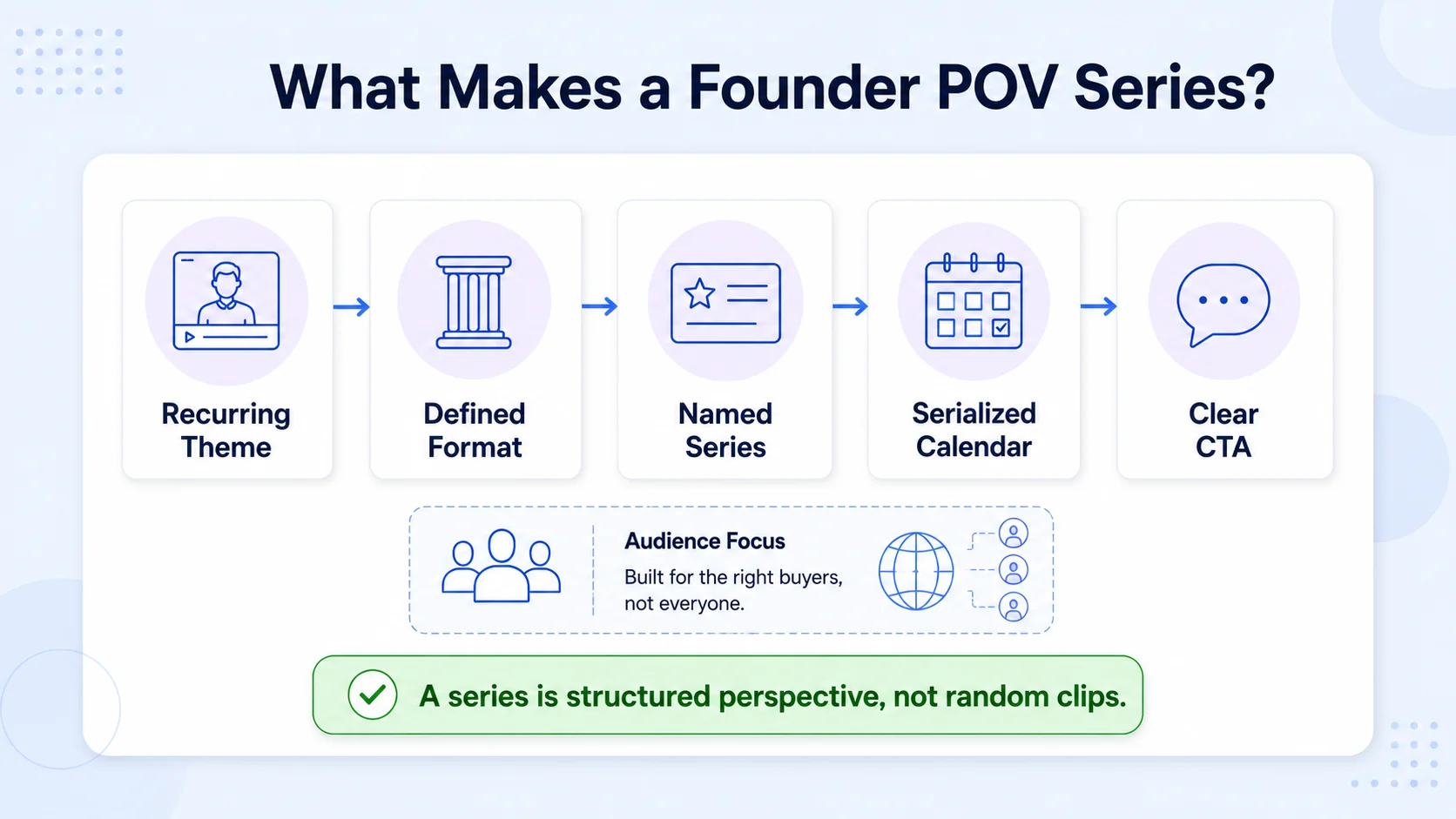
Here is what distinguishes a true series from one-off posts:
- Recurring theme: Every episode connects to a defined topic pillar (e.g., "founder-led sales," "scaling without VC," "building in public").
- Defined format: Consistent video length, style, and hook structure so your audience knows what to expect.
- Named series: Gives your content identity and makes it searchable (e.g., "The 5-Minute Founder" or "Unfiltered: CEO Perspective").
- Serialized content calendar: Episodes are planned in batches, not reactive.
- Call to action: Each episode ends with a clear, specific prompt to comment, connect, or follow.
The case for this format in 2026 is structural. LinkedIn reported its third straight quarter of double-digit growth in video uploads in Q1 2026 , and according to LinkedIn Marketing Solutions, 4 out of 5 LinkedIn members drive business decisions at their organizations. A founder who shows up consistently on this platform with a clear POV is not just building an audience. They are sitting inside the feed of their next buyer every time they post. For founders without an existing content library, this series is also the starting point. You do not need repurposed assets from day one. You need a camera, a topic, and a framework.
How to Start a Founder POV Video Series on LinkedIn
Starting well beats starting perfectly. Here is the exact sequence I use and recommend to founders at Komet Media:
- Define your positioning pillar: Choose one to two core topics you will own. Not five. The 2026 LinkedIn algorithm, known as 360Brew, rewards narrow topic consistency. Post regularly about a narrow topic and 360Brew learns to distribute your content to people interested in that topic, even outside your network.
- Name your series: A named series gives each episode identity and compounds searchability. It also signals to your audience that more is coming.
- Build a 12-episode content calendar: Plan your first 12 episodes before you record episode one. Group them into three themes (4 episodes each) so there is logical progression.
- Set your format: Choose a talking head video format, 45–90 seconds for discovery episodes, longer for warmer audiences. The 2026 LinkedIn algorithm prioritizes native video, dwell time, and educational content. Short clips between 30 and 90 seconds work best for discovery, while longer videos (2 to 5 minutes) are better suited for audiences who already know you.
- Record in batches: Film 4–6 episodes in one session. This is the single biggest time-efficiency unlock for busy founders.
- Enable LinkedIn Creator Mode: This switches your default action to "Follow," expands your reach to non-connections, and unlocks video analytics. Essential for any serious series.
- Upload natively: Never share a YouTube or Vimeo link. Native LinkedIn videos get an average of 5x more organic reach than external video links.
- Write a strong caption with a question: Asking a question in the caption increases comment volume by 33%.
The entire setup, pillar definition through the first published episode, can be done in one week. Batch recording every two weeks keeps the calendar full without burning out the founder.
How to Structure Each Episode for Maximum Engagement
The structure of each individual video determines whether it gets watched or skipped. On LinkedIn in 2026, the algorithm is obsessed with one metric above all others: completion rate. Not views. Not likes. Whether people actually watch your entire video.
Every episode should follow this framework:
- Hook (0–3 seconds): State a result, a mistake, or a counterintuitive claim. Not "Hi, I'm Rajan and today I want to discuss..." More like "We lost a $200K deal because of one slide." The hook cannot be about you. It has to be about them.
- Stakes (3–10 seconds): Why does this matter to your specific viewer? Name them. Videos that mention the audience ("you," "your," etc.) in the first 15 seconds see a 22% lift in engagement.
- Insight (10–60 seconds): Deliver one specific, actionable observation from your real experience. Not advice-column generics. Specificity drives algorithm distribution.
- POV (60–75 seconds): Take a clear stance. Disagree with conventional wisdom if warranted. Videos where the creator has skin in the game, sharing their own failures, investments, or real results, consistently outperform theoretical content. Appropriate controversy, not clickbait drama but willingness to take a position some people might disagree with, is rewarded.
- Call to action (final 5 seconds): Ask a real question or tell them exactly what to do next. Videos with direct CTAs in the final 10 seconds get 27% more likes and comments.
Technical non-negotiables:
- Always add captions. Add captions for 85% of users who watch without sound.
- Use a vertical (9:16) or square (1:1) format. Vertical videos receive 58% more engagement on mobile compared to landscape formats.
- Invest in audio before investing in a camera. A bad microphone kills completion rate immediately.
- Add a custom thumbnail. Video posts with a custom thumbnail drive 24% more engagement than those using auto-generated frames.
How Often Should Founders Post Video Content on LinkedIn?
Posting frequency is where most founders either under-invest or burnout trying to post daily. Neither extreme serves the goal of building a trusted Founder POV Video Series on LinkedIn.
The data and the algorithm tell a consistent story:
Companies that post at least once a week see 2x higher engagement with their content, making a regular posting schedule one of the easiest wins. For personal profiles specifically, daily posting is acceptable for individual profiles, but only if quality stays high.
The cadence I recommend for founders building a new series: 2–3 videos per week for the first 90 days. This is enough to train the algorithm on your topic DNA, build recognizable series identity with your audience, and generate enough data to see what specific angles land.
For timing, engagement rates peak when videos are published between 9 AM and 11 AM local time. Tuesday through Thursday consistently outperforms the rest of the week. Inconsistent posting schedules reduce average watch time by 18% over time , which feeds directly into the algorithm penalizing your next post. Consistency is not a vanity metric. It is a distribution signal. Batch recording solves the consistency problem. Three hours in the camera one Saturday produces two weeks of content. That is the actual workflow, not daily inspiration.
What Makes a Founder Video Series Successful on LinkedIn: The Algorithm Reality in 2026
Understanding the 2026 LinkedIn algorithm is not optional for a founder building a video series. The rules changed significantly, and many founders are still playing by the 2023 playbook.
Here is what actually drives distribution for a Founder POV Video Series on LinkedIn in 2026:
What the algorithm rewards:
- Dwell time and completion rate above all else. LinkedIn's ranking system shifted from rewarding viral reach to "Depth and Authority." The algorithm measures how long people actually engage with your content. A post someone reads for 30 seconds outperforms one with 50 quick likes.
- Niche topic consistency. Post about one topic consistently and LinkedIn recognizes your expertise. Post about everything and the algorithm cannot categorize you. Pick your niche and own it completely.
- First-hour engagement quality. The algorithm shows your post to 2–5% of your network within the first 60 minutes. Engagement quality during this window determines platform-wide amplification potential. Strong signals trigger second and third-degree distribution. Weak engagement kills the post immediately.
What gets penalized:
- External links in posts. Posts with links to external websites see approximately 60% less reach than identical posts without links.
- Engagement pods and automation. LinkedIn's March 2026 Authenticity Update officially killed engagement bait, automation pods, and external link spam.
- Posting without a defined topic identity. The 360Brew system distributes based on demonstrated expertise, not network size.
According to LinkedIn, thought leadership posts generate 6x more engagement than job-related content.
A founder POV series is the most direct expression of thought leadership the platform can reward.
Common Mistakes Founders Make with LinkedIn Video Content
Knowing what not to do is as important as knowing the right strategy. Here are the most common patterns I see founders fall into:
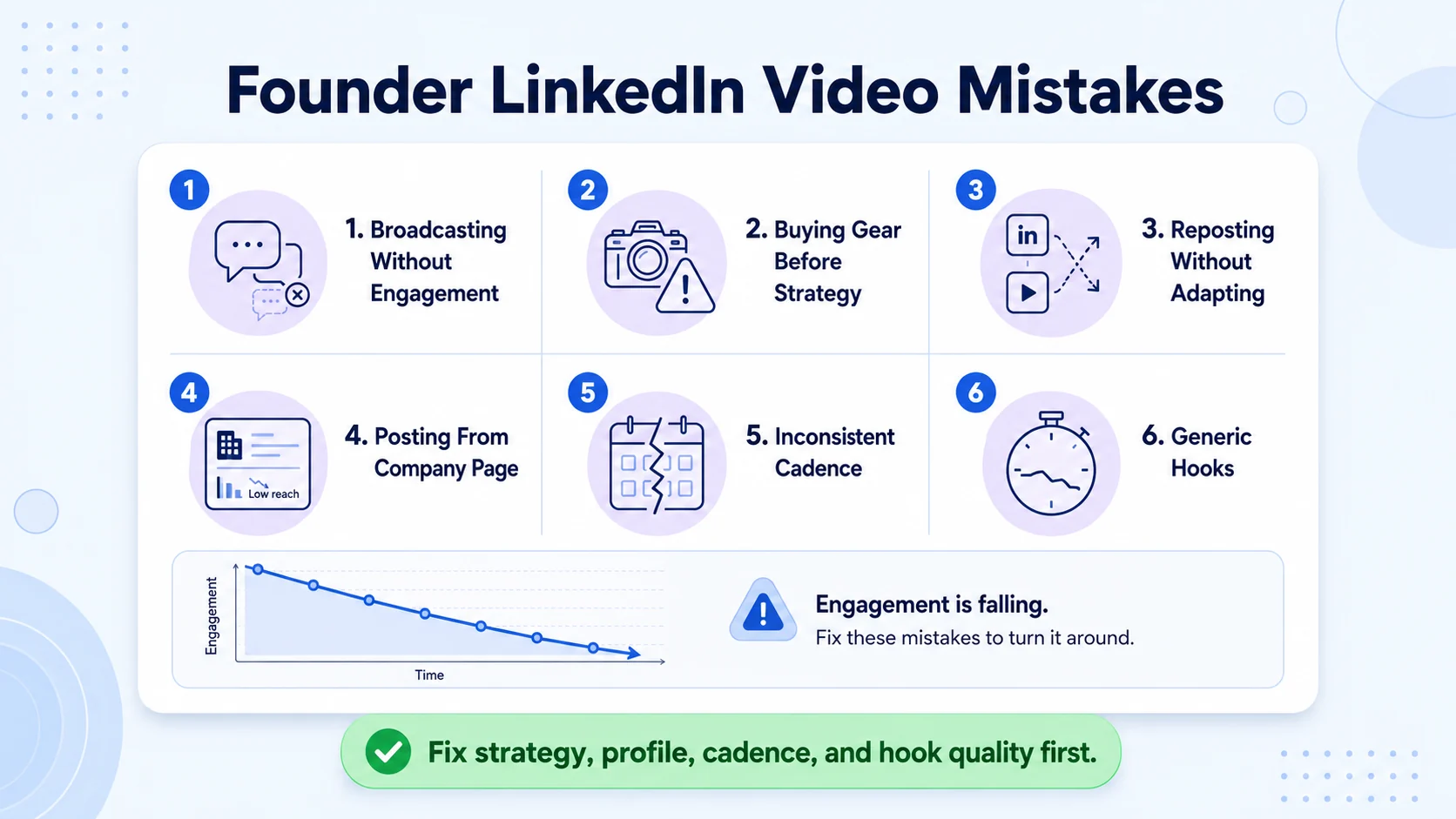
Mistake 1: Treating LinkedIn like a broadcast channel. Posting without engaging in the first 60 minutes kills reach. Respond to every comment within the first hour. A post with twelve substantive comments that spark discussion will outperform a post with fifty generic reactions. Posts with fewer but deeper comment threads reached 3.2 times more people and drove eight times more profile visits.
Mistake 2: Starting with production, not strategy. Founders spend money on cameras and lighting before they have a topic pillar, a series name, or a content calendar. Gear is the last decision. Topic authority is the first.
Mistake 3: Posting the same video to all platforms without adaptation. A LinkedIn native video is not the same as a YouTube repost. Native LinkedIn videos average 5.60% engagement rate in 2025. The key is creating videos specifically for LinkedIn's feed rather than just dumping your YouTube content.
Mistake 4: Posting from the company page instead of a personal profile. Personal profiles receive 65% of LinkedIn feed allocation, while company pages receive just 5%. A founder's personal profile almost always outperforms the brand page for reach and trust.
Mistake 5: Inconsistent cadence with no batch strategy. Posting three times one week and zero the next trains the algorithm to deprioritize you. The fix is simple: batch record, schedule in advance, and never go dark.
Mistake 6: Generic hooks. "I've been thinking about leadership lately..." is not a hook. It is a skip. The first three seconds decide everything. If you do not lead with stakes, tension, or a specific claim, the video fails before it starts.
For founders who want support turning their existing conversations, podcasts, or webinar recordings into a structured series, our short-form video editing service and video marketing offering are built exactly for this workflow. If you are already recording a podcast, our podcast editing and podcast production team can turn every episode into LinkedIn-native video clips automatically.
LinkedIn Video Strategy for Startup Founders Building Personal Brand Authority
Building a personal brand on LinkedIn through video is not a vanity play. It is a buyer trust mechanism, a talent magnet, and an investor signal, all running simultaneously from the same content. LinkedIn is home to 10 million C-level executives, along with 63 million decision makers and 180 million senior-level influencers. When your series reaches even a fraction of that audience consistently, the compounding effect on pipeline and reputation is measurable.
Here is how to frame your Founder POV Video Series on LinkedIn as a full personal branding system:
Content distribution layer: Your video series is not a standalone effort. It feeds everything. A webinar can be cut down into three or four short standalone videos, all without requiring your team to invent new ideas from scratch. Repurpose every long-form asset you already have: podcast recordings, panel appearances, investor decks, team meetings.
Social proof accumulation: Every episode that earns comments, shares, and saves builds credibility signals on your public profile. Buyers who visit your profile after a referral or cold outreach see 12 episodes of consistent, specific insight. That is the difference between "looks interesting" and "let's talk."
Audience engagement metrics that matter: Track completion rate, comment depth, and profile visits from video posts, not vanity metrics like raw view counts. Videos that receive engagement in the first hour are 4.1x more likely to be promoted by the algorithm.
Digital brand authority through topic ownership: Choose two or three topics and never deviate. Over 90 days, the LinkedIn algorithm assigns you topical authority and begins distributing your content to relevant professionals outside your network. This is how a founder with 3,000 connections reaches 50,000 relevant buyers.
For founders ready to build this system, the Komet Media services page outlines how we build the full video production workflow, from concept to published episode. You can also contact us directly to discuss your current content situation.
Conclusion
A Founder POV Video Series on LinkedIn is the highest-leverage content format available to B2B founders in 2026. The platform is actively rewarding native video, niche consistency, and authentic voices. Buyers, investors, and candidates are all on LinkedIn and making trust decisions based on what they see in their feed.
Key takeaways:
- Define one topic pillar, name your series, and plan 12 episodes before you record anything.
- Post 2–3 times per week, upload natively, add captions, and respond within the first hour.
- Lead every episode with a specific hook and end with a genuine CTA.
- Post from your personal profile, not your company page.
- Turn every long-form asset you already own into series content.
Frequently Asked Questions
Q1: What is a Founder POV Video Series on LinkedIn?
A Founder POV Video Series on LinkedIn is a recurring short-form video format where a founder or executive shares their direct perspective on industry topics, business decisions, and market insights. It is structured, themed, and posted on a consistent cadence to build authority, trust, and visibility with a defined professional audience.
Q2: How long should each video be in a founder video series?
For discovery and new audiences, 45–90 seconds is the optimal length. Videos under 60 seconds retain approximately 87% of viewers to completion, which is the metric the LinkedIn algorithm uses most heavily for distribution. For your existing audience, 2–5 minute deeper-dive episodes also perform well.
Q3: Do I need professional video equipment to start?
No. Audio quality matters far more than camera quality. A $50 external microphone, good natural lighting, and a clean background are sufficient to start. Vertical format (9:16) shot on a modern smartphone outperforms polished corporate video that was produced for a different platform.
Q4: How many episodes should I plan before launching a founder video series?
Plan a minimum of 12 episodes before recording episode one. This ensures you have consistent topic pillars, prevents content drought, and allows you to batch-record two to three weeks of content in a single session. Running out of ideas on week two is the most common failure mode.
Q5: Should I post from my personal profile or my company page?
Always your personal profile. Personal profiles receive 65% of LinkedIn's feed allocation versus just 5% for company pages. Founder-led marketing from a personal profile also signals authenticity, which the 2026 LinkedIn algorithm actively favors over polished brand content.
Q6: How does a founder video series help with hiring and investor interest?
Consistent video content creates a public record of your thinking, judgment, and leadership style. Candidates and investors research founders before reaching out. A 20-episode series demonstrating specific domain expertise and clear strategic thinking is stronger social proof than any pitch deck. It also attracts inbound interest from people who already trust you before the first conversation.