
🪄 AI Summary
Heading 1
Heading 2
Heading 3
Heading 4
Heading 5
Heading 6
Lorem ipsum dolor sit amet, consectetur adipiscing elit, sed do eiusmod tempor incididunt ut labore et dolore magna aliqua. Ut enim ad minim veniam, quis nostrud exercitation ullamco laboris nisi ut aliquip ex ea commodo consequat. Duis aute irure dolor in reprehenderit in voluptate velit esse cillum dolore eu fugiat nulla pariatur.
Block quote
Ordered list
- Item 1
- Item 2
- Item 3
Unordered list
- Item A
- Item B
- Item C
Bold text
Emphasis
Superscript
Subscript
I've worked with enough B2B SaaS teams to know the pattern: a founder hosts a strong webinar, maybe a sharp 45-minute podcast episode, and then it disappears. The recording sits in a Google Drive folder. Three days later, no one mentions it. A week later, the pipeline hasn't moved. This is exactly why your webinars and podcasts get forgotten, and how to fix it is the whole point of this guide. The content isn't the problem. The system is.
TL;DR
- Most webinars and podcasts are treated as live events, not content assets, which causes immediate content decay.
- Short-form video clip extraction is the fastest way to extend lifespan and drive re-discovery.
- A repurposing system can turn one 45-minute recording into 15-30 channel-ready assets.
- Consistency without distribution is still invisible.
Why Nobody Remembers Your Webinar After a Week
The problem isn't that your webinar was bad. The problem is that you built a live event when you needed to build an evergreen content asset. Nearly 42% of total webinar viewership happens after the live event ends, making on-demand availability and follow-up content essential parts of any webinar strategy. Yet most teams send one follow-up email with a replay link and call it done. That's a single touchpoint for an asset that should generate 30. Content decay is real and fast. The attention economy doesn't wait.
Consumers remember 95% of messages from video clips compared to just 10% from text posts. So if your only post-webinar output is a replay link buried in an email, you're counting on 10% retention from the fraction of people who actually click. That math doesn't support pipelines. The core structural failure is what I call the episodic trap: treating every webinar or podcast episode as a standalone media file with a start and end date, rather than as raw material for a content system.
Without repurposing, a podcast episode becomes a one-time piece of content with limited reach and a short lifespan. The same applies to webinars. They're not events. They're vaults of product insight, founder thinking, and buyer education that most teams lock away after one use. 65% of marketers repurpose webinar content, but this is a time-saving, money-saving, and audience-building tactic that the other 35% are skipping entirely. Those teams are paying full production cost for a fraction of the potential return.
For SaaS teams specifically, this missed opportunity stings hardest. A demo walkthrough in a webinar, a founder framing a customer pain point on a podcast, a panel discussion that surfaces real buyer objections, all of it is high-quality, trust-building content. And all of it evaporates without a repurposing system behind it. The fix starts by recognizing the recording isn't the final product. It's the source material.
Why Your Podcast Isn't Growing Even With Consistent Episodes
Consistency is necessary but not sufficient. I see SaaS founders and marketing heads publish weekly episodes for six months and wonder why the pipeline hasn't moved. The issue is that publish-and-move-on is a distribution strategy built for audiences you already have, not buyers who haven't found you yet.
While video content struggles with 12% completion rates, podcasts command 80%+ listener retention through entire episodes. That's a remarkable attention asset. The problem is that most B2B podcasts are only discoverable to people already subscribed. There's no surface area for new buyers to find you between episodes. 42.5% of podcasters still cite audience growth as their primary challenge , and most of them are publishing without distributing. Podcast distribution isn't posting to Apple and Spotify. It's clip extraction, LinkedIn video, YouTube Shorts, snackable content drops mid-week, email sequences between episodes, and show notes that rank in search. That's what turns one recording into seven days of presence.
B2B podcast-engaged prospects close 23% faster than non-engaged ones. But those prospects have to encounter the content more than once, across more than one channel, before that effect kicks in. Brand recall is cumulative. A single audio episode doesn't compound. A system of short-form assets pulled from that episode does. Cross-channel campaigns using both video and audio see 23% higher ROI. The podcasters winning in 2026 are the ones treating every episode as a content atomization event, not a broadcast. The question for your team isn't "how do we make better episodes?" It's "how do we make each episode work harder across more surfaces for longer?"
How to Repurpose Webinar Content So It Keeps Getting Discovered
The goal of repurposing is discoverability after the live moment has passed. Here's the framework I use with B2B SaaS teams at Komet Media:
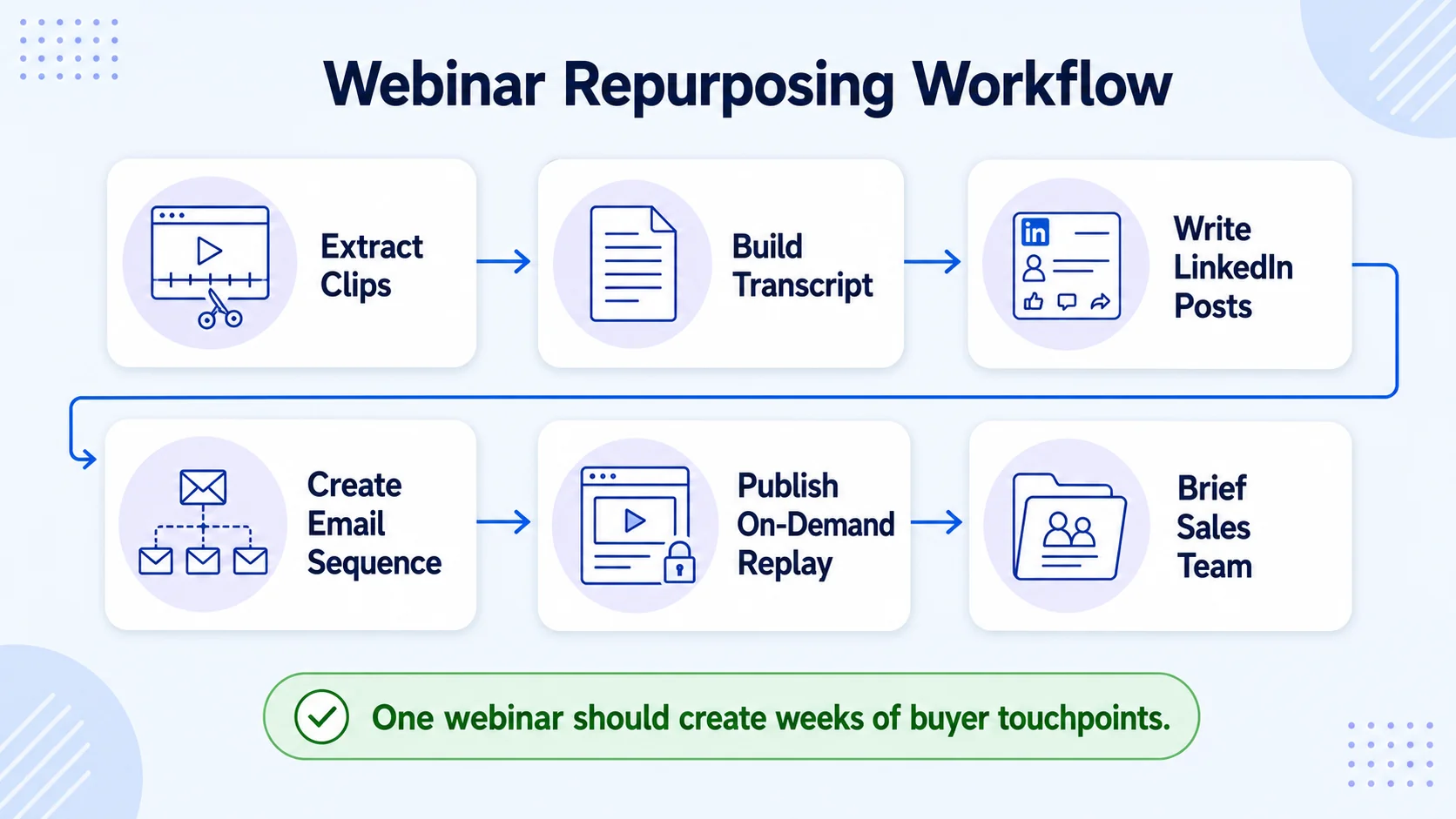
Step 1: Extract the clips first. Before writing a single word, pull 4-8 short-form video clips from the recording. These are your highest-ROI assets because they show the thinking, not just describe it. Target 45-90 seconds per clip for LinkedIn Video and YouTube Shorts. Flag moments where the speaker makes a counterintuitive claim, answers a sharp buyer question, or demonstrates the product in action.
Step 2: Build show notes and a searchable transcript.
Transcripts add thousands of keyword-rich words, improving search rankings and organic traffic. This is how your webinar enters the knowledge graph and gets discovered by buyers who weren't at the live event and never saw your follow-up email.
Step 3: Draft a short-form LinkedIn post per clip. Each clip gets one post. The post frames the insight, the clip proves it. This is how founder-led growth operates in practice: the clip earns the watch, the post earns the share.
Step 4: Repurpose into an email sequence. Each major section of your webinar is one email. Three-part webinar equals a three-part nurture sequence. Link back to the relevant clip. This keeps the content working inside your digital marketing funnel for weeks.
Step 5: Publish the replay as on-demand gated content. Recorded webinars broaden your audience reach and extend the lifespan of your webinar when surfaced through SEO-optimized landing pages. Gate it lightly (first name, email, company) and drive traffic to it from the clips.
Step 6: Brief your sales team. The clips and show notes become sales enablement assets. A prospect who watches a 60-second clip of your founder addressing their exact objection is warmer than one who reads three blog posts. Post-event AI-generated content production increased 3.5X, with e-books, articles, blog posts, and transcripts helping to maximize value and fuel nurture flows once the webinar ends.
That's the direction the market is moving. Build the system now.
How to Turn a Podcast Episode Into Evergreen Content
Evergreen content doesn't happen by accident. It requires deciding, at the production stage, that an episode is a content source, not a deliverable. Here's how that works for B2B podcast teams: The single most valuable action is clip extraction guided by retention data. When analytics show a spike in a recording, that signals a moment people replayed or rewatched. Map those spikes back to the episode timeline, then pull clips from the exact timestamps that earned extra attention. This makes your snackable content decisions data-driven rather than guesswork.
From one well-structured 45-60 minute episode, a full repurposing run produces:
One episode properly repurposed typically yields 15-30 pieces of content, depending on the strategy and formats used. The TikTok Algorithm and LinkedIn Video algorithm both reward original, value-dense short-form content. A 60-second clip of a founder explaining a product insight or a customer pain point gets native reach that a replay link never will. Marketers say short-form video delivers the highest ROI across all content formats, at 21%, outpacing live streaming video at 16% and images at 19%. Clip extraction is not optional for teams that care about inbound demand and thought leadership in 2026.
Best Ways to Extend the Lifespan of Webinar and Podcast Recordings
Lifespan extension comes from distribution breadth and content format variety, not from republishing the same recording in the same place.
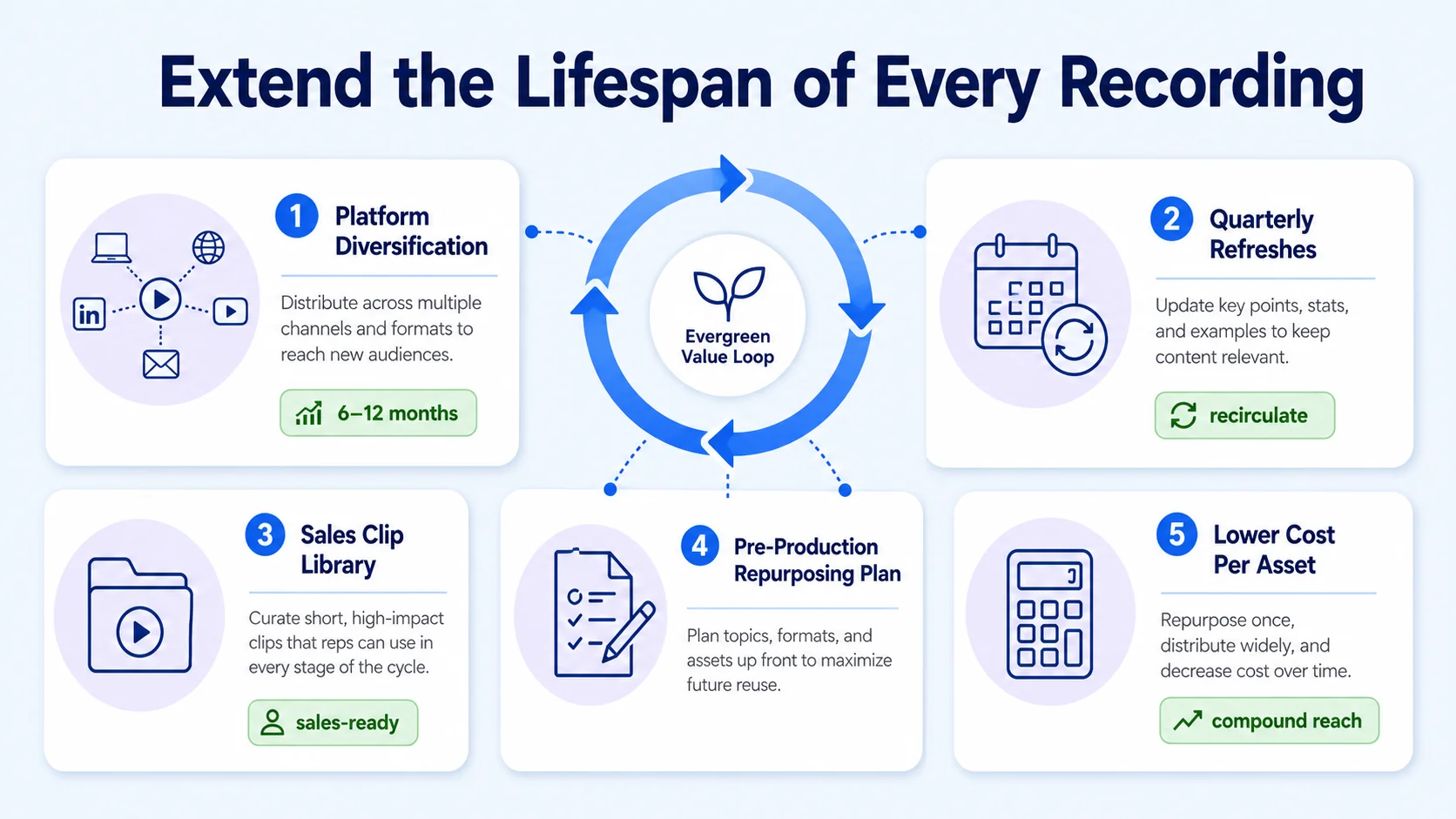
Platform diversification is the floor, not the ceiling. A recording that lives only on your webinar platform has a lifespan of roughly 7-14 days. The same recording, broken into clips distributed across LinkedIn Video, YouTube Shorts, your podcast feed, and email, has a lifespan of 6-12 months as individual assets continue to surface in feeds and search.
Quarterly content refreshes compound the asset. Take your top-performing webinar clip from Q1 and repost it in Q3 with fresh context. Markets shift, buyer pain points resurface, and new audience members haven't seen it. Evergreen content doesn't expire; it just needs re-circulation.
Internal repurposing turns recordings into sales infrastructure. Your short-form video editing workflow should include a step where the sales team receives 2-3 clips per recording with suggested outreach context. "Here's our founder addressing the exact integration concern you mentioned" is a more powerful sales email than any brochure. Repurposing content extends the lifespan of webinars and broadens their impact, helping teams do more with less. The operational logic is straightforward: your production cost is fixed at the recording. Every additional asset you extract from that recording drives the cost-per-asset down while increasing total reach.
The biggest mistake SaaS teams make: treating content repurposing as a post-production task for later, rather than a system designed before recording begins. Build the repurposing plan into the production brief. Using AI to repurpose webinar recordings into blogs, clips, and social posts saved marketers an estimated 13,000 hours in a single year. Systematize this with a consistent workflow and your team stops leaving value on the table after every recording.
How to Repurpose Podcast and Webinar Content Across Multiple Channels
Multi-channel distribution is where content atomization turns into a demand generation system. Here's how it maps across channels for B2B SaaS teams:
LinkedIn Video is the highest-priority channel for B2B SaaS in 2026. Founder clips, product insight moments, and customer objection responses perform well natively. Captions are non-negotiable (85% of LinkedIn videos are watched without sound). Each clip anchors a text post. Link to the full episode in the comments, not the post body, to preserve organic reach.
YouTube Shorts and YouTube serve different purposes. Shorts drive discovery from cold audiences. The full webinar or podcast episode, uploaded to YouTube with SEO-optimized title, description, and chapters, becomes a searchable evergreen content asset. 64% of podcast listeners find YouTube to be a better podcast experience compared to audio-only formats , making it a primary destination for podcast marketing.
Email remains the highest-converting distribution channel for warm audiences. Each repurposed clip or key insight becomes one email. Keep it under 200 words, embed the clip thumbnail with a play button graphic linking to the full episode, and include one CTA aligned to the pipeline (demo request, content download, direct reply).
Podcasts show notes and transcripts feed semantic SEO. Optimizing podcast titles, descriptions, and transcriptions improves discoverability on platforms like Apple Podcasts, Spotify, and Google. Well-structured show notes with timestamps, key quotes, and linked resources help new listeners navigate the episode and help search engines index the content.
Sales sequences are an underused channel. Sales-led teams at SaaS companies should receive a clip library per episode, organized by buyer persona and objection type. A 60-second clip of the founder addressing "we already use tool X" is a direct sales enablement weapon.
The output of a fully executed multi-channel repurposing run isn't just reach. Companies running pipeline-first repurposing strategies see 3x higher ROI compared to teams that publish and move on. That's the gap between content and a content system.
Conclusion
Webinars and podcasts get forgotten because most teams treat them as events. The fix is treating them as raw material for a content system.
Key takeaways:
- One recording, 15-30 assets: clip extraction, show notes, emails, social posts, and sales sequences all come from the same source.
- Short-form video is the distribution engine: LinkedIn Video and YouTube Shorts earn organic reach that replay links never will.
- Data guides what to clip: use retention and replay analytics to find the moments that actually land.
- Repurposing is pre-production: build the distribution plan before the recording starts, not after.
At Komet Media, we build exactly this system for B2B SaaS and funded tech teams. If your webinars and podcasts are generating zero pipeline after the live moment, the problem is solvable. The content is already there.
Frequently Asked Questions
Q1: Why do webinars get forgotten after they end?
Because most teams send one replay email and stop there. Without clip extraction, SEO-optimized on-demand pages, and multi-channel distribution, the webinar has a single touchpoint window. Content decay sets in within days. The fix is a post-production repurposing system, not a better recording.
Q2: How many assets should one podcast episode or webinar produce?
A properly repurposed 45-60 minute recording should yield 15-30 assets: 4-8 short-form video clips, 2-3 audiograms, one SEO blog post, a LinkedIn long-form post, show notes with transcript, an email sequence, and 2-3 sales enablement clips. Each asset extends the content's lifespan on a different channel.
Q3: What makes short-form video clips so effective for content repurposing?
Short-form video earns native platform reach that text and replay links don't. Clips get distributed in feeds to cold audiences. They also drive brand recall far better: video messages are retained at 95% versus 10% for text. For B2B SaaS, clips showing founder thinking or product insights build buyer trust at scale.
Q4: How long does it take for repurposed podcast content to generate pipeline results?
SEO results from transcripts and show notes typically take 3-6 months. Social clip distribution and sales enablement results can appear faster, often within 4-8 weeks of systematic distribution. The compounding effect builds over quarters, not days, which is why consistency in the repurposing system matters more than individual episode performance.
Q5: Should SaaS founders be the ones on camera for these clips?
Founder-led content performs strongest for trust-building and inbound demand. Buyers want to see the thinking behind the product from the people building it. However, subject matter experts, customer success leads, and product managers all make effective clip subjects. Authenticity outperforms polish every time in B2B short-form video.
Q6: How is Komet Media different from video editing subscription services?
Subscription editing services like Vidpros or TastyEdits deliver edited files. Komet Media builds a content system. That means strategy before production, repurposing plans tied to pipeline goals, clip extraction guided by buyer personas, and output designed to support sales enablement and inbound demand, not just fill a content calendar. The deliverable isn't a video. It's a working growth asset.