
🪄 AI Summary
Heading 1
Heading 2
Heading 3
Heading 4
Heading 5
Heading 6
Lorem ipsum dolor sit amet, consectetur adipiscing elit, sed do eiusmod tempor incididunt ut labore et dolore magna aliqua. Ut enim ad minim veniam, quis nostrud exercitation ullamco laboris nisi ut aliquip ex ea commodo consequat. Duis aute irure dolor in reprehenderit in voluptate velit esse cillum dolore eu fugiat nulla pariatur.
Block quote
Ordered list
- Item 1
- Item 2
- Item 3
Unordered list
- Item A
- Item B
- Item C
Bold text
Emphasis
Superscript
Subscript
Most VC firms are invisible to the founders they actually want to back. A cold email from an unknown partner gets ignored. A YouTube channel that has published 50 videos answering exactly the questions your target founders are asking does not. This YouTube playbook for VC firms lays out the system: what to publish, how to structure it, how to optimize it for search, and how to turn partner insights into compounding deal flow. No fluff, no theory.
TL;DR
- YouTube is the highest-trust, highest-retention distribution channel available to VC firms right now.
- Content that articulates your investment thesis, amplifies portfolio founders, and communicates LP updates builds all three audiences simultaneously.
- A consistent video publishing cadence compounds into a proprietary deal flow and LP trust asset over 12 to 18 months.
- Video SEO is the distribution engine that makes organic discovery possible without a paid budget.
Why VC Firms Need a YouTube Strategy in 2026
YouTube is no longer just a social platform. It is now a core component of the search ecosystem, appearing in Google AI Overviews, ChatGPT, Perplexity, and increasingly, generative answer engines. For VC firms, that changes the calculus on fund brand building entirely.
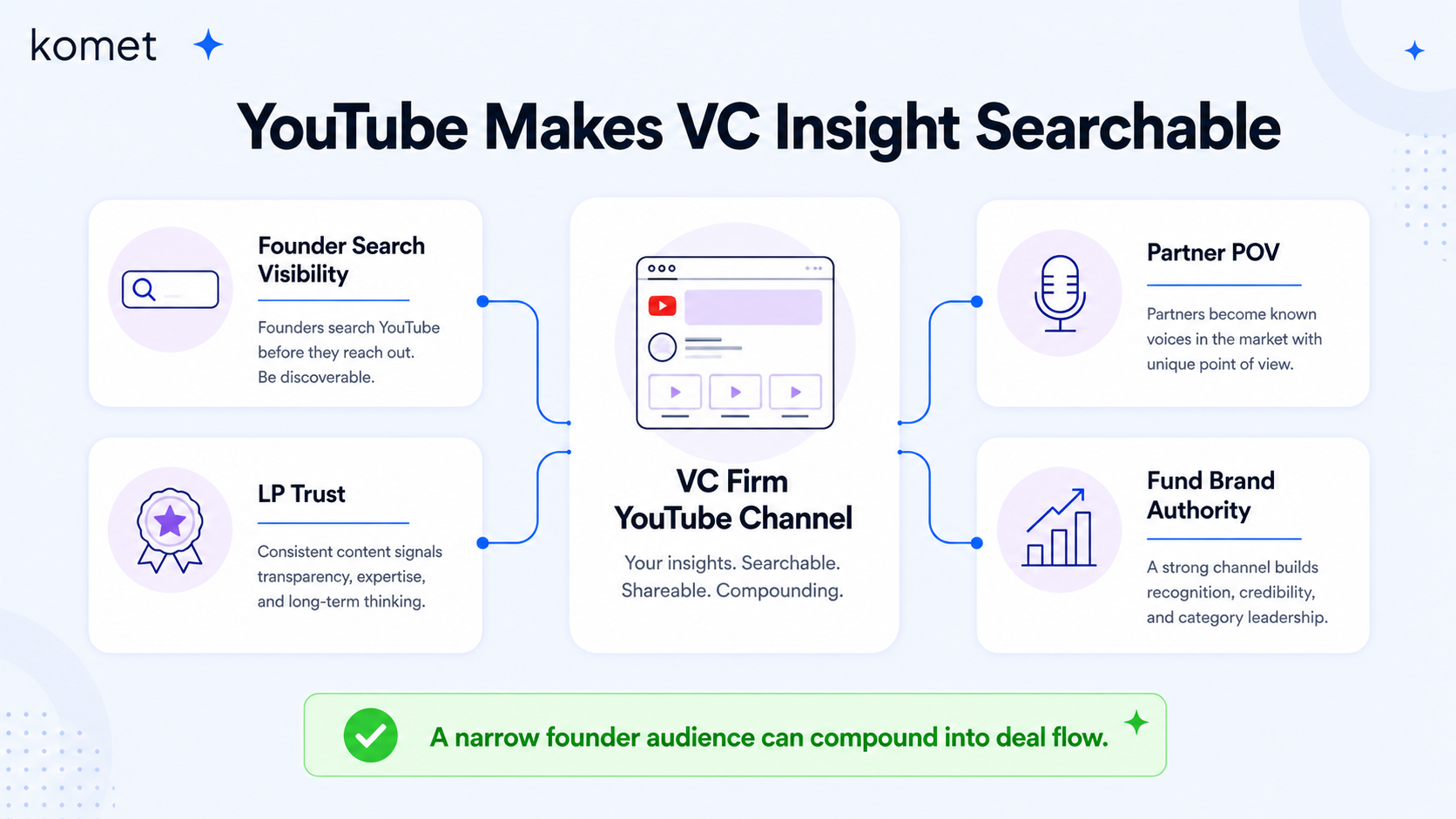
YouTube now receives approximately 48.6 billion visits per month, making it the second most-visited website in the world, trailing only Google.com itself. When a first-time founder is researching which firms to approach, they are on YouTube. When an LP is sizing up a new fund manager, they are on YouTube. When a portfolio company's CEO wants to understand the market, they are on YouTube.
When you help founders directly with the work of being interesting constantly over time, that work compounds in value: in founder goodwill and portfolio outcomes, in follower growth and channel reach, and in tacit knowledge of how to launch a company really well. Andreessen Horowitz understood this early. Each week, a16z shares videos on technology trends and advice for building companies.
That weekly cadence is not content for content's sake; it is a systematic founder acquisition and LP trust-building machine. When talking about "New Media," the goal is this new world where to win you must go direct, and to go direct you must be interesting. For VC firms, that means publishing partner insights, investment theses, and founder conversations in video form rather than waiting to be profiled by TechCrunch.
In 2026, consistency, niche authority, and audience relevance matter more than viral luck. A VC firm that owns a narrow, high-intent search audience of pre-seed and seed-stage founders in a specific vertical will outperform a broader channel with no clear positioning. The YouTube playbook for VC firms is, at its core, a positioning document expressed in video.
What Kind of Videos Should VC Firms Post on YouTube?
Most firms either post nothing or post polished panel recordings that die at 200 views. The firms gaining real traction publish across three content categories that serve distinct audiences.
Thesis content: Videos where a managing partner explains exactly what the firm looks for, what sectors they are excited about, and why. Titles like "Why We Invested in AI Infrastructure Over Vertical SaaS" or "What We Mean by Founder-Market Fit" answer the exact questions founders ask before reaching out. This is investment thesis articulation in searchable, permanent form.
Founder storytelling content: Portfolio company founders interviewed about their origin story, how they closed their first customers, and how they think about their market. The heart of Y Combinator's YouTube strategy lies in its founder stories. From household names like Airbnb and Dropbox to rising stars like Brex and Instacart, these interviews offer a rare glimpse into the journeys of successful startups. For any VC firm, this content doubles as social proof and deal flow magnet simultaneously.
Market point-of-view content: Weekly or bi-weekly takes on what is happening in a sector. Think: "What the OpenAI deal means for enterprise AI infrastructure" or "Why fintech valuations are compressing in 2026." This positions partners as sector experts, not just check-writers, and builds the partner authority that attracts inbound from top-tier founders.
A practical content split for a fund publishing two to three videos per week:
The Komet Media short-form video editing service can handle the repurposing layer so your partners stay focused on ideas, not production. We also produce short-form videos from scratch, regardless of whether or not you have existing content.
How Top VC Firms Use Video to Attract Founders
Andreessen Horowitz does not do small talk. They talk about deep tech, fund mechanics, and market structure directly from partners and portfolio leads, which is exactly what founders in frontier tech, fintech, and infrastructure want. That content specificity is what creates trust before a cold email is ever sent.
Y Combinator operates the most scaled version of this playbook. Y Combinator's YouTube channel grew its subscriber count by 200,000 between November 2025 and May 2026, reaching 2,250,000 total subscribers. That audience is almost entirely composed of founders, aspiring founders, and operators: the exact people a fund wants to be in front of.
The structural reason it works is that the impact of a YouTube channel extends far beyond views and subscribers. It empowers aspiring founders with the knowledge and confidence to take their ideas forward. A founder who has watched 15 hours of a firm's content before reaching out arrives warm, pre-qualified, and already aligned with the fund's investment thesis articulation.
The Alex Hormozi framework for content applies directly here: volume of trust-building content over time beats a single viral moment. For a VC, this means:
- Record every GP call where a partner shares a market perspective. Clip the best three minutes.
- Turn every portfolio company milestone (launch, fundraise, key hire) into a short founder interview.
- Film partner meetings about sector theses. Edit to 10 to 15 minutes. Publish weekly.
- Clip the sharpest takes into 60-second Shorts and push to discovery.
The content distribution flywheel starts with long-form depth and uses short-form reach to feed the top of the funnel. This is the video marketing system that separates firms building real brand equity from those who occasionally post and wonder why nothing compounds.
YouTube for Investor Relations and LP Communication
Limited partner communication is one of the most underserved use cases for video in venture capital. Most funds send quarterly PDF reports that LPs skim at best. A 10-minute video from a managing partner walking through portfolio performance, market conditions, and fund thesis evolution is retained, rewatched, and shared within LP networks.
Sequoia Capital and Andreessen Horowitz both use video as part of their LP communication and thought leadership infrastructure. The carried interest narrative is no longer just a legal document; it is a story that must be told compellingly to attract the next fund's capital.
Key video formats for LP trust and institutional investor relations:
- Annual letter companion video: The managing partner reads and annotates the annual letter on camera. Adds context that a PDF cannot.
- Portfolio spotlight series: Five to eight minute deep-dives on a single portfolio company's progress each month.
- Fund thesis update: Quarterly video where a GP explains how market conditions are validating or challenging the fund thesis.
- Q&A format: LPs submit questions; the GP answers on camera. Creates intimacy and signals accessibility.
Writing one great essay every once in a while, or producing one charming video, is not going to cut it. You need to be relentless if you want a media asset to actually compound. For LP communication specifically, this means treating video updates as a non-negotiable operational rhythm, not an optional extra.
The Komet Media podcast production service and YouTube video editing workflows are built to handle exactly this kind of recurring, high-stakes video output for institutional teams.
How to Grow a YouTube Channel as a Venture Capitalist
Growth on YouTube in 2026 is not about virality. It is about compounding searchability and consistent execution. Here is the system:
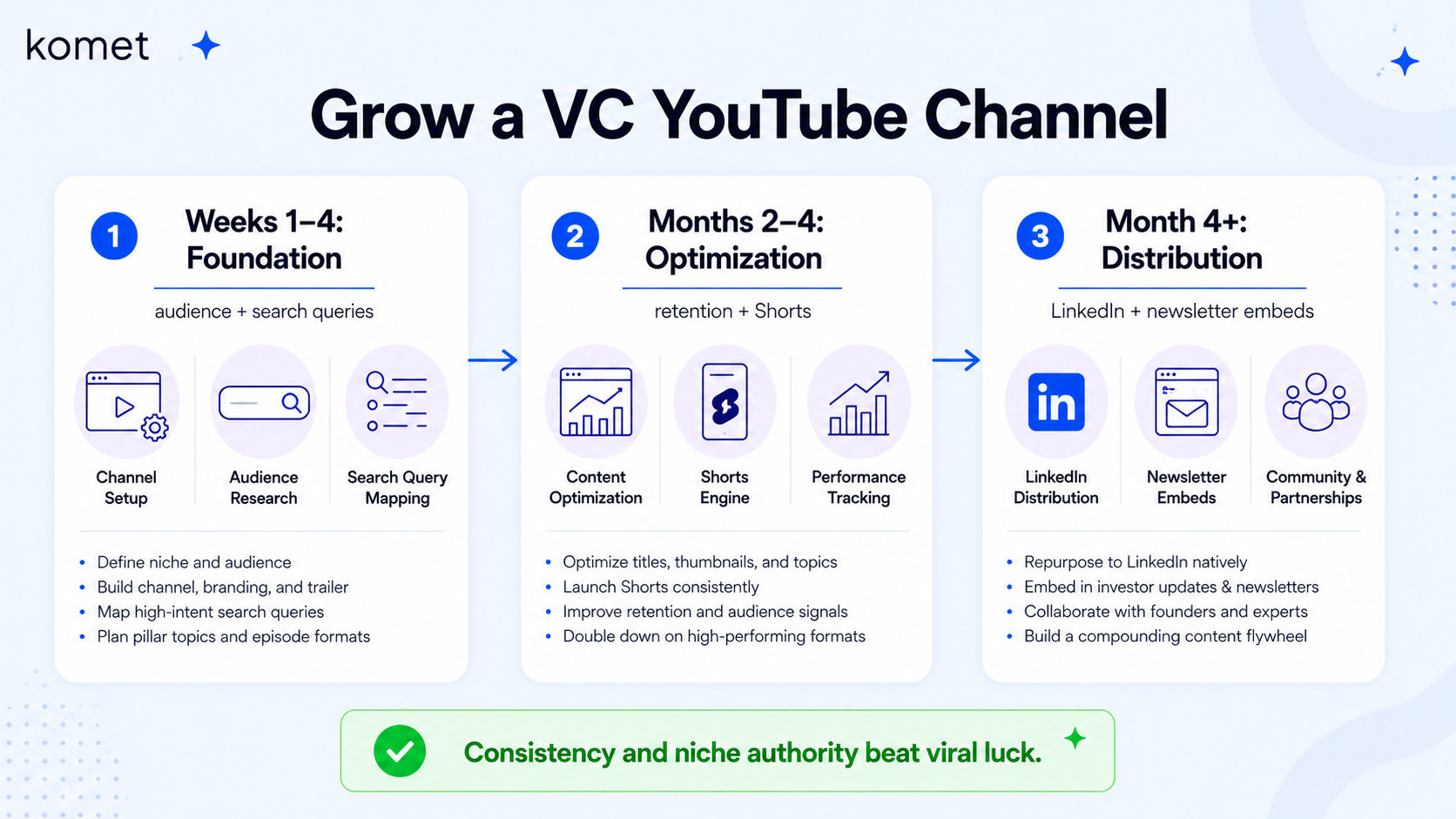
Phase 1: Foundation (Weeks 1 to 4)
- Define one primary audience: founders in a specific stage and sector, or LPs. Do not try to serve both with the same channel in the early phase.
- Build a content calendar around 10 to 15 core search queries your target audience is actively typing into YouTube.
- Record and publish 10 videos before optimizing anything. Volume builds judgment faster than perfection.
- Set up channel metadata correctly: channel description, keywords, and playlists organized by content series.
Phase 2: Optimization (Months 2 to 4)
- Focus on the algorithm signals that matter most: click-through rate, likes, comments, and viewer retention.
- Use Shorts for discovery. Shorts are a major growth driver in 2026, providing high reach and fast views.
- Review YouTube Studio analytics at the end of each month. Double down on content types with above-average retention.
Phase 3: Distribution (Month 4 onward)
- Cross-post clips to LinkedIn, where the founder and LP audiences are most active in parallel.
- Embed video content in the fund newsletter to drive watch time from an existing warm audience.
- Submit podcast episodes from recorded video content to reach the startup ecosystem visibility layer. YouTube Shorts are heavily promoted by the algorithm and can bring new traffic to your channel. Shorts are great for visibility, repurposing content, or teasing longer videos.
A well-defined YouTube content strategy is the foundation of sustainable growth. In 2026, consistency, niche authority, and audience relevance matter more than viral luck.
YouTube SEO Strategy for Venture Capital
YouTube SEO is optimizing your YouTube channel and videos to improve their visibility on YouTube, both in search results and in suggested feeds. It is about making your content easier for people to find on the world's second-largest search engine.
For VC firms, the keyword opportunity is large and largely untapped. Terms like "how to pitch a VC," "what do venture capitalists look for," "seed funding for B2B SaaS," and "how to build investor updates" have high search volume and almost no quality video content from actual funds.
The video SEO optimization checklist for every video published:
- Title: Place the main keyword in the title, as far left as possible. Aim for 50 to 60 characters. Lead with the benefit, not the fund name.
- Description: The first two to three lines should explain what viewers learn. Total description should be 300 to 500 words with natural keyword integration.
- Tags: Choose 8 to 12 tags based on keyword research. Include both broad and niche keywords related to the topic.
- Captions: Upload a transcript. If your video is well-optimized, it does not just appear in search; it is also being quoted by LLMs.
- Chapters: Add timestamps for any video over eight minutes. This creates Google "key moments" snippets that appear in search results.
- Playlists: When you group related videos into a playlist, people are more likely to binge-watch and boost your channel's watch time, signaling to YouTube that your channel is popular.
The YouTube algorithm in 2026 is incredibly sophisticated; multiple algorithms determine what content to show across different surfaces on the platform. Optimizing for search and for suggestions are two separate, parallel disciplines. The firms that treat video SEO as a system rather than a one-time task will own the namespace for venture capital marketing in their category.
Examples of VC Firms with Successful YouTube Channels and What to Learn From Them
The best reference points are already public. Study them structurally, not just for inspiration.
Top VCs break down fund strategy, how decisions are made, what they look for, and how deals get closed. This content is must-watch for founders prepping to pitch tier-1 funds. That is the trust mechanism. A founder who has watched a partner explain their decision-making process on video feels they already know the person before the first meeting.
The MrBeast production framework applies in a narrow but important way: thumbnails, hooks, and retention structure matter regardless of how sophisticated the audience is. A managing partner explaining their investment thesis in the first 15 seconds of a video retains more viewers than one who spends three minutes on introduction. Test thumbnails with a clear visual hierarchy and a single compelling text overlay. Thumbnails with a clear message increase your click-through rate. When paired with an optimized video title, they help your YouTube videos outperform competitors in crowded search queries.
The Komet Media events repurposing service turns summit recordings, panel sessions, and LP meetings into structured video content series without adding production overhead to your team.
Building the Content Distribution Flywheel for Long-Term Deal Flow
A single video does not build deal flow. A system does. The content distribution flywheel for a VC fund looks like this:
- Long-form anchor video (20 to 40 minutes): A partner deep-dive, a founder interview, or a thesis podcast published to YouTube.
- Short-form clips (3 to 5 per long-form piece): The sharpest 60-second moments cut and posted to YouTube Shorts, LinkedIn, and Instagram.
- Written companion content: A blog post or newsletter edition that embeds the video and targets the same search terms in text form.
- Podcast feed: The audio version of the long-form video distributed to Spotify, Apple Podcasts, and the startup ecosystem.
- Warm re-engagement: The newsletter links back to the video; LP updates include the portfolio spotlight clip; the fund website embeds the thesis video.
Businesses can treat YouTube as a one-stop channel: for advertising, content marketing, customer support, and even recruiting to show company culture. For a fund, that last point is significant. The best operators and future GPs are watching the content you publish before they decide where to work.
Effective YouTube promotion combines on-platform optimization with external distribution. Sharing videos across email, social media, and communities helps accelerate early engagement. For a VC fund, the community layer is the startup ecosystem: accelerators, founder forums, operator Slack groups, and co-investor networks.
The carry interest narrative is built video by video. Every clip of a managing partner explaining why they made a specific bet, every founder interview that shows the quality of portfolio company operators, and every market commentary that demonstrates genuine sector fluency adds another data point to the LP's decision to commit to the next fund.
A fund's YouTube channel is not a marketing expense. It is a proprietary asset that compounds in value every time a new founder, LP, or co-investor finds it through search.
Conclusion
The YouTube playbook for VC firms is not complicated, but it requires commitment and system-thinking. Here are the four things that matter most:
- Choose a specific audience first. Founders at seed stage in a specific vertical beats "everyone in tech" every time.
- Publish with enough volume to compound. Two to three videos per week, minimum. One great video per quarter builds nothing.
- Treat every long-form piece as a content production hub. Clips, posts, audio, blog content, and LP updates all flow from one recorded session.
- Optimize for search from day one. Titles, descriptions, chapters, and captions are not optional extras; they are the distribution engine.
The firms that build this system in 2026 will own the namespace for venture capital marketing in their sector for the next decade. Komet Media builds this system for B2B firms that are ready to stop being invisible.
Frequently Asked Questions
Q1: How often should a VC firm publish on YouTube to see real results?
Two to three times per week produces compounding results within six months. One video per week is the viable minimum. Anything less than that generates awareness but does not build the algorithmic momentum or audience trust that drives inbound deal flow or LP confidence.
Q2: Do VC firm YouTube videos need high production quality?
No. Channels adding real value through unique insights, personality, or meaningful commentary perform well regardless of production level. A well-lit, clearly audio-recorded partner sitting at a desk consistently outperforms a slickly produced video published once per quarter.
Q3: Can a VC firm use YouTube for LP communication without compliance issues?
Yes, with care. General partner commentary on market trends and investment thesis articulation is widely published by leading funds. Videos directed specifically at existing LPs that discuss fund performance should be gated or distributed through private channels rather than public YouTube. Always consult legal counsel on what constitutes a general solicitation.
Q4: What is the fastest way to grow a VC firm's YouTube channel from zero?
Start with content that answers high-intent founder questions your partners already know the answers to. Optimize titles for search from video one. Distribute every clip to LinkedIn, where the venture audience already spends time. Use Shorts for discovery. They are a major growth driver in 2026 and provide high reach and fast views.
Q5: How do top VC firms repurpose event content for YouTube?
Conference keynotes, LP summits, founder panels, and demo day recordings are each a production hub. Each one yields a full-length YouTube upload, three to five 60-second Shorts, an audio podcast episode, and a written recap. The Komet Media events content service handles this repurposing workflow end to end.
Q6: How does the YouTube playbook for VC firms differ from general B2B video strategy?
The audience is smaller but the trust stakes are higher. A VC fund does not need 100,000 subscribers to generate meaningful deal flow; it needs 5,000 highly relevant founders and operators watching regularly. This makes niche depth, search optimization, and authentic partner voice more important than reach metrics or subscriber counts.