
🪄 AI Summary
Heading 1
Heading 2
Heading 3
Heading 4
Heading 5
Heading 6
Lorem ipsum dolor sit amet, consectetur adipiscing elit, sed do eiusmod tempor incididunt ut labore et dolore magna aliqua. Ut enim ad minim veniam, quis nostrud exercitation ullamco laboris nisi ut aliquip ex ea commodo consequat. Duis aute irure dolor in reprehenderit in voluptate velit esse cillum dolore eu fugiat nulla pariatur.
Block quote
Ordered list
- Item 1
- Item 2
- Item 3
Unordered list
- Item A
- Item B
- Item C
Bold text
Emphasis
Superscript
Subscript
Most B2B teams treat X as an afterthought, a place to paste links and hope for clicks. That is a waste of the platform's real utility. A deliberate X (Twitter) video strategy for B2B brands turns the platform into a thought leadership engine that feeds your demand generation funnel, warms cold buyers before your SDRs ever reach out, and creates dark social engagement that shows up in pipeline conversations you never saw coming. Here is how to build that system from the ground up.
TL;DR
- Video content delivers up to 10x more interactions than text-only posts on X.
- The sweet spot for B2B video on X is 30–60 seconds, always uploaded natively.
- X works best as a thought leadership and brand authority channel, not a primary lead-gen channel.
- Repurpose your webinars, demos, and podcasts into short clips to fuel the entire strategy without doubling your production budget.
Does Video on X Actually Work for B2B?
The honest answer is: it depends on what you expect from the platform. X is not LinkedIn. LinkedIn generates 80% of B2B social media leads while X contributes 12.73%, a dramatic shift from 2020 when Twitter generated approximately 32% of B2B social leads. That decline is real, and anyone pretending otherwise is selling you something.
But here is what the critics miss: X is not where deals close. It is where deals start. Buyers research vendors across every channel before they ever raise their hand, and X is part of that dark social orbit. A founder clip that a CFO saves, shares in a Slack channel, and screenshots into a board deck, none of that shows up in your CRM attribution. It still moved the sale.
Video earns roughly 9× more engagement than text-only posts and 6× more retweets than photos on X. For a B2B brand trying to cut through a noisy feed, those are meaningful signal multipliers. And according to the 2026 Social Media Content Strategy Report, 37% of users are most likely to interact with short-form video from brands, the highest of any content format on the platform. The practical framing: budget X for brand authority signals and buyer education, not direct pipeline attribution. Use it to prime the audience that LinkedIn and your sales team will then convert. Brands that treat it as a top-of-funnel awareness layer, distributing insight clips, product explainers, and founder perspective, generate the kind of social proof mechanics that compound over months, not days.
X video works for B2B when the goal is trust at scale, not clicks today. Measure it on pipeline influence and inbound demand, not last-touch conversion. X's place in B2B marketing strategy has shifted from primary channel to supporting player. The platform remains useful for thought leadership positioning, real-time industry engagement, and technical community building. That is exactly where a smart X (Twitter) video strategy for B2B brands lives.
What Types of Videos Work Best for B2B Brands on X?
Not all B2B video content travels equally well on X. The platform rewards fast, opinionated, and visually crisp content. Long corporate explainers die in the first scroll. The formats that consistently drive engagement velocity and video completion rate in B2B contexts:
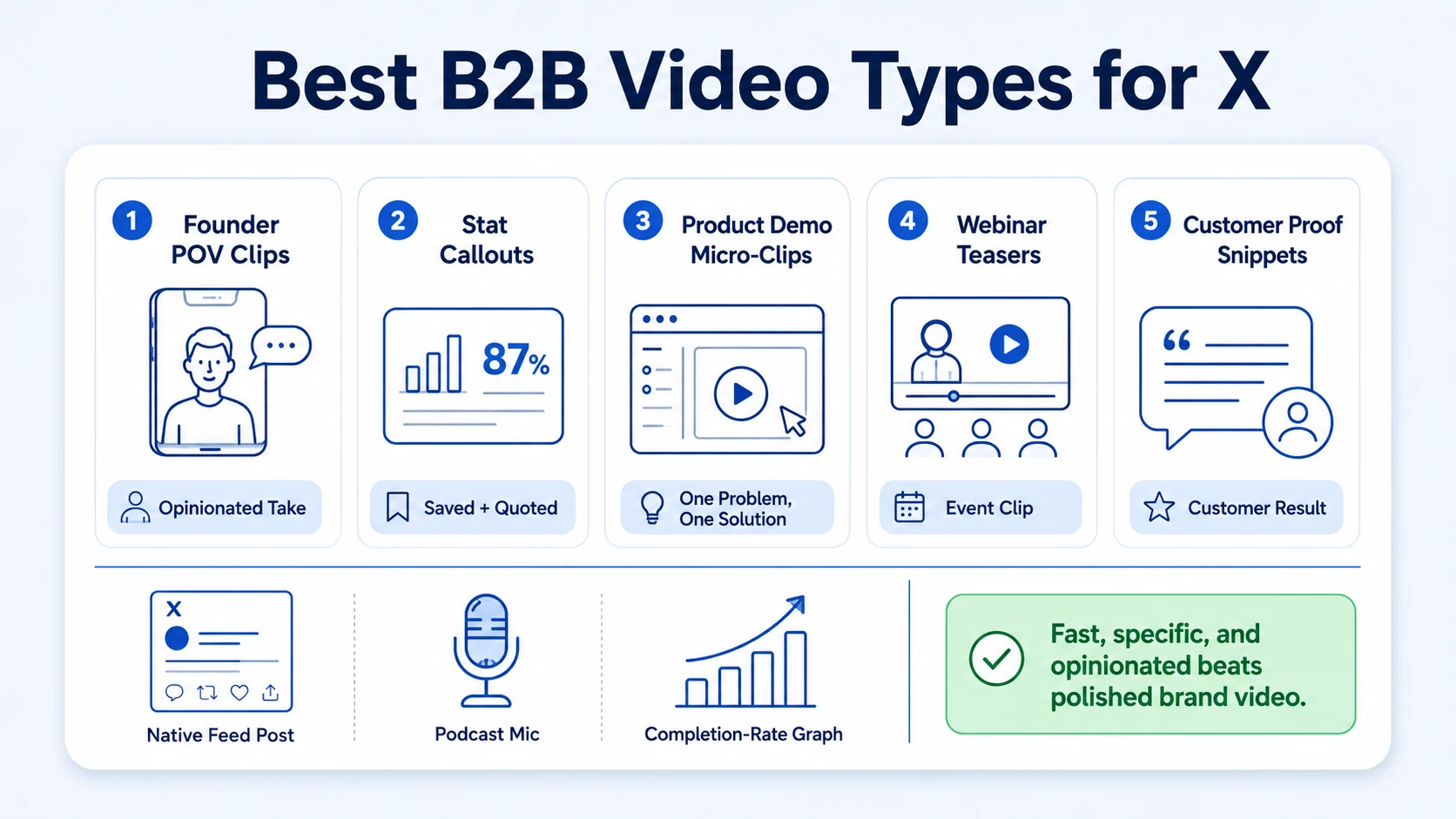
- Founder POV clips: 30–60 second takes on an industry trend, a product decision, or a counterintuitive belief. These build thought leadership positioning faster than any other format because they attach a face and a perspective to the brand.
- Stat or insight callouts: Pull one powerful data point from a report or your own product data, frame it visually, and let the text layer carry the argument. These get saved and quoted.
- Product demo micro-clips: A 45-second clip showing a specific feature solving a specific problem. Not a full demo, one problem, one solution, one moment of clarity. This is pure sales enablement content that buyers share internally.
- Event and webinar teaser clips: Pull the sharpest 30 seconds from your last webinar or podcast recording, add captions, and post natively. It drives registrations and positions your team as people worth listening to.
- Customer proof snippets: A 20-second clip of a customer naming a result. No script, no production polish needed, authenticity is the social proof mechanic here.
The top content categories performing on X are podcast clips (14.5%), news and politics (13.5%), and commentary and talk (9.3%). For B2B brands, podcast clip repurposing and direct commentary on industry developments are the most accessible and highest-leverage entry points.
Avoid: brand anthem videos, animated company overviews, or anything that feels like a TV commercial. X audiences are sophisticated and will scroll past polished but substanceless content without a second of guilt.
What Length Should B2B Twitter Videos Be?
Length is the most controllable lever in your X (Twitter) video strategy for B2B brands, and the data is clear. Based on 380,000 X clips analyzed, the most popular video length is 30–60 seconds, accounting for 40.7% of all high-performing clips. The underlying mechanism is video completion rate. Videos that play to completion get more impressions, and shorter, punchier clips tend to outperform on X.
The algorithm distributes content that people actually finish watching, which means a 45-second clip with a 70% completion rate will consistently outperform a 3-minute clip with a 20% rate. Under 15 seconds gets the most complete views but the lowest total watch time, good for reactions, one-liner takes, and highlight clips. 15 to 30 seconds is the algorithm's comfort zone. For B2B, where you need enough time to make a coherent point, the 30–60 second window is ideal.
In practice, treat 45 seconds as your target and 90 seconds as your ceiling, not because of the platform limit, but because of how X's algorithm distributes video content based on completion rate. On the technical side, always use native video upload rather than linking to YouTube or Vimeo. Native uploads autoplay in-feed; external links do not.
The three main supported video dimensions are 1920×1080 (16:9 landscape), 1080×1920 (9:16 vertical), and 1080×1080 (1:1 square). MP4 or MOV with H.264 video and AAC audio at up to 60 fps is the recommended format in 2026. The most critical window in any X video is the first three seconds. Without autoplay sound, users decide in under three seconds whether to tap for audio or keep scrolling. Open every clip with a visual hook or bold on-screen text, not a logo animation.
How to Use Video on X for B2B Marketing: The Core System
This is the operational layer, the actual system that separates brands generating consistent pipeline influence from those posting randomly and wondering why it isn't working.
- Audit your existing content: Identify every webinar recording, podcast episode, demo call, and founder interview you have produced in the last 90 days. This is your raw material. You do not need to create new content to start, you need to extract what already exists.
- Extract clip candidates: For each long-form asset, pull the 3–5 moments where a single insight lands cleanly in 30–60 seconds. These are your clip candidates. Apply our short-form video editing workflow to each one.
- Add captions natively: Most X users scroll without sound. Burned-in captions are non-negotiable. They also extend watch time by giving the viewer a second modality to follow the content.
- Write a text hook above the video: The copy in your post is as important as the video itself. Lead with a counterintuitive claim, a stat, or a provocative question. The algorithm reads text engagement alongside video completion rate.
- Post natively, not via link: Upload the video file directly to X. Never link to an external video platform for organic posts.
- Reply fast in the first 30–60 minutes: Timing still matters on X. Posts published when your specific audience is online receive front-loaded engagement in the first 30–60 minutes, which signals the algorithm to expand distribution. Reply to every comment in that window.
- Track completion rate, not just views: Video views on X are counted when a video plays for at least two seconds, a relatively low threshold. This means view counts can look impressive while actual engagement depth is shallow. Completion rate is the metric that maps to real buyer attention.
How Often Should B2B Brands Post Videos on X?
Frequency is a question most teams overthink and under-execute on. The answer is simpler than it appears. For B2B brands maintaining a serious X (Twitter) video strategy for B2B brands, a realistic and effective cadence is 3–5 video posts per week. That sounds high until you commit to a content repurposing framework, at which point one webinar or podcast episode yields enough clips for two full weeks of posting.
The best days to post on X are Tuesdays, Wednesdays, and Thursdays, with 9 AM to 3 PM the most engaging hours. For B2B audiences specifically, Tuesday through Thursday mornings align with when decision-makers are most likely to be active and in a professional headspace. X prioritizes content that gets rapid engagement in the first minutes, early likes and retweets compound reach. This means consistency matters more than volume. A predictable posting rhythm trains your existing audience to engage, which consistently seeds new organic reach distribution.
On the question of X Premium verification: X Premium subscribers see 6–10x more impressions on their posts, and Premium+ subscribers see up to 15x more. For B2B brands investing in a serious video presence, the Twitter Blue verification and Premium subscription is a structural advantage worth the cost, it removes an artificial ceiling on your organic reach algorithm. Audience segmentation matters for scheduling. Use Hootsuite analytics or the native X analytics dashboard to identify when your specific follower segment, which for most B2B brands skews toward founders, operators, and buyers, is most active. Global benchmarks are a starting point, not a final answer.
How to Repurpose LinkedIn Video Content for X (Twitter) B2B Strategy
This is the section most B2B teams skip, and it is the one that makes everything else sustainable. Repurposing existing video content is a high-leverage strategy: it saves production time, preserves messaging consistency, and unlocks new audience segments without starting from scratch. The content repurposing framework I use with every client at Komet Media works like this: one long-form asset becomes a minimum of five to eight X-ready clips.
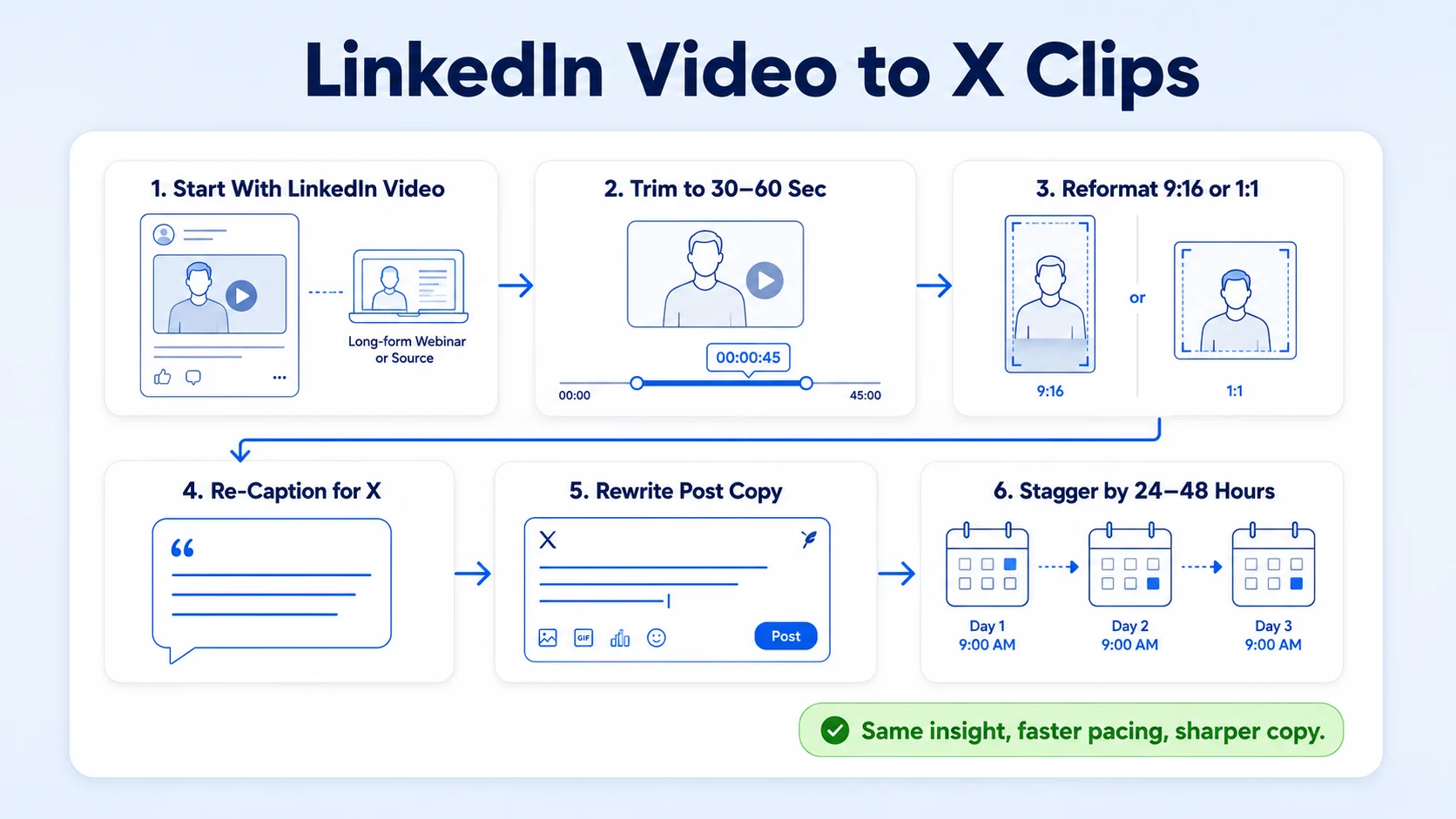
The mechanics of the LinkedIn-to-X workflow:
- Start with your LinkedIn video or webinar recording. LinkedIn content typically runs longer and is formatted for a professional, scroll-at-desk audience. That is your source material.
- Trim to 30–60 seconds. Pull the single sharpest moment, a data point, a counterintuitive take, a customer result. One idea per clip.
- Reformat to 9:16 or 1:1. Mobile-first vertical clips (9:16) and shorter videos (15–60 seconds) typically deliver better engagement and are easiest to reuse across platforms. LinkedIn content is often 16:9, you will need to reframe or add side panels.
- Re-caption for X's pace. LinkedIn captions can be slower and more formal. X captions should be punchy, front-loaded, and scrollable.
- Rewrite the post copy for X's voice. Drop the LinkedIn formality. Shorter sentences, a stronger opening hook, direct language.
- Schedule with a 24–48 hour gap from the LinkedIn post. Do not post identically on both platforms simultaneously, let each platform's audience engage independently.
A SaaS vendor converted a 45-minute product webinar into ten 60- to 90-second clips. Over six weeks they saw a 3× increase in video impressions, a 40% lift in profile visits, and a measurable uptick in demo requests tied to video CTAs. That is what a disciplined repurposing engine delivers, more output, lower cost, consistent distribution across your entire B2B buyer journey.
Our video marketing services are built around exactly this kind of production-to-distribution system.
Common Mistakes B2B Brands Make With Video on X
Most teams that fail with video on X make the same set of errors. Avoiding them is half the battle.
- Sharing YouTube links instead of native uploads. External links do not autoplay. They are dead in the feed. Always upload the video file directly.
- Starting with a logo animation. The first three seconds determine everything. A logo animation wastes them. Open with a face, a bold stat, or a visual hook.
- Posting without captions. The majority of X users scroll without sound. A captionless video loses most of its potential audience before a single word is heard.
- Measuring views and calling it done. Views are not pipeline. Track video completion rate, click-through rate on linked CTAs, and downstream demo requests tied to video content. Connect your tracking to HubSpot CRM integration if you want to map video influence to actual deals.
- No account-based marketing (ABM) overlay. Posting video publicly is fine. But for B2B brands targeting specific accounts, a paid amplification strategy layered on top of organic posts, targeting by company size, job title, or industry, turns your best video content into a precision demand generation tool.
- Treating X in isolation. X is great for quick, viral content, and LinkedIn gives your videos longevity and a professional audience. Posting on both platforms lets you maximize reach and expand your influence. An X-only video strategy leaves enormous reach on the table.
- Inconsistency. Posting three videos in a week and then going silent for two weeks kills algorithmic momentum and audience conditioning. Build a system that sustains 3–5 posts per week before you worry about production quality.
If your team needs help building this system, from editing to distribution, explore our video editing services or contact us directly.
How B2B Brands Use Twitter Video to Generate Leads and Support Pipeline
The funnel mechanics matter here, because video on X does not generate leads the same way a gated landing page does. It generates pipeline influence, and that requires a different measurement mindset. The framework is a three-layer funnel:
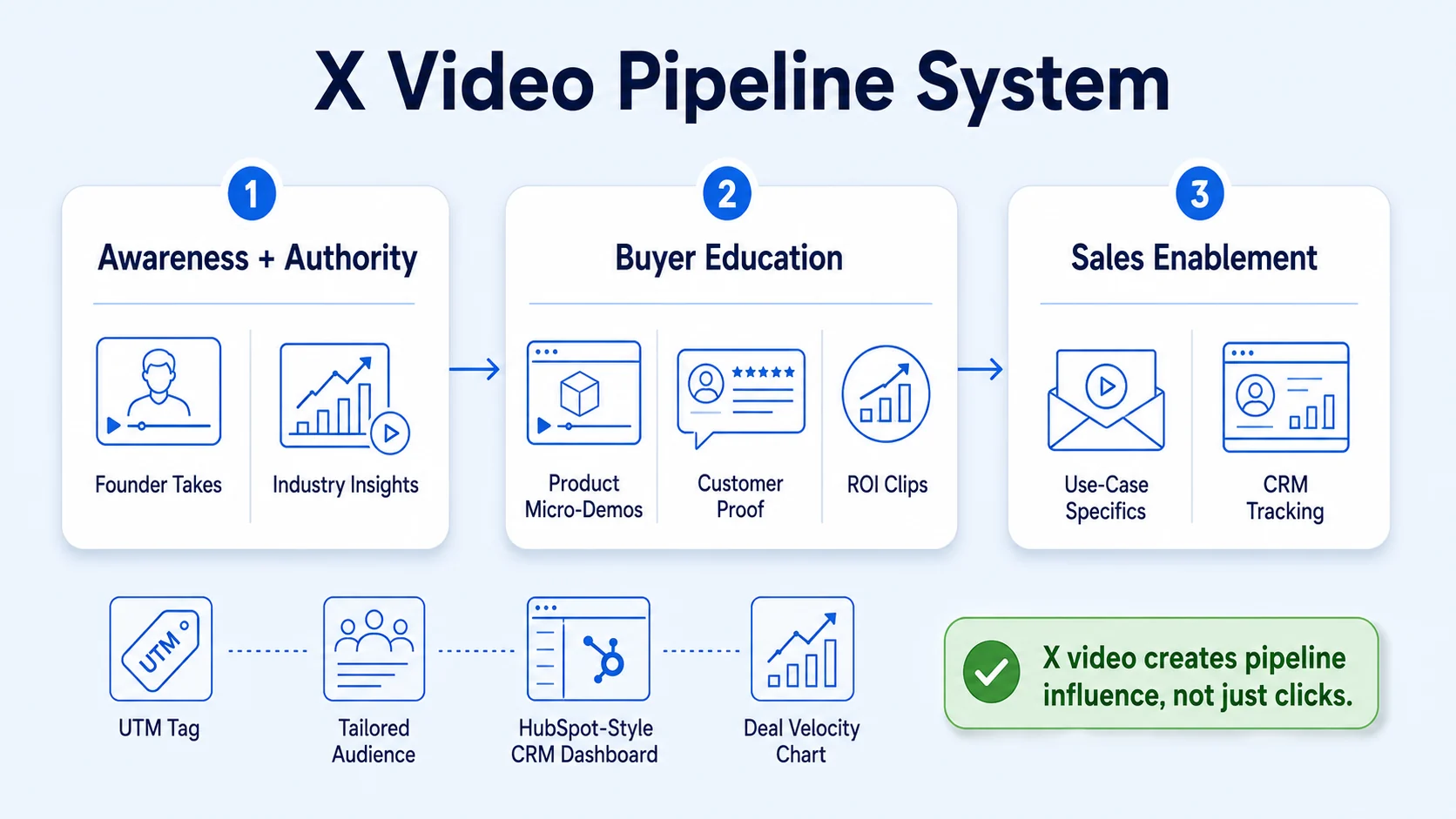
- Layer 1, Awareness and brand authority signals. Top-of-funnel clips: founder takes, industry insight callouts, stat-driven content. Goal is impression volume and engagement velocity with the right audience segments.
- Layer 2, Buyer education. Mid-funnel clips: product demo micro-clips, customer proof snippets, feature explainers. These address specific objections and accelerate the B2B buyer journey from awareness to consideration. Your events and podcast content feed this layer perfectly.
- Layer 3, Sales enablement content. Bottom-funnel clips: use-case specifics, ROI framing, competitive positioning. These are the videos your sales team shares in follow-up emails and LinkedIn DMs. They do not live on X for long, they get clipped, downloaded, and used in the sales cycle directly.
The connection point between X video and your CRM is intentional distribution. When a prospect engages with your X video content, retarget them via paid amplification strategy using X's tailored audience tools or match their profile via account-based marketing platforms that ingest social engagement signals. Layer that data into your HubSpot CRM integration to create a full-picture view of which video content is influencing deal velocity.
X is used by 55.8% of brands for social media marketing, with 31.3% of B2B marketers ranking it among their top platforms for impact. The brands extracting real pipeline value from X are the ones treating it as a content distribution channel that works in concert with their CRM, their sales team, and their LinkedIn presence, not as a standalone social media experiment.
Conclusion
A complete X (Twitter) video strategy for B2B brands in 2026 is not about chasing likes. It is about building a video presence that earns buyer trust before a sales conversation ever starts.
Key takeaways:
- Video drives 9× more engagement than text on X, always upload natively, always add captions.
- Keep clips to 30–60 seconds and measure completion rate, not just views.
- Repurpose your existing webinars, demos, and podcast content into a weekly clip cadence.
- Use X for thought leadership and brand authority; connect it to your CRM and sales team for pipeline attribution.
- Consistency beats perfection, build the system before you optimize the content.
Frequently Asked Questions
Q1: How many times should a B2B brand post video on X per week?
Aim for 3–5 video posts per week. That cadence maintains algorithmic momentum without requiring net-new production, a content repurposing framework that clips your existing webinars and demos makes it achievable. Tuesdays through Thursdays during business hours are the highest-value windows.
Q2: Should B2B brands invest in X Premium for video strategy?
X Premium subscribers see 6–10x more impressions on their posts. For brands building a serious video presence, that visibility multiplier makes the subscription cost straightforward to justify. It also unlocks longer upload limits and the brand authority signal of verification.
Q3: What is the best video format to upload on X in 2026?
MP4 or MOV with H.264 video and AAC audio at up to 60 fps is the recommended format in 2026. For aspect ratio, 9:16 vertical fills more mobile screen real estate; 1:1 square performs well across both mobile and desktop feeds.
Q4: How do I connect X video performance to pipeline and CRM?
Use UTM parameters on any links in your video posts. Layer X's tailored audience tools with your account-based marketing platform to match video engagers to known accounts. Feed that data into HubSpot CRM integration to see which video content correlates with shorter deal cycles or increased demo requests.
Q5: Is it worth repurposing LinkedIn video content for X?
Absolutely. The two platforms serve different audience modes, LinkedIn for deep professional engagement, X for fast, real-time discovery. Reformatting your best LinkedIn clips to 9:16, trimming to under 60 seconds, and rewriting the post copy for X's pace is a low-cost way to extend the reach of every piece of content you produce.
Q6: What metrics should B2B brands track for X video?
Prioritize video completion rate, click-through rate on post CTAs, and engagement velocity in the first 30–60 minutes. Avoid optimizing for raw view counts alone, X counts a view after just two seconds of playback, meaning view counts can look impressive while actual engagement depth is shallow. Completion rate is the signal that maps to real buyer attention.