
🪄 AI Summary
Heading 1
Heading 2
Heading 3
Heading 4
Heading 5
Heading 6
Lorem ipsum dolor sit amet, consectetur adipiscing elit, sed do eiusmod tempor incididunt ut labore et dolore magna aliqua. Ut enim ad minim veniam, quis nostrud exercitation ullamco laboris nisi ut aliquip ex ea commodo consequat. Duis aute irure dolor in reprehenderit in voluptate velit esse cillum dolore eu fugiat nulla pariatur.
Block quote
Ordered list
- Item 1
- Item 2
- Item 3
Unordered list
- Item A
- Item B
- Item C
Bold text
Emphasis
Superscript
Subscript
Most SaaS teams don't have a content problem. They have a system problem. You produce a webinar, a demo, a podcast episode, then scramble to figure out what to post next week. That cycle burns your team and buries your pipeline. Learning how to build a video content system that never runs dry means flipping the model: one piece of long-form content becomes 10 short-form assets, and your calendar fills itself. This guide shows you exactly how we built that system at Komet Media.
TL;DR
- A sustainable content system starts with one long-form pillar and atomizes it into short-form video, clips, quotes, and posts.
- Batching production and using a Notion Content OS keeps your calendar full without daily creative decisions.
- 94% of content marketers repurpose content across channels, and doing so improves ROI by an average of 32%.
- The fastest path to pipeline is turning your existing product knowledge, demos, and founder thinking into a short video that educates buyers.
Why Content Teams Always Run Out of Ideas (And How to Fix It)
The real reason teams run dry has nothing to do with creativity. It's a structural failure. Most B2B SaaS teams operate content reactively, someone has an idea, they produce it, they post it, then stare at a blank calendar again. There's no repurposing framework, no editorial calendar, no content pillar system. Just chaos, followed by silence.
58% of B2B marketers rate their content strategy as merely "moderately effective," and nearly half of those say their strategy struggles because they lack clear goals. Only one in three say they have a scalable model for content creation. That last number is the one I obsess over at Komet. One in three. That means two-thirds of B2B marketing teams are operating without a repeatable engine. They're writing from scratch every week. No wonder they burn out.
The fix is Atomic Content Theory applied to video: every long-form asset your company has ever produced, a webinar, a podcast, a demo, a sales call recording, is a content mine. You don't need new ideas. You need to extract what's already there. Gary Vaynerchuk's Reverse Pyramid model makes the same case: create one flagship piece of content, then slice it down into micro-content for every channel.
For a SaaS team, this looks like:
- A 45-minute product webinar becomes 8–12 short video clips for LinkedIn and YouTube Shorts.
- A founder interview becomes 5 quote cards, 3 email snippets, and a LinkedIn carousel.
- A customer success call becomes a 60-second testimonial clip and a written case study.
Repurposed content saves 60–80% of content creation time compared to starting from scratch. That time savings is your system dividend. It compounds every time you commit to the process. The root of sustainable content velocity is a documented Content Pillar System: 3–5 core themes your brand owns, and every piece of content maps back to one of them. This builds Topical Authority over time and eliminates the "what should we post?" conversation entirely.
How to Build a Video Content System That Never Runs Dry, Step by Step
This is the exact framework we use at Komet to build a video content system for B2B SaaS teams from scratch.
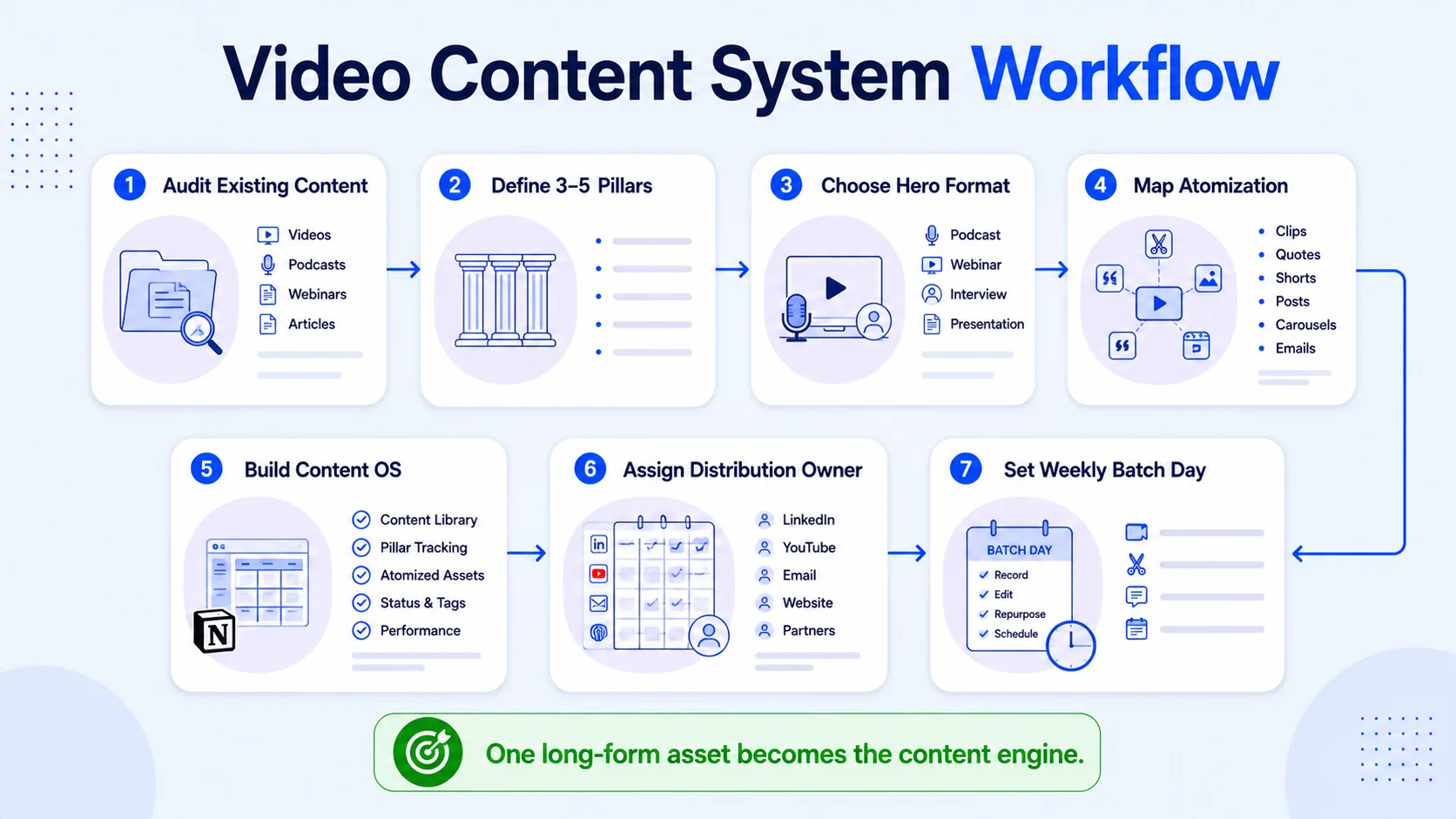
- Audit your existing content: Run a content audit using a tool like Ahrefs or Semrush. Find every webinar recording, podcast episode, demo video, and sales deck. This is your raw material.
- Define 3–5 content pillars: These are the core themes your brand competes on. For a SaaS product, pillars might be product education, founder thinking, customer outcomes, category POV, and team culture.
- Choose one long-form hero format: For most SaaS teams, this is a weekly podcast, a recurring webinar, or a founder video series. This is your top of the pyramid.
- Map the atomization playbook: Decide in advance what each hero asset produces. One 30-minute recording should yield at minimum: 5 short clips, 3 LinkedIn posts, 1 email snippet, and 1 blog summary.
- Build your Notion Content OS: One database for all content, with fields for pillar, format, platform, status, and publish date. This is your editorial calendar and production tracker in one.
- Assign a distribution owner: Content that isn't distributed is content that doesn't exist. One person owns the publishing calendar.
- Set a weekly batch day: Produce raw content in one session. Edit and schedule in another. Never mix the two modes.
AI-powered repurposing workflows can reduce adaptation time by an estimated 65% per asset , making step 4 faster than most teams expect once the playbook is defined.
The Content Repurposing Framework That Powers Consistent Publishing
If you want to know how to build a video content system that never runs dry, repurposing isn't an optional add-on, it's the engine. The Content Repurposing Framework I use with every Komet client follows three layers:
Layer 1: Extract Pull 5–8 standalone moments from any long-form recording. A clear opinion, a counterintuitive stat, a step-by-step explanation, a moment of genuine tension. These are your clips.
Layer 2: Adapt Each clip gets adapted by platform:
Layer 3: Compound After 90 days, run a performance audit. The clips that outperformed become Evergreen Content that gets re-posted, re-edited, and recycled into new formats, feeding the YouTube Flywheel and extending the life of your Content Moat. Content repurposing strategies improve ROI by 32% on average. Those who repurpose report up to 300% more reach. The math alone makes this non-negotiable for any SaaS team competing on a finite budget.
For short-form video editing, the adaptation layer is where most teams lose momentum, they know they should cut clips, but no one on the team owns it. That's the problem we solve directly at Komet.
Content Batching vs. Content Scheduling, Which Wins for Consistency?
Both matter. They solve different problems.
Content batching is a production strategy: you record or write all content for a 2–4 week period in a single session. It reduces context-switching, protects deep work time, and means your team isn't in "create mode" every single day.
Content scheduling is a distribution strategy: you use tools like Buffer, Hootsuite, or native platform schedulers to queue posts in advance. It means publishing happens even when your team is heads-down on a product sprint.
The mistake teams make is treating these as alternatives. They aren't. You need both:
For SaaS founders running founder-led growth, I recommend a monthly batch: one full recording day producing 3–4 long-form assets, atomized into 30–40 pieces of short-form content, then scheduled across the month using your Notion Content OS. The brands that achieve stronger results in 2026 are building scalable video systems rather than isolated campaigns. Batching without scheduling is a pile of content. Scheduling without batching is an empty calendar. The system connects both.
How to Build an Evergreen Content Machine That Compounds Over Time
Evergreen Content Strategy is how you stop reinventing the wheel. Evergreen content answers questions your buyers will still be asking 18 months from now. For SaaS: "How does [feature] work?", "Why should I choose [category]?", "What does [outcome] actually look like?"
Here's how to build an evergreen machine:
- Identify your 10 highest-intent buyer questions. These come from sales calls, support tickets, onboarding calls, and lost deal notes.
- Produce one definitive video answer for each. Not a trend piece. A reference piece. The resource your sales team would send to a prospect.
- Optimize for Topical Authority. Each evergreen video maps to a Semrush Topic Cluster, building owned media depth that compounds in search and on social media.
- Refresh on a 6-month cycle. Schedule a content audit, identify top-performing evergreen content using analytics tools, look for assets with high traffic but declining engagement, and review them quarterly or bi-annually.
- Re-promote evergreen assets. Most teams post once and move on. Top-performing teams re-share evergreen clips 3–4 times per year with updated framing.
Updating high-performing content can boost traffic by 146%, making content refreshing one of the highest-return repurposing activities for existing content libraries.
For SaaS, the highest-value evergreen formats are product explainers, founder POV videos, and customer outcome walkthroughs. These aren't trend-chasing, they're the exact assets a buyer needs to say yes to a demo. At Komet, we build these as part of every client's video marketing engagement.
Tools and AI Workflows That Keep Your Content System Running on Autopilot
Companies with a documented content strategy are 3.5x more successful than those without one. The tools below are what make that documentation functional at scale.
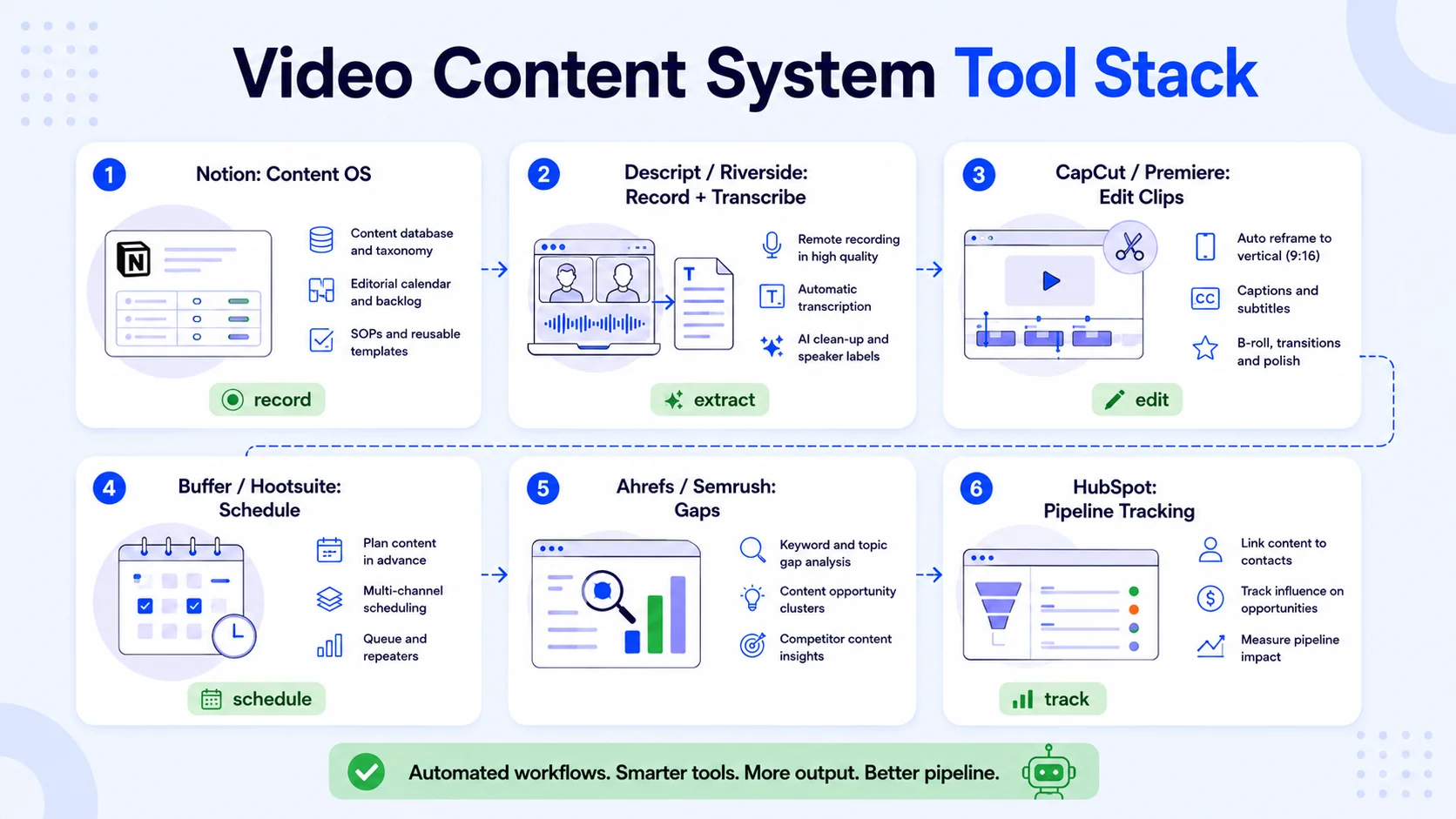
Core stack for a B2B SaaS content system in 2026:
- Notion Content OS: Master database for every content idea, asset, and publish date. Tracks pillar, format, platform, and status.
- Descript or Riverside: Record long-form video and audio, auto-transcribe, and identify clip-worthy moments.
- CapCut or Premiere Pro: Edit short-form clips with captions, pacing, and platform-specific formatting.
- Buffer or Hootsuite: Schedule and distribute across LinkedIn, YouTube, Instagram, and X.
- Ahrefs or Semrush: Run topic cluster audits and identify content gaps in your evergreen library.
- HubSpot: Track content performance against pipeline, MQLs, and demo requests.
AI Workflow for Content Repurposing:
- Record your long-form asset (podcast, webinar, demo, or founder interview).
- Auto-transcribe in Descript.
- Use an AI prompt to extract 8 clip-worthy moments from the transcript.
- Generate short-form captions, LinkedIn post copy, and an email snippet from each moment.
- Human review and edit, AI creates the scaffold, your voice makes it land.
76% of content marketers use AI to draft content copy in 2025, with repurposing existing content into new formats being one of the top three AI applications. The AI Content Workflow above cuts production time in half without removing the strategic and editorial judgment that makes B2B content credible. 78% of B2B marketers currently use video in their programs, and 56% plan to increase their investment within the next year. Almost half say short-form social video delivers the highest ROI. The teams winning in 2026 pair that investment with a repeatable system, not just a production budget.
The system is the strategy. A SaaS team that batches, atomizes, and distributes consistently will outperform a team with twice the budget and no process every single time.
Conclusion
Building a video content system that never runs dry comes down to three commitments:
- Pillar-first thinking: Every long-form asset is raw material, not a finished product.
- Atomize relentlessly: One recording produces 10+ assets across every distribution channel.
- System over inspiration: Notion Content OS, batch days, and scheduled distribution replace the creative scramble with a machine.
Short-form video generated the highest ROI among all content formats in 2026, with 48.6% of marketers ranking it among their top-performing assets. The question isn't whether video content belongs in your pipeline strategy. It's whether you have a system built to produce it without burning out your team. If you want to see what this looks like for your specific product, let's talk.
Frequently Asked Questions
Q1: What is a content pillar system and why does it prevent running out of ideas?
A content pillar system organizes all of your content around 3–5 core themes your brand owns. Every piece of content maps to a pillar, eliminating blank-slate decisions. Instead of asking "what should we post?", your team asks "which pillar and which format?", a much faster, more consistent workflow.
Q2: How many short-form videos can one long-form asset realistically produce?
A 30–45 minute webinar, podcast episode, or founder interview typically yields 8–12 short clips, 4–6 LinkedIn posts, 1–2 email snippets, and 1 blog summary. A structured atomization playbook, built in advance, makes this extraction consistent rather than ad hoc.
Q3: Is content batching better than daily publishing for SaaS teams?
Yes, for most SaaS teams. Daily publishing burns out small teams quickly. Batching once per week or month lets founders and marketing heads stay in creation mode during a defined window, then let automation and scheduling handle the rest without constant manual attention.
Q4: What is the minimum viable content system for a SaaS startup with a small team?
One long-form recording per month (webinar, demo, or founder video), atomized into 12–16 short clips, scheduled across LinkedIn and YouTube. Managed in a single Notion board. Only one in three B2B teams currently have a scalable model for content creation, even a lightweight system puts you ahead of the majority.
Q5: How does content repurposing directly support pipeline and sales enablement?
Repurposed short clips that answer buyer objections, explain product features, and showcase customer outcomes give your sales team assets to share during active deals. Buyers who encounter your thinking across multiple formats before a demo arrive more educated and more trusting, shortening cycles and improving close rates.
Q6: How often should I refresh evergreen video content?
Every 6 months at minimum. Review performance data using Ahrefs or your platform analytics, update any outdated references, and re-promote top performers with new framing. Content updated within the past two months is 28% more likely to be cited by AI systems, making freshness a distribution advantage, not just an SEO one.