
🪄 AI Summary
Heading 1
Heading 2
Heading 3
Heading 4
Heading 5
Heading 6
Lorem ipsum dolor sit amet, consectetur adipiscing elit, sed do eiusmod tempor incididunt ut labore et dolore magna aliqua. Ut enim ad minim veniam, quis nostrud exercitation ullamco laboris nisi ut aliquip ex ea commodo consequat. Duis aute irure dolor in reprehenderit in voluptate velit esse cillum dolore eu fugiat nulla pariatur.
Block quote
Ordered list
- Item 1
- Item 2
- Item 3
Unordered list
- Item A
- Item B
- Item C
Bold text
Emphasis
Superscript
Subscript
You just closed your Series A. Your pitch narrative is sharp. Your product is real. But your buyers don't know you exist yet. The LinkedIn video playbook for funded tech startups closes that gap faster than any paid channel, turning founder thinking into a trust engine that runs 24/7. This guide gives you the exact framework, content types, cadence, algorithm rules, and a repeatable calendar, to convert your funding momentum into a measurable pipeline on the platform where B2B buyers actually live.
TL;DR
- LinkedIn video drives 5x the engagement of text posts and is the fastest way for funded tech startups to build a founder-led brand in 2026.
- Post 3–5 times per week from the founder's personal profile, with at least 2 videos, using the 3:2:1 content framework.
- Repurpose webinars, demos, and podcasts into short clips, don't create from scratch every time.
- The algorithm rewards dwell time and native uploads. Never link to YouTube. Always add captions.
How to Use LinkedIn Video for Funded Tech Startups: The Core Framework
Most funded tech startups burn their post-round momentum on PR that fades in a week. The smarter move is building a content distribution flywheel on LinkedIn that compounds over 90 days. Here's how to use the LinkedIn video playbook for funded tech startups as your operational system.
The foundation is the 3:2:1 framework per week:
- 3 authority videos: Educational, insight-driven content tied to your product category, no pitch, no CTA. Teach the buyer something they'd pay a consultant to learn.
- 2 engagement posts: Short video reactions to industry trends, a contrarian take, or a question that invites comment from your ICP.
- 1 social proof post: A customer win, a metric, a testimonial clip from a webinar. One post per week builds the trust layer.
The entire system runs from the founder's personal profile, not the company page. Company pages receive just 5% of user feed allocation while personal profiles dominate 65% of content consumption. That single fact makes founder-led brands the only rational choice for early-stage visibility.
Founder-led LinkedIn marketing builds trust and pipeline for B2B SaaS startups through authentic thought leadership, personal storytelling, and strategic content, turning founders into the brand's most credible demand generation channel.
Every video asset you create from scratch can also be extracted from existing long-form content. A 45-minute webinar contains at least six standalone clips. A 30-minute podcast contains eight insight moments. This is the content repurposing framework that separates teams who scale from teams who burn out by week three.
The operational setup takes one batch session per week. Record 3–4 clips in one sitting, edit for LinkedIn natively, schedule Tuesday through Thursday during the morning window. The middle of the working week, Tuesdays to Thursdays, sees the highest levels of engagement on LinkedIn, with best posting times at 7–9am, 12–1pm, and 5–6pm in your target audience's time zone. This system is your flywheel. Each video builds recognition with your ICP. Recognition builds trust. Trust converts to demo requests without a single cold email.
LinkedIn Video Strategy for Early Stage Startups: What the Algorithm Actually Rewards
Before you script a single video, understand the rules of the game. The LinkedIn algorithm in 2026 prioritizes helpful, relevant content targeted to a professional audience, authentic engagement like insightful comments and point-of-view shares, and signals of real expertise, not just reach.
Five algorithm mechanics matter more than anything else for the LinkedIn video playbook for funded tech startups:
- Dwell time over likes. The algorithm measures how long people actually engage with your content, not just whether they clicked. A post someone reads for 30 seconds outperforms one with 50 quick likes. For video, this means your hook must work in the first 3 seconds, and your content must earn the next 60.
- The golden hour. The first 60 minutes represent LinkedIn's algorithmic testing window where the platform shows your post to 2–5% of your network. Strong engagement during this window determines whether content receives second-degree and third-degree amplification or dies immediately. Reply to every comment within 15 minutes of posting.
- Native video only. Always upload video natively. The algorithm heavily penalizes external links to YouTube or Vimeo. Native videos receive up to 38% more engagement and reach.
- Captions are non-negotiable. Add captions, since 85% of users watch without sound. Uploading an SRT file also gives the algorithm a text transcript to understand and categorize your content, boosting topical relevance.
- Video length: For SaaS, the sweet spot is between 30 and 90 seconds, long enough to explain a key concept but short enough to maintain high completion rates. The algorithm also now detects AI-generated content patterns.
Posts with recognizable AI patterns achieve an average of 47% less organic reach. The most effective strategy is a hybrid approach: AI as a support tool for research and initial drafts, followed by human expertise for refinement and authentic industry insights. The platform rewards genuine founder voice.
A founder sharing a genuine insight from their home office often resonates more than a sterile, corporate-produced video. For organic LinkedIn video, authenticity trumps production value every time.
What Kind of LinkedIn Videos Should Startups Post After Funding?
Funding changes what you can say and how much proof you have. Use it. Your investors, whether Y Combinator, Andreessen Horowitz, or any other firm, are social proof. Your round is credible. Your product decision-making history is thought leadership. Here are the six video types that perform in the LinkedIn video playbook for funded tech startups:
The founder POV is the highest-leverage format. No script required. Turn on your camera, open with a counterintuitive take on your category, and make one specific point. That format is what drives venture capital storytelling that feels human rather than corporate. CEO video posts rose 52% over two years as leaders embrace unscripted videos for authenticity.
Your Series A announcement video should not be a press release read to a camera. It should be a founder answering one question: "What does this money let us do for customers that we couldn't do yesterday?"
The product demo snippet is the most underused format in SaaS marketing. Cut the first 90 seconds of your best demo, the part where you show the buyer's core pain disappearing. Post it. Add a caption that names the specific buyer problem. That single clip can drive more demo requests than a paid LinkedIn campaign.
For teams that already run webinars or podcasts, the repurposing math is obvious: one long-form asset becomes 6–8 short video clips, each targeting a different buyer pain, each feeding a different point in the content distribution flywheel.
How Do Funded Tech Startups Build Brand on LinkedIn Through Video?
Brand is trust at scale. And trust on LinkedIn in 2026 is built through one thing: consistent founder-led content that demonstrates real expertise week over week. The data on why personal branding for CEOs outperforms brand pages is clear. According to LinkedIn Marketing Solutions, 4 out of 5 LinkedIn members drive business decisions at their organizations. These decision-makers scroll past company page posts. They stop on a founder who writes and speaks like someone who has lived the problem. Prospects in 2026 are increasingly cynical of polished brand accounts. They want to buy from experts, founders, and engineers.
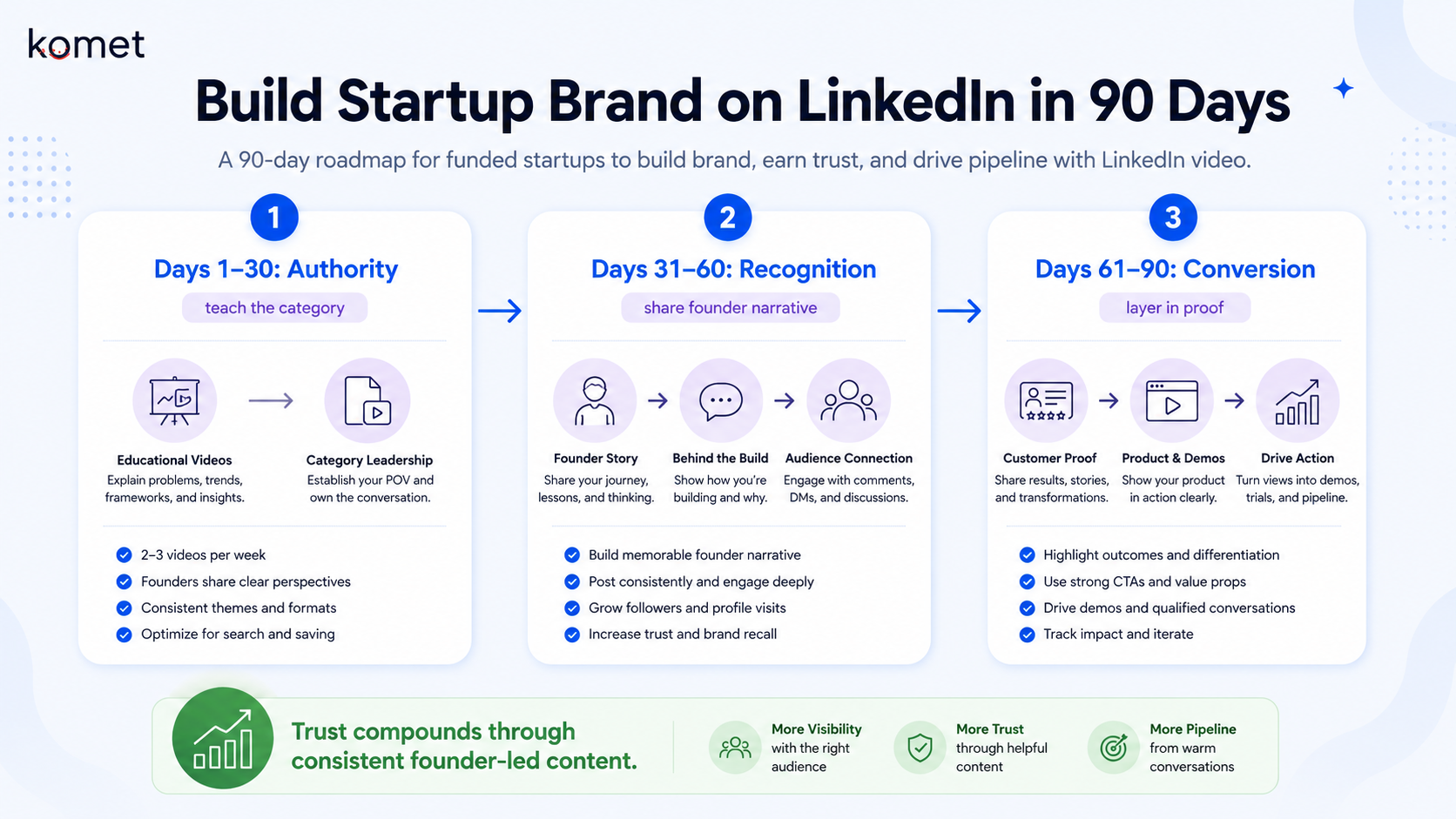
The brand-building flywheel works in three phases:
- Authority phase (days 1–30): Post exclusively educational content. No product mentions. Teach your ICP about the category problem. Establish topical authority so the algorithm begins routing your content to the right professional segments.
- Recognition phase (days 31–60): Layer in founder narrative, the "why we built this," the decisions made post-funding, the customer patterns you've observed. This is where venture capital storytelling becomes your brand differentiator.
- Conversion phase (days 61–90): Introduce social proof. Customer clips, product insights, specific outcomes. By this point, your ICP has seen you 10+ times. The demo request feels like a next logical step, not a cold ask.
According to 2025 benchmarks, organic LinkedIn activity delivers an average ROI of 229% over a three-year window. Paid social is a dial you can turn up later. Organic brand built through video is the moat. Funded tech startups that ignore LinkedIn video in the first 90 days post-round are leaving the highest-ROI demand generation channel on the table while competitors claim the category narrative.
The Komet Media services team works with Tech teams, C-Suite Executives, and Tech Startup Founders to build exactly this flywheel, extracting video from existing content so founders can stay in their zone of genius instead of becoming full-time content producers.
LinkedIn Video vs. Text Posts for Startup Growth: What the Data Says
This comparison is not close, but it is nuanced. Here's the honest breakdown for 2026:
Source: Socialinsider's 2025 LinkedIn Benchmarks, based on 1 million posts, reports video posts average 5.60% engagement rate by impressions. Multi-image posts lead at 6.60%, followed by native documents at 6.10%, then video at 5.60%. The argument for video over text is not raw engagement rate, it's pipeline quality. Video content drives 5x higher interaction rates for awareness-stage distribution while text posts generate more substantive comments within existing networks. For a funded startup whose buyers don't know you yet, awareness-stage distribution is everything.
Text posts build depth within your existing network. Video builds width, it surfaces your content to second and third-degree connections who match your ICP. For the LinkedIn video playbook for funded tech startups specifically, video is the fastest trust-builder because it puts a face, a voice, and a real perspective behind the company name. The winning strategy is not video-only. Run text posts twice a week to spark conversation within your network, and run video 2–3 times a week to reach new buyers. In Q4 of 2025, video uploads increased 20% year-over-year, and watch time increased 36% year-over-year, so buyer appetite for video is growing faster than most SaaS teams are producing it.
Best LinkedIn Video Content Ideas for Startup Founders: 10 Ready-to-Record Formats
Blank page paralysis kills more LinkedIn strategies than bad content. Use these formats to record your next 10 videos in one session:
- The contrarian take: "Every SaaS team runs [X process] the same way. Here's why it's costing them [Y outcome]." Name the category assumption your product disproves.
- The customer insight: Share one specific thing you learned from a customer call this week, anonymously. No pitch. Just the insight.
- The funding intent clip: "We raised [round] to do [specific thing]. Here's what that means for the [category] buyer in practice."
- The demo highlight: 60 seconds showing the exact moment in your product where the buyer's core pain disappears.
- The "I was wrong" post: One belief you held about your market 6 months ago that customer data has since corrected.
- The process breakdown: Walk through one internal process, how you run sales reviews, how you structure onboarding. Buyers trust teams who show their thinking.
- The trend reaction: Pick one thing happening in your category, a competitor move, a regulatory shift, an Andreessen Horowitz thesis post, and give your founder-level read on it.
- The metric story: One number from your product data that reveals something unexpected about how buyers use the category.
- The hire announcement: Introduce a key team member and let them deliver one insight. Signals momentum, builds team credibility.
- The before/after: Customer outcome framed as a before-after arc in 75 seconds. No deck required.
LinkedIn's own team confirmed: "The videos that perform best are grounded in real experience and a clear point of view." They advised sharing perspective on what's happening in your industry, breaking down trends, or talking through lessons from your career.
Every one of these formats can be pulled from existing events, demos, or internal meetings. The short-form video editing workflow at Komet Media exists specifically to extract these clips at scale, so founders aren't manually clipping their own content. If you don't have existing assets, we can also help you create videos from scratch.
How to Create a LinkedIn Video Content Calendar for Startups
A calendar isn't about rigid scheduling, it's about removing the decision of what to post so the only remaining job is to record. The rule of topical consistency: posting in the same subject area repeatedly signals authority to the algorithm and builds audience trust. Scattered topics produce scattered results.
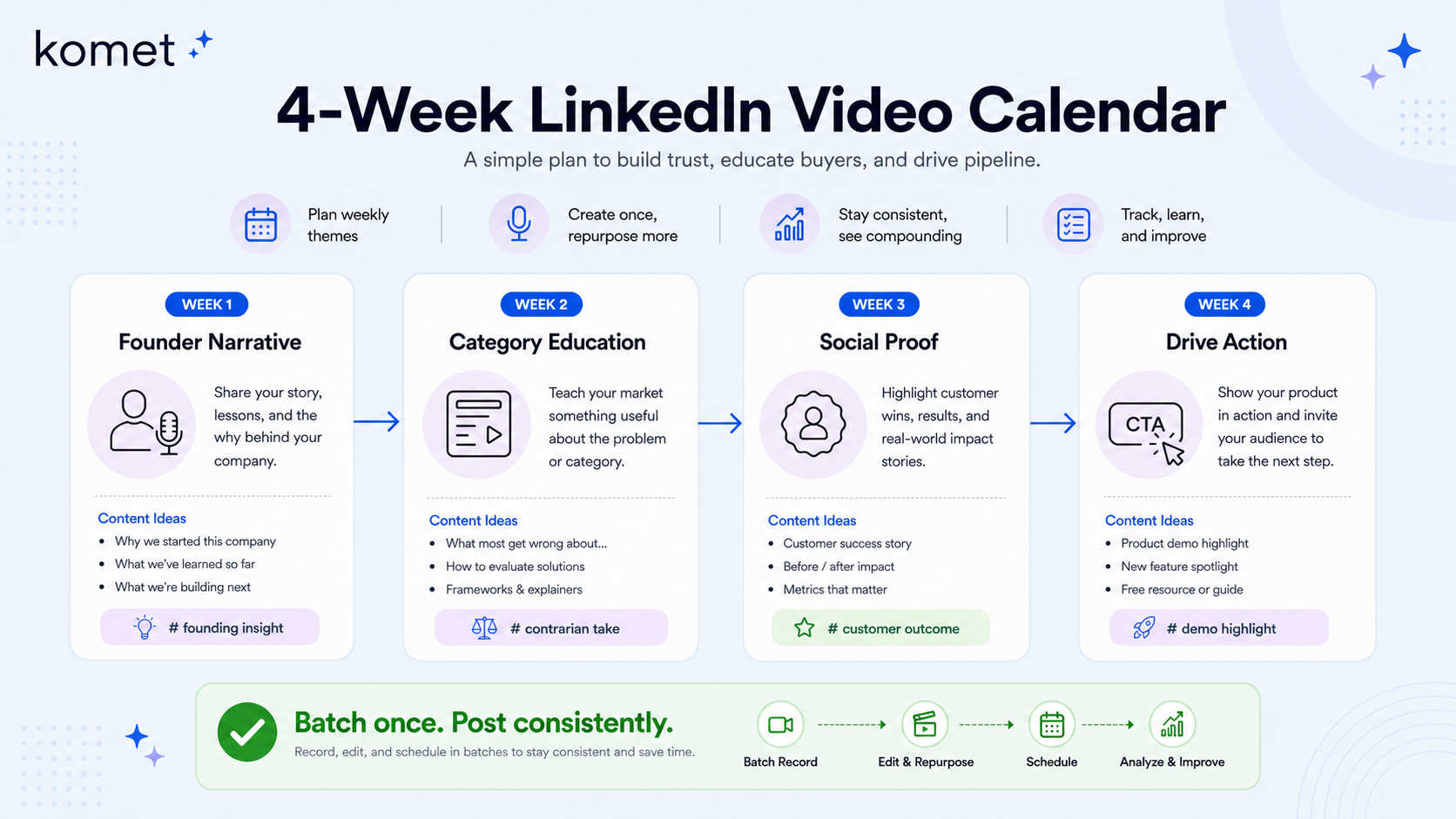
Here's the 4-week launch calendar template for the LinkedIn video playbook for funded tech startups:
Week 1, Establish the founder narrative
- Monday: Text post, your founding insight
- Wednesday: Video, "The problem we're solving and why now"
- Friday: Video, One customer pain, explained in 60 seconds
Week 2, Educate on the category
- Tuesday: Video, A contrarian take on your product category
- Thursday: Text or carousel, A framework your buyers can use today
- Friday: Engagement post, A question your ICP wrestles with
Week 3, Layer in social proof
- Tuesday: Video, Customer outcome story (anonymized is fine)
- Wednesday: Text, A metric from your product that proves the category problem
- Friday: Video, "What our Series A investors kept asking us"
Week 4, Drive action
- Monday: Video, Product demo highlight (the "aha" moment)
- Wednesday: Text, A lesson from 30 days of founder content
- Friday: Video, Next 90-day product direction (signals momentum, triggers demo curiosity)
The minimum effective posting frequency for algorithmic consistency is three times per week. For lead generation, four to five posts per week is the recommended range, enough to stay top-of-mind with your ICP without sacrificing content quality. LinkedIn itself recommends two to five posts per week, with at least two of them being video, as a strong starting point. For funded tech startups with lean marketing teams, the sustainable sweet spot is 3–4 total posts per week: 2 videos, 1 text, 1 carousel or engagement post. Batch your recording.
You can realistically produce a full week's worth of LinkedIn content in a single focused session, the kind of throughput that makes a consistent video calendar actually sustainable for a small or mid-sized team. Track six columns in your calendar: Date, Content Pillar, Format, Goal (Awareness/Engagement/Conversion), Draft headline, and Status. Review every Friday. Double down on what hit. Cut what didn't.
Conclusion
The LinkedIn video playbook for funded tech startups is not a content strategy, it's a pipeline system. Here's what to carry into execution:
- Operate from the founder's personal profile. Company pages get 5% of feed allocation. Founders get the rest.
- Post 3–5 times per week, with at least 2 videos. Use the 3:2:1 framework: authority, engagement, social proof.
- Repurpose first, create second. Every webinar, demo, and podcast you already have contains 6–8 LinkedIn video clips.
- Native uploads only, captions always, 30–90 second clips. These three rules alone put you ahead of most SaaS competitors on the platform.
- Commit to 90 days. The LinkedIn video playbook for funded tech startups pays out in compounding trust, not overnight virality.
If you want the production system without the production overhead, Komet Media builds it for you.
Frequently Asked Questions
1) How long should LinkedIn videos be for B2B startups?
For SaaS, the optimal range is 30–90 seconds, long enough to explain a key concept, short enough to maintain high completion rates. Awareness-stage clips work best under 60 seconds. Demo highlights and founder narratives can stretch to 90 seconds without losing viewers.
2) Should the founder post from their personal profile or the company page?
Always the personal profile. Company pages receive just 5% of user feed allocation while personal profiles dominate 65% of content consumption. Founder-led content also signals authenticity, which the 2026 algorithm rewards explicitly over polished brand page output.
3) How often should a funded startup post LinkedIn videos?
LinkedIn recommends two to five posts per week with at least two being video. For funded tech startups in growth mode, 3–4 total weekly posts (2 video, 1 text, 1 carousel) is the sustainable cadence that keeps algorithmic authority without burning out a lean team.
4) Can existing content like webinars and podcasts be repurposed into LinkedIn video?
Yes, and this is the highest-leverage move in the playbook. A webinar can be cut into three or four short standalone videos, all without requiring your team to invent new ideas from scratch. One long-form asset can fuel an entire week of LinkedIn video content.
5) Does LinkedIn penalize external video links like YouTube?
Always upload video natively. The algorithm heavily penalizes external links to YouTube or Vimeo , reducing distribution significantly. Native uploads also get richer analytics and are prioritized in the immersive video feed LinkedIn is expanding globally in 2026.
6) How long does it take for a LinkedIn video to generate a pipeline for a funded startup?
Meaningful inbound leads from LinkedIn content typically take three to six months of consistent posting to materialize. The first 30 days build baseline reach, days 30–60 establish topical authority, and by day 90 you'll see inbound DMs and profile visits from your ICP with increasing frequency. Funded tech startups with strong founder POV often see this timeline compress to 60 days.