
🪄 AI Summary
Heading 1
Heading 2
Heading 3
Heading 4
Heading 5
Heading 6
Lorem ipsum dolor sit amet, consectetur adipiscing elit, sed do eiusmod tempor incididunt ut labore et dolore magna aliqua. Ut enim ad minim veniam, quis nostrud exercitation ullamco laboris nisi ut aliquip ex ea commodo consequat. Duis aute irure dolor in reprehenderit in voluptate velit esse cillum dolore eu fugiat nulla pariatur.
Block quote
Ordered list
- Item 1
- Item 2
- Item 3
Unordered list
- Item A
- Item B
- Item C
Bold text
Emphasis
Superscript
Subscript
Most funded tech startups treat Instagram as a checkbox, not a channel. They post sporadically, chase followers, and wonder why no pipeline ever comes from it. Instagram growth, done right, is a system, one that turns your product knowledge, founder thinking, and existing content into a compounding visibility engine. This guide breaks down exactly how to build that system, from your first 100 followers to a channel that drives real inbound demand.
TL;DR
- Instagram growth for tech startups requires a clear content system, not just consistent posting.
- Reels and carousels dominate reach and engagement, short-form video is non-negotiable.
- Founder-led content and content repurposing are your highest-ROI moves with a limited team.
- Paid amplification accelerates what organic content proves works.
How to Grow Instagram for a Tech Startup: The Foundation First
Before you post a single Reel, you need a position. Funded startups often skip this step and pay for it in wasted content. Your Instagram profile is not a social media page, it's a landing page with a scrollable portfolio attached.
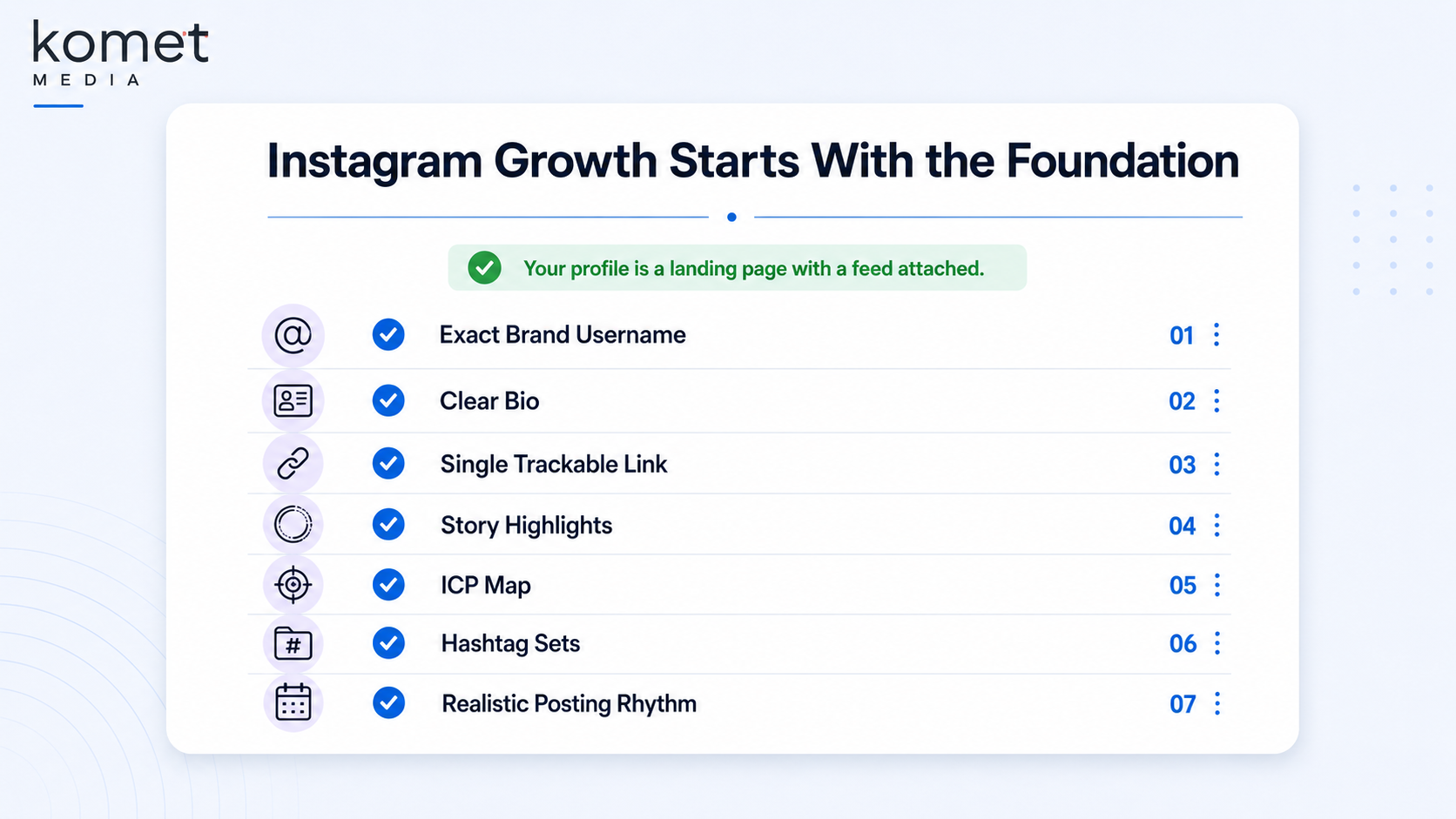
Profile setup that converts:
- Username: Match your brand name exactly. No underscores, no abbreviations. Discoverability starts here.
- Bio: One sentence on what you do, one sentence on who you help, and one hard CTA, a link to a demo, a webinar, or a free resource.
- Link: Use a single, trackable destination. A landing page built for Instagram traffic outperforms a homepage every time.
- Highlight structure: Pin three to five Story Highlights covering your product, social proof, and your founder story. Visitors who hit your profile land on those highlights before they ever scroll your feed.
90% of all Instagram users follow at least one business account, meaning commercial intent is essentially universal among the active user base. That matters for tech startups: the audience is already primed to engage with businesses. Your job is to give them a reason to follow yours specifically.
The strongest foundation for a B2B startup is audience segmentation. Map your ICP first, job title, industry, company stage, pain points, and let that map dictate everything: your tone, your content pillars, your hashtag sets, and your outbound engagement strategy. Vague accounts attract vague followers. Specific accounts attract buyers.
Hashtags remain a primary discovery mechanism in 2026, but strategy has shifted from "use 30 hashtags on every post" to "use 10–15 highly relevant hashtags per post, rotated across 5 hashtag sets." Build five sets around your core content pillars, product education, founder thinking, industry insight, social proof, and community, and rotate them systematically.
Finally, set a posting rhythm you can actually hold. Posting 2 to 3 times per week drives an average 19% growth, while posting 10 or more times per week can boost growth by 79%. For a funded team without a full content operation, 3–4 posts per week is the realistic ceiling. Hit it consistently before scaling volume.
Instagram Growth Strategy for Funded Tech Startups: Content That Drives Pipeline
Follower count is a vanity metric. Pipeline is the real scorecard for a Series A company.
The content types that actually move B2B buyers on Instagram fall into four buckets:
41% of B2B marketers say short-form video drives the highest ROI of any content format. That figure alone should anchor your content strategy. Product walkthroughs under 60 seconds, founder takes on industry problems, and customer win clips are the formats that generate saves, shares, and DM conversations, which are the three signals that actually move the algorithm and move buyers.
DM shares are now the strongest algorithm signal for content distribution. If users send your content to friends, the algorithm treats it as highly distributable to new audiences. Design every piece of content with a question: "Would a buyer send this to their team?" If the answer is no, the idea needs a rewrite.
Build your content calendar around three to four pillars, rotate formats daily (Reel one day, carousel the next, Story-only the next), and map every pillar back to a stage in the buyer journey. Awareness content earns reach. Consideration content earns saves. Decision content earns DMs and profile visits. All three need to exist in your feed simultaneously.
For short-form video production that maps directly to pipeline stages, that's exactly the system we build at Komet Media, starting with your existing product knowledge, not from scratch.
What Instagram Content Works Best for Tech Startups: The Format Breakdown
The format question gets asked constantly. Here is the current answer, based on 2026 data. Reels recorded a slight decrease in engagement in Q1 2026, dropping to 0.50% from 0.52% in Q4 2025. Despite the decline, Reels continue to be one of Instagram's strongest-performing content formats. Carousel posts maintained the highest engagement rate among all Instagram post types in Q1 2026, holding steady at 0.52%.
Key takeaway: Reels generate the widest reach. Carousels generate the deepest engagement. Funded tech startups need both working in tandem. Reels lead all formats with a 2.7% engagement rate and a 30.81% average reach rate. Carousels follow at 2.4%, making them the top-performing static format for product walkthroughs and educational posts.
For B2B SaaS startups specifically, here's how to deploy each format:
- Reels (60–90 seconds): Founder takes, product demos, "myth vs. reality" for your category, quick-fire tips. Hook in the first two seconds. Add captions, most users watch on mute.
- Carousels (6–10 slides): Step-by-step product education, data breakdowns, before/after client results, thought leadership frameworks. Carousel posts see 1.5x more engagement than standard image posts.
- Stories (daily): Polls, question boxes, behind-the-scenes clips, and link stickers to demo pages or blog content. Stories keep your account active between feed posts without burning your main content.
- Static images: Use sparingly. Single-image posts continued to generate the lowest engagement rates on Instagram, remaining flat at 0.35% in Q1 2026 and significantly underperforming compared to both Reels and carousels.
Instagram has officially transitioned to Views as the primary metric across all content formats in 2026, unifying how performance is measured for Reels, Stories, photos, and carousels. Track views and shares first. Follower count and likes are secondary.
How to Build an Instagram Following from Zero for a Tech Startup
Zero-to-traction is the hardest phase, and most startup teams burn out here because they have no system. Here is the process that actually works.
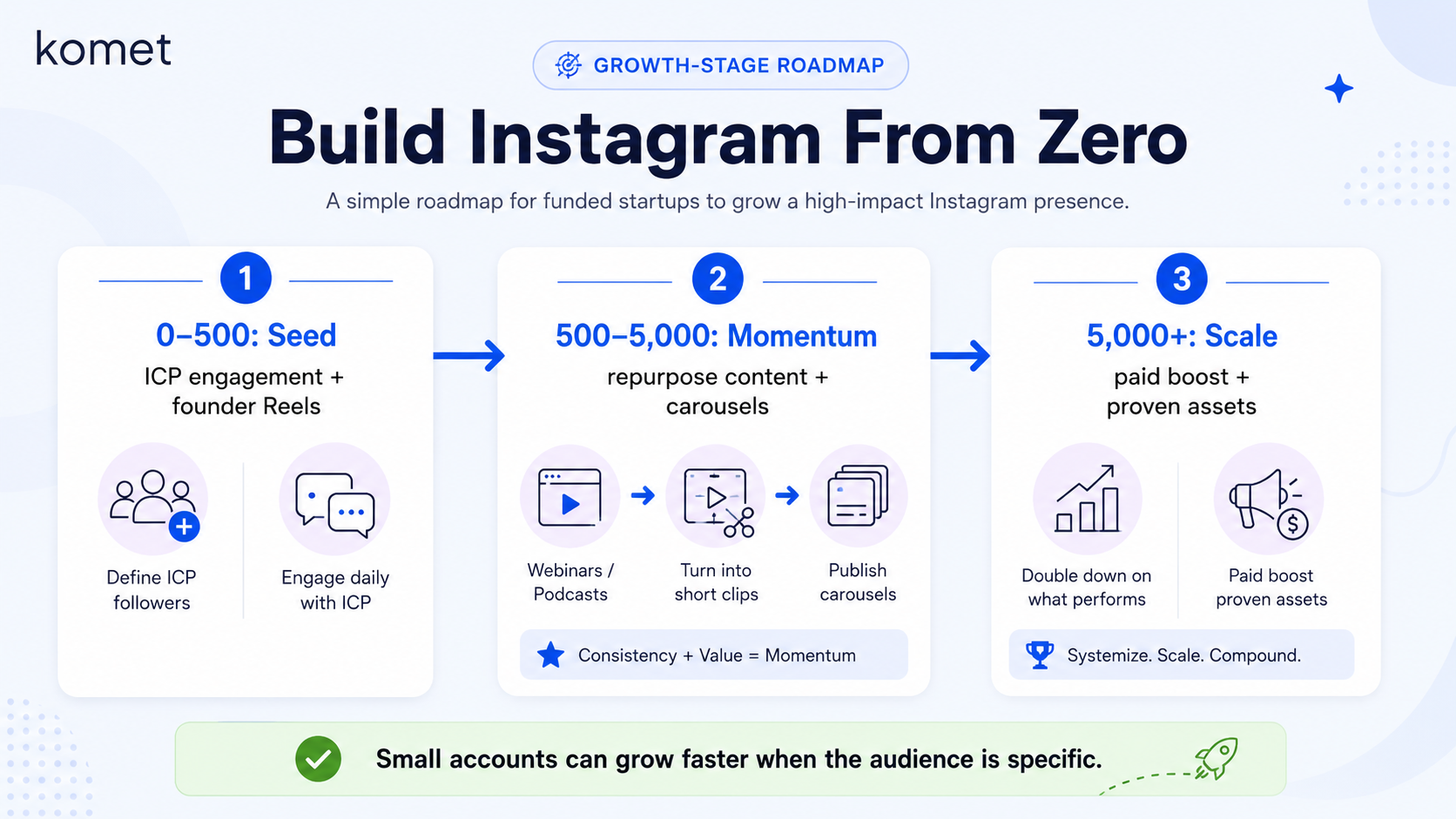
Phase 1: Seed (0–500 followers)
- Identify 30 accounts your ICP already follows, competitors, industry newsletters, SaaS tools, and adjacent founders.
- Engage genuinely with every post from those accounts for 20–30 minutes per day. Substantive comments, not emojis.
- Post five founder-perspective Reels in the first two weeks. Personal, direct, opinionated. This is the fastest path to early follows.
- DM every new follower with a genuine, non-salesy message. Build individual relationships at this stage.
Phase 2: Momentum (500–5,000 followers)
- Launch a content repurposing pipeline. Every webinar, demo, podcast episode, or internal presentation becomes three to five Instagram assets.
- Introduce carousels for product education. Tie each one to a real buyer question your sales team hears weekly.
- Use Story polls to source content ideas directly from your audience. This builds community and guarantees relevance.
Phase 3: Scale (5,000+)
- Introduce paid amplification behind your best-performing organic content. Advantages include fastest growth, scalability, low founder time investment, and high-quality creative assets, best for established brands, venture-backed startups, and enterprises.
Small accounts with 1,000 to 5,000 followers see a 38% average growth rate, significantly outpacing larger accounts. The early stage is your highest-leverage window. Don't skip it by trying to pay your way to 10,000 followers before you have proven content.
Instagram vs. LinkedIn for Tech Startup Marketing: Which Is Better?
This is the wrong question. The right question is: which platform owns which role in your go-to-market strategy?
Instagram generates 20 times more engagement per post than LinkedIn for B2B companies. But that reach advantage is most valuable at the top of the funnel, brand awareness, category education, and social proof. Sprout's research shows around 70% of marketers plan to increase their investment in Instagram in 2026, and that shift is not happening at LinkedIn's expense. Winning B2B startups run both platforms with different content roles. Instagram handles discovery and brand storytelling. LinkedIn handles relationship-building and pipeline conversations.
For funded tech startups, the practical allocation is: build your Instagram content system first (it's cheaper to produce, repurposes faster, and reaches broader audiences), then mirror your strongest performers to LinkedIn with adapted copy. Our Instagram marketing services are built specifically for this dual-channel motion.
Common Instagram Mistakes Tech Startups Make After Funding
More budget reveals bad habits. Here are the six most expensive mistakes I see post-funding teams make:
- Posting polished brand content instead of real expertise. Production quality matters, but a founder talking directly to camera about a real product problem will outperform a slick brand video every time. Stock photos and text-on-image posts underperform by 70% on Instagram compared to authentic behind-the-scenes photos, product shots, or customer stories.
- Optimizing for followers instead of pipeline. Follower count is not a growth metric. Track profile visits, DM volume, link-in-bio clicks, and demo request conversions.
- Ignoring content repurposing. Your last three webinars, your last five sales calls, and your last ten internal Slack discussions are a content library. Most teams waste them.
- Running ads before organic proof of concept. Ad fatigue causes a 19% drop in CTR for static creatives shown over seven days, reinforcing the need for regular creative refreshes. Spending a budget on content that hasn't proven organic traction first burns money fast.
- Skipping Stories. Meta says more than half a billion people use Instagram Stories daily. If you're only posting to the feed, you're invisible between posts.
- Treating every platform identically. Content repurposed from LinkedIn without adaptation for Instagram format and tone consistently underperforms. Each platform has its own native language.
How to Scale Instagram Presence with a Marketing Budget
Once you have organic proof of concept, posts that generate saves, shares, and DM conversations, paid amplification is how you scale it without scaling headcount.
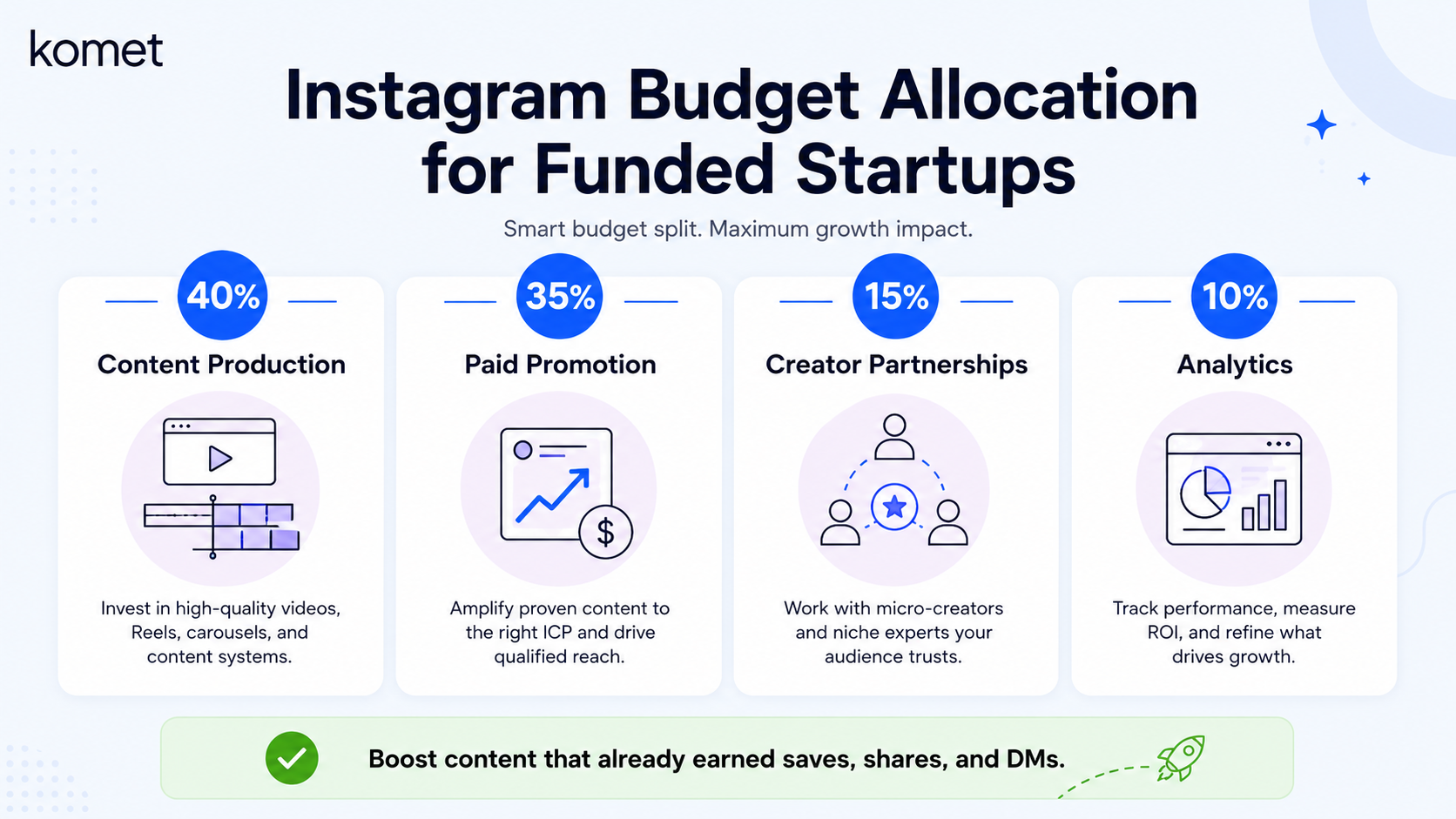
The funded tech startup budget framework:
- Content production (40% of budget): Invest here first. Video editing services and a structured video production pipeline ensure you never run out of assets. One monthly webinar or podcast episode becomes 12–15 short-form clips through proper content repurposing.
- Paid promotion (35% of budget): Boost only content that has already proven organic engagement. Carousel ads deliver 111% higher return on ad spend compared to standard single-image ads, making them the first format to test in paid.
- Influencer partnerships (15% of budget): Influencer marketing has shifted from one or two mega-influencer partnerships to ecosystems of 10 to 15 micro-influencers with deeply engaged niche communities. Brands in 2026 report higher ROI and trust metrics from micro-influencers (5K–50K followers) compared to macro-influencers, due to higher engagement rates and audience-creator intimacy.
- Analytics and optimization (10% of budget): Track saves, shares, DM volume, and profile visits weekly. Cut underperforming formats monthly. Double what works.
According to HubSpot, 48% of marketers say Instagram delivers the highest ROI of any social platform in 2026. That return does not come from scattered posting, it comes from a system where organic content, paid amplification, and influencer partnerships operate as one integrated go-to-market motion.
For Series A and growth-stage teams with a real budget and a real pipeline target, our Instagram growth service builds that system end-to-end. You bring the product expertise. We build the video content engine around it.
Conclusion
Instagram growth for funded tech startups is a system problem, not a creativity problem. The playbook is clear:
- Start with a positioned profile and a segmented ICP, everything else flows from that.
- Prioritize Reels for reach and carousels for depth; use both every week.
- Repurpose existing content aggressively, webinars, demos, and founder thinking are your best raw material.
- Prove organic before scaling paid, and allocate budget across production, promotion, and partnerships in that order.
Treat Instagram as a pipeline channel, not a social media checkbox, and it compounds over time.
Frequently Asked Questions
1) How many times per week should a funded startup post on Instagram?
Three to four times per week is the realistic target for most startup teams. Consistency outperforms volume. Posting 2 to 3 times per week drives an average 19% growth, sustainable cadence beats a burst-and-burn approach every time.
2) What engagement rate should a B2B startup expect on Instagram?
B2B brands typically see 0.5–2% engagement, while B2C categories like lifestyle and fashion often achieve 3–10%. For a B2B SaaS account, a rate above 1.5% is solid, and above 3% is exceptional. Track saves and shares more than likes.
3) Is Instagram actually worth it for B2B startups, or should we focus on LinkedIn?
Both platforms serve different roles. Instagram generates 20 times more engagement per post than LinkedIn for B2B companies, making it more powerful for brand awareness and content reach. LinkedIn converts better for direct pipeline conversations. Run both with different content roles.
4) What is the fastest way to grow Instagram followers for a startup from zero?
Engage daily with accounts your ICP follows, post five to ten founder-perspective Reels in your first month, and launch a content repurposing pipeline from existing webinars and demos. Small accounts with 1,000 to 5,000 followers see a 38% average growth rate, the early window is your highest-leverage phase.
5) Should we run Instagram ads before building an organic following?
No. Prove content organically first. Ads amplify what already works, spending budget on untested creative wastes money and delivers weak results. Use organic performance data to identify your best posts, then put budget behind those specific formats and topics.
6) How does content repurposing support Instagram growth for startups?
Content repurposing turns one long-form asset, a webinar, podcast episode, or demo recording, into 10 to 15 short-form clips, carousels, and Stories. This gives you a sustainable publishing cadence without constantly creating from scratch, and it ensures every piece of content is grounded in real product expertise rather than generic brand messaging. Learn more about how we approach this at Komet Media.