
🪄 AI Summary
Heading 1
Heading 2
Heading 3
Heading 4
Heading 5
Heading 6
Lorem ipsum dolor sit amet, consectetur adipiscing elit, sed do eiusmod tempor incididunt ut labore et dolore magna aliqua. Ut enim ad minim veniam, quis nostrud exercitation ullamco laboris nisi ut aliquip ex ea commodo consequat. Duis aute irure dolor in reprehenderit in voluptate velit esse cillum dolore eu fugiat nulla pariatur.
Block quote
Ordered list
- Item 1
- Item 2
- Item 3
Unordered list
- Item A
- Item B
- Item C
Bold text
Emphasis
Superscript
Subscript
Security buyers have heard every scare story. CISOs and security engineers are tired of vendors who open with breach headlines and close with vague promises. Video marketing helps cybersecurity companies when it does the opposite: explains threats clearly, shows how the product actually works, and puts credible practitioners on camera. Security content also carries real risk. A careless clip can overstate protection, reveal sensitive details, or misdescribe an incident. This guide covers how Komet Media produces original videos from scratch and repurposes existing content, how to review it, and how to distribute and measure video for security buyers.
Quick Answer
Video marketing for cybersecurity companies works when it educates instead of frightening, shows real product behavior, and features credible practitioners. Komet Media helps security teams combine original videos produced from scratch with repurposed clips, supported by structured technical and legal review.
Why Security Buyers Respond to Clear Explanation
Security teams are overloaded. They evaluate tools under time pressure, with incomplete information, while responding to real incidents. Every minute a video wastes is a minute they could spend on actual security work. They value vendors who make complex problems easier to understand.
The threat landscape gives you plenty to explain. Verizon's 2025 Data Breach Investigations Report analyzed more than 22,000 security incidents, including 12,195 confirmed data breaches. Verizon reported that third-party involvement in breaches doubled to 30%, and that exploitation of vulnerabilities rose 34% compared with the previous report. Findings like these are useful starting points for educational video, as long as you present them accurately and do not use them to manufacture fear.
At the same time, almost every company now produces video. Wyzowl's 2026 survey of 266 marketers found that 91% of businesses use video as a marketing tool. Cybersecurity feeds are full of dramatic animations of hooded hackers. Clear, practical, human video stands out precisely because it is rarer.
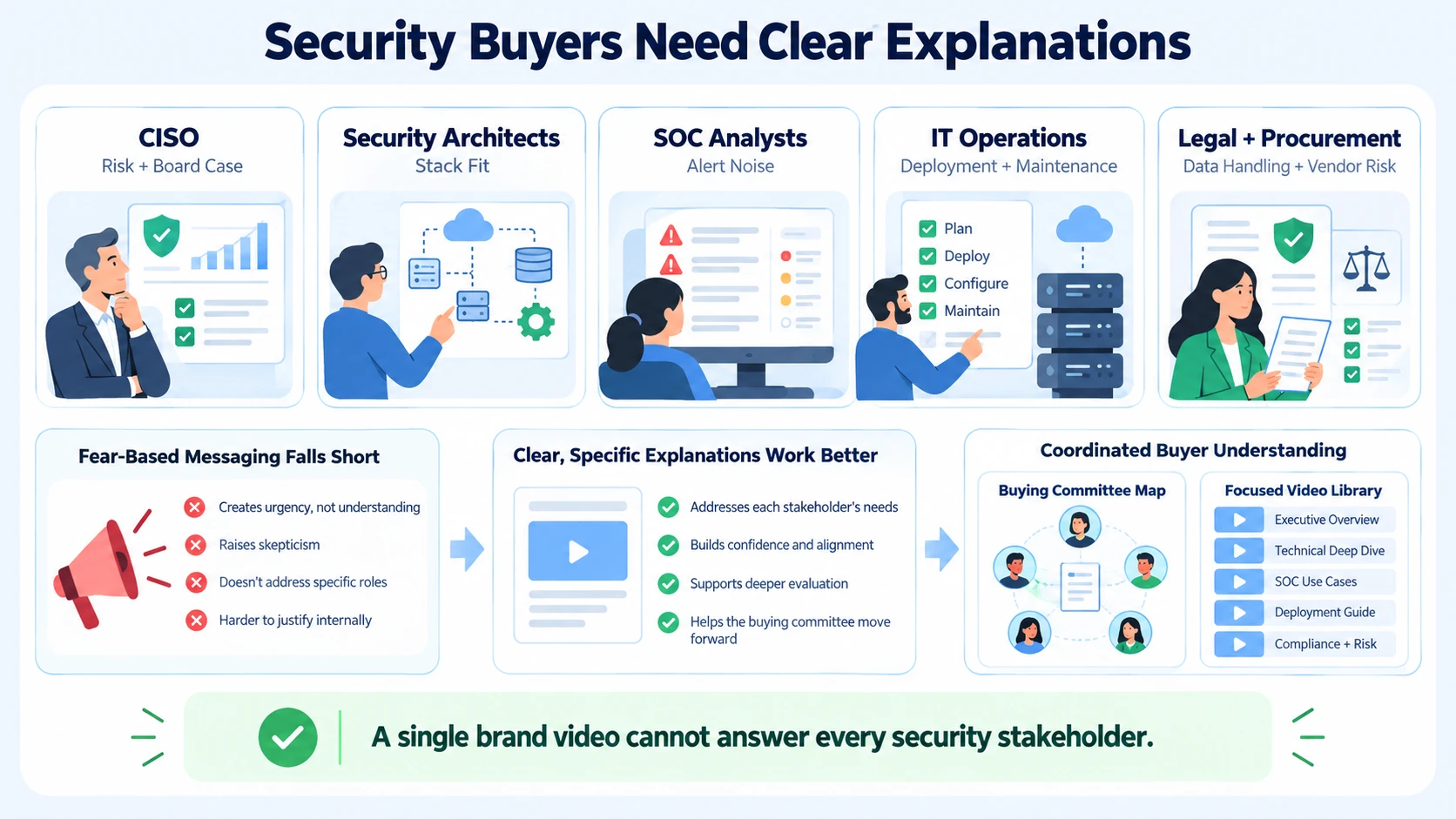
Buying committees add another layer. A security purchase can involve the CISO, security architects, SOC leads, IT operations, legal, procurement, and sometimes the board. The 2025 Edelman and LinkedIn B2B Thought Leadership Impact Report, based on a survey of nearly 2,000 management-level professionals, found that more than 40% of B2B deals stall because of internal misalignment within buying groups. Each stakeholder needs a different explanation.
Each stakeholder brings a different question:
- The CISO asks how the tool reduces risk and how to explain the spend to the board.
- Security architects ask how it fits the existing stack and where it might break.
- SOC analysts ask whether it reduces noise or adds more alerts to triage.
- IT operations ask how hard deployment and maintenance will be.
- Legal and procurement ask about data handling, contracts, and vendor risk.
A single brand video cannot answer all of these. A small library of focused videos can.
The Cybersecurity Video Mix: What to Produce
One mistake I see repeatedly is security companies investing in dramatic brand animations and very little else. Buyers need practical videos that help them evaluate, not just remember.
At Komet Media, we help security teams build this mix through both original production created from scratch and repurposed content. Security companies often have conference talks, research briefings, webinars, and podcasts that can be repurposed into focused clips. At the same time, many require brand-new threat explainers, product-in-action walk-throughs, and executive briefings recorded from scratch. Most successful video programs leverage both approaches. If you run a podcast, our guide to repurposing cybersecurity podcast episodes covers that specific workflow.
What makes a strong product-in-action video? In my experience, it starts with a realistic scenario, such as a phishing email that leads to a credential being used from an unusual location. It shows what the analyst sees, what the product detects, and what action follows, step by step. It names the limits honestly and avoids pretending the tool replaces the team. Good cybersecurity video marketing shows the product as a capable colleague, not a magic shield.
Production style matters. Security audiences prefer realistic product footage and clean diagrams over cinematic hacker imagery. Simple animated attack chains can explain more than a minute of talking. Our guide to explainer videos for technical products covers how to make complex systems easy to follow.
Length should follow the job. Short clips work for single insights and quick tips. Product-in-action videos usually need a few minutes to show a full scenario. Research explainers and conference talks can run much longer, because practitioners who care about the topic will watch.
Accuracy, Sensitivity, and Incident Talk
I am not a lawyer, and your legal, security, and communications teams decide what applies to you. From a production view, security video has review points that most B2B content does not.
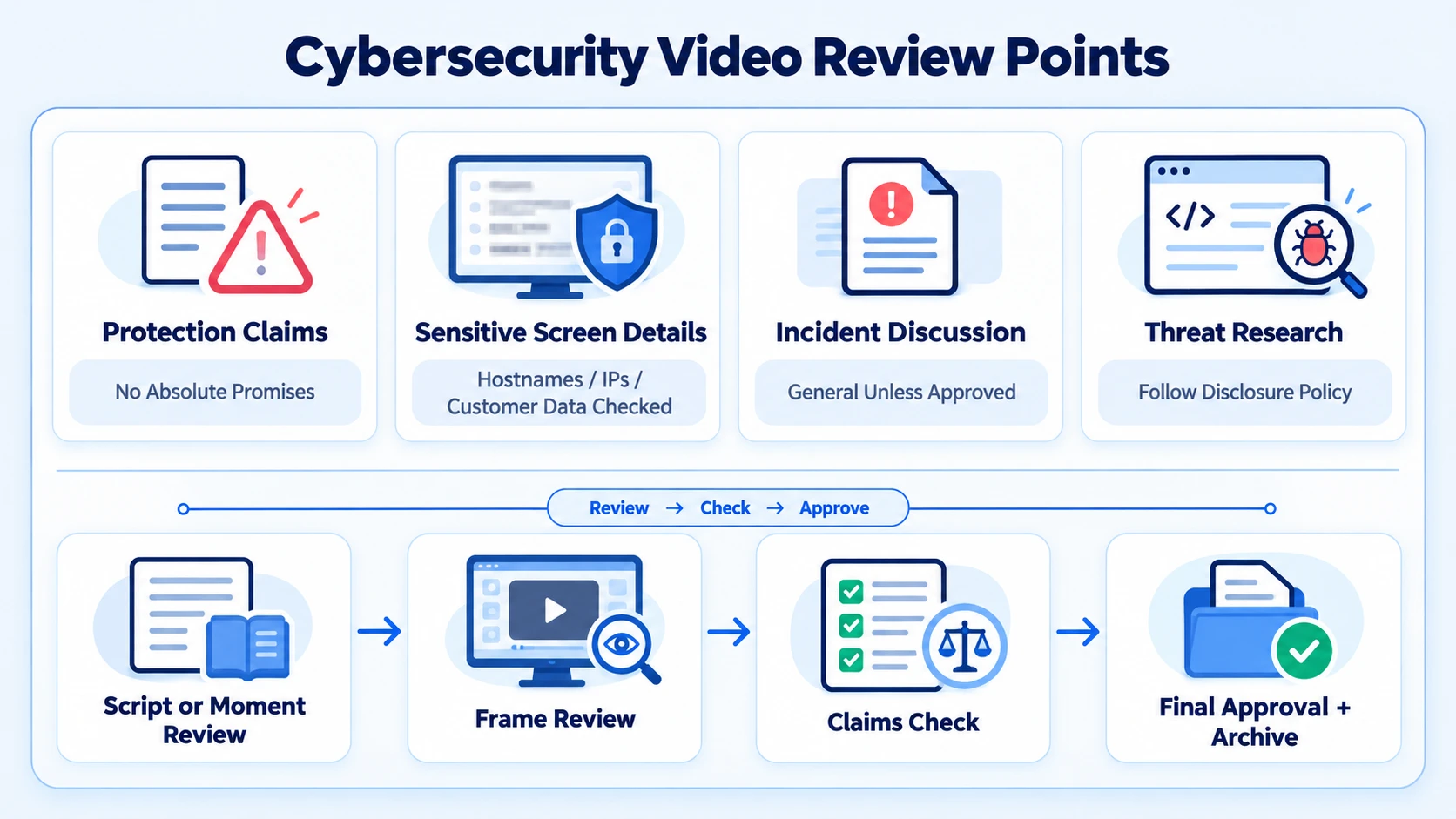
Protection claims. A clip saying "stops all ransomware" or "zero false positives" invites both skepticism and liability. Keep claims tied to tested conditions, and state what was measured and how.
Sensitive details on screen. Product demos can expose internal hostnames, IP addresses, customer data, or detection logic you do not want published. Use dedicated demo environments, and review every frame of screen recordings. Synthetic data that looks realistic is far safer than anonymized production data.
Incident discussion. Guests sometimes discuss breaches they responded to. Those details may be confidential, under investigation, or subject to disclosure rules. For example, the SEC's 2023 rules require public companies to disclose material cybersecurity incidents, with an Item 1.05 Form 8-K generally due four business days after a company determines an incident is material. A casual comment in a video about a customer's incident could create real problems. Keep incident stories general unless the organization has approved them.
Threat research. When researchers discuss vulnerabilities or attacker techniques, make sure the video follows your disclosure policy and does not hand out operational detail that helps attackers.
How we usually structure review:
- Script or moment review. Security and legal review scripts for original videos and transcript excerpts for repurposed clips.
- Frame review. Someone technical checks every screen recording for sensitive information.
- Claims check. Protection and performance statements are matched to evidence.
- Final approval and archive. Approvals are stored with final files.
Captions need care as well. Security terms, product names, and acronyms are easy for automatic transcription to get wrong. We keep a glossary for each client so terminology stays consistent across every video.
Building a Repeatable Video Marketing System
Security teams are busy, and researchers are in high demand. A simple system keeps video moving without pulling experts away from their real work.
A typical monthly rhythm might look like this:
This is an example rhythm, not a fixed package. Companies with stricter review requirements may need a longer cycle.
Where strong topics come from:
- Sales and solutions engineering. The questions asked on every call deserve a video.
- Your research team. New findings make excellent explainers when presented accurately.
- Customer success. Deployment and integration questions become helpful onboarding videos, which also reassure prospects during evaluation.
- Current events, carefully. When a major threat is in the news, a calm explainer can help buyers, as long as it avoids speculation about specific victims.
Do not overlook existing recordings. Conference talks, research briefings, and webinars often contain excellent explanations buried in long sessions. Cutting them into focused clips with clear titles can fill much of the calendar without new recording time.
Common reasons security video programs stall are predictable: researchers get pulled into incidents, reviews happen too late, and nobody owns distribution. Each is a process problem, not a creative one.
Speed matters in security in a way it does not in most categories. When a major vulnerability is disclosed, buyers look for clear explanations within days. A video marketing system with pre-approved templates, a ready recording setup, and a fast review path lets you publish a calm, accurate explainer while the topic is still relevant. Without that system, the moment passes.
Distribution: Reaching Security Leaders and Practitioners
A polished video with no distribution plan is still an underused asset. Security audiences gather in specific places, and they react poorly to anything that feels like spam.
LinkedIn is the main channel for reaching CISOs, security leaders, and IT executives. Video consumption on the platform has grown: Digiday reported that total video viewership on LinkedIn rose 36% year over year for the period from October 30, 2024, to January 29, 2025, based on figures shared by the company.
YouTube works for threat explainers, product walkthroughs, and full conference talks. Searchable titles help practitioners find videos long after release. Organize videos into playlists by threat type or use case, so a viewer who finds one explainer can easily find the next.
Security communities and conferences matter a great deal. Research-led clips fit naturally into community discussions and event follow-ups. Promotional clips do not.
Your website should host product-in-action videos and deployment explainers on the pages buyers visit during evaluation.
Sales enablement needs a clip library organized by objection: integration effort, false positives, data handling, deployment time, and cost. A two-minute video from a solutions engineer can answer what would otherwise take another call.
Executive and board content deserves its own track. Short briefings that explain risk in business terms help CISOs make the case internally. Many security leaders will share a clear, vendor-neutral explainer with their leadership if it saves them time.
Paid distribution can extend your best organic videos to specific accounts or job titles. Prove a video organically first, then put budget behind the pieces that already earn engagement from security roles.
Email keeps prospects and customers informed. A monthly update with one threat explainer and one product clip gives them something useful rather than another sales message.
Our guide to short-form video for cybersecurity companies covers short formats in more depth.
How to Measure What Video Is Doing for the Business
Do not judge security videos only by views. A threat explainer watched by a few hundred security leaders at target accounts can matter more than a dramatic animation with broad reach.
Attribution is imperfect in security, where buying cycles can be long and involve many stakeholders. Combine platform data with a "how did you hear about us" field, sales notes, and community feedback. Review monthly.
Qualitative signals matter too. Notice when a prospect references a specific explainer in a meeting, when a practitioner shares your clip in a community thread, or when sales stops answering the same deployment question repeatedly. These moments rarely show up in dashboards, but they show that video is building trust.
Over time, your video marketing results should shape what you produce. If researcher explainers consistently start conversations, invest more there. If brand animations collect views but never come up in deals, move budget toward practical content.
Conclusion
Cybersecurity companies sell to some of the most skeptical buyers in B2B. Those buyers do not need more fear. They need clear explanations, honest product demonstrations, and practitioners they can trust.
The decision that matters is to run video marketing as an educational, carefully reviewed system. Combine original and repurposed video, protect sensitive details, keep claims grounded, and distribute through the channels where security professionals already learn. That is how video earns trust in a market full of noise.
FAQ
1) What does video marketing for cybersecurity companies include?
It usually includes threat explainers, product-in-action videos, researcher and practitioner videos, executive briefings, customer stories, clips from talks and webinars, and sales follow-up videos.
2) How much does it cost?
It depends on volume and complexity. Freelancers often charge per video or per hour, subscriptions charge a flat monthly fee for editing volume, and agencies price by scope. At Komet Media, engagements typically fall in the range of about $2,500 to $5,000, depending on volume, motion graphics, original production needs, review requirements, and distribution support.
3) How long does it take to produce security videos?
Editing time depends on complexity, but technical and legal review often set the timeline. Reviewing scripts and moment lists before editing usually saves time.
4) Should we use fear-based messaging?
I would avoid it. Security buyers have seen it many times. Accurate, calm explanation of real threats builds more trust than dramatic warnings.
5) Should we hire a freelancer or an agency?
A skilled freelancer can handle editing well. An agency fits better when you need strategy, scripting, original production, repurposing, technical visuals, review coordination, and distribution handled as one system.
6) Can our internal team handle this?
Yes, if someone owns production and distribution every week. The common risk is that researchers and engineers get pulled into urgent work, and video stops for months.
7) Which video should a cybersecurity company make first?
Start with a clear product-in-action video based on a realistic scenario. It answers the most common evaluation question: what does this actually do? Once that video is working in sales conversations, add threat explainers and researcher videos to build reach and authority.
8) How does Komet Media work with cybersecurity companies?
We help security teams plan, script, produce, edit, and distribute video, including original content created from scratch and clips repurposed from talks, webinars, and podcasts. Technical and legal review steps are built into the workflow. If you want to talk through your plans, you can book a call with our team.