
🪄 AI Summary
Heading 1
Heading 2
Heading 3
Heading 4
Heading 5
Heading 6
Lorem ipsum dolor sit amet, consectetur adipiscing elit, sed do eiusmod tempor incididunt ut labore et dolore magna aliqua. Ut enim ad minim veniam, quis nostrud exercitation ullamco laboris nisi ut aliquip ex ea commodo consequat. Duis aute irure dolor in reprehenderit in voluptate velit esse cillum dolore eu fugiat nulla pariatur.
Block quote
Ordered list
- Item 1
- Item 2
- Item 3
Unordered list
- Item A
- Item B
- Item C
Bold text
Emphasis
Superscript
Subscript
Most SaaS teams treat YouTube as an afterthought. A product launch video here, a recorded webinar there, then silence. That's the wrong model entirely. The YouTube Playbook for B2B SaaS is about turning your existing product knowledge, founder thinking, and customer stories into a compounding demand engine. 46% of B2B technology buyers purchase after viewing video content , and 60% of B2B buyers use YouTube during vendor research. If your SaaS isn't showing up, a competitor is.
TL;DR
- 93% of B2B buyers say video builds trust in purchase decisions , making YouTube non-negotiable for serious pipeline.
- YouTube works as a mid-funnel demand channel: Shorts for discovery, mid-form for credibility, long-form for conversion.
- Repurpose first: webinars, demos, and podcasts are ready-made raw content for your channel.
- Measure on 30–60-day view-through conversion, not last-click, or the channel will look broken.
Does YouTube Actually Work for B2B SaaS Companies?
The short answer: yes. The caveat: only if you treat it as an education and trust channel, not an ad platform. About 53% of B2B content marketers use YouTube, with the platform ranking among the top four most valued social media channels for B2B decision-makers. That number is still climbing. In 2025, 104% more marketers named short-form video their most valuable channel compared to 2024, and it's where investment is growing fastest for 2026.
The trust signal is what makes YouTube genuinely different from paid social. A Gartner study from July–August 2025 found that 61% of consumers consider YouTube trustworthy for accurate information, ahead of Reddit at 47% and Instagram at 32%. For B2B SaaS, where buying committees are evaluating vendor credibility before they ever book a demo, that trust advantage is enormous. 81% of B2B buyers say they trust video more than text-based content, and 88% say video influenced their final vendor selection. Those aren't vanity numbers. They're pipeline indicators.
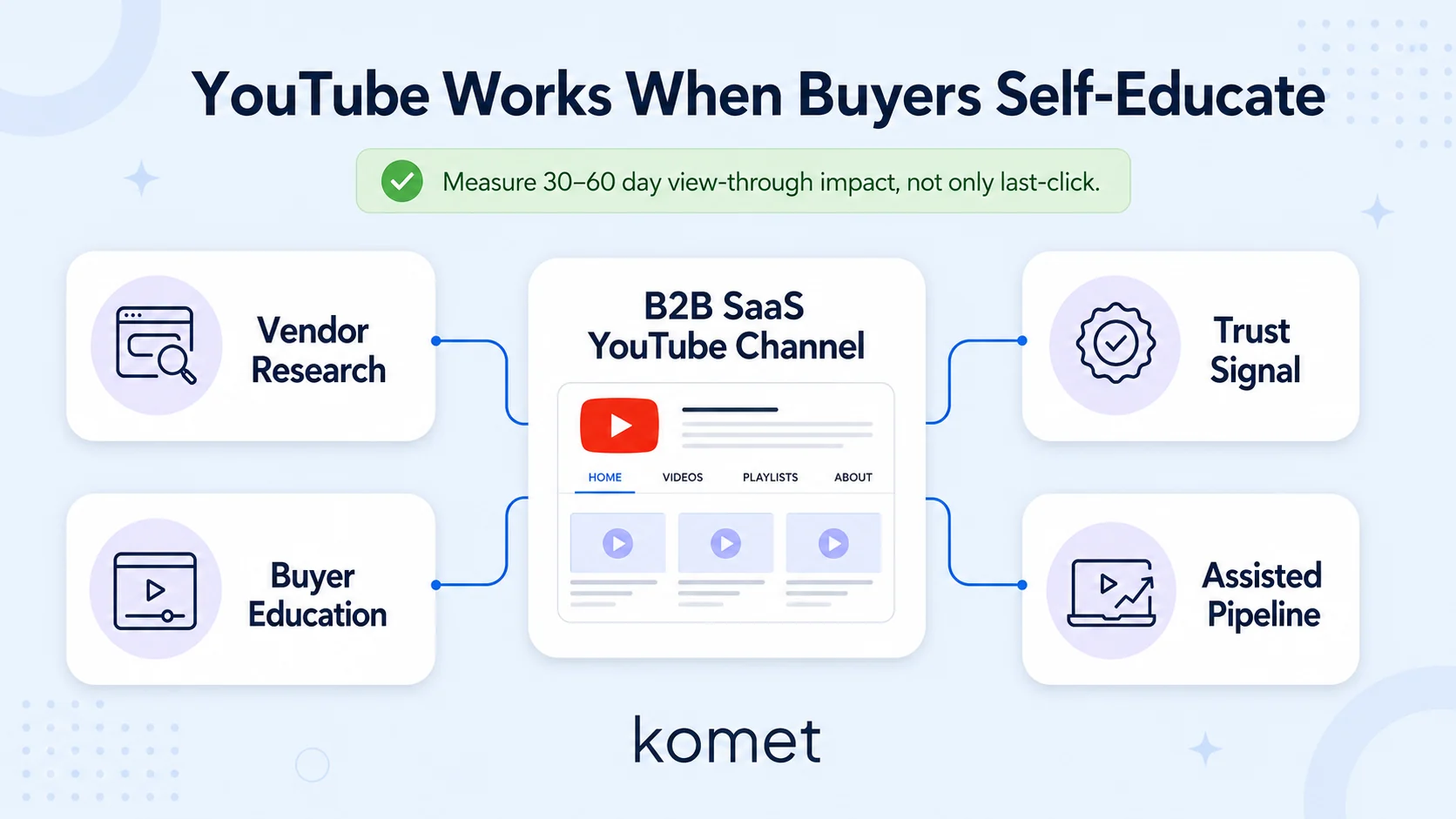
The platform dynamics in 2026 have also shifted in ways that benefit SaaS teams willing to publish consistently. YouTube's December 2025 algorithm overhaul reduced long-form video slots on home feeds by up to 80%, while YouTube Shorts now drive 200 billion daily views globally. A modern B2B YouTube marketing strategy needs both: Shorts for discovery at the top of the buyer journey, long-form for consideration-stage buyers who are already evaluating vendors.
The measurement mistake most SaaS teams make: they judge YouTube on last-click attribution within seven days and conclude it's not working. When you measure YouTube on last-click within 7 days, you'll always conclude it's failing. When you measure on 30–60-day view-through conversion plus assisted pipeline contribution, you get 1.8x–3.2x ROAS. Change the measurement window before you change the channel.
How to Build a YouTube Content Strategy for a SaaS Company
A YouTube strategy without structure is just a content calendar. The YouTube Playbook for B2B SaaS starts with mapping video formats to funnel stages. Success in B2B YouTube marketing requires aligned content across awareness (Shorts), consideration (mid-form), and decision (long-form) stages.
Here's how to execute each layer:
Awareness (Shorts, 15–35 seconds): Clip founder opinions, product "aha moments," and single-tip educational content from existing long-form recordings. Shorts drive discovery with a 5.91% engagement rate and reach 53% of B2B buyers before they request demos.
Consideration (mid-form, 3–8 minutes): Product walkthroughs, use case explainers, "how we solved X" case study videos. This is where your buyers spend real time evaluating.
Decision (long-form, 15–45 minutes): Webinar replays, deep-dive product demos, founder interviews, and customer success stories. Webinar recordings average 29 minutes of watch time , making them strong long-form candidates with zero additional production cost.
For search intent optimization, use vidIQ or TubeBuddy to find keywords your buyers are already searching. Title formats that consistently perform for SaaS include "How to [solve problem] with [product category]," "[Software category] vs [alternative]," and "How we [achieved outcome] using [method]."
A practical content cadence for a lean SaaS team:
- Record one 30–45 minute long-form asset per month (webinar, demo, or podcast).
- Clip 4–6 Shorts from that recording using a short-form video editing workflow.
- Produce one 5–8 minute mid-form educational video from the same themes.
- Publish consistently, YouTube rewards cadence over volume.
- Optimise every video with chapters, keyword-rich descriptions, and closed captions.
Building audience retention metrics starts with the hook. If you lose viewers in the first 30 seconds, the algorithm stops recommending the video. Aim for 50%+ average view duration as your baseline benchmark.
What Kind of Videos Should a SaaS Company Make?
The most common mistake I see SaaS teams make: they produce content they want to make rather than content their buyers are searching for. Here's the video taxonomy that drives the pipeline.
- Buyer education videos are the core of any SaaS YouTube channel. These address the exact questions your prospects type into Google and YouTube before they ever engage with sales. Think "how to reduce churn in a B2B SaaS product" or "what is product-led growth." These support the buyer journey mapping process and position your brand as the authoritative answer.
- Product demonstration videos are the highest-intent content on your channel. Product demos perform best at 2–5 minutes , focused on one use case or persona problem per video, not a full feature tour.
- Thought leadership content from founders and executives builds channel authority and drives the kind of trust that shortens sales cycles. According to the 2025 Edelman-LinkedIn report, 86% of B2B decision-makers see thought leadership as a more trustworthy way to assess a company's capabilities than marketing materials or product sheets. Founder-led content on YouTube compounds over time in ways paid content cannot.
- Customer story videos convert browsers into demo requests. Testimonial videos deliver 44% higher conversion rates. Keep them under three minutes and lead with the outcome, not the problem.
- Sales enablement clips are short videos your sales team drops into email sequences. Personalised video follow-ups increase response rates by 36%. These don't need to be polished; they need to be specific and relevant to the prospect's situation.
Here's a practical content mix for a SaaS team in scale mode:
The raw material for most of this content already exists: your webinars, podcast episodes, sales calls, and product demos. Repurposing is not cutting corners. It is the strategy.
How Do B2B SaaS Companies Use YouTube to Generate Leads?
YouTube generates leads through two distinct mechanisms: organic search and paid demand creation. Both require different tactics within The YouTube Playbook for B2B SaaS.
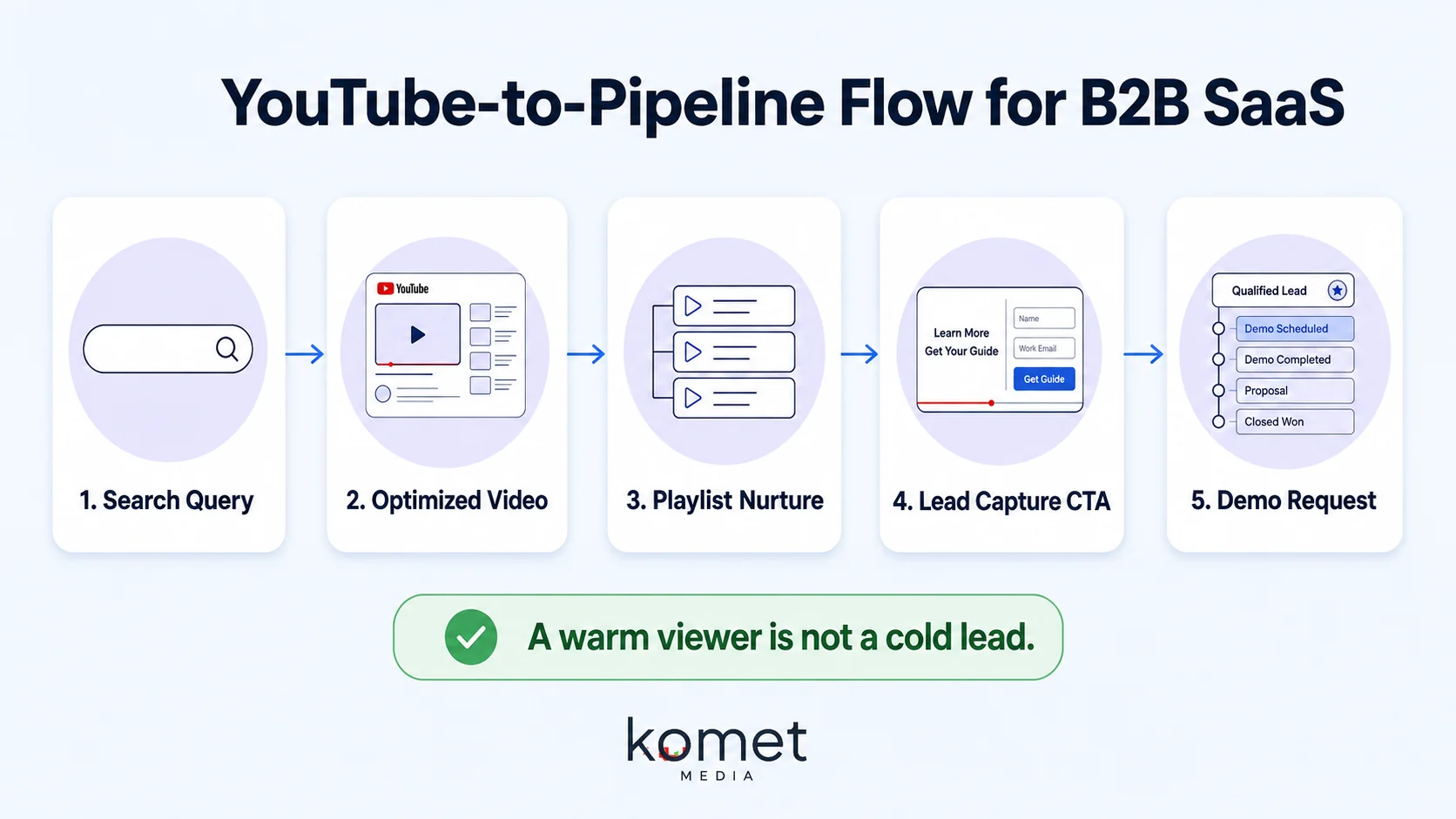
Organic search: YouTube is the world's second-largest search engine. With over 79 billion annual visits, YouTube ranks as the second most visited website globally. When a VP of Operations searches "how to reduce software onboarding time," a well-optimised video from your channel can be the first thing they see. That is inbound demand generation with no paid media cost.
To capture organic demand:
- Research keywords using vidIQ or TubeBuddy before every video.
- Put the primary keyword in the video title, first 150 characters of the description, and in spoken dialogue (YouTube auto-transcribes).
- Add chapters so YouTube can index individual sections.
- Build playlists by buyer persona or use case to extend session time and channel authority building.
Paid demand creation: YouTube Ads for B2B work best as a mid-funnel demand-creation channel, not as a top-of-funnel direct response channel. The most effective structure layers custom audiences from HubSpot MQL lists or LinkedIn engagement on top of in-stream video ads. Use TrueView In-Stream for mid-funnel nurture, such as case studies, demo intros, and ROI explainers. Use TrueView Discovery for capture against in-market searches. Use Bumper ads for repeated brand exposure to retargeting pools.
YouTube Shorts CPM runs $6–$14, which is 35–50% cheaper than TrueView In-Stream, with view rates of 60–75%. Yet 75% of B2B advertisers still run only horizontal creative, locking themselves out of half the YouTube inventory. For MQL to SQL conversion, gate high-value content (frameworks, calculators, extended demos) with a lead capture step in the video description or end screen. A viewer who has watched 8 minutes of your product walkthrough is not a cold lead. They are a warm conversation. Our video marketing process at Komet Media builds this exact structure: repurpose long-form content into short clips that pull viewers into mid-form explainers, which then convert into demo requests or content downloads.
YouTube vs LinkedIn for B2B SaaS: Which Is Better?
This is the wrong question. The right question is: what role does each platform play in your video sales funnel? LinkedIn leads search-like discovery for 26.9% of B2B marketers, ahead of YouTube at 17.9%. For intent-to-research behavior, LinkedIn is where buyers surface vendor shortlists. B2B SaaS leads LinkedIn engagement at 2.8% median engagement rate, 1.5x the platform average, due to alignment between audience and content. YouTube, by contrast, owns long-session, high-attention consumption. Users spend an average of 48.7 minutes daily on YouTube in 2026. No other platform gets that level of sustained engagement from the same B2B audience.
Here is how the two platforms compare for SaaS marketing teams:
LinkedIn Ads can run $150–$450+ per bottom-of-funnel lead for enterprise or high-intent campaigns. YouTube builds the awareness that makes those LinkedIn ads convert. The winning approach: publish thought leadership on LinkedIn, then retarget LinkedIn video viewers on YouTube with deeper product content. Treating YouTube like a 6-touch nurture surface delivers 1.8x–3.2x assisted ROAS at 180 days when paired with LinkedIn or Meta retargeting. Both platforms in sequence outperform either platform in isolation.
Best B2B SaaS YouTube Channels to Learn From in 2026
The fastest way to shortcut your YouTube strategy is to study what is already working. These channels are doing it right.
SaaStr is the benchmark for B2B SaaS channel authority building. Jason Lemkin started the SaaStr blog in 2012, and it grew into a community of 1M+ members, now the world's largest SaaS community offering free tactical advice. Their channel consistently publishes conference keynotes and founder interviews that rank for high-intent SaaS queries.
Y Combinator publishes structured educational content in the form of Startup School lectures, founder discussions, and operator frameworks. YC is a notorious startup accelerator, and its YouTube channel consists of videos from Startup School tutors sharing their advice and founder discussions. The format is simple: expertise on camera, no production theatrics.
MicroConf focuses on the bootstrapped SaaS segment. The MicroConf channel features keynotes and updates from Rob Walling, who has launched 6 companies, invested in over 120 startups, and authored four books on bootstrapped SaaS. Its consistency and niche authority are the lessons here.
HubSpot operationalizes YouTube as part of its inbound marketing flywheel. Their channel pairs search intent optimization with product demonstration content, turning viewers into trial users through end-screen CTAs and linked tools.
Wistia produces some of the most polished B2B video content marketing examples available. Their "One, Ten, One Hundred" series is a textbook case study in product-led content that drives brand awareness campaigns without feeling like advertising. The pattern across every successful B2B SaaS YouTube channel: specificity, consistency, and a clear buyer outcome in every video. They are not broadcasting. They are educating.
You can explore how Komet Media's services help SaaS teams build this same model, even if they are starting from zero content inventory.
How to Grow a YouTube Channel for a SaaS Product: The Execution Stack
Knowing the strategy is step one. Executing it without burning out your team is the harder part. Here is the operational stack I recommend for SaaS teams working within real content bandwidth.
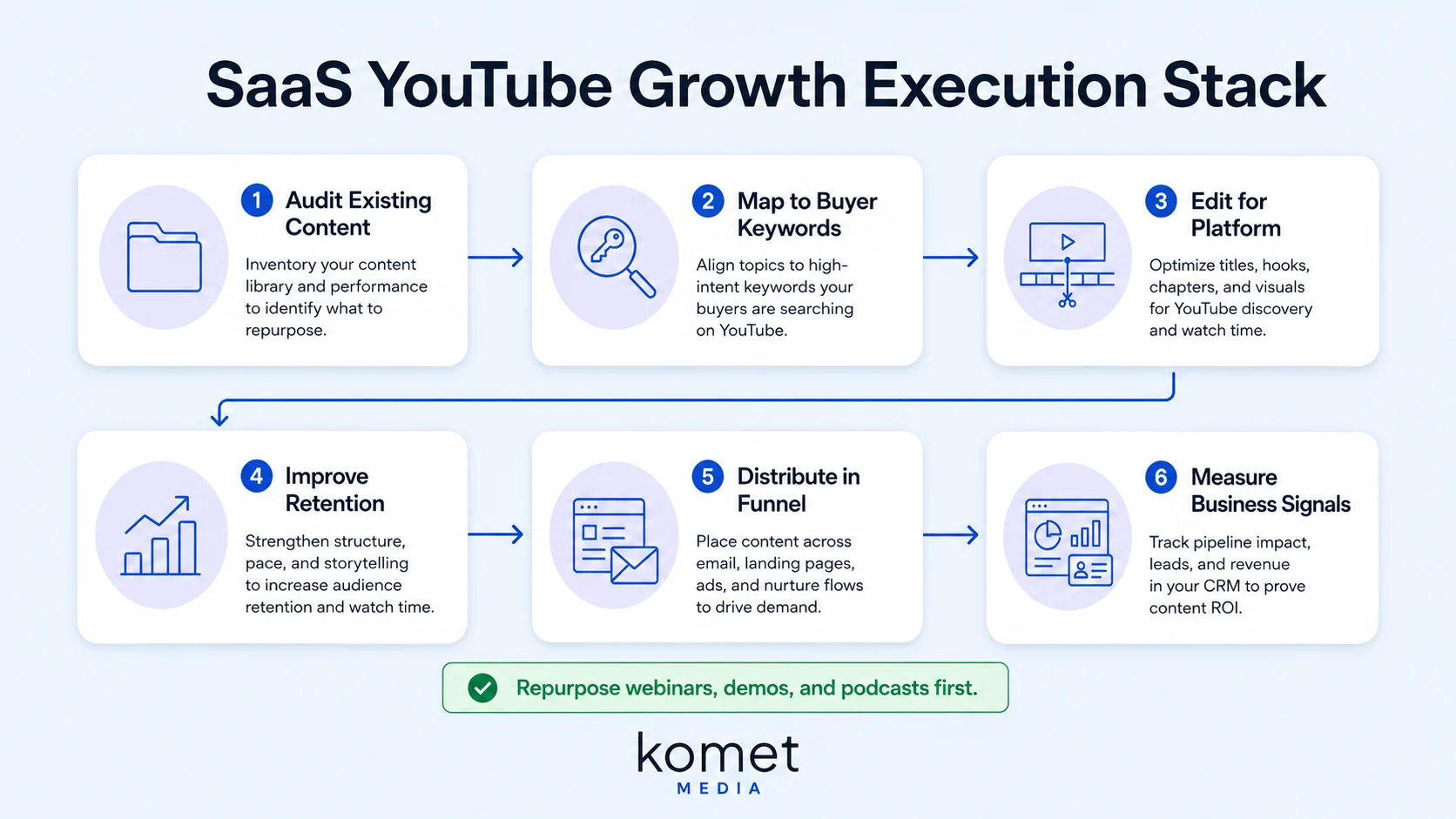
Step 1: Audit your existing content library. Pull all recorded webinars, product demos, sales call recordings, and podcast episodes. This is your raw material. Most SaaS teams have 20–40 hours of usable footage they have never repurposed.
Step 2: Map each asset to a keyword. For every piece of raw content, identify the buyer question it answers. Use vidIQ or TubeBuddy to validate search volume. Prioritise topics with clear purchase intent.
Step 3: Edit for platform. Long-form content goes up with chapters, keyword descriptions, and end screens. Short-form clips get subtitles, tight pacing, and a hook in the first three seconds. The YouTube video editing process is where most SaaS teams lose time. Build a repeatable system or partner with a team that already has one.
Step 4: Optimise for audience retention metrics. Track average view duration and click-through rate on thumbnails. If CTR is below 3%, the thumbnail or title needs work. If retention drops before 30%, the hook is too slow.
Step 5: Distribute across your video sales funnel. Embed videos in nurture emails, HubSpot sequences, sales proposals, and landing pages. 96% of B2B video marketers say video marketing increased their users' understanding of their products and services. That understanding accelerates the sales cycle.
Step 6: Measure what matters. Track views, watch time, and subscriber growth as channel health signals. Track leads, demo requests, and influenced pipeline as business signals. Connect YouTube analytics to HubSpot or your CRM so you can tie video views to revenue. B2B video achieves a 4.8% conversion rate versus 2.9% for sites without video. That gap closes faster with a systematic distribution approach. Modern buying committees shape opinions early through short video, expert voices, and trusted content ecosystems long before they speak to a vendor. When your channel is live and consistent, you are in that pre-shortlist conversation. When it is not, you are not.
Conclusion
The YouTube Playbook for B2B SaaS is not about going viral. It is about showing up consistently in front of your buyers before they talk to sales.
- Start with what you already have: webinars, demos, podcasts, and founder conversations.
- Build across all three funnel stages: Shorts for discovery, mid-form for education, long-form for conversion.
- Measure on a 30–60 day window, not last-click, or the channel will always look underperforming.
- Pair YouTube with LinkedIn for a full-funnel content distribution system that reduces customer acquisition cost over time.
The SaaS teams winning in 2026 are publishing regularly, repurposing relentlessly, and measuring what actually moves the pipeline. Connect with Komet Media to build the system.
Frequently Asked Questions
Q1: How many videos should a B2B SaaS company post on YouTube per month?
Consistency beats volume. A realistic starting cadence is two to four videos per month: one long-form asset (webinar replay or product deep-dive) plus two to four Shorts clipped from that asset. Once your publishing process is systemised, scale to weekly. What matters most is that you never go dark for more than two weeks.
Q2: How long should SaaS product demo videos be on YouTube?
Keep product demo videos between two and five minutes for YouTube. Each video should cover one use case or one buyer persona problem, not a full feature tour. Viewers self-select deeper content; give them a clear CTA to book a live demo if they want to see more.
Q3: Can a new SaaS company with no YouTube audience generate leads from the channel?
Yes, but the mechanism is search, not subscribers. New channels generate leads by ranking for specific buyer queries, not by building an audience first. Optimise every video title and description for the exact keyword your ICP searches. Leads come from discoverability, not follower count.
Q4: What tools do B2B SaaS teams use to manage and grow YouTube channels?
The core stack: vidIQ or TubeBuddy for keyword research and search intent optimization, YouTube Studio for audience retention metrics, HubSpot for tracking video influence on pipeline, and a dedicated video editing workflow. Wistia is also useful for embedding gated content off-platform.
Q5: Should a SaaS founder appear on camera for their company's YouTube channel?
Yes, especially for early-stage teams. Founder-led content works exceptionally well for B2B companies because it is hard to fake, opinionated, specific, and rooted in real experience. Founder presence builds the kind of trust that marketing assets alone cannot generate. Start with a talking-head format and improve production quality over time.
Q6: How does YouTube content support sales enablement for SaaS teams?
Sales reps can share specific product demo videos, use case explainers, or customer story clips directly in email sequences and LinkedIn outreach. A prospect who has watched a five-minute walkthrough of a relevant feature arrives at a demo call significantly more qualified than a cold contact. This is how B2B content marketing and sales enablement compound together.