
🪄 AI Summary
Heading 1
Heading 2
Heading 3
Heading 4
Heading 5
Heading 6
Lorem ipsum dolor sit amet, consectetur adipiscing elit, sed do eiusmod tempor incididunt ut labore et dolore magna aliqua. Ut enim ad minim veniam, quis nostrud exercitation ullamco laboris nisi ut aliquip ex ea commodo consequat. Duis aute irure dolor in reprehenderit in voluptate velit esse cillum dolore eu fugiat nulla pariatur.
Block quote
Ordered list
- Item 1
- Item 2
- Item 3
Unordered list
- Item A
- Item B
- Item C
Bold text
Emphasis
Superscript
Subscript
Most B2B teams still treat TikTok as a consumer channel and walk away empty-handed. That's the wrong read. The platform now reaches nearly 2 billion monthly active users, and the buyers evaluating your SaaS product or AI tool are in that audience. This guide breaks down a complete TikTok Strategy for B2B Brands & AI-Native Companies, what formats work, what mistakes kill results, and how to turn short-form video into a pipeline.
TL;DR
- TikTok's algorithm surfaces content to non-followers, giving B2B brands organic reach that LinkedIn and Instagram no longer offer.
- Founder-led, educational, and "show the product" formats consistently outperform polished brand content for SaaS and AI buyers.
- Cross-posting to LinkedIn and repurposing existing webinar or podcast content removes the biggest production barrier.
- Treat TikTok as a dark funnel awareness channel, not a direct-response tool, pipeline follows trust, not clicks.
How Do B2B Companies Actually Use TikTok Effectively?
The honest answer: the B2B teams winning on TikTok are not making TikToks about their product features. They are making TikToks about ideas their buyers already care about, then letting the product earn its way in. The top social media marketing channels for B2B in 2025 are YouTube, Instagram, and TikTok , which signals a real shift from the LinkedIn-only mindset that defined B2B social for years. The opportunity sits in the gap: only 23% of B2B marketers currently use TikTok , which means there is still genuine first-mover advantage in most verticals.
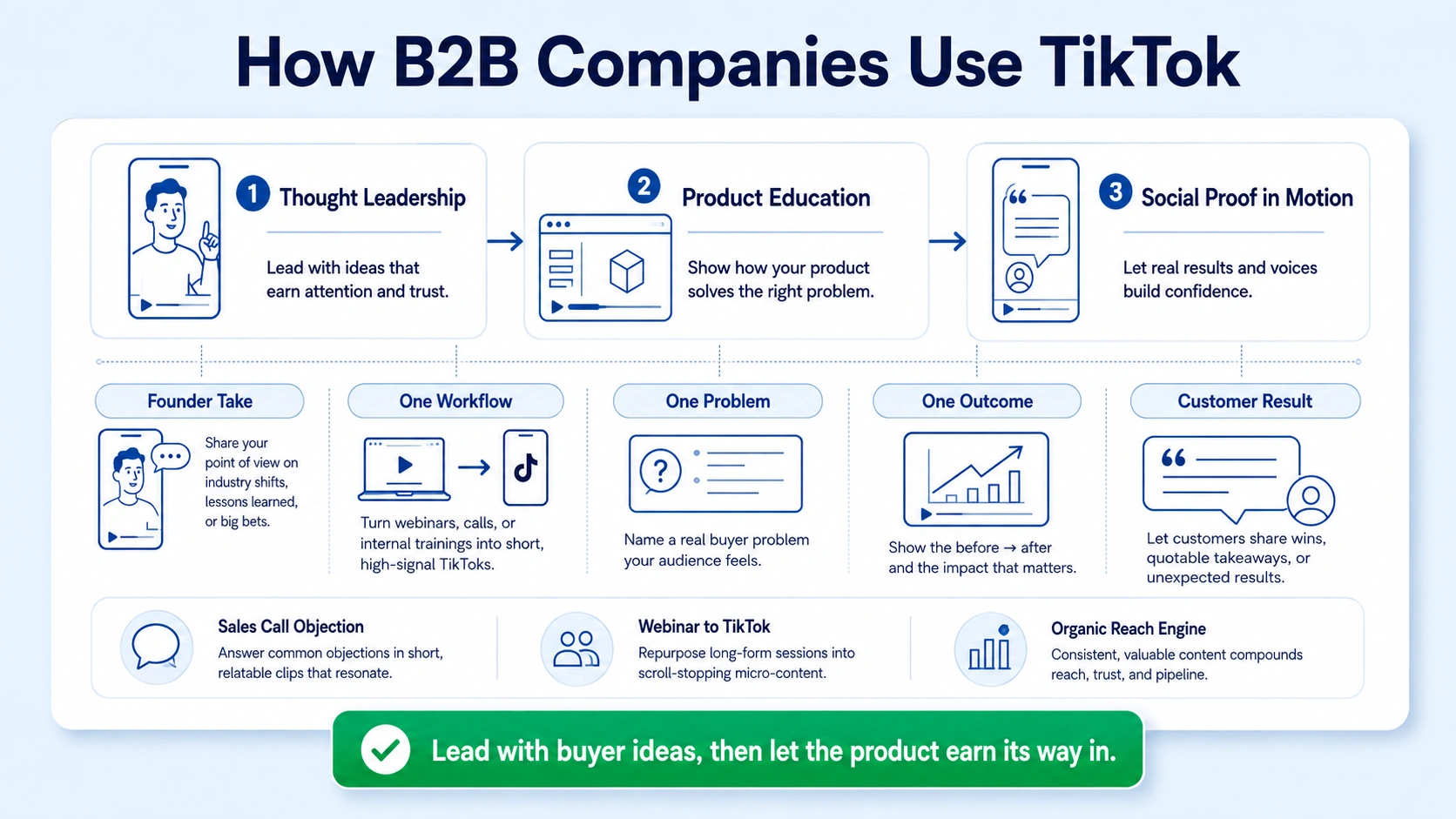
Effective B2B use breaks into three operating modes:
- Thought leadership content: The founder or a senior team member shares a sharp take on an industry problem in 60–90 seconds. No production budget required. The opinion is the asset.
- Product education: Short demos that show one workflow, one problem, one outcome. Not a feature tour, a before-and-after.
- Social proof in motion: A customer outcome, a metric, a case study compressed into a punchy vertical video.
One of TikTok's biggest advantages for B2B brands is its ability to humanize communication. Instead of faceless logos or corporate jargon, TikTok invites businesses to show the people behind the brand. Employees sharing day-in-the-life clips, founders giving behind-the-scenes insights, or clients offering testimonials all help foster trust and relatability.
The distribution mechanic matters here. The algorithm-first distribution model means content reaches people who don't follow you, which naturally inflates per-follower engagement. TikTok gives new accounts a real chance to be seen, something Instagram and Facebook stopped doing years ago. For a SaaS or AI team, that means a zero-follower account can get a demo clip in front of 10,000 relevant viewers in week one, provided the hook and content quality earn the watch time. The playbook is: post consistently, lead with the problem your buyer has, and let the platform do the distribution.
At Komet Media, we help teams build this engine using both existing assets (webinar recordings, founder Q&As, sales call objections) and from-scratch production. See what's possible at our short-form video editing service.
TikTok Strategy for B2B Brands That Don't Have Visual Products
Software is invisible. AI is even more so. This is the objection I hear constantly from SaaS founders: "We can't show anything." That belief is the problem, not the platform. You don't have to show the product. You show the outcome, the thinking, and the people.
Four formats that work without a visual product:
- The whiteboard explainer: Draw out the problem your product solves. Analog on camera lands better than a screenshare on TikTok.
- The live dashboard walk: Screen-record the one metric your tool moves, narrate it in plain English, and stop at 45 seconds.
- The "we built this because" origin story: Founders explaining why they built something create more purchase intent than any feature announcement.
- The buyer question series: Answer one ICP question per video. Each video is a SEO-indexed asset and a trust signal.
Short explainers or "how-to" videos help potential clients understand your offerings quickly. For SaaS and tech companies, this is an effective way to simplify complex features. While we specialize in repurposing existing content, we also create content systems from scratch for teams without existing assets. A 45-minute webinar contains 10–15 standalone TikToks: each question the audience asked, each statistic cited, each moment where the speaker said something surprising. We build these systems for B2B teams regularly; if you run events or webinars, your existing content is already halfway there.
TikTok users come for content that feels real. Brands like Duolingo and Scrub Daddy have leaned into bold, self-aware content, and it works because it fits the tone of the platform. Overly polished content signals a brand keeping the audience at arm's length. Personality signals one that's willing to show up. The rule for B2B teams without visual products: pick one format, produce five videos, ship them, and look at completion rate before adjusting. The data tells you what resonates far faster than internal debate will.
Can AI Companies Build an Audience on TikTok?
Yes, and AI-native companies have a structural advantage most traditional SaaS brands don't: the product itself is the content. Showing an AI tool working in real-time is inherently watchable. A 60-second clip of your model doing something that would have taken a human analyst three hours is native TikTok content. It creates the reaction the algorithm rewards: "wait, how did it do that?"
In 2025–2026, TikTok deepened its integration of AI tools, commerce features, and search capabilities. AI optimization tools like Smart+ and GMV Max expanded performance potential. AI companies showing real outputs, not staged demos, outperform every other B2B content type on the platform. The most effective B2B creator types are thought leaders and industry analysts, named by 28% of B2B marketers as their most effective influencer type. In B2B, trust and expertise outrank reach, because the buying decision is slower, higher-stakes, and made by committee.
For AI-native startups, that translates to a specific content strategy:
- Show the model's output first, lead with the result, not the explanation.
- Then explain what it just did in plain language.
- End with the implication: what does this mean for the buyer's workflow?
This structure respects how the For You Page (FYP) works: hook in second one, substance in seconds two through forty-five, payoff at the close. It's not the type of brand you'd expect to find its fit on TikTok, and yet real B2B companies have built audiences exceeding 100,000 followers. Many feature product education in compelling formats, but audiences follow them for the personality behind the brand. By shining a light on the personalities behind the brand, they have managed to get tens of thousands of strangers invested in their mission. The biggest mistake AI companies make: over-explaining the technology before earning the viewer's attention. Lead with the result. The how comes second.
What Type of TikTok Content Works for Enterprise Software Brands?
Enterprise software teams face a specific challenge: long sales cycles, multiple stakeholders, and content that needs to work at different funnel stages simultaneously. The content mix that works:
"How-to" videos get 2.1x more shares than entertainment content. B2B companies finally cracked the TikTok code with educational storytelling. Zapier has proved that B2B works on TikTok with relatable productivity content. Authenticity, consistency, and creator collaboration beats polished advertising. HubSpot's TikTok approach is another reference point.
Their campaigns produced brand association improvements of +4.35%, brand awareness lift of +7.13%, and brand favorability increases of +10.5% , showing that awareness metrics translate into meaningful brand equity shifts for B2B brands willing to invest in the platform seriously.
For enterprise software teams specifically, the content that drives results is the content that lives in your sales team's head: the common objection, the "aha" moment from a demo, the thing customers say in month three that they wish they'd known in month one. Turn those into 45–60 second videos. Your sales team will share them. Your prospects will find them. That is founder-led content doing pipeline work.
Use TikTok SEO aggressively. TikTok's search volume has grown 150% year-over-year since 2024. Optimize your captions, on-screen text, and hashtags for the search queries your audience uses. Think of each video as a search-discoverable asset, not a one-time post.
How to Explain Complex AI Products on TikTok Without Losing Viewers
The first three seconds determine everything. If you open with "today we're going to talk about our AI-powered workflow automation platform," you've already lost. Open with the problem, or better, the result. A framework I use with clients at Komet Media:
- Open with the pain or the payoff (0–3 sec): "Your sales team is manually writing 200 follow-up emails a week. Here's what we did instead."
- Show, don't explain (3–30 sec): Screen record, whiteboard, or live output. Minimal narration.
- Translate to plain English (30–45 sec): "What just happened is that the model read the CRM, understood the buyer's stage, and wrote a personalized email in 4 seconds."
- Land the implication (45–60 sec): "Your team gets 6 hours back per week. Pipeline velocity goes up. Rep burnout goes down."
The 2025 Edelman x LinkedIn Thought Leadership Impact Report revealed that 55% of decision-makers use thought leadership as part of their vetting process. That vetting now happens across channels, including TikTok, which means your complex product explanation has to hold up to a sharp buyer scrutinizing it on a phone screen. Caption strategy matters equally.
Reels and short-form videos with text overlays and captions generate 35% higher engagement rates than video-only content. This accessibility feature has become a ranking signal, not just an accommodation, rewarding creators who make content consumable without sound.
For AI products specifically, avoid jargon like "LLM," "vector database," or "RAG architecture" unless your ICP is a technical buyer. Use outcome language instead: "it reads your data," "it writes the brief," "it flags the anomaly." The algorithm does not reward complexity. The buyer does not reward it either, not in 60 seconds.
Best TikTok Content Formats for SaaS and Tech Companies
Consistency produces compounding results. Intentional posting beats high frequency. Brands posting fewer than six times per week see 93% higher engagement than those flooding their feeds with eight or more posts weekly. The formats with the highest signal-to-noise ratio for SaaS and tech:
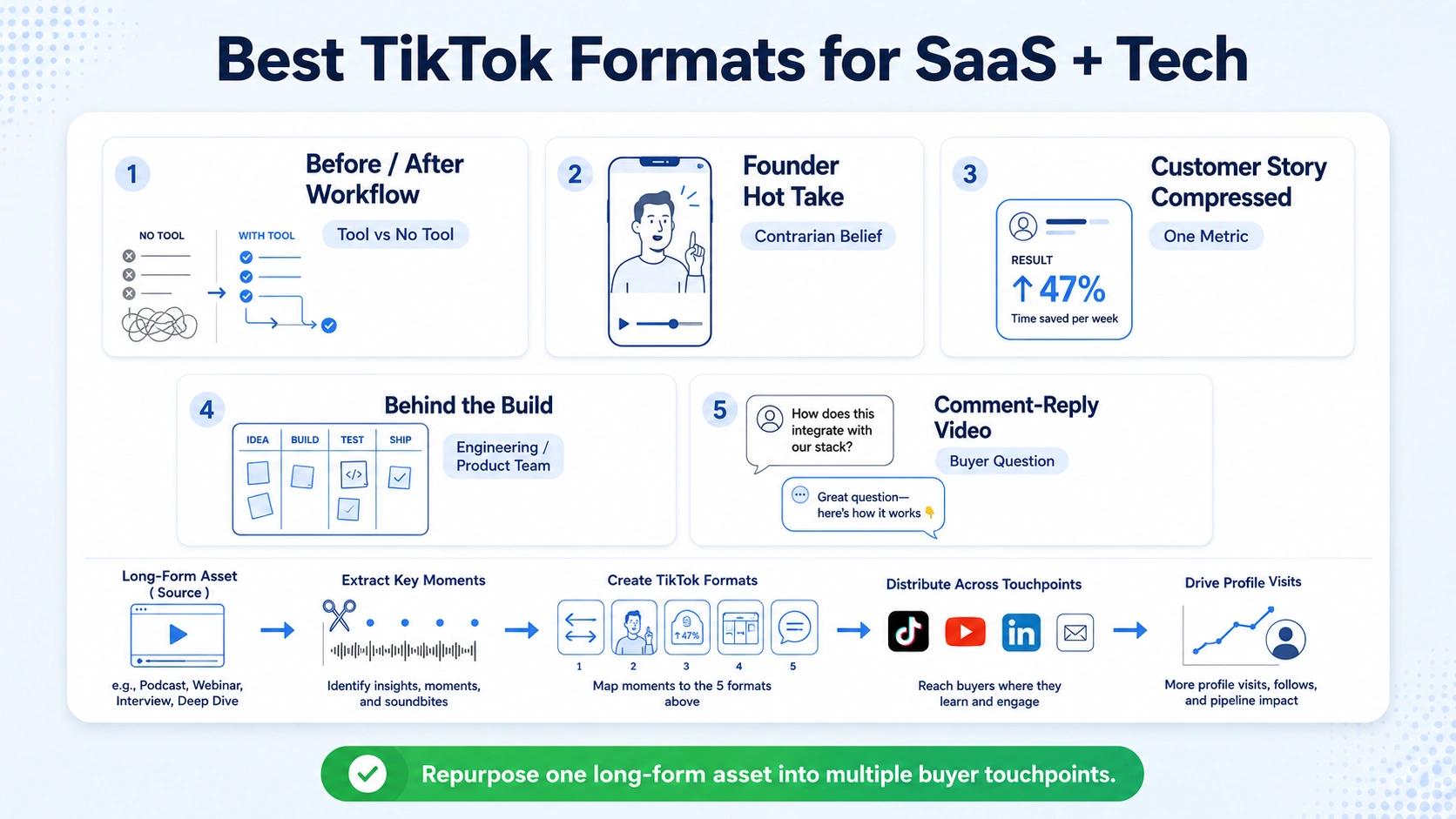
- "Before and after" workflow clips: 30–60 seconds showing a process with your tool versus without. Immediate, tangible proof.
- Founder hot take: 45–60 seconds of a founder challenging a mainstream belief in their industry. High share rate, strong authority signal.
- Customer story compressed: One metric, one customer, one sentence of context. Social proof without a 3-minute case study.
- Behind the build: Engineering or product team showing something being built or shipped. Humanizes abstract software teams.
- Comment-reply videos: Respond to buyer questions or objections in video form. The TikTok algorithm distributes these to audiences with the same question.
On TikTok, the average engagement rate is 3.4% by video views, making it the strongest platform for interaction. For B2B SaaS teams, 3%+ ER is a strong signal, but the next layer matters: profile visits, qualified followers, newsletter signups, demo clicks, and employee amplification.
Repurposing is the distribution multiplier most SaaS teams ignore. A podcast episode becomes five short clips. A product demo webinar becomes eight education clips. A founder interview becomes three thought leadership cuts. For teams without existing assets like podcasts or webinars, we provide from-scratch filming and production services. If your team runs a podcast, the content is already there, it just needs to be cut and formatted for vertical video. Cross-post every TikTok to LinkedIn Reels. The organic reach mechanic on LinkedIn for short-form video is currently outperforming static posts. One shoot, two platform distributions, two audience touchpoints.
Is TikTok Worth It for B2B Lead Generation?
Direct-response thinking is the wrong frame for TikTok. The platform does not generate form fills the way Google Ads does. What it generates is familiarity, and familiarity drives conversion in B2B buying cycles. 75% of B2B buyers use social media platforms during the buying process. When a buyer who has watched six of your TikToks lands on a demo call, they already trust the founder, understand the product, and have done their objection-handling in private. That call converts at a higher rate. That is the TikTok pipeline play.
Brands that treat TikTok as just another paid media channel are leaving 60–70% of the platform's growth potential untapped. The startups winning on TikTok in 2026 run coordinated organic-plus-paid engines where each side amplifies the other, organic content builds brand equity that lowers paid CPMs, while paid distribution accelerates the reach of top organic performers. The dark funnel dynamic is real and measurable. Buyers who engage with TikTok content before entering a sales process show up in CRM as "direct" or "organic search" traffic. They don't self-attribute to TikTok. But ask any SaaS AE what happens when a prospect says "I've been following you for months", that is TikTok working.
TikTok outpaces every other social platform for account growth. 16.47% of TikTok accounts moved up a tier between 2025 and 2026, compared to 8.87% on Instagram and 6.89% on LinkedIn. If audience growth is the goal, this is where the math works in your favor.
The honest answer: TikTok is worth it for B2B lead generation if you measure it correctly, as a trust and familiarity channel that shortens sales cycles and increases demo-to-close rates, not as a source of direct MQLs.
What Mistakes Do B2B Brands Make on TikTok?
Most B2B brands fail on TikTok for the same five reasons. Every one of them is avoidable.
Mistake 1: Posting brand content, not buyer content. Announcing your Series A, sharing your office photos, celebrating team milestones, your buyers do not care. They care about their problems. Lead with those.
Mistake 2: Over-producing every video. A polished 90-second explainer with motion graphics and a voiceover tells the algorithm this content belongs on YouTube. Overly polished content signals a brand keeping the audience at arm's length. Personality signals one that's willing to show up.
Mistake 3: No hook in the first three seconds. If your video opens with a logo or a title card, you've lost the viewer before the algorithm even counts the view.
Mistake 4: Treating TikTok as isolated from the rest of the funnel. Every TikTok should have a next step: a link in bio, a newsletter, a related video, a demo booking. The organic reach is free. The conversion architecture needs to be built deliberately.
Mistake 5: Giving up after 30 days. Being consistent with your efforts holds the key to leveraging TikTok for brand growth. Even after choosing all the right tools and strategies, if you don't implement them to create content for regular posting, then it won't matter.
The competitor landscape reflects these mistakes clearly. Agencies like Vidpros and TastyEdits own search terms around video editing subscriptions, but few are executing a genuine B2B TikTok content strategy for SaaS and AI teams. That gap is exactly where Komet Media operates, building video content systems for B2B teams that include both repurposing and from-scratch production. These systems compound over time, rather than acting as one-off production jobs. If you want to see where to start, reach out directly.
Conclusion
TikTok Strategy for B2B Brands & AI-Native Companies in 2026 comes down to four things:
- Earn attention with buyer problems, not brand announcements, the algorithm rewards relevance, not polish.
- Repurpose what you already have, webinars, podcasts, demos, and founder thinking are all TikTok content waiting to be edited.
- Measuring trust and pipeline velocity, not just views, TikTok operates in the dark funnel; its ROI shows up in close rates and cycle length.
- Stay consistent for 90+ days, the compounding effect of short-form content is real, but only for teams that don't quit after week three.
Frequently Asked Questions
Q1: How often should a B2B brand post on TikTok?
Intentional posting beats volume. Brands posting fewer than six times per week see 93% higher engagement than those pushing for daily or multiple-daily uploads. For most B2B teams, three to five high-quality, focused videos per week is the right starting point.
Q2: Do TikTok videos need to be professionally filmed?
No. Native, phone-filmed content consistently outperforms polished production on TikTok. A founder speaking directly to camera on a phone earns more trust and watch time than a studio-produced brand video. Editing and captions matter more than camera quality.
Q3: What's the difference between TikTok and LinkedIn for B2B content?
LinkedIn reaches buyers who are actively in professional mode and self-identify as your ICP. TikTok reaches those same buyers when they are in discovery mode, before they are actively searching. Both are valuable, and cross-posting the same short-form video to both platforms costs nothing extra.
Q4: How does TikTok fit into a SaaS demand generation strategy?
TikTok sits at the top of the funnel as a brand awareness and dark funnel trust-builder. It shortens sales cycles by warming buyers before outbound reaches them, and increases demo-to-close rates for buyers who have already seen proof of value through content.
Q5: Can a funded AI startup with no audience build on TikTok from zero?
Yes. TikTok gives new accounts a real chance to be seen, something Instagram and Facebook stopped doing years ago. An AI company with a compelling live product demo and a founder willing to appear on camera can build meaningful reach within 60 to 90 days of consistent posting.
Q6: Should B2B brands run paid TikTok ads alongside organic content?
Brands treating TikTok as just another paid media channel are leaving 60–70% of the platform's growth potential untapped. The startups winning in 2026 run coordinated organic-plus-paid engines where organic builds brand equity that lowers paid CPMs, while paid distribution accelerates top organic performers. Start organic, identify what earns watch time, then put budget behind it.