
🪄 AI Summary
Heading 1
Heading 2
Heading 3
Heading 4
Heading 5
Heading 6
Lorem ipsum dolor sit amet, consectetur adipiscing elit, sed do eiusmod tempor incididunt ut labore et dolore magna aliqua. Ut enim ad minim veniam, quis nostrud exercitation ullamco laboris nisi ut aliquip ex ea commodo consequat. Duis aute irure dolor in reprehenderit in voluptate velit esse cillum dolore eu fugiat nulla pariatur.
Block quote
Ordered list
- Item 1
- Item 2
- Item 3
Unordered list
- Item A
- Item B
- Item C
Bold text
Emphasis
Superscript
Subscript
Most private equity firms still treat social media as a compliance risk, not a growth lever. That framing is costing them. Short-form video has moved from consumer novelty to a B2B trust signal that shapes how LPs, founders, and deal targets perceive your firm before a first meeting ever happens. If you're asking about reels for private equity, you're already ahead of 80% of the market. Here's exactly what you need to know before you shoot a single frame.
TL;DR
- Reels for private equity belong primarily on LinkedIn, where finance and insurance engagement rose from 1.9% to 2.6% year-over-year in 2026.
- The right content types are thought leadership, portfolio storytelling, and fund manager commentary, not performance claims.
- SEC Marketing Rule compliance is non-negotiable; a single non-compliant post can trigger five- to six-figure penalties.
- Firms that post weekly grow their audience 5.6x faster than those that post monthly.
What Are Reels for Private Equity and Why Do They Matter Now?
"Reels" in a PE context means short-form vertical video, typically 30 to 90 seconds, published natively on LinkedIn, Instagram, or YouTube Shorts. The format is not a consumer trend that spilled into finance. It's a structural shift in how professional audiences consume information. Social media is no longer just marketing for PE firms, it's a competitive weapon.
The drivers are real: a tougher fundraising environment, digital-first LP due diligence, and a new generation of decision-makers who vet GPs online before they pick up the phone. Use of social media and financial influencers among UK investors rose from 39% in 2024 to 43% in 2025 , and the direction is identical in North American markets. For private equity specifically, reels for private equity serve four concrete functions:
- GP brand authority: A managing partner who publishes regular short commentary on sector trends builds institutional credibility that a PDF deck cannot replicate.
- LP communications: LPs increasingly expect digital touchpoints between annual meetings. Short portfolio updates and market perspective videos fill that gap efficiently.
- Deal sourcing visibility: Social platforms help identify potential investment opportunities and connect with business owners who are researching prospective partners before engaging intermediaries.
- Talent acquisition: Founders and operators assess firm culture through public content. A dormant LinkedIn page signals a closed, opaque organization.
For firms in the mid-market, where brand awareness is typically lower and firms compete across a fragmented sourcing landscape, strong digital visibility can act as a beacon for potential portfolio companies, signaling credibility, cultural fit, and strategic alignment. The attention economy has already priced in video. Staying out of it is not a neutral decision, it's a visibility deficit.
How PE Firms Actually Use Short-Form Video in Their Marketing
The most effective PE video programs operate across three distinct layers, each serving a different audience and funnel stage.
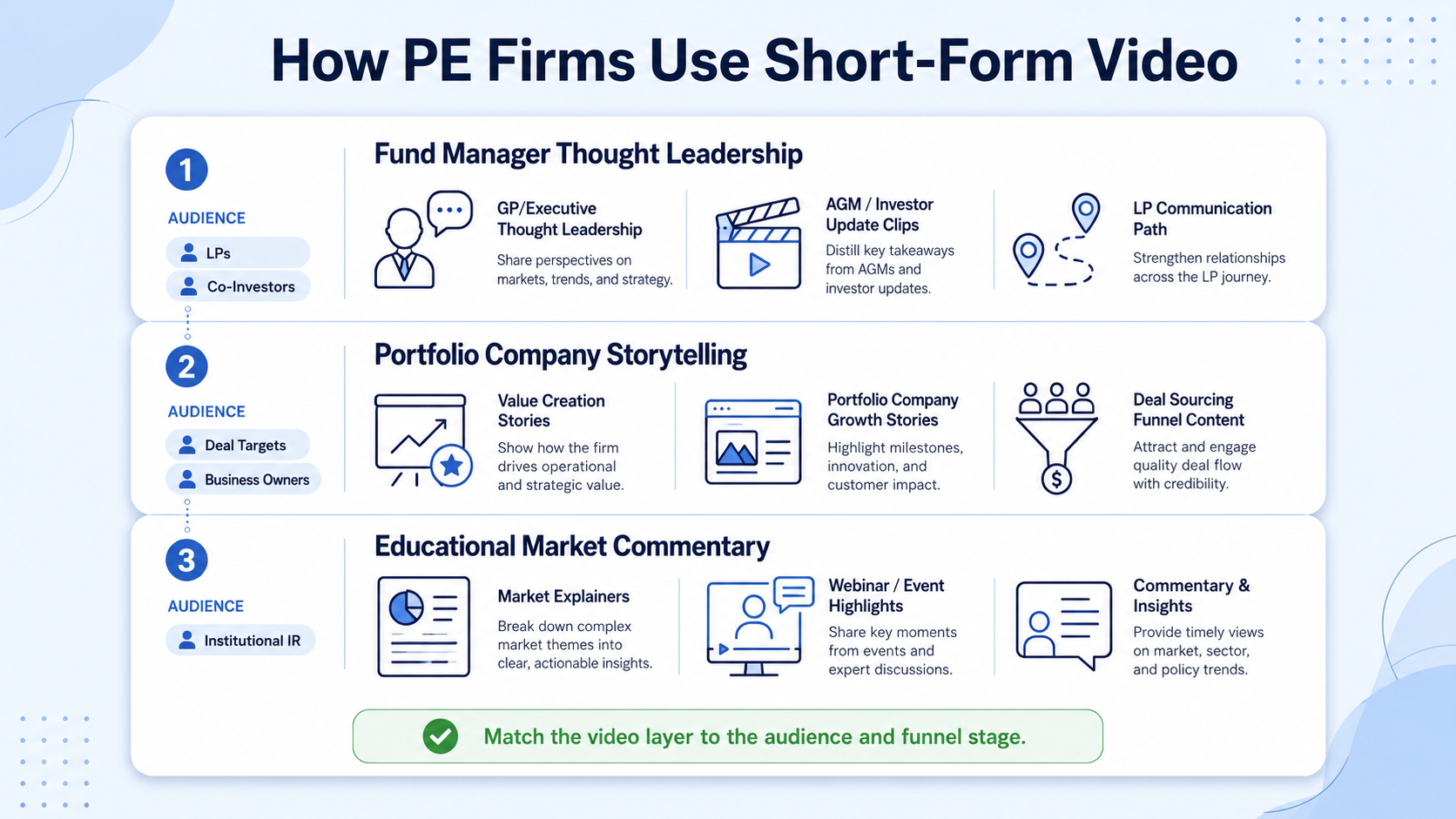
Layer 1: Fund manager thought leadership. Managing partners and sector heads record 45- to 90-second takes on market conditions, deal theses, and macro themes. This content targets LPs, co-investors, and the broader institutional investor relations community. It keeps your firm's voice active in the conversation between AGMs and capital calls.
Layer 2: Portfolio company storytelling. Short videos that highlight value creation inside portfolio companies, operational improvements, leadership stories, market expansion, function as living case studies. Video content captivates audiences with dynamic explanations of complex topics, and PE firms use it to humanize their brand and simplify financial concepts for broader appeal.
Layer 3: Educational and market commentary. These are the highest-reach formats for deal sourcing. Videos that explain alternative assets, break down carried interest mechanics, or contextualize a sector thesis attract inbound from business owners who are not yet in any deal process but are beginning to identify capital partners. Many GPs are using videos to engage their audiences, they are powerful at showcasing a GP's value-add and differentiators that support fundraising, deal sourcing, and attracting employees.
The GP-LP dynamic also shapes format choice. Content aimed at existing LPs should be more substantive and gated, think webinar clips and AGM highlights. Content aimed at prospective LPs and deal targets should be ungated, discoverable, and optimized for LinkedIn's native feed. Both are valid. Most firms only build one.
Should Private Equity Firms Use Instagram Reels or Stick to LinkedIn?
This is the right question to ask, and the honest answer is: LinkedIn first, always. For many investment firms, LinkedIn has replaced the conference hallway as the place where first impressions form, it's where analysts skim a thesis, partners scan a case, and boards click through to your portal. LinkedIn outranks Instagram, TikTok, and Reddit as Gen Z investors' top social media platform, which matters because the LP base is diversifying and the next generation of allocators is already there. Here's how the platforms compare for PE video:
Finance and Insurance averaged 2.6% LinkedIn engagement in 2026, up from 1.9% in 2025, the largest year-over-year gain of any sector. That upward trend rewards firms that start building now. Instagram and TikTok are not off-limits, but they require a clear content brief that separates brand-building from anything that could be construed as solicitation. For most PE teams, LinkedIn is where the ROI concentrates.
Navigating SEC Marketing Rule and FINRA Compliance for PE Video
Compliance is not a reason to avoid video. It is a parameter to design within. Firms that treat it as a blocker simply haven't built the right review workflow. The SEC Division of Examinations issued four Marketing Rule Risk Alerts between September 2022 and December 2025, with the most recent focused on testimonials, endorsements, and third-party ratings.
Video adds surface area for violations because it is harder to amend post-publication than a web page. FINRA's rules on communicating with the public apply to social media, and they protect investors from false or misleading claims, exaggerated statements, and material omissions. What this means in practice for PE video content:
- Permitted: Market commentary, sector theses, general educational content, fund strategy overviews, portfolio company narratives (non-performance-specific), GP thought leadership.
- Restricted: Specific return claims, IRR figures, fund performance without required disclosures, testimonials without proper compensation disclosure.
- Prohibited: Hypothetical performance presented without audience-targeting procedures, misleading implied endorsements.
A September 2024 SEC action against nine investment advisers resulted in over $1.2 million in combined penalties for misleading advertisements, unsubstantiated claims, and improperly disclosed testimonials.
The practical fix: build a pre-cleared script library for recurring content themes, route new angles through a single compliance checkpoint, and publish only from pre-approved frameworks. Top-performing finance accounts focus on macroeconomic explainers, personal investment journeys that are compliant, and expert commentary on market events, and compliance-vetted templates accelerate posting frequency without legal review bottlenecks.
Best Practices for Creating Professional Reels for a Private Equity Firm
Getting this right comes down to format discipline, production clarity, and a repurposing system that keeps output consistent without burning out your team.
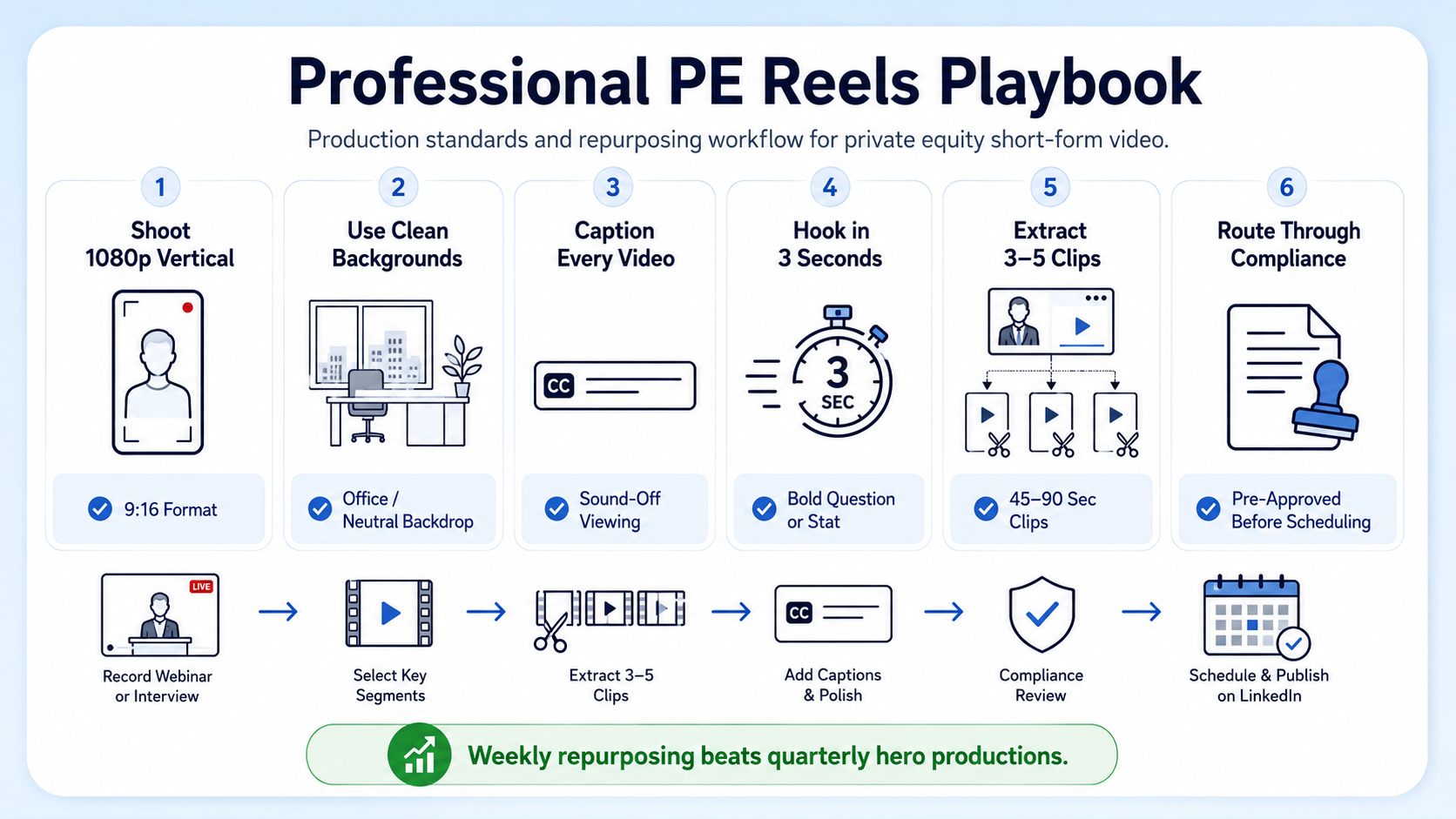
Production standards that signal authority:
- Shoot at 1080p minimum in vertical (9:16) format for LinkedIn native video and Instagram Reels.
- Clean, uncluttered backgrounds, a branded environment, office setting, or neutral backdrop. Not a Ring Light-on-couch aesthetic.
- Captions on every video. Most LinkedIn videos are watched without sound.
- Hook within the first three seconds. Video success depends heavily on the first three seconds, hook viewers immediately with a bold question, surprising statistic, or direct statement.
Content repurposing workflow (the asset-multiplication approach):
- Record one long-form source asset: a webinar, podcast, panel discussion, or recorded LP call.
- Extract three to five 45-to-90-second clips around discrete points or insights.
- Write captions for each clip optimized for LinkedIn feed (leading line acts as the hook).
- Route all clips through compliance review before scheduling.
- Publish across LinkedIn natively, then repurpose to YouTube Shorts and Instagram Reels where appropriate.
- Repurpose top-performing clips into written posts, email updates, or LP newsletter snippets.
LinkedIn's 2025 benchmarks show video achieves 5.6% engagement per impression, making it the third-highest format on the platform. Short-form clips pulled from a webinar or podcast deliver that performance at a fraction of the standalone production cost.
Pages posting weekly grow followers 5.6x faster than those posting monthly, which makes the repurposing workflow, not one-off hero productions, the real competitive advantage. Explore how Komet Media builds short-form video editing systems and video marketing programs built specifically for B2B teams.
Private Equity Video Content Strategy: Building a System That Scales
Most PE firms that try video fail at the system layer, not the content layer. They record one great clip, see modest results, and stop. The firms gaining ground are treating video as infrastructure. A scalable PE video content strategy has three components: a source asset engine, a repurposing workflow, and a publishing calendar.
Source asset engine: Your firm already generates content-worthy intellectual capital. Partner investment memos, sector deep-dives, portfolio company results calls, conference presentations, and due diligence commentary are all raw material. The goal is to capture your existing intellectual capital on video, though Komet Media can also produce high-impact video content from scratch.
Publishing cadence: Post two to five times per week to stay in front of your audience and grow your following , depending on the platform. For LinkedIn specifically, three posts per week from a personal GP profile, supplemented by firm-page posts, is a practical starting cadence.
Measuring what matters for PE: Views and likes are vanity metrics at this stage of the market. The metrics that map to GP-LP dynamics and deal sourcing visibility are:
- Profile visits from target-audience job titles following a video post
- Inbound connection requests with relevant ICP attributes
- DM volume and quality tied to specific video topics
- Repeat viewer behavior on LinkedIn analytics
LinkedIn reports that 63% of B2B buyers say short-form video content influences their buying decisions.
In PE, "buying decision" translates to: choosing to take a GP meeting, committing capital to a new fund, or reaching out after seeing a sector thesis.
The firms winning this space are not the ones with the biggest production budgets. They're the ones with the most consistent, strategic presence. If your team needs a production partner who understands B2B, explore Komet Media's video editing services or podcast production as feeder content for your video clips. You can also learn more about Komet Media's approach to B2B video growth.
Conclusion
Reels for private equity are no longer experimental. They are a measurable component of brand authority, LP communications, and deal sourcing visibility in 2026.
Key takeaways:
- LinkedIn is the primary platform; build there first, then expand.
- Compliance is a design parameter, not a veto, build pre-cleared content frameworks.
- Repurpose existing intellectual capital (webinars, panels, podcasts) into short clips, or collaborate with Komet Media to produce fresh content from scratch.
- Consistency beats production value, weekly publishing compounds faster than quarterly hero videos.
Ready to turn your firm's thinking into a video system? Contact Komet Media to start.
Frequently Asked Questions
Q1: What types of video content are safe for private equity firms to post on social media?
Thought leadership commentary, sector trend analysis, fund strategy overviews, team culture content, and portfolio company narratives are generally safe. Performance claims, specific IRR figures, and testimonials require careful compliance review under the SEC Marketing Rule before publication.
Q2: How long should reels for private equity be?
30 to 90 seconds is the optimal range for LinkedIn and Instagram Reels. Clips under 30 seconds often lack the depth needed to position a GP as credible. Clips over 90 seconds see sharply higher drop-off rates in the LinkedIn native video environment.
Q3: Can private equity firms post on Instagram and TikTok?
Yes, but LinkedIn should come first. LinkedIn outranks Instagram, TikTok, and Reddit as Gen Z investors' top social media platforms. Instagram works for brand awareness and culture; TikTok carries the highest compliance and audience-mismatch risk for institutional-facing content.
Q4: How do reels support deal sourcing for PE firms?
Short educational videos on sector theses, acquisition criteria, or value creation frameworks attract inbound from business owners researching capital partners. This creates warm deal flow from founders who already understand your firm's approach before the first conversation.
Q5: How often should a private equity firm post short-form video?
Two to three times per week from a GP's personal LinkedIn profile is a practical starting cadence. Pages posting weekly grow followers 5.6x faster than those posting monthly , but daily posting can suppress per-post reach. Consistency matters more than volume.
Q6: Do PE firms need a dedicated video team to produce reels?
No. The most scalable approach is content repurposing, extracting short clips from existing long-form assets like webinars, podcasts, or conference recordings. A B2B video agency handles editing, captions, and formatting, while your team supplies the ideas and the on-camera presence. Explore Komet Media's webinar and podcast editing services as starting points.