
🪄 AI Summary
Heading 1
Heading 2
Heading 3
Heading 4
Heading 5
Heading 6
Lorem ipsum dolor sit amet, consectetur adipiscing elit, sed do eiusmod tempor incididunt ut labore et dolore magna aliqua. Ut enim ad minim veniam, quis nostrud exercitation ullamco laboris nisi ut aliquip ex ea commodo consequat. Duis aute irure dolor in reprehenderit in voluptate velit esse cillum dolore eu fugiat nulla pariatur.
Block quote
Ordered list
- Item 1
- Item 2
- Item 3
Unordered list
- Item A
- Item B
- Item C
Bold text
Emphasis
Superscript
Subscript
Most vertical SaaS companies are sitting on a content goldmine they never ship, product demos, customer calls, founder interviews, webinars, and then wondering why pipeline is slow. Short-form video for vertical SaaS companies is the mechanism that turns that locked content into buyer trust, category authority, and inbound demand. This guide covers strategy, content types, platform selection, and execution, so your team stops producing content in theory and starts generating pipeline in practice.
TL;DR
- Short-form video is the highest-ROI content format for B2B buyers in 2026, and vertical SaaS teams are underusing it.
- The best content comes from what your team is already doing: demos, calls, webinars, and founder thinking.
- LinkedIn, YouTube Shorts, and Instagram Reels are the three platforms that matter most for niche B2B audiences.
- You do not need a full production team, you need a system.
Why Short-Form Video for Vertical SaaS Companies Belongs at the Center of Your Strategy
Vertical SaaS is not horizontal SaaS. You serve a specific industry, a defined buyer, and a niche set of workflows. That focus is an advantage in video, your content does not need to reach everyone, it needs to land with the right few. HubSpot's 2025 State of Marketing Report found that short-form video outperforms every other content type on ROI, and for B2B SaaS, that means LinkedIn video clips, product demos, and customer story snippets are worth the production effort. This is even more true when your addressable audience is narrow, because precision targeting means less waste and faster trust.
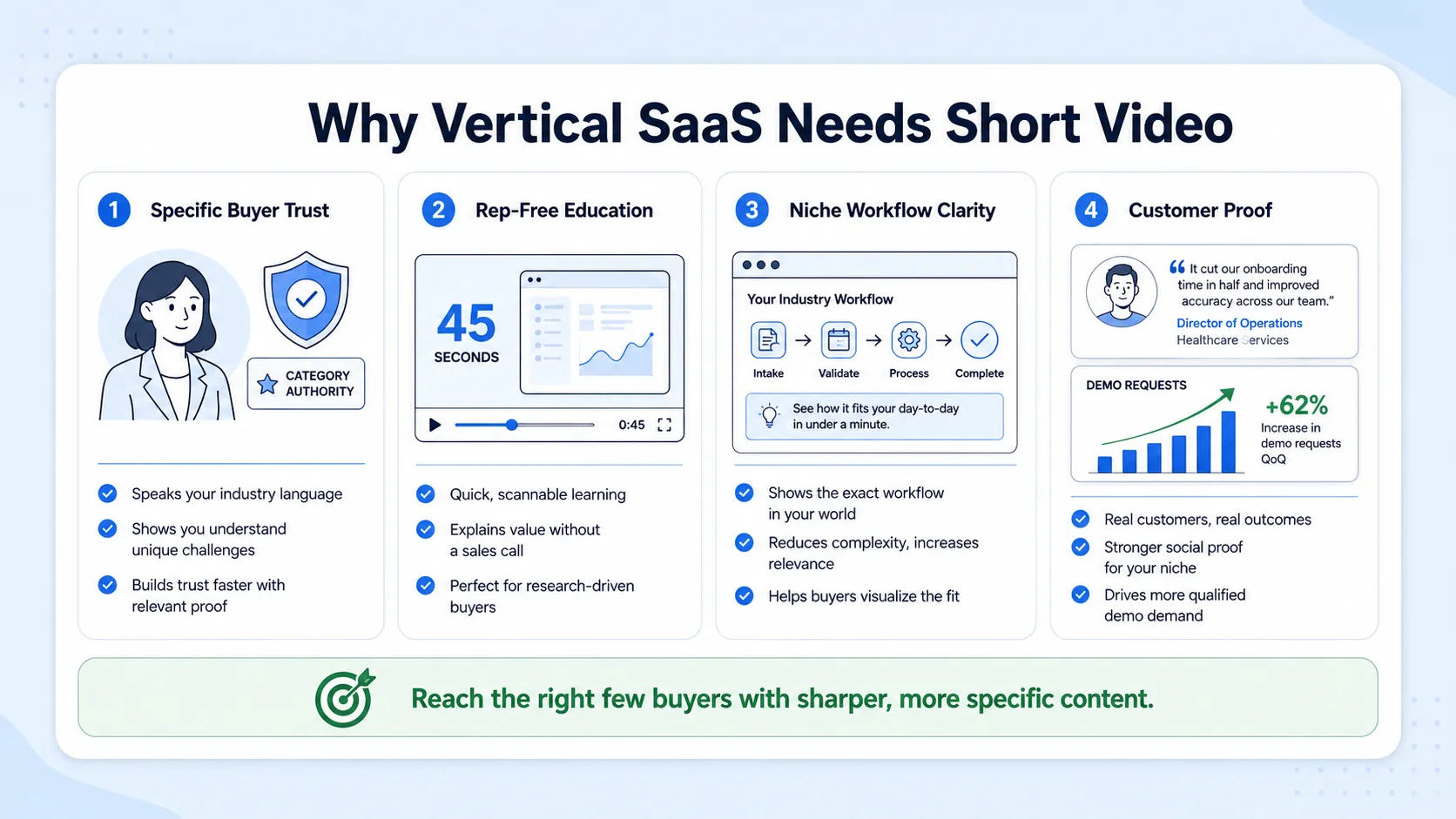
67% of B2B buyers now prefer a rep-free buying experience, and 45% report using AI during their most recent purchase, per Gartner's March 2026 sales survey. That shift puts your video content in the position your sales team used to occupy. If a buyer is researching your construction management software or your restaurant compliance platform without ever talking to a rep, a 45-second product clip has to do the education work.
Videos under one minute achieve a 65% completion rate among B2B viewers, while videos over 20 minutes drop to 20%. For niche SaaS buyers who are time-poor and skeptical, short and precise wins every time. The strategic case is straightforward:
- Your niche audience is smaller, so every touchpoint must work harder, video multiplies each one.
- Vertical SaaS buyers trust specificity. A video that speaks directly to a dental office manager or a property developer outperforms a generic explainer every time.
- Customer outcomes and results are the most persuasive proof type at 42.7%, and in Vidico's 2026 State of Creative in Tech report, surveying 230+ B2B tech marketing leaders, customer success stories ranked as the single most convincing proof format for B2B buyers.
At Komet Media, the vertical SaaS teams we work with consistently see pipeline impact when they stop trying to reach everyone and start creating video that speaks the exact language of their industry.
What Types of Short-Form Video Content Work Best for Niche SaaS Products
Not every video format earns its place in a vertical SaaS content system. Here are the formats with the highest signal-to-noise ratio for niche B2B audiences:
Micro product demos: Show one feature solving one real industry problem. Not a full walkthrough, a 30-to-60-second screen capture of the exact moment your product removes friction from a workflow your buyer lives inside every day.
Example:
Customer success clips: Pull two to three sentences from a recorded customer call where a user describes a specific outcome. Add captions, a name, a company, and a title. 98% of B2B decision makers have watched explainer videos, and 87% of B2B buyers say video influenced their purchase decisions. A real customer voice in a short clip carries far more weight than a polished copy.
Example:
Founder POV clips: The founder or a product lead speaks directly to camera about a real problem the industry faces. No script. One idea per video. This is where founder-led growth happens at scale.
Example:
Webinar and podcast highlights: Document what's already happening in customer calls, demos, internal updates, podcast interviews, and team syncs, that shift is what makes short-form video sustainable while you're also building a business. A 45-minute webinar contains eight to twelve standalone clips. Repurpose them.
Example:
Industry-specific how-tos: Teach one workflow tip specific to your buyer's vertical. A video titled "How healthcare SaaS teams handle compliance handoffs" speaks louder than "How to use our software."
Example:
How to Explain a Complex Vertical SaaS Product in Under 60 Seconds
This is the question I hear most from SaaS founders: "Our product is too complex for a short video." It is not. Complexity is a positioning problem, not a video problem. The fix is structure. Follow this sequence for every micro-explainer:
- Open with the industry pain (0–5 seconds): Name the specific problem your buyer faces. "Most HVAC service companies lose 30% of their invoices to manual entry errors." The more specific, the better the hook.
- Show the broken workflow (5–15 seconds): Briefly visualize what life looks like without the solution. Screen recording, stock clip, or talking head, keep it tight.
- Demonstrate the fix in the product (15–45 seconds): One feature, one workflow, one clear outcome. No feature tours. Show the result, not the journey.
- Close with a proof anchor or CTA (45–60 seconds): A customer outcome stat, a recognizable client logo, or a direct call to action: "See how [Company Name] cut invoicing time by 40%, link in bio."
Video on landing pages increases conversions by 86%, and B2B SaaS pages with explainer videos see conversion lifts exceeding 100% in controlled testing. Apply that same logic to your social clips: every video is a micro landing page. The goal is not to explain everything, it's to make the right buyer think, "That's exactly my problem," in under ten seconds. Glossy explainers no longer win, when B2B buyers spot corporate shine, they scroll past it. Put your subject matter experts and founders in front of the camera. Authenticity and specificity will always outperform production polish for niche audiences.
Best Platforms for Short-Form Video Marketing for Vertical SaaS in 2026
Platform selection for vertical SaaS is not about being everywhere, it is about being precise. Here is how the main platforms break down for niche B2B buyers:
LinkedIn is the new B2B video channel, 81% of B2B teams share video on LinkedIn, making it the top distribution platform for B2B, overtaking YouTube for the first time. For vertical SaaS, LinkedIn is non-negotiable. Your buyers are there, and organic reach for native video is still strong. LinkedIn short-form is still early enough that organic reach is unusually high for B2B content. That is the window vertical SaaS companies should be exploiting right now.
YouTube Shorts pulls research-stage buyers who are actively comparing solutions. Shorts feed subscribers into your long-form content, a Short that hooks a viewer can drive them to your full channel. For vertical SaaS companies with product deep-dives and demo recordings, this creates a natural content ladder. Companies like Notion, Monday.com, HubSpot, and Gong have all built significant TikTok followings not by dumbing down their message, but by translating real product value into formats that work on a vertical screen.
Your vertical SaaS product can do the same within your specific industry community. Use Komet Media's from-scratch video production and short-form video editing services to repurpose your existing content across all four platforms without rebuilding each clip from scratch.
Is Short-Form Video Worth It for Vertical SaaS with a Small Target Audience?
The short answer: small audiences make short-form video more valuable, not less. Here is why the math works in your favour. 65% of B2B companies have gained new customers through video marketing on LinkedIn, and LinkedIn remains the primary distribution channel for B2B video, nearly two-thirds of companies report acquiring new customers through the platform.
When your total addressable market is 5,000 dental office managers or 8,000 independent freight brokers, a single video that earns 400 views from that exact audience is worth more than a generic video with 40,000 mixed views. Precision is the point. 73% of B2B marketers report a positive impact on ROI from video marketing, making it one of the most reliably positive B2B channels.
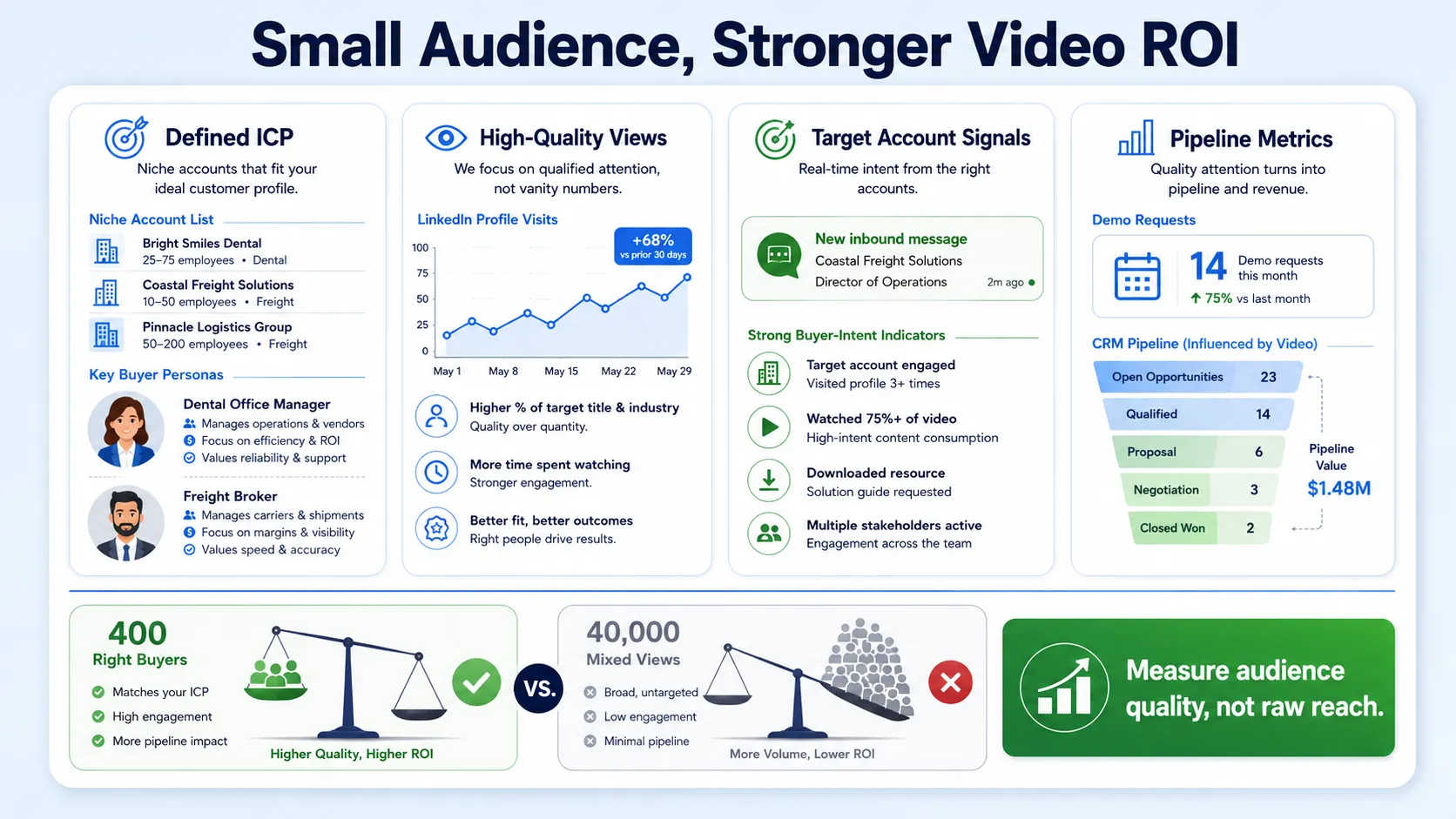
ROI scales with audience quality, not audience size, and vertical SaaS inherently has higher-quality, more defined audiences. The objection I hear from small marketing teams is volume: "We can't produce enough content." That framing is wrong. Volume is not the goal, consistency with a small, targeted set of buyers is. For a vertical SaaS company with a 500-account target list, two high-quality LinkedIn clips per week aimed directly at that buyer's daily operational pain points will outperform ten generic reels.
Three practical points for lean teams:
- Start with one platform. LinkedIn first, always, for vertical SaaS B2B audiences.
- Repurpose before you create. Your last three webinars, demo calls, and customer interviews are your first thirty clips.
- Measure pipeline signals, not vanity metrics. Track demo requests, inbound messages, and profile visits from target accounts, not follower counts.
Explore how Komet Media's video marketing services support lean B2B teams building consistent short-form systems.
The Biggest Mistakes Vertical SaaS Companies Make with Short-Form Video
Most vertical SaaS teams do not fail at video because of budget. They fail because of their approach. These are the patterns I see consistently:
Treating every video like a product tour: Buyers do not want a walkthrough on social media. They want to see their problem solved in thirty seconds. Lead with the outcome, not the feature set.
Ignoring captions: 90% of vertical videos achieve higher watch completion rates than horizontal ones , but most of those views happen on muted devices. Videos without captions lose the message before the hook lands.
Posting once and disappearing: The algorithm does not reward sporadic effort. For LinkedIn, posting 2 to 3 times per week builds algorithmic momentum. Consistency over brilliance, especially early.
Using horizontal video on vertical platforms: Social platforms like TikTok, Instagram, LinkedIn, and YouTube now prioritize vertical video in their algorithms, and viewers are 2x more likely to engage with vertical content than horizontal on mobile.
Making the content about the product instead of the buyer: A clip titled "Announcing Feature X" performs far worse than "How [Industry] teams eliminate [specific problem] with one step." Frame it around the buyer's day, not your roadmap.
Skipping the first 1.5 seconds: Completion rate is the primary algorithmic signal, meaning the hook in the first 1.5 seconds determines distribution more than anything else. If the opening line is generic, the algorithm buries the clip.
The costliest mistake is waiting until the content is "perfect." In vertical SaaS video, specific and timely beats are polished and late every time. Komet Media's from-scratch video production and content repurposing services are built specifically to help B2B teams avoid these patterns and build a system that actually ships.
Conclusion
Short-form video for vertical SaaS companies is not a trend to monitor, it is a pipeline lever your competitors are either using or ignoring. Here is what matters:
- Specificity beats volume: one clip speaking directly to your buyer's operational pain drives more pipeline than ten generic product promos.
- Your content library already exists in your demos, webinars, calls, and founder conversations, repurpose it.
- LinkedIn is your primary platform in 2026; YouTube Shorts and Instagram Reels amplify reach to research-stage buyers.
- Consistency and precision are the system, not perfection and polish.
Ready to build the system? Talk to Komet Media.
Frequently Asked Questions
Q1: How many videos per week should a vertical SaaS company post to see results?
Start with two to three LinkedIn clips per week targeting your specific buyer persona. Consistency over 60 to 90 days matters more than frequency. Quality and industry specificity will outperform posting volume for niche B2B audiences with a defined ICP.
Q2: Can we create short-form video content without on-camera talent?
Yes. Screen recordings, product walkthroughs with voiceover, customer quote cards, and animated workflow explainers all perform well without a talking head. However, founder-led or team-led clips consistently generate stronger trust signals with B2B buyers evaluating vendors.
Q3: How do we measure whether short-form video is driving the pipeline?
Track demo requests, inbound LinkedIn messages from target accounts, and profile visits from your ICP. UTM parameters on any link in bio or caption help attribute traffic. Vanity metrics like views tell you reach, pipeline metrics tell you whether the content is working.
Q4: Should vertical SaaS companies invest in TikTok for Business or focus on LinkedIn?
Start with LinkedIn for direct B2B buyer access. Add TikTok for Business once your LinkedIn content system is consistent, especially if your buyers skew younger or if you are targeting emerging verticals. LinkedIn organic reach for B2B video remains stronger and more predictable in 2026.
Q5: What is the ideal length for a vertical SaaS short-form video?
Thirty to sixty seconds performs best across LinkedIn, YouTube Shorts, and Instagram Reels for B2B product content. Founder POV or educational clips can extend to ninety seconds if the hook is strong. Any longer and completion rates drop sharply for B2B audiences.
Q6: How does content repurposing reduce the production burden for small SaaS marketing teams?
A single 45-minute webinar can yield eight to twelve standalone clips: one per key insight, one customer quote, one product demo moment, and one founder takeaway. Repurposing eliminates the blank-page problem and ensures every piece of long-form content generates weeks of short-form distribution without additional recording sessions.