
🪄 AI Summary
Heading 1
Heading 2
Heading 3
Heading 4
Heading 5
Heading 6
Lorem ipsum dolor sit amet, consectetur adipiscing elit, sed do eiusmod tempor incididunt ut labore et dolore magna aliqua. Ut enim ad minim veniam, quis nostrud exercitation ullamco laboris nisi ut aliquip ex ea commodo consequat. Duis aute irure dolor in reprehenderit in voluptate velit esse cillum dolore eu fugiat nulla pariatur.
Block quote
Ordered list
- Item 1
- Item 2
- Item 3
Unordered list
- Item A
- Item B
- Item C
Bold text
Emphasis
Superscript
Subscript
Most developer tool companies build remarkable products and then explain them with walls of API documentation, GitHub READMEs, and 45-minute webinar recordings that never leave the company drive. Short-form video for developer tools and API companies changes that equation entirely. A well-executed 60-second clip can demonstrate an SDK integration, surface a founder's product thinking, or close the gap between a developer's problem and your tool's value, faster than any documentation page ever could.
TL;DR
- 70% of B2B buyers incorporate video in their purchase decisions , making short video non-negotiable for developer tool growth in 2026.
- The highest-performing formats are quick-demos, error-fix walkthroughs, and founder POV clips, not product ads.
- YouTube Shorts and LinkedIn are the two primary distribution channels for developer audiences right now.
- Repurposing existing webinars, demos, and podcasts is the fastest path to a sustainable short-video library.
Does Short-Form Video Actually Work for B2B API Companies?
The honest answer: yes, but only when the content matches how developers actually consume information. According to the 2024 and 2025 Stack Overflow Developer Surveys, developers primarily discover and evaluate tools through documentation, community spaces, and peer recommendations. Short-form video slots into that discovery layer when it feels peer-driven, not promotional. The moment it feels like a product ad, you lose the room.
The data backs the opportunity. 53% of B2B buyers report watching short-form video before filling out a contact form or requesting a demo. For API companies, that pre-demo video is doing real pipeline work. It primes the buyer, removes the "what does this even do?" friction, and shortens your sales cycle. Companies using video in their marketing see an average increase of 38% in lead generation.
For developer tools specifically, video accelerates the trust-building that documentation alone cannot accomplish. A developer who has watched your founder explain a REST API problem they've personally run into arrives at your docs already warm. B2B companies that delay adopting short-form video face 12% to 18% higher customer acquisition costs, and that gap widens as early movers build compounding audience advantages on YouTube Shorts and LinkedIn.
The key reframe: short-form video for developer tool companies is not a brand play. It is a buyer education and technical content marketing asset that happens to live on social platforms. Approach it that way and the ROI becomes much clearer to justify internally.
What Types of Short Videos Perform Best for SaaS Developer Products?
Not all short-form video formats work equally well for technical audiences. The ones that earn engagement from developers and engineering-adjacent buyers fall into six clear categories:
The quick-demo format earns the most pipeline lift because it answers the developer's core question in under a minute: "Does this tool actually do what it claims?" Pairing that with an error + fix walkthrough targets the Stack Overflow and Hacker News mindset, showing your product solving a real, relatable problem.
The moment a developer feels like they're being "pitched," the trust evaporates. When Vercel announced new feature-flag integrations, it was Dominik Ferber, one of their engineers, posting directly, not a generic corporate account sharing a press release. That approach transfers directly to short video: the best-performing clips feel like a developer sharing something useful, not a marketing team broadcasting a product update.
Founder POV clips are particularly high-leverage for early-stage API companies. A 40-second clip where your founder says "here is the problem I kept running into with REST API auth flows, and here is how we solved it" does more for product positioning than a full landing page rewrite.
Short-Form Video Strategy for Developer Tool Companies: Build the System
Posting sporadically does not build a pipeline. A repeatable system does. Here is how to build one:
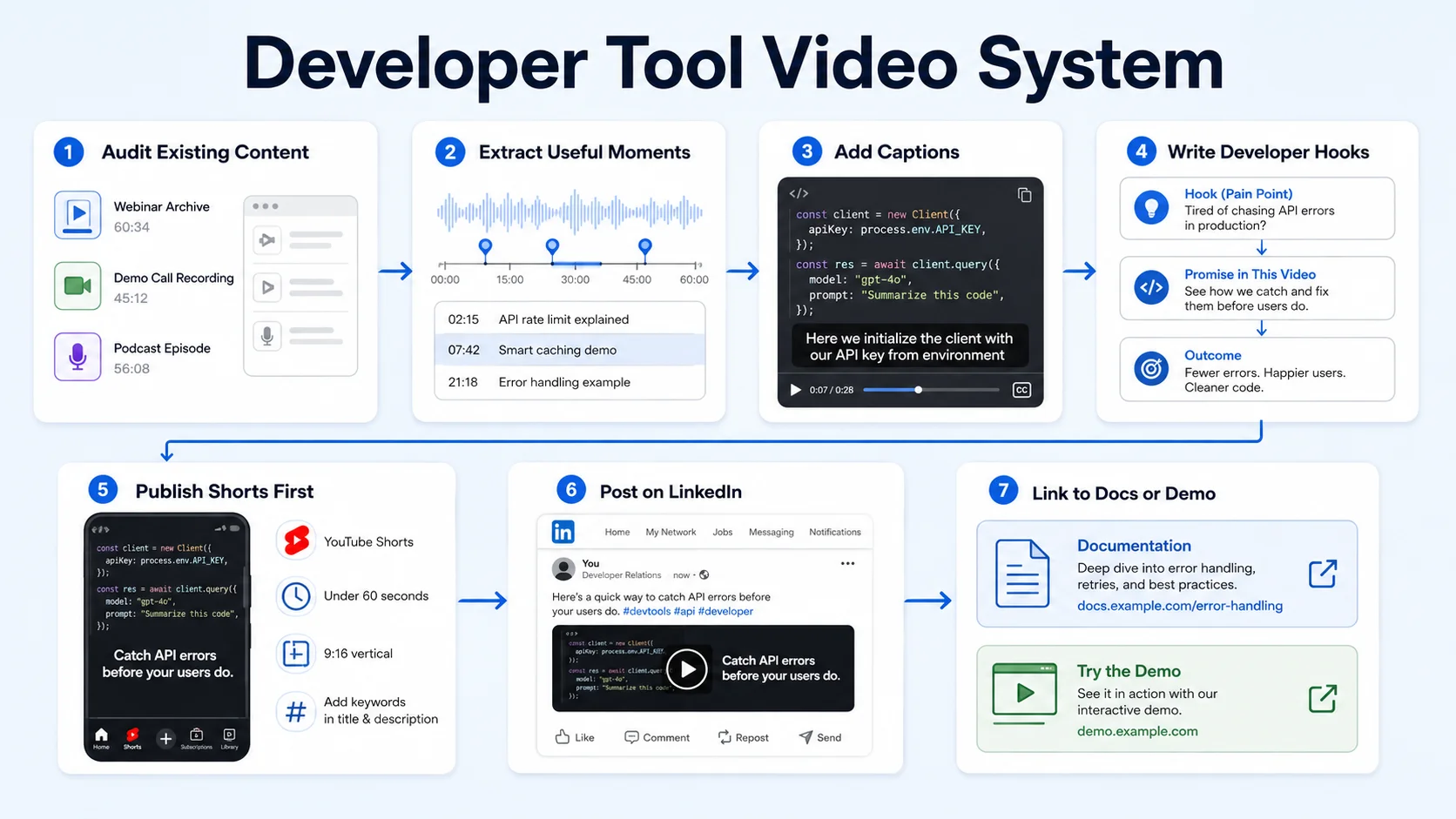
- Audit your existing content: Identify every webinar recording, demo call, podcast episode, and product walkthrough you already have. These are your raw materials.
- Extract the moments: Pull 45-90 second segments where your founder or a team member explains one concrete concept, solves one error, or makes one sharp product claim.
- Add on-screen text and captions: Developers often watch without audio. Captions also improve Video SEO discoverability on YouTube Shorts.
- Write a hook that mirrors a developer's internal monologue: "Why does OAuth integration always break here?" outperforms "Check out our new auth feature."
- Publish to YouTube Shorts first, then LinkedIn: These are your two highest-ROI channels for developer and engineering-adjacent audiences.
- Repurpose to Reels for algorithm reach: The Reels algorithm surfaces technical content to adjacent audiences, including CTOs and product leads who influence purchasing decisions.
- Link to relevant docs or a demo CTA in the caption: Short video earns the click. The docs or demo page closes the loop.
The 2026 LinkedIn algorithm prioritizes native video, dwell time, and educational content over promotional posts and anything with an external link. Short clips between 30 and 90 seconds work best for discovery.
Treat your short-form video editing pipeline the same way you treat your engineering sprint. Batch production, consistent publishing cadence, and clear KPIs per video type. That discipline separates teams that build an audience from teams that post once and wonder why nothing happened.
How Developer Tools Use TikTok, Reels, and YouTube Shorts to Grow
Platform selection is not a one-size-fits-all decision for developer tool companies. Each platform serves a different role in your distribution stack. YouTube Shorts has 2 billion monthly users, ahead of TikTok (1.59B) and Instagram Reels (1.8B). Shorts leads all short-form platforms in engagement with a 5.91% rate.
For developer audiences aged 25-44, YouTube is already the preferred learning platform, which means Shorts gets served to an audience that is actively in a learning mindset, exactly where you want them. 57% of B2B decision-makers say they use TikTok to get ideas and information for work-related decisions.
TikTok's algorithm does not require an existing audience to surface your content, which makes it the fastest organic reach vehicle for early-stage API companies with zero followers. A sharp 50-second clip explaining a REST API concept can reach engineering leads who have never heard of your product.
LinkedIn is the highest-intent channel. LinkedIn reported a 34% year-over-year increase in video uploads in Q4 2024 and a 36% year-over-year growth in total video viewership in 2025. The audience on LinkedIn is already primed for a professional context, and a founder-led video demonstrating a technical insight consistently earns more qualified pipeline engagement than any text post.
The smart distribution play: publish natively to all three. Each platform's algorithm treats native uploads differently from cross-posted links. If your content has B2B value, including marketing tips, founder insights, or industry commentary, drop it on LinkedIn with a short caption that reframes it for a professional audience. Add a takeaway or lesson and it becomes content marketing.
You can also pair your video marketing with your existing webinar and podcast assets. Every webinar your team hosts is a library of short-form source material waiting to be extracted and distributed.
How to Make Technical Content Engaging in 60 Seconds or Less
This is where most developer tool teams struggle. They know their product deeply, but they explain it the way engineers document it: comprehensively, linearly, and with every edge case included. Short-form video demands the opposite. One problem. One solution. One outcome.
Here is the structure that works for technical content in under 60 seconds:
- Open with the pain, not the product: "If you've ever spent two hours debugging a webhook signature error, this one's for you."
- Show the moment of friction: Screen-record the actual error or the messy workaround developers currently deal with.
- Introduce the solution in one move: One code block, one config change, one API call. Not three.
- State the outcome explicitly: "That's it. Webhook validation in 8 lines. No library."
- End with a pull, not a push: "Link in bio for the full integration guide" works. "Sign up for a free trial today" gets scrolled past.
Attention spans have dropped to about 47 seconds, and viewers now prefer content they can consume quickly without committing to a long watch. That means your hook must land in the first 3 seconds or the video is invisible. For developer tool content, the fastest hook is naming a specific, recognizable pain: an SDK integration that breaks silently, an auth flow that fails on mobile, an API rate limit that surfaces at the worst moment.
The rule I use with every client: if a senior developer would pause their scroll to watch it, publish it. If it reads like a product page, cut it. Companies like Twilio and Stripe have shown that authentic DevRel content not only strengthens community trust but also delivers tangible business results. That same principle scales down to a 45-second clip. Authenticity is the production value that matters most to this audience.
Mistakes to Avoid When Making Short Videos for Technical Audiences
Getting the format right matters less than avoiding the mistakes that kill trust with developers immediately.
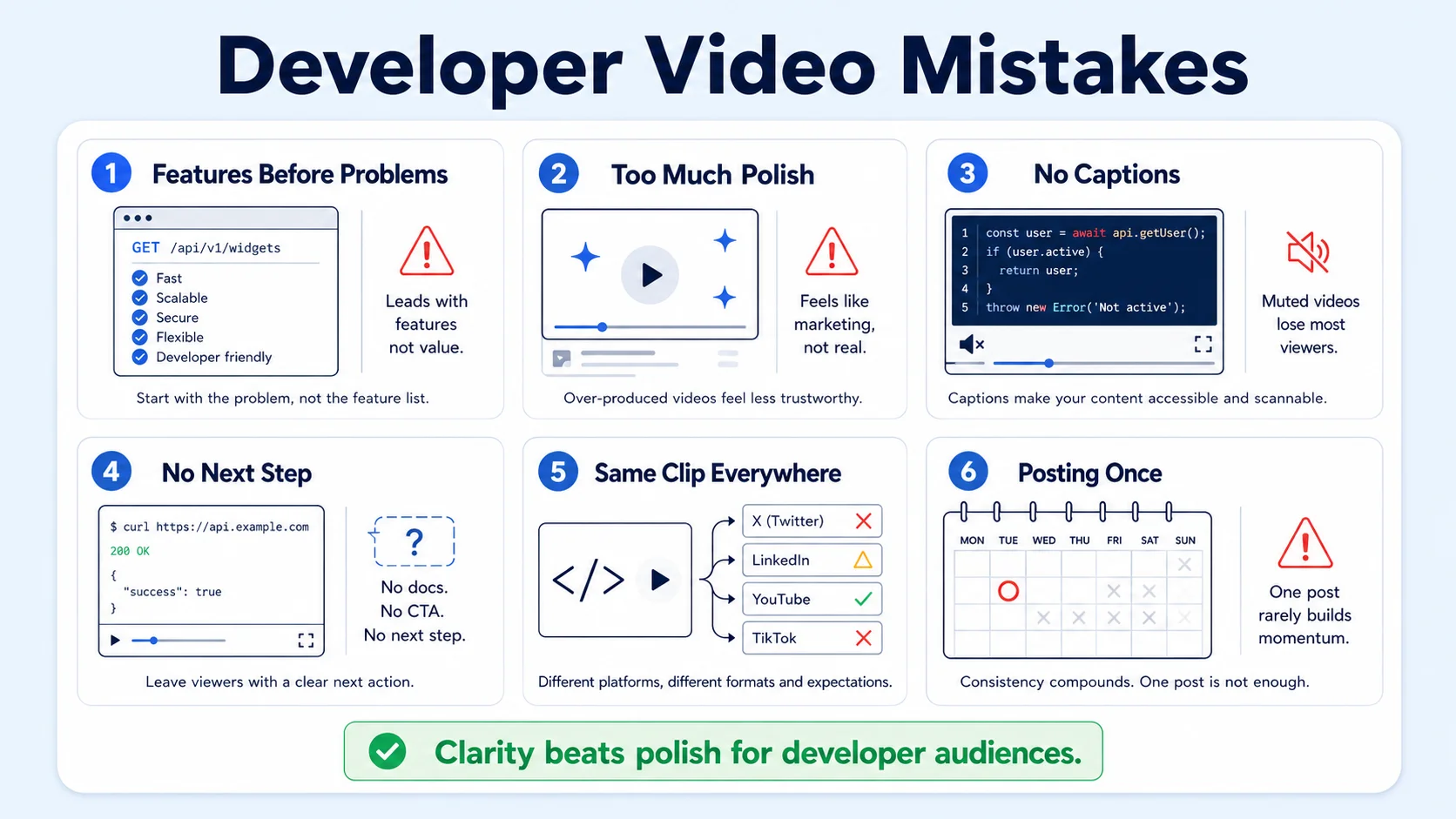
Mistake 1: Leading with features, not problems. "Our API now supports multi-region failover" means nothing to a developer scrolling LinkedIn. "Here's what happens to your users when your primary region goes down, and how to route around it in 20 lines" earns the watch.
Mistake 2: Overproducing for polish instead of clarity. Developers are skeptical of glossy marketing videos. A screen recording with clear narration and tight captions outperforms a motion-graphics reel every time. Reserve motion graphics for product explainers, not technical walkthroughs.
Mistake 3: Ignoring captions and on-screen text. A significant portion of your audience will watch without sound, especially on LinkedIn. Text on screen is not optional.
Mistake 4: Publishing without a next step. Short videos earn attention. The caption, the pinned comment, or the link in bio closes the pipeline loop. Every video needs a specific, frictionless CTA tied to where the viewer is in their journey: docs, a demo, a contact form, or a deeper piece of content.
Mistake 5: Treating every platform identically. A YouTube Shorts hook optimized for search ("How to fix OAuth 401 errors in Node.js") is different from a LinkedIn hook optimized for feed scroll ("I spent a week debugging this. Here's what I found").
Mistake 6: Posting once and abandoning the strategy. The edge is not in publishing more. It is in knowing what to publish before everyone else figures it out. Track which formats drive the most profile visits, doc clicks, and demo requests. Double down on those, and cut the rest.
Conclusion
Short-form video for developer tools and API companies is not a trend to watch. It is a pipeline lever that compounds over time. Here are the core takeaways:
- Developer audiences respond to problem-first, peer-driven video content, not product ads.
- YouTube Shorts and LinkedIn are the highest-ROI distribution channels for this audience in 2026.
- Your existing webinars, demos, and podcasts are already a short-form video library waiting to be extracted.
- Consistent publishing with tight feedback loops beats sporadic high-production drops every time.
Whether your team is sitting on a library of recorded demos and webinars or is starting from scratch with no existing content, closing that distribution gap is the priority. Komet Media builds exactly that system for B2B SaaS and developer tool teams, regardless of their starting point.
Frequently Asked Questions
Q1: What length works best for short-form video targeting developer audiences?
45-75 seconds is the sweet spot for technical content. Long enough to show a real problem and its solution, short enough to hold attention. Short clips between 30 and 90 seconds work best for discovery, while longer videos of 2 to 5 minutes are better suited for audiences who already know you.
Q2: Should API companies post on TikTok or is LinkedIn enough?
Both serve different roles. TikTok delivers organic reach to cold audiences fast. LinkedIn converts warm audiences and technical buyers into demo requests. Start with LinkedIn for pipeline, add TikTok for top-of-funnel reach.
Q3: How do we explain a complex API feature in under 60 seconds?
Narrow the focus to one use case, one error, or one outcome. Do not explain the full product. Show the moment a developer would actually hit this feature, solve it on-screen, and state the outcome clearly. One problem. One solution. One clip.
Q4: Can we repurpose our existing webinars and demos into short-form videos?
Yes, and this is often the fastest path to volume. A 45-minute webinar typically contains 6-10 extractable moments: a founder making a sharp product claim, a live demo solving a specific problem, or a Q&A answer that addresses a common developer pain point.
Q5: Which metrics should developer tool companies track for short-form video?
Track profile visits, link-in-bio clicks, demo requests, and watch-through rate, not vanity metrics like views or likes. A video with 800 views and 40 demo page visits outperforms one with 50,000 views and zero clicks.
Q6: How is short-form video different from long-form content for developer marketing?
Long-form content, like a podcast, deep-dive blog, or full product walkthrough, earns trust with developers already evaluating your tool. 59% of senior executives prefer video over text when researching solutions, and short-form video captures them at the discovery stage, before they have committed to evaluating anything. Both formats work together in a healthy content stack.