
🪄 AI Summary
Heading 1
Heading 2
Heading 3
Heading 4
Heading 5
Heading 6
Lorem ipsum dolor sit amet, consectetur adipiscing elit, sed do eiusmod tempor incididunt ut labore et dolore magna aliqua. Ut enim ad minim veniam, quis nostrud exercitation ullamco laboris nisi ut aliquip ex ea commodo consequat. Duis aute irure dolor in reprehenderit in voluptate velit esse cillum dolore eu fugiat nulla pariatur.
Block quote
Ordered list
- Item 1
- Item 2
- Item 3
Unordered list
- Item A
- Item B
- Item C
Bold text
Emphasis
Superscript
Subscript
Most B2B SaaS and AI/tech founders think cross-posting video is simple: export once, post everywhere. Then they watch the Reach collapse and blame the platform. The real issue isn't cross-posting itself, it's how you do it. Cross-posting video without killing reach is entirely achievable, but it requires a system, not a shortcut. This guide covers every variable that kills distribution across LinkedIn, YouTube Shorts, Instagram Reels, and TikTok, and shows you how to build a repeatable multi-platform video strategy that actually drives the pipeline.
TL;DR
- Platforms don't penalize cross-posting, they penalize lazy cross-posting: wrong ratios, watermarks, copy-paste captions.
- Native uploads always beat linked video for algorithmic reach on every major B2B platform.
- Cross-posting video without killing reach means one source asset adapted into platform-native versions, not one file blasted everywhere.
- B2B SaaS teams that treat each platform as its own distribution channel build compounding inbound demand.
Why Your Video Gets Less Reach When You Post the Same Content Everywhere
This is the question I hear constantly from SaaS founders: "We posted the same clip on LinkedIn, Shorts, and Reels, and reach was terrible on all three. What happened?" There is no algorithmic penalty for posting the same video to TikTok, Instagram, YouTube, Facebook, or LinkedIn; platforms don't talk to each other and can't detect duplicate content across services. So the penalty isn't duplication. It's execution.
Three mechanics kill reach on lazy cross-posts:
- Watermarks: Leaving a TikTok watermark on a video you upload to Instagram or YouTube triggers active suppression from both platforms.
- Copy-paste captions: Each platform's audience expects different tone, identical captions tank engagement.
- Wrong aspect ratios: Letterboxing happens when you upload the wrong ratio, and the platform adds black bars that hurt engagement.
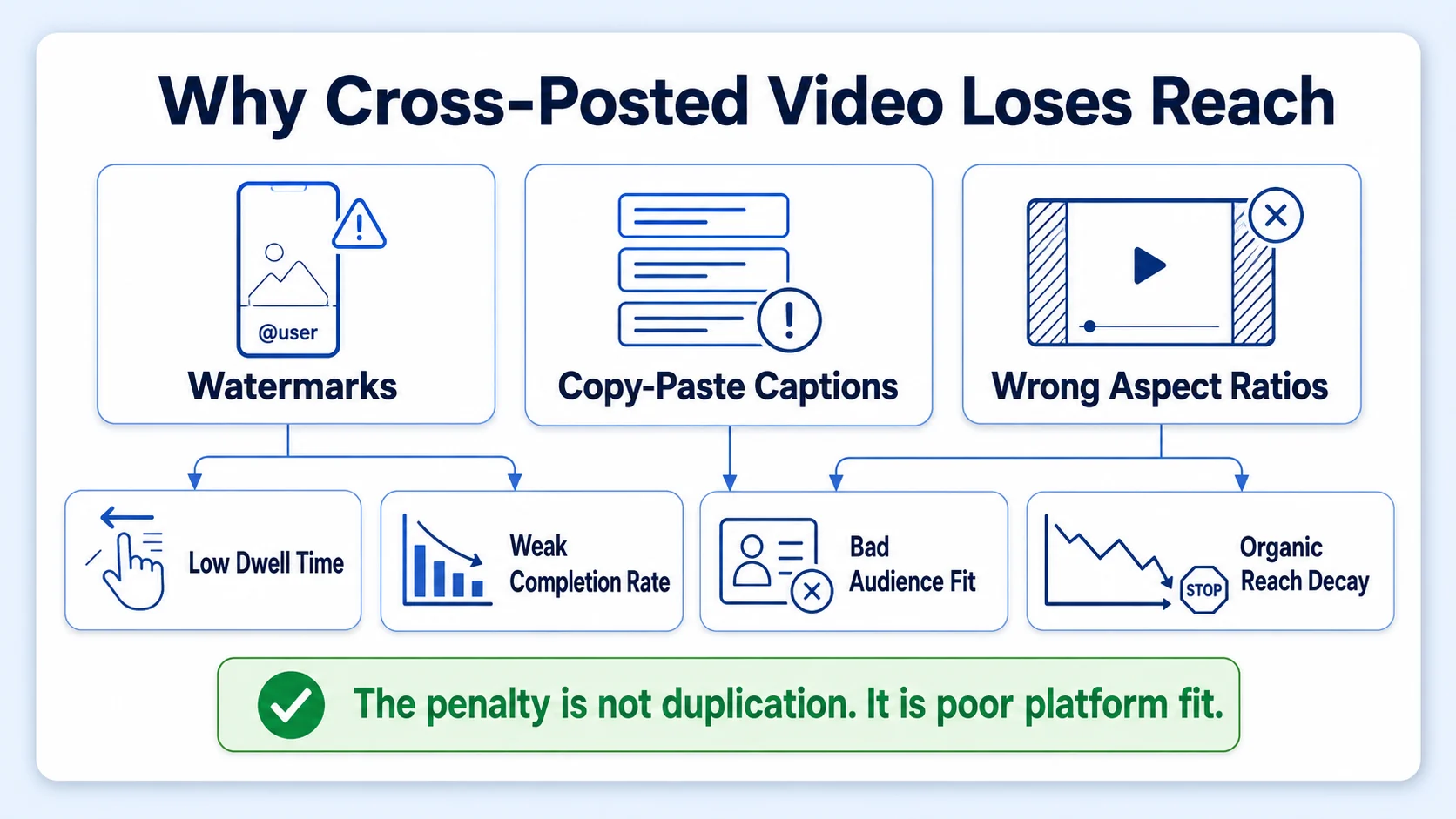
Beyond these three triggers, there's a deeper algorithmic reason. Every major 2026 platform has moved from follow-graph to interest-graph recommendation, followers no longer guarantee reach; content itself has to earn distribution. And dwell time and completion rate are the two most under-reported ranking signals, both now carrying more weight than likes on Instagram, TikTok, YouTube, and LinkedIn.
When you post a horizontal Zoom recording to LinkedIn's vertical short-form feed, or a TikTok clip with a consumer hook to a B2B professional audience, the audience swipes or scrolls away immediately. That low completion rate is what signals the algorithm to stop pushing the video. The moment your audience swipes away, the algorithm interprets it as poor content, not a poor audience fit. That's the reach killer.
For B2B SaaS teams, this matters even more. Your buyers are decision-makers with 30-second attention windows. A mis-formatted video in an unfamiliar hook style reads as noise, not signal. Every poor completion rate compounds organic reach decay over time.
Does LinkedIn Penalize Cross-Posted Videos from YouTube or TikTok?
LinkedIn doesn't explicitly "penalize" cross-posted video, but the structural disadvantage is the same as a penalty. External video links from YouTube are penalized because LinkedIn wants users on-platform. Even more specifically, the LinkedIn algorithm has learned to distinguish native vertical content from recycled horizontal video, vertical format signals you created for LinkedIn specifically.
Native uploads earn 38% more engagement than external links, and keeping outbound links out of the post lifts reach by another 38%. That's a combined distribution gap that no amount of great content can close if you're linking out instead of uploading directly. The 2026 LinkedIn algorithm prioritizes native video, dwell time, and educational content over promotional posts and anything with an external link.
Here's what LinkedIn's algorithm actually rewards in 2026:
- Short-form vertical video in portrait orientation, 15–90 seconds, is LinkedIn's biggest algorithmic push in 2026.
- Fast responses to early comments, responding within 15 minutes of posting, trigger a significant algorithmic boost by signaling active engagement.
- In 2026, the platform rewards its most active creators and subject-matter experts. If you consistently post about a particular topic, LinkedIn is more likely to recognize your authority and boost your content.
For founder-led and sales-led SaaS teams, this is significant. You'll consistently get more reach distributing video through team members' personal profiles than through your company page, company page organic reach dropped roughly 60–66% between 2024 and 2026. That's a structural shift, not a temporary dip.
The practical rule: upload video natively to LinkedIn, keep it vertical, respond to comments fast, and move the YouTube link to the first comment.
Cross-Posting vs. Native Video Upload: Which Gets More Reach?
Native always win. Every platform in 2026 rewards content that keeps users on-platform, and native-per-platform always beats cross-posting, visible watermarks, wrong aspect ratios, and mismatched hook patterns all trigger distribution penalties. Here's how the platforms compare for B2B SaaS teams:
When you share a YouTube link on LinkedIn, the video doesn't autoplay in the feed, LinkedIn detects an outbound link that takes users away from their platform. Native uploads receive approximately 38% higher engagement than identical content shared via external links.
On YouTube Shorts, the dynamic is different. YouTube Shorts no longer shares an algorithm with long-form videos, YouTube fully decoupled the two systems in late 2025. Shorts are now enormous, over 200 billion daily views, and the system that distributes them works on completely different rules from long-form.
For cross-platform publishing, the short-form video editing workflow matters as much as the strategy. Producing one clean, watermark-free master file and exporting platform-native versions is the production baseline.
Platform-Specific Aspect Ratios and Technical Specs (2026)
This is where most B2B teams bleed to reach silently. The video is good, the message is right, but the file is wrong for the placement. The 2026 specs across major platforms are: YouTube Shorts (9:16, 1080×1920, MP4, 3 min max), Instagram Reels (9:16, 1080×1920, H.264/MP4, 3 min max), TikTok (9:16, 1080×1920, H.264, up to 10 min), and LinkedIn (1:1 or 4:5, H.264, up to 15 min).
For a practical cross-posting workflow:
- Shoot vertical 9:16 (1080×1920) for TikTok, Instagram Reels, and YouTube Shorts. Use 4:5 (1080×1350) for the Instagram feed and LinkedIn's mobile feed. Keep 16:9 (1920×1080) for YouTube long-form.
- If you only want to shoot once, frame your subject in the top two-thirds of a 9:16 vertical clip, that one file crops cleanly into every other shape.
- TikTok's UI safe zones sit slightly differently than Instagram Reels', so a caption or CTA positioned perfectly for one can sit under a button on the other, check both overlays before publishing the same file to both.
For LinkedIn specifically, captions are critical because a large percentage of users scroll with sound off in professional settings, burn captions directly into the video rather than relying on auto-generated subtitles. Export one 9:16 master at 1080×1920 in MP4/H.264. Reframe for 4:5 on LinkedIn feed. Export 16:9 only for YouTube long-form. Never letterbox. Never watermark.
For B2B teams repurposing webinars, podcasts, and demos, these specs apply to every asset you produce. Our video editing services are built around this multi-format production workflow from the first export.
How to Repurpose One Video Into Multiple Platform-Specific Versions
Cross-posting video without killing reach doesn't mean posting the same file everywhere, it means extracting maximum mileage from one source asset by rebuilding it for each surface. Here's the repurposing framework we use at Komet Media:
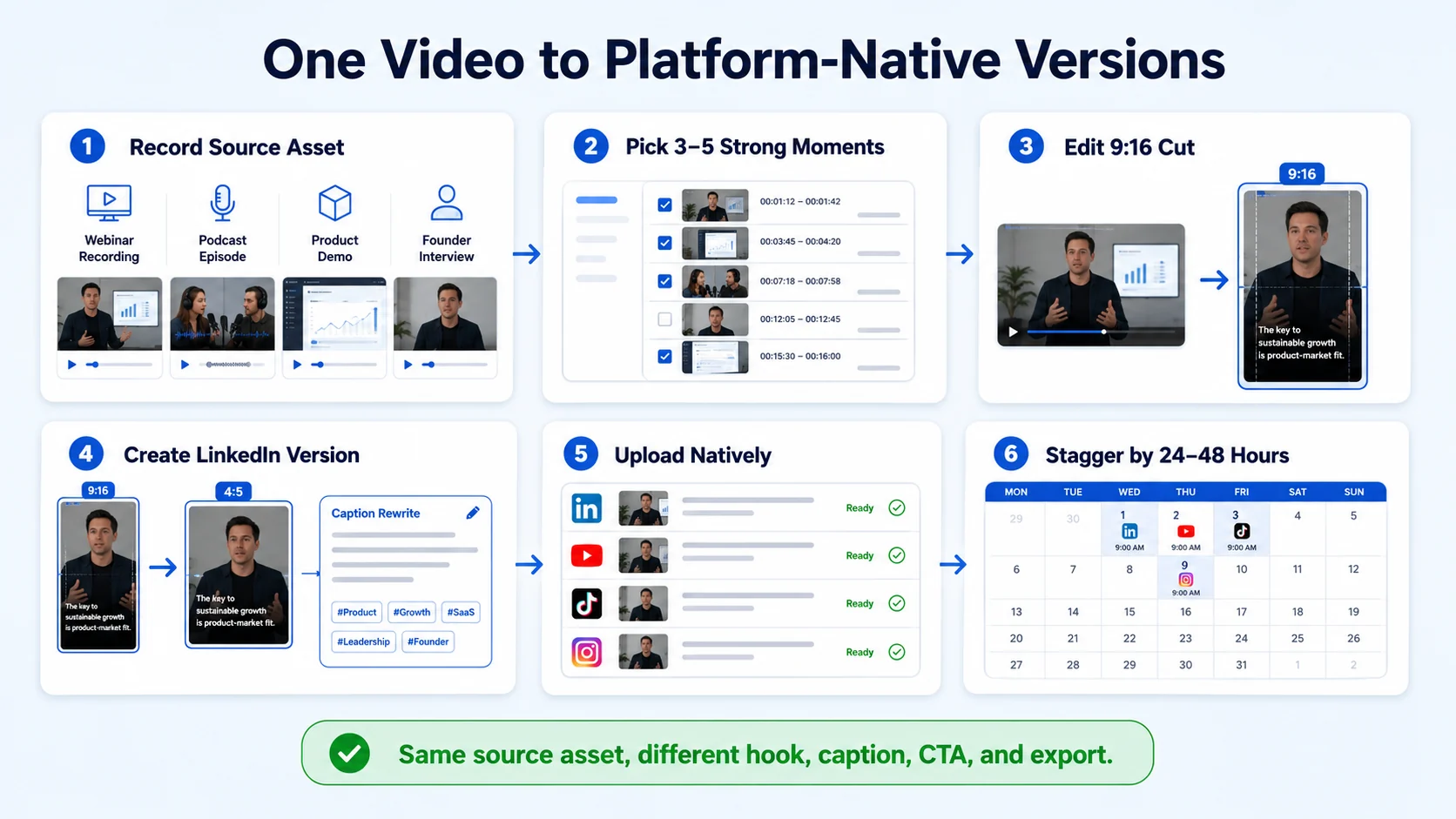
Step 1: Record the source asset, a webinar, podcast, product demo, or founder interview, in the highest quality available. This is your repurposing engine.
Step 2: Identify the three to five highest-value moments. These become your short-form clips. Each clip needs its own hook, its own caption, and its own CTA matched to its platform.
Step 3: Edit a 9:16 vertical cut for TikTok, Reels, and Shorts. Keep key text and faces in the center third to survive safe zone variations.
Step 4: Edit a 4:5 or 1:1 version for the LinkedIn feed and LinkedIn's vertical video feed. Rewrite the caption for a professional buyer audience, remove slang, sharpen the insight, add a business-specific hook.
Step 5: Upload natively to every platform. Never post a YouTube link to LinkedIn. Never export a watermarked TikTok to Reels. Instagram gives original content roughly 40–60% more distribution than reposts, and watermarked TikTok exports get suppressed, the lazy cross-posting habit that worked in 2023 is now an active penalty in 2026.
Step 6: Stagger posting by 24–48 hours per platform. This protects early engagement velocity on each platform independently, and avoids audience overlap fatigue.
For podcast content repurposing or webinar repurposing, this same framework extracts 8–12 short-form clips from a single 45-minute recording.
Cross-Posting Video Strategy for AI/Tech Startups in 2026
AI/tech startups face a specific cross-posting challenge: your product is complex, your buyers are skeptical, and undifferentiated content gets ignored. The goal isn't views, it's pipeline from the right buyers. Here's what a functional cross-posting video strategy looks like for a funded AI/tech startup in 2026:
LinkedIn (primary pipeline channel): Founder-led talking head clips explaining product problems, not features. LinkedIn video posts average a 5.60% engagement rate by impressions , and the buyer audience is active. Use 30–90 second clips, native upload, burned captions, professional tone. This is your highest-intent distribution surface.
YouTube Shorts (search and discovery): Product education clips, "how does X work," "why traditional tools fail at Y." YouTube Shorts ranks in search, optimize titles for keywords. Shorts build discoverability that compounds over time, unlike social feed content that decays in 48 hours.
Instagram Reels (awareness and retargeting): Brand storytelling, team culture, customer wins. The three signals doing the heaviest lifting for Reels distribution are watch time, sends per reach, and likes per reach, so hook fast and make clips worth sharing.
The biggest mistake AI/tech startups make: posting the same educational clip with the same caption across all three platforms. LinkedIn buyers want insight framing. YouTube viewers want search-optimized titles. Reels audiences want immediate visual hooks. Same clip, different context layer, that's cross-posting video without killing reach done right.
Connect your video marketing strategy to actual pipeline metrics: demo requests, landing page visits from video CTAs, and inbound leads attributable to specific clips.
Best Practices for Reposting Video Content in B2B Marketing
Reaching buyers repeatedly across platforms requires a system, not a one-off post. These are the non-negotiable practices for B2B SaaS and AI/tech teams in 2026:
Cadence over volume: You don't need to post every day, you need to post consistently and with a clear purpose for each piece of content. For LinkedIn, three to four posts per week on Tuesday through Thursday performs best.
Engagement velocity is currency: The first 60 minutes are diagnostic, early engagement velocity trains the initial retrieval layer and determines whether a post reaches its second-tier audience. Respond to every comment in the first hour.
Avoid reposting windows: Reposting the same video within 30 days results in 52% lower engagement the second time. Space reposts to the same platform by at least six weeks, or update the hook and caption to make it functionally new.
Caption every video: Native videos with captions can boost reach by 112%. This is also a baseline accessibility requirement, not optional.
AI-generated content disclosure: AI-generated voiceovers without disclosure now require an AI label, detected AI without labels gets de-ranked aggressively on YouTube. LinkedIn and Instagram are moving in the same direction.
Scheduling over manual posting: Uploading directly to LinkedIn rather than linking from outside boosts post visibility by 42%, and videos scheduled through LinkedIn's native tool perform 17% better than those posted manually.
For teams managing YouTube video editing and LinkedIn distribution simultaneously, these rules create the production standard that protects reach across every platform.
Conclusion
Cross-posting video without killing reach comes down to four principles every B2B SaaS and AI/tech team can execute:
- Native always wins: Upload directly to each platform, never link from YouTube to LinkedIn.
- Format is not optional: 9:16 for short-form, 4:5 for LinkedIn feed, 16:9 for YouTube long-form, wrong ratios tank dwell time.
- Adapt, don't duplicate: Same clip, different hook, different caption, different CTA per platform audience.
- Engagement velocity protects reach: Respond to comments within 60 minutes of posting on every platform.
Build these rules into your production workflow from day one and multi-platform distribution compounds into inbound demand. Ready to build the system? Start here.
Frequently Asked Questions
Q1: Does cross-posting video hurt your algorithm reach?
Not directly, platforms can't detect duplicate content across services. What hurts reach is how you cross-post: watermarks, wrong aspect ratios, copy-paste captions, and posting linked video instead of native uploads. Fix those four variables and cross-posting becomes a distribution multiplier, not a penalty.
Q2: Should I upload the same video file to every platform?
Only if it meets every platform's native specs. The same 9:16 MP4 at 1080×1920 works cleanly for TikTok, Reels, Shorts, and LinkedIn's vertical feed. But LinkedIn's standard feed prefers 4:5, and YouTube long-form requires 16:9. One master file works as a starting point, not as a final export for every platform.
Q3: Does LinkedIn suppress videos shared from YouTube?
Yes, structurally. LinkedIn's algorithm penalizes external links because they send users off-platform. Shared YouTube links don't autoplay in the feed, and they receive significantly lower distribution than natively uploaded video. Always upload the video file directly to LinkedIn, then place the YouTube link in the first comment.
Q4: How many platforms should a B2B SaaS team actively cross-post to?
Start with two: LinkedIn for pipeline intent and YouTube Shorts for search discoverability. Once you have a consistent production workflow producing three to four clips per week, add Instagram Reels for brand awareness and retargeting. Three well-executed platforms outperform six inconsistent ones.
Q5: How do I repurpose a webinar into platform-ready short-form clips?
Identify the three to five highest-insight moments from the recording. Edit each into a standalone 30–90 second vertical clip with a platform-specific hook, burned captions, and a clear CTA. Export 9:16 for Reels and Shorts, 4:5 for LinkedIn feed, native upload to each. One webinar yields 8–12 short-form assets.
Q6: What's the biggest mistake B2B teams make when cross-posting video?
Posting the same caption to every platform. LinkedIn buyers respond to insight and professional framing. YouTube Shorts audiences respond to keyword-optimized titles. Instagram Reels audiences need an immediate visual hook. The video can be the same clip, the caption, hook, and framing need to be rebuilt for each audience and surface.