
🪄 AI Summary
Heading 1
Heading 2
Heading 3
Heading 4
Heading 5
Heading 6
Lorem ipsum dolor sit amet, consectetur adipiscing elit, sed do eiusmod tempor incididunt ut labore et dolore magna aliqua. Ut enim ad minim veniam, quis nostrud exercitation ullamco laboris nisi ut aliquip ex ea commodo consequat. Duis aute irure dolor in reprehenderit in voluptate velit esse cillum dolore eu fugiat nulla pariatur.
Block quote
Ordered list
- Item 1
- Item 2
- Item 3
Unordered list
- Item A
- Item B
- Item C
Bold text
Emphasis
Superscript
Subscript
Data and analytics companies tend to record some of the smartest podcasts in B2B. They also tend to bury the best parts under forty minutes of architecture talk. Whether you are producing original content from scratch or repurposing existing episodes, the goal is pulling out the clearest explanations and turning them into clips that data leaders, engineers, and budget holders will actually watch. The hard part is not finding good material. It is keeping technical accuracy while making the idea understandable in under ninety seconds. This guide covers how I approach that balance, from moment selection and original creation to distribution.
Quick Answer
Podcast repurposing for data and analytics brands means turning technical episodes into short, accurate clips for practitioners and buyers. It works when you pick clear explanations, make visuals legible, and distribute through the communities where data teams spend time.
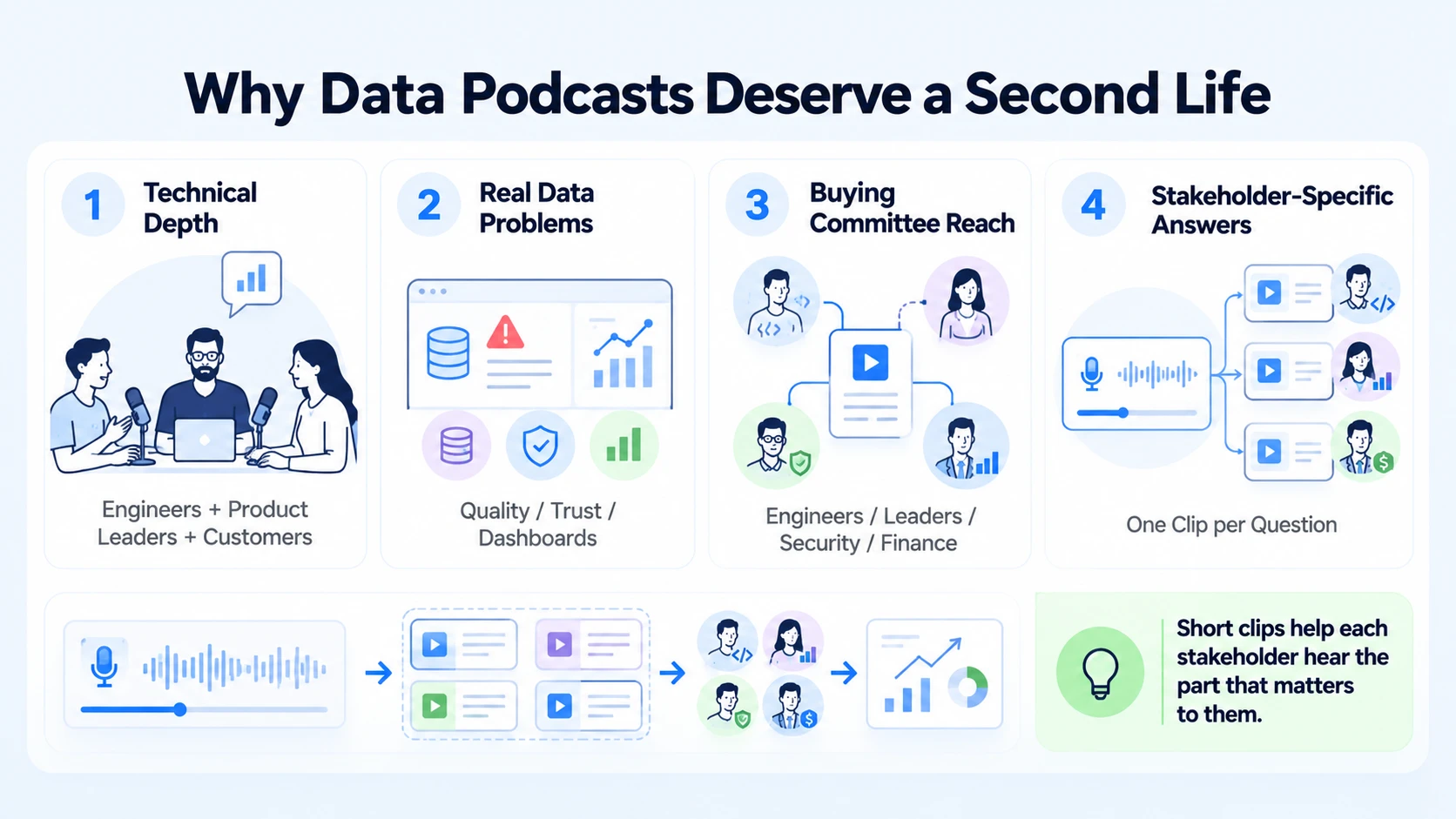
Why Data and Analytics Podcasts Deserve a Second Life
Data teams are a demanding audience. They are skeptical of marketing, they spot vague claims quickly, and they respect people who explain hard problems well. A podcast is one of the few formats that lets your engineers, product leaders, and customers show that depth naturally.
The problems they talk about are real and persistent. In the dbt Labs 2025 State of Analytics Engineering report summary, 56% of survey respondents identified data quality as a problem. When a guest on your show explains a practical way to catch bad data before it reaches a dashboard, that moment speaks directly to a widely felt pain. It should not live only inside a long episode.
The format has broad reach too. The Infinite Dial 2026 from Edison Research at SSRS found that 45% of Americans age 12 and older consumed a podcast in the last week, a record for the study. That is general population data, not a measure of data professionals, but it confirms that long conversations are a mainstream habit, not a niche one.
The commercial reason is the buying committee. A data platform purchase usually involves data engineers, analytics leaders, security reviewers, and finance. The 2025 Edelman and LinkedIn B2B Thought Leadership Impact Report found that more than 40% of B2B deals stall because of internal misalignment in buying groups. Short clips let each stakeholder hear the part of the conversation that matters to them.
The Translation Problem: Technical Depth Versus Short-Form Attention
One mistake I see repeatedly is assuming that technical audiences only want long, dense content. Data professionals watch short clips too. They just have a low tolerance for clips that oversimplify or hide the real point.
The challenge is translation. A guest might spend four minutes building up to one excellent sentence about why semantic layers reduce metric disputes. A good clip finds that sentence, then adds just enough setup for it to stand alone.
Here is how I handle it:
- Start with the claim, not the context. Open the clip with the clearest statement, then let the guest explain it.
- Define one term per clip. If a clip needs three acronyms explained, it is probably two clips.
- Keep the nuance that makes it accurate. Phrases like "for teams above a certain scale" or "in a warehouse-first setup" often matter. Cut filler, not qualifiers.
- Avoid hype language in captions. Data audiences notice when on-screen text promises more than the speaker said.
Different clips also serve different readers. I usually sort moments by audience:
The example angles above are illustrations of how to frame clips, not quotes from real episodes.
Opinion clips deserve special attention. Data practitioners follow people with clear, defensible views on testing strategy, build versus buy, or how much modeling is too much. A guest who says "most teams over-engineer their first warehouse, and here is why" gives you a clip that invites discussion. Bland consensus statements rarely travel. When two moments are equally accurate, pick the one with a point of view.
Visual Problems Unique to Data Content
Data podcasts often include screen shares: SQL, notebooks, dashboards, pipeline diagrams. These visuals are valuable, but they rarely survive the move to a vertical phone screen without work.
A dashboard that looks fine in a 16:9 recording becomes unreadable when cropped to 9:16. Small fonts, dense tables, and wide code blocks lose all meaning on a phone. Posting them anyway signals carelessness to an audience that cares about detail.
What we usually do instead:
- Crop to the part that matters. Zoom into the one chart, query, or error message the guest is discussing.
- Rebuild key visuals. A clean animated diagram of a data flow is often clearer than the original screen share. Our motion graphics work is often used for exactly this kind of explanation.
- Use split layouts. Put the speaker on top and the simplified visual below, so viewers get both the person and the point.
- Check for sensitive data. Customer names, table names, and real figures sometimes appear in demos. Blur or replace them before publishing.
The last point matters more than most teams expect. A demo recorded inside a real customer environment can expose schema names or business metrics. Build a quick visual review into every edit that includes a screen share.
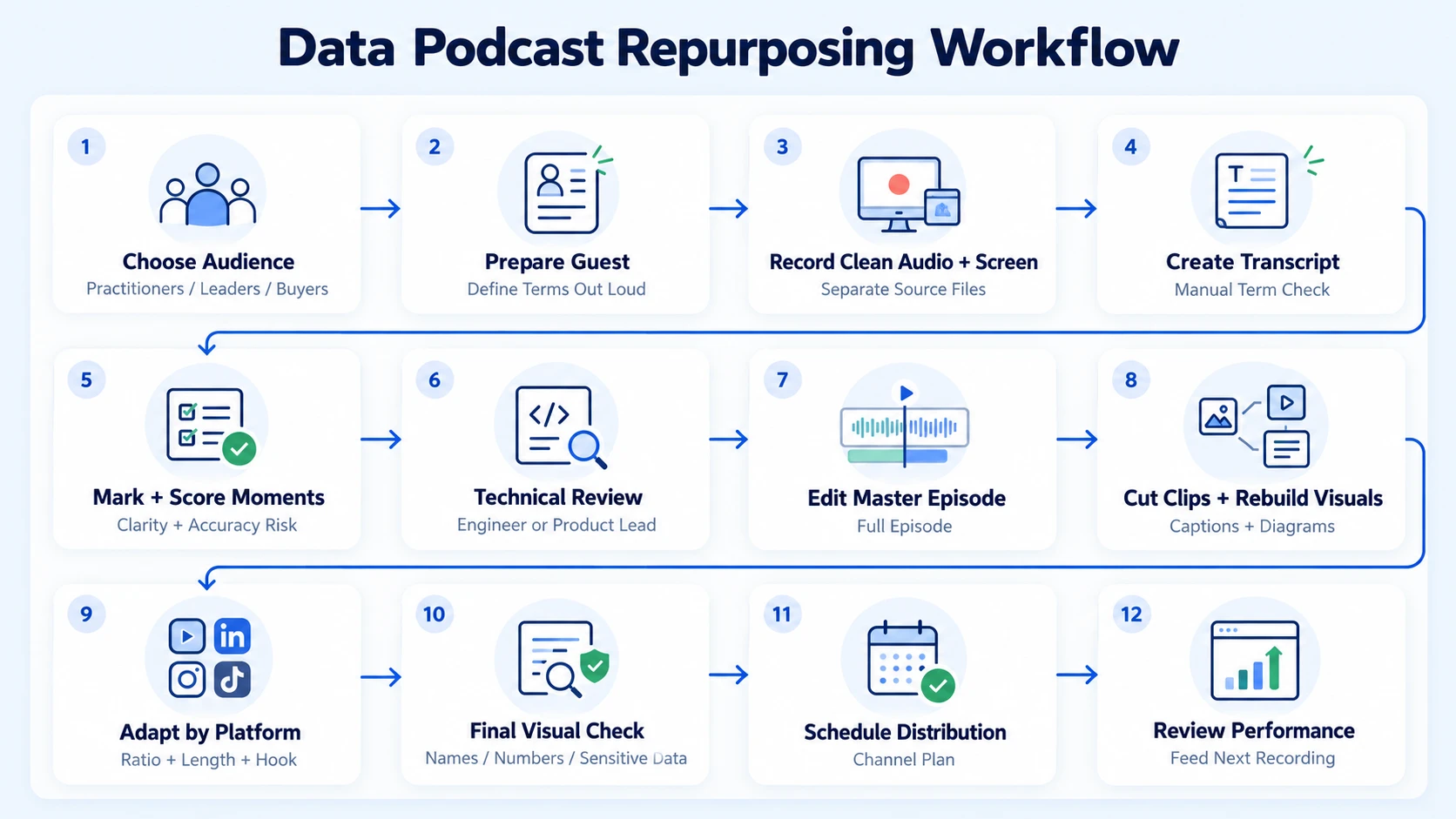
A Podcast Repurposing Workflow for Data Teams
Most podcast repurposing fails before editing starts, because nobody decided who the content is for. A written workflow makes those decisions once and keeps every episode moving.
The cycle I recommend:
- Choose the audience for the episode. Practitioners, leaders, or buyers in evaluation.
- Prepare the guest. Ask them to define terms out loud and to avoid sharing customer details on screen.
- Record clean audio, video, and screen capture separately where possible, so editors can reframe visuals later.
- Create an accurate transcript. Technical vocabulary needs a manual check, since automatic tools often mangle product names and acronyms.
- Mark and score moments. I score on clarity, audience value, whether it stands alone, and accuracy risk.
- Get a technical review of the moment list. An engineer or product lead confirms nothing is misstated.
- Edit the master episode.
- Cut clips, rebuild visuals, and add captions.
- Adapt for each platform.
- Final check and archive. Confirm names, terms, numbers, and that no sensitive data is visible.
- Schedule distribution.
- Review performance and feed lessons into the next recording.
Small teams can merge steps 5 and 6 if the person selecting clips is technical. I would not skip the transcript check or the final visual review. Those are the steps that protect credibility with a technical audience.
Recording with clips in mind
The easiest clips to cut come from episodes that were planned for them. That does not mean scripting the guest. It means designing questions that invite short, complete answers. This is where podcast repurposing really starts: in the recording plan, not the edit.
A few habits help:
- Ask one question at a time. Compound questions produce answers that wander.
- Follow every abstract answer with a request for an example. "Walk me through the last time that happened" often produces the best moment in the episode.
- Ask where the guest disagrees with common practice. "What do most data teams get wrong about this?" draws out a clear point of view.
- Close with a summary. Ask the guest to sum up their main advice in two sentences. That summary often makes a strong opening clip.
In my experience, hosts who consistently ask for examples give editors far more usable material, without making the episode any longer.
What one episode can produce
A typical output plan for one strong episode:
These are planning ranges, not promises. A focused, opinionated guest gives you more usable moments than a general overview.
Distribution: Reaching Data Practitioners Where They Actually Are
A polished clip with no distribution plan is still an underused asset. Data audiences are spread across professional networks, video platforms, and communities, and each one has its own norms.
LinkedIn works well for data leaders and executives. It has also become a stronger video platform. Digiday reported that total video viewership on LinkedIn increased 36% year over year for the period from October 30, 2024, to January 29, 2025, based on figures shared by the company. For format specifics, see our guide to LinkedIn video for data and analytics companies.
YouTube is where many practitioners go to learn. Full episodes and topic-focused clips can rank for how-to searches long after publication. YouTube reported more than 1 billion monthly active viewers of podcast content as of January 2025. That is a platform-wide number, but it shows how common it is to watch long conversations there.
Communities are where data practitioners talk honestly. Slack groups, forums, and newsletters can be powerful, but they reject anything that looks like an ad. Share clips that teach something, credit the guest, and join the discussion. Our guide to distributing video in Slack and communities covers the etiquette in more detail.
Sales enablement benefits from short explainer clips. When a prospect asks how your product handles lineage or access control, a 90-second clip from your product lead can answer more clearly than a long email.
Events and meetups create short windows of attention. If your team speaks at a data conference, publish clips from related podcast episodes in the weeks before and after. Attendees who liked a talk often look for more from the same speakers.
Guests often have strong followings in data circles. Send them their clips with suggested captions and ask them to share. A respected practitioner posting your clip can reach people your brand page never will.
How to Measure Whether Clips Are Working
Views alone tell you very little. A clip seen by a small group of analytics leaders at target accounts can matter more than a broadly shared one.
Comments are an underrated signal with technical audiences. A thread where practitioners debate the guest's point tells you the topic is worth a follow-up episode. Over time, podcast repurposing should shape your editorial calendar. If clips about one problem keep starting discussions, record more about it.
Attribution will be imperfect, especially with product-led or self-serve motions. Combine platform data, a "how did you hear about us" field, and feedback from sales and community teams. Review results monthly and use them to choose your next guests and questions.
Conclusion
Data and analytics brands rarely lack strong ideas. Their podcasts are often full of clear, hard-won explanations from people who do the work. What they lack is a reliable way to get those explanations in front of practitioners and buyers in a form they will actually watch.
The decision to make is to run podcast repurposing as a technical editorial process. Select moments for clarity, protect accuracy, rebuild visuals for small screens, and distribute through the channels where data teams already learn from each other. If you are ready to scale your podcast repurposing, book a call with our team.
FAQ
What is podcast repurposing for a data company?
It is the process of turning podcast episodes into shorter assets such as clips, explainer videos, write-ups, and community posts. For data and analytics brands, it includes checking technical accuracy and making visuals readable on small screens.
How much does it cost?
Freelancers often charge per clip or per hour, subscriptions charge a flat monthly fee for editing volume, and agencies price by scope. At Komet Media, engagements typically fall in the range of about $2,500 to $5,000, depending on episode volume, clip count, motion graphics, turnaround, and distribution support.
How long does it take to turn an episode into clips?
It depends on episode length, clip count, and how much visual rebuilding is needed. Clips that require new diagrams take longer than talking-head clips. Agree on a technical review turnaround with your team early so approvals do not become the bottleneck.
What deliverables should we expect from one episode?
A typical plan includes the full edited episode, several short clips, one or two explainer clips with rebuilt visuals, a technical write-up, and snippets for communities or newsletters. The mix should follow your audience and channel plan.
Should we hire a freelancer or an agency?
A skilled freelancer can edit well at low volume. An agency is a better fit when you need selection, visual rebuilding, platform adaptation, and distribution handled together. Either way, ask how they handle technical review and sensitive data in screen shares.
Can our internal team handle it?
Yes, if someone has the time, editing skills, and technical understanding to own it weekly. Many data companies have the expertise in-house but not the production time, so the work stalls during product releases.
Do engineers need to review every clip?
Not every clip, but someone technical should review the selected moments and any clip that includes code, numbers, or architecture claims. That small step protects your credibility with an audience that notices mistakes.
How does Komet Media work with data and analytics brands?
We handle end-to-end video creation from scratch as well as podcast repurposing—including moment selection, editing, visual rebuilding, captions, platform adaptation, and distribution support, with technical review built into the workflow. Whether launching a new show or scaling content output, we help data and analytics brands build authority. If you want to talk through your show, you can book a call with our team.