
🪄 AI Summary
Heading 1
Heading 2
Heading 3
Heading 4
Heading 5
Heading 6
Lorem ipsum dolor sit amet, consectetur adipiscing elit, sed do eiusmod tempor incididunt ut labore et dolore magna aliqua. Ut enim ad minim veniam, quis nostrud exercitation ullamco laboris nisi ut aliquip ex ea commodo consequat. Duis aute irure dolor in reprehenderit in voluptate velit esse cillum dolore eu fugiat nulla pariatur.
Block quote
Ordered list
- Item 1
- Item 2
- Item 3
Unordered list
- Item A
- Item B
- Item C
Bold text
Emphasis
Superscript
Subscript
If your B2B content looks different every week, reads differently depending on who wrote it, and arrives on no predictable schedule, you have a content operations problem, not a creativity problem. Solving inconsistent content production for B2B teams is a structural challenge, one that kills pipeline momentum, confuses buyers mid-journey, and quietly erodes the trust your sales team needs to close. I've seen this pattern across SaaS teams of every size. The fix is always the same: systems before execution.
TL;DR
- 31% of B2B marketers have no structured content production process, and 29% lack an editorial calendar with clear deadlines.
- Inconsistency is a workflow problem, not a talent problem. Fix the process first.
- Brand voice guidelines, content governance, and standardized briefs eliminate quality variance across writers.
- Repurposing existing long-form assets into short-form video is the fastest path to content velocity without adding headcount.
What Causes Inconsistent Content Output in B2B Organizations?
Most teams I talk to think inconsistency means they need better writers. It rarely does. The cause is almost always upstream. According to the CMI/MarketingProfs B2B Content Marketing benchmarks, almost half (48%) of B2B marketers cite "not enough content repurposing" as a scaling challenge. Lack of communication across organizational silos hits 40%. A further 31% have no structured content production process, 29% lack an editorial calendar with clear deadlines, and 11% have no style guide.
These aren't isolated issues. They compound. When there's no editorial calendar, writers produce on instinct. When there's no style guide, every piece sounds like a different brand. When silos dominate, subject matter expert (SME) knowledge never makes it into content, so the output stays shallow and generic. 65% of marketing content is never used by sales teams due to misalignment. That's the downstream cost of ignoring content operations upstream.
Three root causes drive the majority of inconsistency I diagnose with B2B teams:
- No single brief format: Writers interpret each assignment differently, so tone, depth, and structure vary wildly from piece to piece.
- No SME pipeline: Founders and product experts hold the insight that creates differentiated content, but there's no repeatable process to extract it.
- No handoff protocol: Content is "done" when the writer submits, not when it's reviewed, approved, and ready for distribution, so quality control is random.
When goals are fuzzy or production is chaotic, even strong writing struggles to translate into leads or sales momentum, and 66.5% of content marketers struggle with knowing where to allocate resources. Solving inconsistent content production for B2B teams starts with acknowledging this: the problem lives in the system, not the people.
Why Does B2B Content Quality Vary So Much Between Writers?
Writers on the same team producing wildly different quality is a governance failure. When there's no content governance framework in place, each writer defaults to their own standards for research depth, formatting, tone, and positioning. 58% of B2B marketers rate their content strategy as merely "moderately effective," and nearly half of those say their strategy struggles because they lack clear goals. Without a clear goal per piece, a writer has nothing to anchor quality decisions against.
The fix requires three governance layers working together:
- Brand Voice Guidelines: Document the vocabulary your brand uses and avoids, the emotional register you write at, and the personas you're addressing. This is the single highest-leverage document a content team can own.
- A content brief template: Every assignment must include target persona, funnel stage, primary keyword, desired outcome, and approved sources. No brief, no brief-without-a-template, no exceptions.
- An editorial review protocol: Who reviews first, who approves, and what does "approved" actually mean? This prevents the last-minute, one-pass review that creates inconsistent final output.
Only one in three B2B marketers say they have a scalable model for content creation. The teams that do have one share a common trait: they treat content production the way a product team treats a sprint, defined inputs, defined outputs, defined handoffs.
At Komet Media, this is where we start with every SaaS team. Before we touch a single piece of content or short-form video, we establish the voice, the brief format, and the review gates. Quality variance collapses almost immediately when those three things exist.
How to Build a Repeatable Content Process for B2B Companies
A repeatable content process isn't a content calendar. A calendar tells you when. A process tells you how, and the how is what produces consistent quality at scale. Solving inconsistent content production for B2B teams demands both.
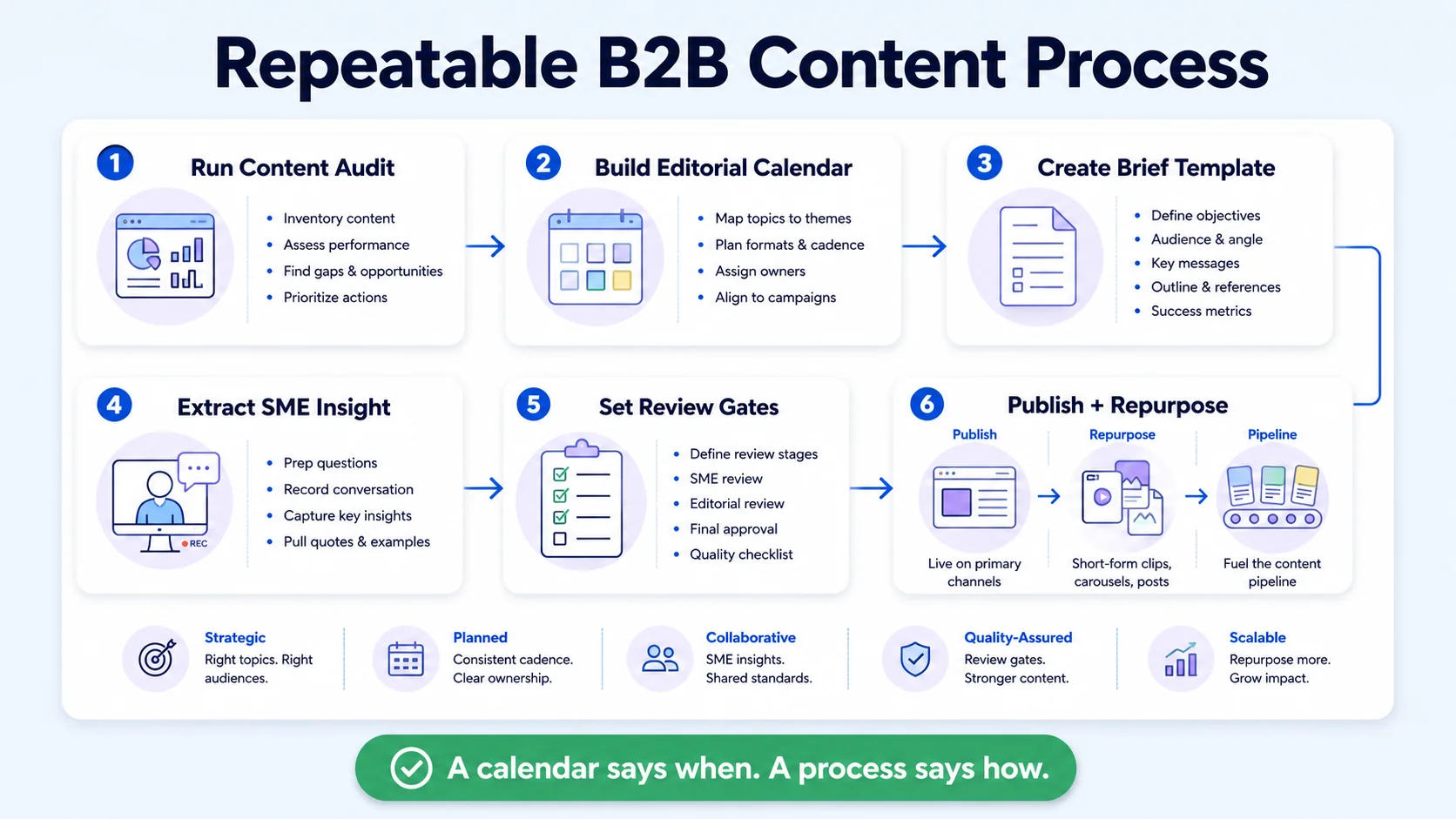
Here's the process architecture I use and recommend:
- Run a content audit: Use a tool like Semrush or Clearscope to assess what content exists, what's performing, and where the gaps are relative to your buyer journey mapping. This eliminates guesswork from planning.
- Build your editorial calendar in Airtable: Map content to funnel stage (awareness, consideration, decision), assign a primary keyword, name the responsible writer, and attach a deadline and brief. Airtable's relational structure makes it easy to filter by status and spot bottlenecks.
- Create a brief template: Each brief contains persona, goal, primary keyword, word count, SME to interview, competing content to differentiate from, and the one action you want the reader to take.
- Standardize the SME extraction process: Block a 20-minute recorded call with the relevant founder, product expert, or sales leader. Transcribe it, pull the insight, and use it to elevate the brief to something a freelancer or agency can execute with genuine depth.
- Set review gates: Draft review, fact-check, brand voice review, and final approval. Assign each gate to a named person, not a team.
- Publish and repurpose systematically: Every long-form piece should yield at least three short-form derivatives, a LinkedIn post, a short-form video clip, and an email snippet.
A Content Marketing Institute 2025 survey found that 72% of B2B marketers increased their content output year-over-year, but only 29% rated their content strategy as highly effective. Marketers who automate content workflows produce 3x more content without adding headcount. The goal isn't more content. It's a system where content velocity and content quality move together.
Tools to Help B2B Teams Produce Consistent Content at Scale
Tools don't fix broken processes, but the right tools make good processes faster and more scalable. For B2B teams serious about solving inconsistent content production, the stack below covers the critical operations:
HubSpot provides a unified interface where campaign management, contact tracking, and pipeline analytics all live together, and it's one of the few platforms that marketing, sales, and content teams can use without heavy training. Because automation, CRM, CMS, and analytics are integrated into one system, teams avoid the delays and data mismatches that come with connecting separate tools.
According to HubSpot's 2025 State of Marketing Report, 86% of marketers say automation has helped save time and scale personalization efforts. For B2B SaaS teams, the most overlooked tool in this stack is short-form video. Short-form video generated the highest ROI of any content format in 2025, and most marketers plan to continue investing heavily in it throughout 2026.
Repurposing a founder podcast episode, webinar recording, or product demo into three to five short clips is the fastest way to increase content velocity without increasing production cost. Our podcast production and video editing services are purpose-built for exactly this motion.
Best Practices for Consistent Content Production in B2B Marketing
Consistency in B2B content is a product of decisions made before writing starts. These are the practices that separate teams with reliable content operations from those stuck in feast-and-famine cycles.
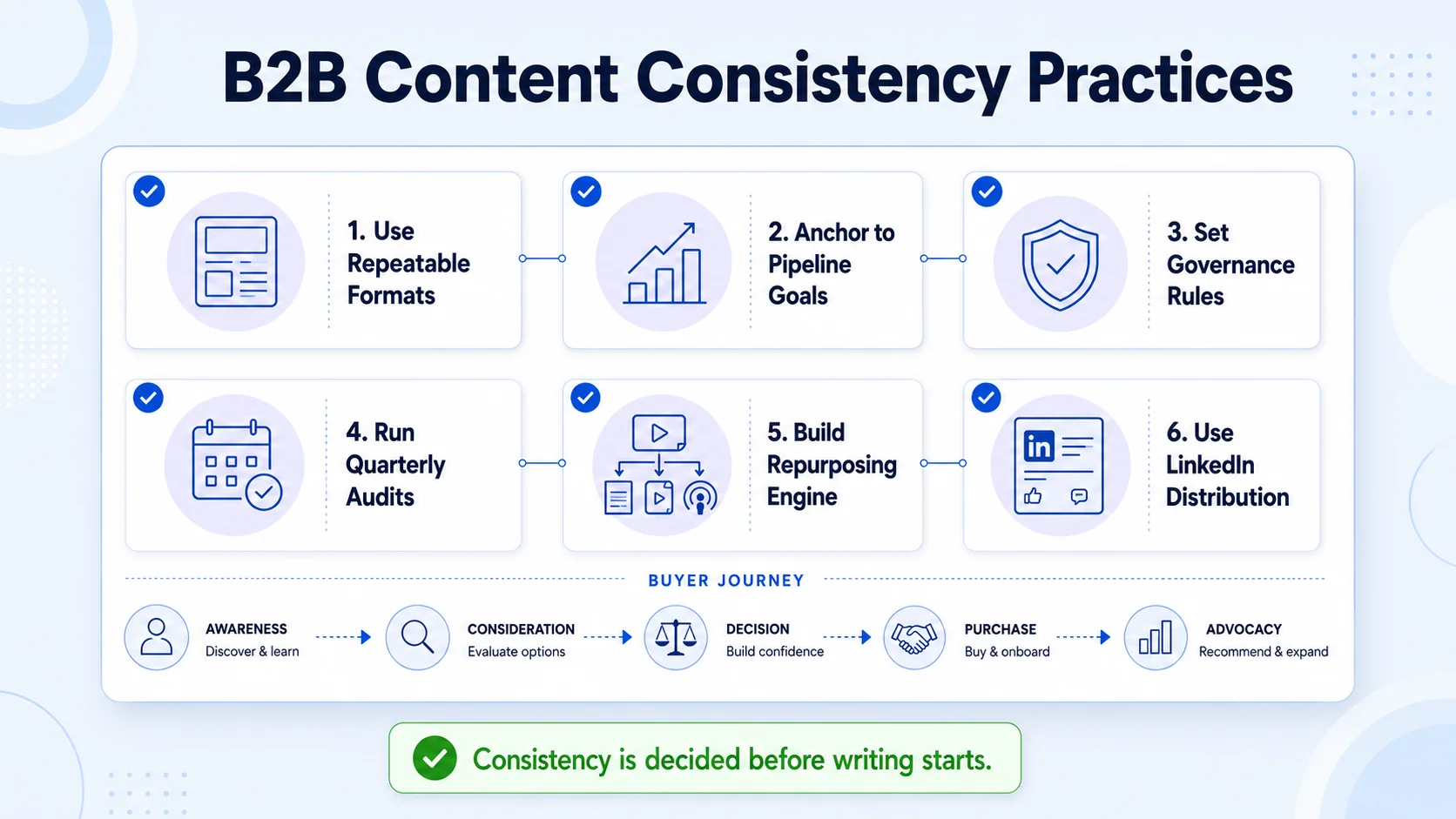
Treat every content type as a format, not a project. A blog post is a repeatable format with a defined structure. A LinkedIn video is a format with defined length, hook, and CTA. Formats have templates. Projects are reinvented every time. Stop reinventing.
Anchor the editorial calendar to pipeline goals, not publishing volume. Marketing teams are expected to operate more efficiently, not just produce more activity. A structured B2B content funnel becomes far more valuable than a disconnected calendar of assets. When category education, evaluation content, and proof connect intentionally, content begins to operate like a system.
Establish a content governance framework. This covers who can publish, what gets reviewed before publishing, how brand voice is enforced, and how content is retired when it becomes outdated. Without governance, one new hire or one rushed quarter collapses everything you built.
Run a quarterly content audit. Use Semrush or Clearscope to identify content that has drifted from keyword targets, dropped in rankings, or no longer aligns with current positioning. Kill or refresh underperformers. Don't keep publishing on top of a broken foundation.
Build a content repurposing engine. Almost half (48%) of B2B marketers cite "not enough content repurposing" as their primary scaling challenge. Every webinar, podcast, or demo your team produces is a content asset waiting to be broken into short-form video, written posts, email sequences, and sales enablement pieces. This is the core of what we do at Komet Media, turning existing long-form content into a systematic pipeline of buyer-facing assets.
Use LinkedIn as your primary distribution channel for B2B. LinkedIn is the top channel for publishing thought leadership, used by 76% of B2B marketers. Founder-led short-form video on LinkedIn is currently the highest-trust distribution format available to B2B teams. It builds a pipeline before a prospect ever books a demo.
Solving inconsistent content production for B2B teams at scale means making these practices non-negotiable, not aspirational.
How to Standardize Content Creation Workflows Across a B2B Team
Standardization isn't about making content feel robotic. It's about making the quality the floor, not the ceiling. Here's how to implement workflow standardization that actually sticks:
- Document your Content Operations playbook: A single source of truth containing your brief template, style guide, brand voice guidelines, approval chain, distribution checklist, and repurposing rules. Store it in Notion or Confluence. Every team member, internal and external, onboards through it.
- Map content to buyer journey stages explicitly: Every piece must be tagged awareness, consideration, or decision. This prevents the common failure of producing mostly top-of-funnel content while leaving mid-funnel buyers with nothing to help them evaluate. Buyer journey mapping isn't optional, it's the architecture.
- Run a weekly content ops standup: 15 minutes, same time, every week. Status of in-progress pieces, blockers, and what's scheduled for publishing. This is your editorial calendar brought to life as a live accountability mechanism.
- Assign a content operations owner: Not a writer. Not a CMO. A dedicated person responsible for the workflow, the calendar, and the quality gates. In lean SaaS teams, this is often a marketing operations manager or a fractional content strategist.
- Integrate your CMS with HubSpot for content-to-pipeline attribution: Content marketing generates $3 for every $1 invested versus paid ads bringing $1.80, but only when you can measure it properly. Required CRM integration should track which content pieces drive qualified leads, influence deal velocity, and contribute to customer expansion.
75% of B2B marketers plan to increase their marketing automation budgets in 2025, signaling that teams are doubling down on automation as a core growth driver. Solve the workflow problem first, then automate it. Automating a broken workflow just breaks faster at scale. Solving inconsistent content production for B2B teams at the workflow level transforms content from a recurring crisis into a compounding asset.
Conclusion
- Inconsistent content production is a systems failure, not a talent failure, fix the process before changing the people.
- A content brief template, brand voice guidelines, and an editorial calendar in Airtable resolve most quality variance immediately.
- Repurposing long-form content (webinars, podcasts, demos) into short-form video is the highest-ROI path to content velocity in 2026.
- Solving inconsistent content production for B2B teams requires a content governance framework, a dedicated ops owner, and pipeline-anchored editorial planning.
- If your team is sitting on recorded content with no system to turn it into assets, talk to us at Komet Media, that's exactly the problem we exist to solve.
Frequently Asked Questions
Q1: How long does it take to fix inconsistent B2B content production?
Most teams see measurable improvement within 30 to 45 days of implementing a brief template, editorial calendar, and brand voice document. Full workflow standardization with governance typically takes 60 to 90 days and requires a dedicated content ops owner to hold the process accountable.
Q2: What's the difference between a content calendar and a content process?
A content calendar tells you what to publish and when. A content process defines the brief format, SME extraction method, writing standards, review gates, and distribution steps. You need both, the calendar without the process produces inconsistent output on a predictable schedule, which is worse than it sounds.
Q3: How do B2B SaaS teams produce more content without hiring more writers?
Content repurposing. One founder podcast episode, webinar, or product demo can yield five to eight short-form assets: LinkedIn video clips, written posts, email snippets, and sales enablement pieces. At Komet Media, this is the primary mechanism we use to increase content velocity for SaaS teams without expanding headcount.
Q4: What tools are essential for consistent B2B content production?
The minimum viable stack: Airtable for editorial planning, Semrush or Clearscope for SEO and content auditing, HubSpot for pipeline attribution, and a short-form video partner for repurposing. The tool choices matter less than having a defined workflow that connects all of them.
Q5: Why does content quality vary so much between writers on the same team?
No brand voice guidelines, no standardized brief, and no structured review process. When writers have no shared reference for tone, depth, structure, or target outcome, each piece reflects individual judgment rather than team standards. The solution is governance, not replacement.
Q6: What's the biggest mistake B2B teams make with content production?
Publishing volume over publishing system. Teams chase output numbers while skipping the brief, skipping the SME interview, and skipping the governance review. The result is a large volume of low-trust content that buyers ignore and sales teams never use. Solving inconsistent content production for B2B teams means prioritizing a repeatable, quality-assured process over raw publishing frequency.