
🪄 AI Summary
Heading 1
Heading 2
Heading 3
Heading 4
Heading 5
Heading 6
Lorem ipsum dolor sit amet, consectetur adipiscing elit, sed do eiusmod tempor incididunt ut labore et dolore magna aliqua. Ut enim ad minim veniam, quis nostrud exercitation ullamco laboris nisi ut aliquip ex ea commodo consequat. Duis aute irure dolor in reprehenderit in voluptate velit esse cillum dolore eu fugiat nulla pariatur.
Block quote
Ordered list
- Item 1
- Item 2
- Item 3
Unordered list
- Item A
- Item B
- Item C
Bold text
Emphasis
Superscript
Subscript
Most founders have their best thinking locked inside a tweet that got 47 likes and disappeared in six hours. When you repurpose a founder tweet into a video, that same idea reaches buyers on LinkedIn, Instagram Reels, TikTok, and YouTube Shorts, formats built for discovery. This guide gives you the exact workflow I use at Komet Media to turn a single tweet into a short-form video asset that educates buyers, builds trust, and supports a pipeline for B2B SaaS, AI, and tech startups and teams.
TL;DR
- Pick a high-signal tweet: counterintuitive claim, strong opinion, or specific insight your buyers care about.
- Expand it into a 60–90 second talking-head script using the Hook → Insight → Proof → CTA structure.
- Record, edit with captions, and distribute natively to LinkedIn, Reels, TikTok, and YouTube Shorts.
- Repurpose systematically, not occasionally, one strong tweet can fuel 3–5 video assets per month.
How to Turn a Founder Tweet into a Video (The Core Framework)
The reason most founders never repurpose a founder tweet into a video is that the process feels undefined. Here is the framework that makes it repeatable.
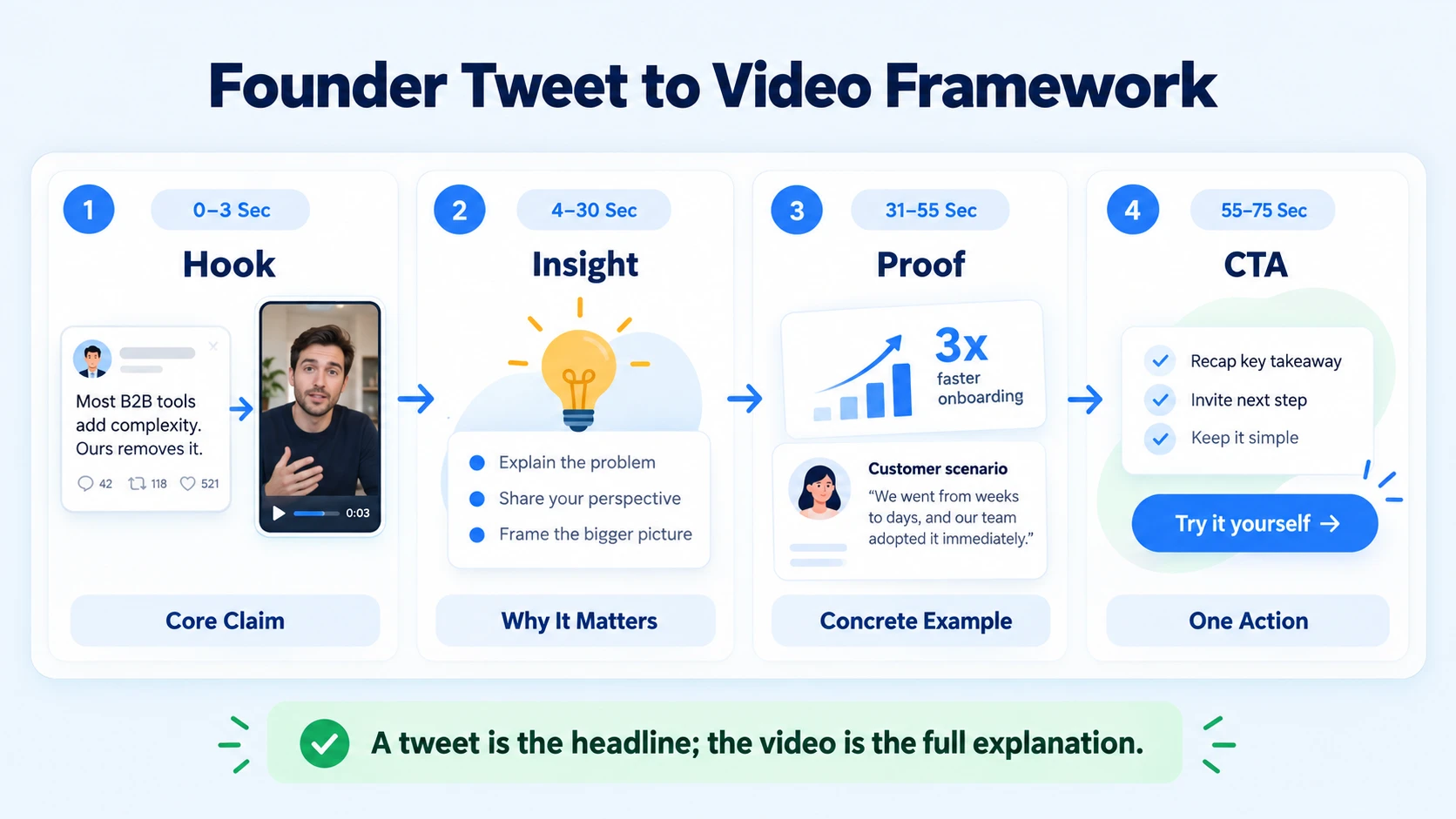
Every tweet that converts well into a video shares three traits: it makes a specific claim, it triggers a reaction ("I agree" or "no way"), and it contains an insight that requires explanation. That last point is the unlock. A tweet is a headline. A video is the article.
The four-part structure I use:
- Hook (0–3 seconds): Open with the tweet's core claim, spoken directly to camera. Do not wind up. Do not introduce yourself first. State the point: "Most SaaS demos lose the deal before the screen share even starts."
- Insight (4–30 seconds): Expand the "why" behind the claim. This is where the tweet's 280 characters become 150–200 spoken words. Use your product knowledge, category experience, or customer patterns.
- Proof (31–55 seconds): Ground the insight with a concrete example, a customer scenario, or a data point. Buyers in B2B need one specific anchor to trust a claim.
- CTA (55–75 seconds): Close with one action. Not "follow me for more." Something direct: "Comment 'DEMO' and I'll send you the framework we use with SaaS teams."
This structure works because it maps directly to how B2B SaaS, AI, and tech decision-makers process thought leadership content. They need the hook to stop scrolling, the insight to justify attention, the proof to believe it, and the CTA to act. Engagement is 29% higher on videos with subtitles , so caption every video from the start, not as an afterthought.
Which Tweets Are Worth Turning into Videos?
Not every tweet earns a video. Selecting the wrong one wastes your production time and dilutes your personal branding in the feed. Here is how to filter fast.
High-value tweet types for video:
- A contrarian take your buyers haven't heard before ("Your onboarding isn't broken, your demo is")
- A process reveal ("Here's the exact framework we used to cut our sales cycle by 30%")
- A specific data point that reframes a decision buyers are making right now
- A "mistake" post that names something your ICP is currently doing wrong
- A question tweet that generated strong reply volume, replies signal genuine buyer curiosity
Low-value tweet types (skip these):
- Engagement bait with no specific insight ("Hot take: most startups fail because of X")
- Company news that only your existing followers care about
- Tweets that are 100% platform-native humor with no educational value
A tweet that already generated discussion is a pre-validated script. If buyers argue about it on Twitter/X, they'll watch a video about it on LinkedIn. To audit your archive: sort by replies and quote tweets, not just likes. Replies signal disagreement or curiosity, both drive video watch time. Once you identify 8–10 strong candidates, you have a full month of short-form video content ready to script.
At Komet Media's content repurposing services, this selection step is where we spend more time than clients expect. Whether serving B2B SaaS, AI, or tech startups and teams, repurposing existing footage or starting from scratch with buyer research, scripting, and recording guidance ensures the right concept makes every downstream step easier.
How to Expand a Tweet into a Full Video Script
This is the step most founders skip or rush. A strong script is the difference between a video that stops the scroll and one that gets three seconds of attention. When you repurpose a founder tweet into a video, the script is the engine.
Step-by-step script expansion process:
- Copy the tweet into a blank document.
- Write three questions a skeptical buyer would ask after reading it. These become your Insight and Proof sections.
- Draft the Hook line, keep it to one sentence, 15 words or fewer, pulled directly from the tweet.
- Write the body at a conversational pace: 130–150 words per minute for on-camera delivery. A 60-second video needs roughly 130–160 words total.
- Write the CTA last. Match it to a pipeline action: demo request, DM reply, resource download, or comment prompt.
- Read the script aloud and cut anything that wouldn't survive a fast listener's attention.
Script length benchmarks by platform:
Keep the language exactly as conversational as the original tweet. The tweet earned the reaction because of its voice, preserving that in the script. Formal rewrites kill the energy that made the tweet work in the first place.
What Tools Can You Use to Turn Tweets into Videos?
Once the script is ready, you need tools for recording, editing, and distribution. The right stack depends on your production level and budget.
Recording:
- Smartphones on a tripod with a ring light handles 90% of founder talking-head video needs. Natural light from a window works as a free alternative.
- For a step up: a Sony ZV-E10 or similar mirrorless camera paired with a Rode VideoMicro reduces friction significantly.
Editing tools by skill level:
Distribution: Publish natively to each platform. Native uploads earn 38% more engagement than external links , so never post a YouTube link in your LinkedIn caption.
For captions specifically, CapCut's auto-caption feature is fast and accurate enough for most use cases. DaVinci Resolve gives you manual control if brand precision matters. Either way, captions are non-negotiable: roughly 80% of videos are watched without sound, while captioned videos hold viewers 32% longer.
For founders and marketing teams at B2B SaaS, AI, and tech startups who want this handled end-to-end—whether working from existing recordings or starting from scratch with research, scripting, recording guidance, and editing—Komet Media's short-form video editing service covers the full production lifecycle through platform-optimized delivery.
Can You Repurpose a Tweet into a YouTube Short, Reel, or LinkedIn Video?
Yes, and the same core asset can feed all three with minor adjustments. This is the real leverage behind deciding to repurpose a founder tweet into a video: one recording session, three to four distribution channels.
Platform-specific adjustments:
- LinkedIn Video: Keep the tone professional but direct. Open with business insight, not a trend hook. In Q4 of 2025, LinkedIn video uploads increased 20% year-over-year, and paid video ads on the platform grew 30% in the same period, buyers are watching here, and the algorithm is actively rewarding video creators.
- Instagram Reels: Hook within 2 seconds. Use on-screen text for the first line since most Reels autoplay silent. Energy should be slightly faster-paced than LinkedIn.
- TikTok: The most conversational delivery works best. Speaking directly to camera without cuts performs well for B2B SaaS, AI, and tech startup founder content.
- YouTube Shorts: Slightly longer at 50–60 seconds. You can afford one more proof point here. Add a pinned comment with your CTA link.
Video posts are shared 20x more often than other content types on LinkedIn , which means every piece of founder-led video has compounding organic reach built in. For teams running a podcast or webinar alongside their social content, the same tweet-to-video workflow applies to clipping those longer formats into platform-ready shorts.
The cross-platform checklist before posting:
- Confirm 9:16 vertical aspect ratio on mobile platforms.
- Verify captions render correctly on each platform's native player.
- Remove any outbound links from the video caption body (kills reach).
- Add a platform-specific engagement question to the caption text.
- Post natively, never use a scheduler that posts as a link redirect.
Founder Content Repurposing Strategy: Building a Repeatable Video System
One video from one tweet is a tactic. A documented system that converts your tweet archive into a rolling video library, that is a founder-led growth strategy. This is where most B2B SaaS, AI, and tech teams underinvest.
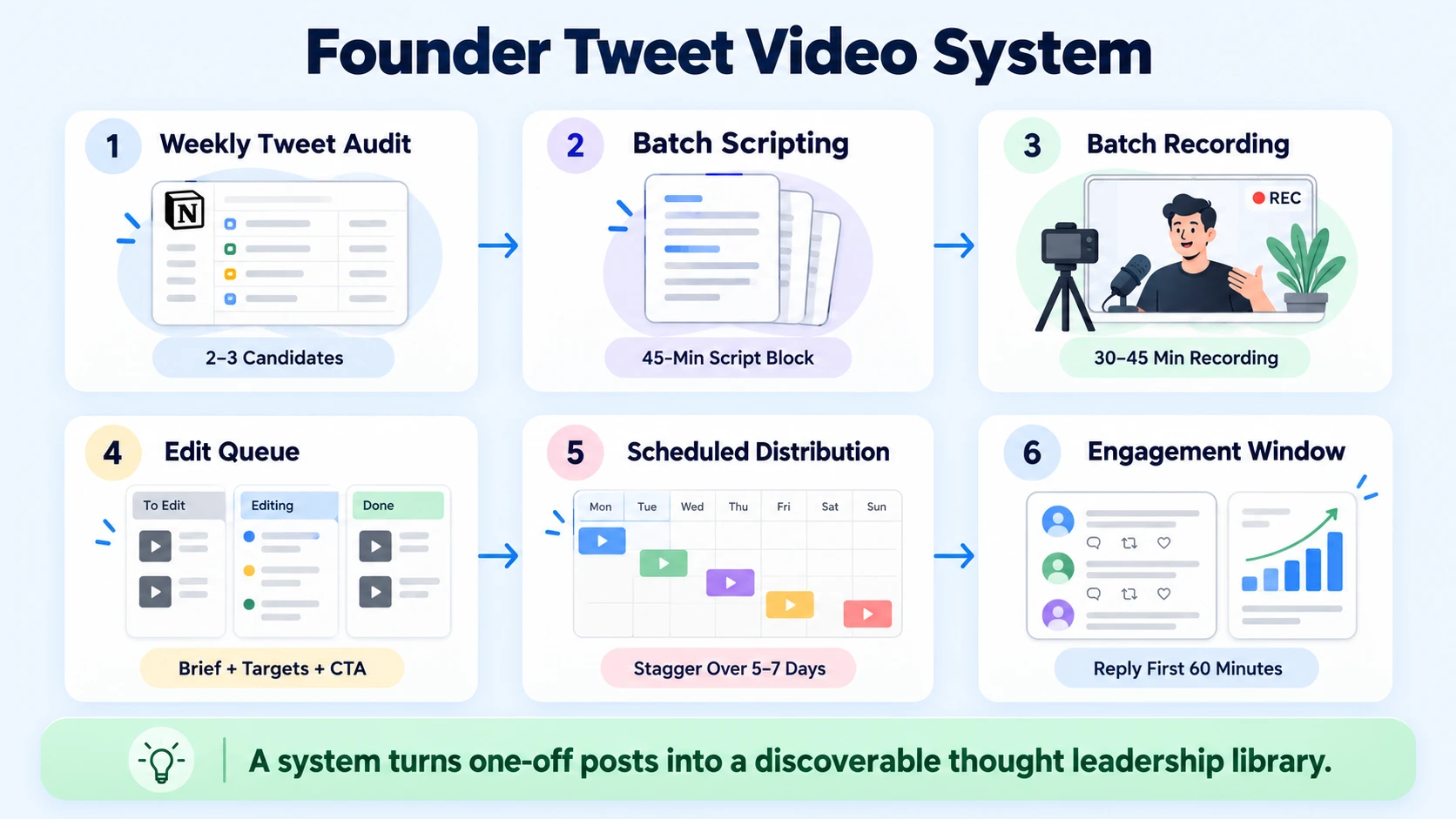
Here is how to build the system:
- Weekly tweet audit: Every Monday, tag 2–3 tweets from the prior week as "video candidates" using a simple Notion or Airtable tracker.
- Batch scripting: Write all three scripts in one 45-minute session. Batching cuts cognitive overhead and keeps your voice consistent across assets.
- Batch recording: Record all three videos in one sitting, same background, same lighting. This is your weekly production block, 30–45 minutes maximum.
- Edit queue: Send to editing (in-house or agency) with a one-line brief per video: platform targets, CTA, any B-roll or text overlay notes.
- Scheduled distribution: Stagger posts across platforms over 5–7 days. Do not post the same video to all platforms on the same day.
- Engagement window: Treat the first 60 minutes after posting as a live engagement window, not a passive wait. Reply to every comment. This signals the algorithm and extends reach.
Founders who maintain consistent LinkedIn presence with co-created content support see a 30% reduction in sales cycle length, as prospects come warm from following the founder's thought leadership.
Running this system consistently across a team means you need a reliable video marketing partner who understands B2B SaaS, AI, and tech content cadence, not just editing. The difference between a one-off post and a content engine is documentation and delegation.
A founder who posts three short videos per week from their tweet archive is building a searchable, discoverable body of thought leadership, while their competitors wait for the "right time" to start.
The 2026 Social Media Content Strategy Report found that 27% of users are most likely to interact with short-form video from brands , making this format the clearest lever for founders of B2B SaaS, AI, and tech startups who want inbound demand without paid acquisition.
Conclusion
When you repurpose a founder tweet into a video, you are not just recycling content. You are turning a single validated idea into a buyer education asset that works across every platform your buyers actually use. Here are the key takeaways:
- Select tweets with genuine insight: contrarian claims, process reveals, and buyer-pattern observations convert best.
- Use the Hook → Insight → Proof → CTA structure: every time, without exception.
- Caption everything, post natively, and engage in the first 60 minutes after publishing.
- Build the system, not just the video: weekly batching is what separates visible founders from invisible ones.
If your B2B SaaS, AI, or tech team is ready to build this pipeline at scale—whether repurposing existing footage or starting from scratch without an existing content library—Komet Media handles research, scripting, recording guidance, and end-to-end production while you focus on high-level strategy.
Frequently Asked Questions
Q1: How long should a video be when I repurpose a founder tweet?
Aim for 45–75 seconds for LinkedIn and 30–60 seconds for TikTok, Reels, and YouTube Shorts. The tweet's core insight drives a tighter script, most founder tweets convert best at 60 seconds, which gives you enough time for the Hook, Insight, Proof, and CTA without losing viewer attention.
Q2: Do I need professional video equipment to repurpose a tweet into a video?
No. A smartphone on a tripod with good natural light produces more than enough quality for short-form video. Buyers respond to clarity of insight and delivery confidence, not cinematic production. If starting from scratch without existing recordings, Komet Media provides recording guidance, scripting, and post-production to build your video library seamlessly.
Q3: What is the best app to convert tweets to video format quickly?
CapCut handles the fastest end-to-end workflow: record, auto-caption, trim, and export in under 15 minutes. For brand-controlled output with more visual precision, DaVinci Resolve gives full editing control at no cost. Use CapCut for speed, DaVinci Resolve when brand standards require it.
Q4: Can I repurpose the same video to LinkedIn, TikTok, Reels, and YouTube Shorts?
Yes, with minor platform adjustments. The core talking-head asset stays the same. Adjust caption tone slightly per platform, add a platform-specific engagement question, and always upload natively. Never cross-post via a third-party link, native uploads consistently outperform redirected posts on every major platform.
Q5: How many videos can I produce per month from my tweet archive?
A founder who tweets 3–5 times per week can realistically produce 8–12 short-form videos per month using the batching system in this guide. Prioritize quality of selection over volume, two high-signal videos per week outperform five generic ones every time.
Q6: How does repurposing tweets into videos support B2B pipeline, not just reach?
Video builds buyer familiarity before a sales conversation starts. When a prospect from a target B2B SaaS, AI, or tech buyer account has watched 10 founder videos on a product problem they recognize, they arrive at the demo already convinced of the founder's credibility. That pre-sold trust compresses the sales cycle and reduces the objection load on your sales team, which is the exact outcome founder-led growth is designed to produce.