
🪄 AI Summary
Heading 1
Heading 2
Heading 3
Heading 4
Heading 5
Heading 6
Lorem ipsum dolor sit amet, consectetur adipiscing elit, sed do eiusmod tempor incididunt ut labore et dolore magna aliqua. Ut enim ad minim veniam, quis nostrud exercitation ullamco laboris nisi ut aliquip ex ea commodo consequat. Duis aute irure dolor in reprehenderit in voluptate velit esse cillum dolore eu fugiat nulla pariatur.
Block quote
Ordered list
- Item 1
- Item 2
- Item 3
Unordered list
- Item A
- Item B
- Item C
Bold text
Emphasis
Superscript
Subscript
Most B2B teams pour everything into launch day, then watch momentum collapse within a week. Firms with post-launch support strategies retain 25% more customers than those without dedicated post-launch programs. The problem is not the product. It is the absence of a system designed to keep product launches alive in the market long after the announcement email goes out. This guide covers exactly how to build that system, from repurposing launch assets into evergreen content to activating email nurture sequences that sustain pipeline for months.
TL;DR
- Launch day is the starting line, not the finish line. Post-launch strategy determines whether momentum compounds or dies.
- Short-form video, repurposed assets, and email nurture sequences are the highest-ROI tools for extending a launch.
- Social proof and community-building convert launch-day awareness into long-term customers.
- Treat every post-launch week as a "mini-launch" with a dedicated content push.
Why Do Product Launches Lose Momentum So Quickly?
Most launch plans are built backwards. The team optimizes for day-one attention and treats everything after as an afterthought. 80% of product launches require significant changes after the initial rollout due to market disruptions and evolving customer needs. But very few teams build the content infrastructure to communicate those changes, capture new buyer interest, or reinforce the initial message after the launch window closes.
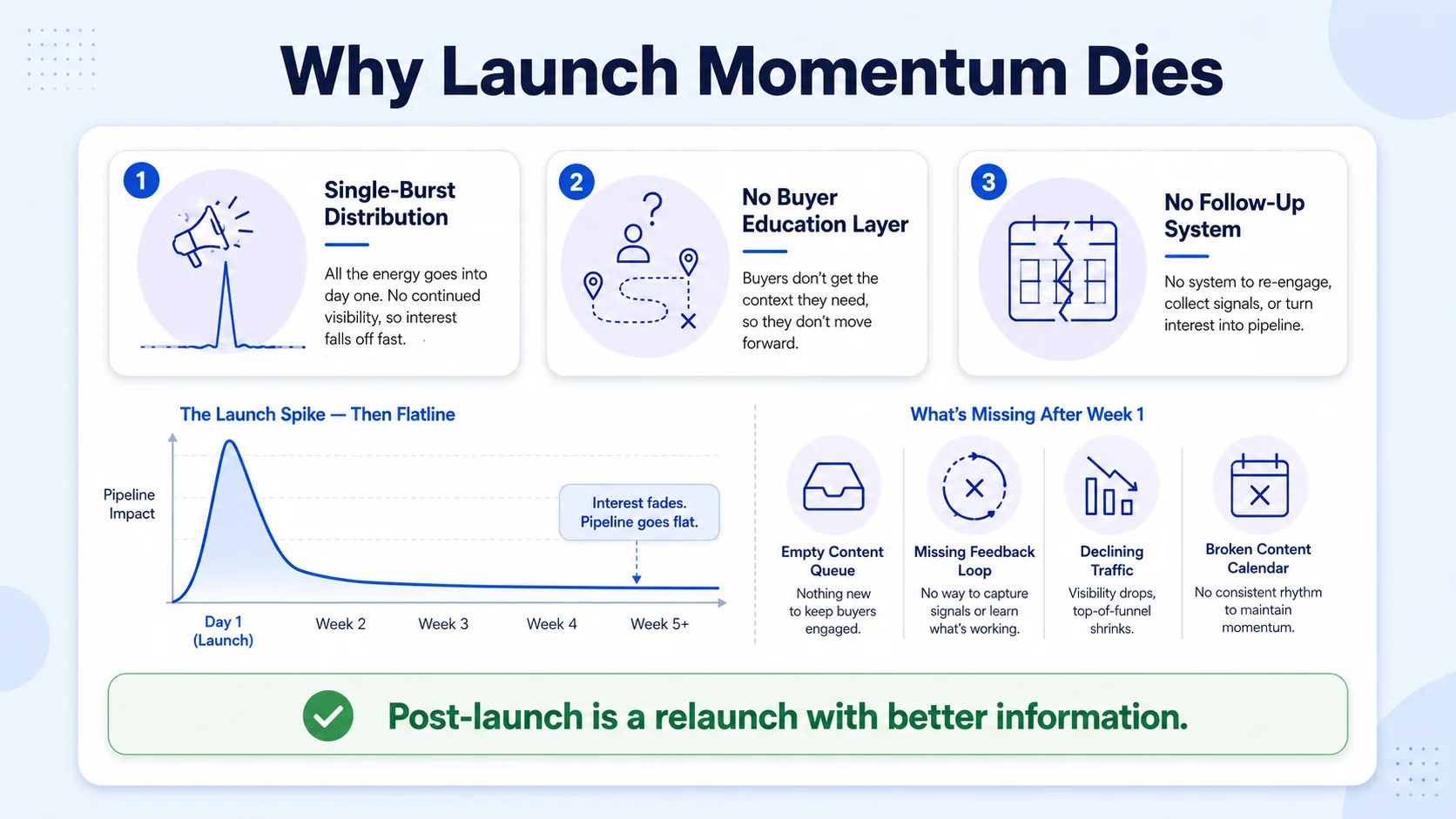
There are three structural reasons momentum dies fast:
- Single-burst distribution: All content drops at once, leaving nothing in the pipeline for weeks two through eight.
- No buyer education layer: The announcement reaches cold audiences who were not ready to act on day one and have no reason to return.
- Absent follow-up system: Over 40% of companies do not collect feedback from end users, creating significant blind spots in both pre-launch validation and post-launch iteration. Without feedback loops, teams cannot create the follow-on content that pulls hesitant buyers forward.
The fix is not more budget. It is a structured post-launch content strategy that treats the launch as the opening chapter, not the full story. Post-launch is not a wrap-up. It is a relaunch with better information. The brands that sustain buzz are the ones who treat the weeks following launch with the same intensity as launch day itself, watching early signals, listening to buyers, and publishing content that answers the questions buyers are actually asking.
Teams that plan their post-launch content calendar before launch day ship the asset that most teams never build: momentum infrastructure. For SaaS founders and marketing heads, this mindset shift is the most important one to make before the next launch cycle begins.
How to Turn Launch Day Traffic Into Long-Term Customers
Launch-day traffic is the warmest audience you will ever have. Most teams let it go cold. The conversion play is to move visitors from awareness into a structured nurture path before they forget you exist.
Here is the sequence that works:
- Tag and segment launch-day visitors by source, content consumed, and product page depth. These segments determine which nurture track each contact enters.
- Deploy a post-launch email nurture sequence within 24 hours. Automated launch emails have a 42% higher open rate than standard marketing emails, making this the single highest-leverage follow-up channel in your arsenal.
- Gate a high-value asset created from launch content, such as a recorded demo, a product teardown video, or a founder-narrated walkthrough. Collect the email in exchange and fire the contact into your lifecycle marketing flow.
- Run a retargeting campaign targeting everyone who visited the launch page but did not convert. Use short-form video ads on Instagram Reels, YouTube Shorts, or LinkedIn to maintain omnichannel distribution and keep the product top of mind.
- Book a post-launch webinar for week three. Frame it as a deep dive or Q&A. Live and virtual formats are becoming powerful B2B demand channels, enabling direct engagement, education, and relationship-building with professional audiences, supporting long sales cycles by building credibility and trust.
- Activate the sales team with video snippets pulled from your launch content. Reps can share 60-second product explainers in outbound sequences, turning the launch into a sales enablement asset.
Video on landing pages increases conversions by 86%. Landing pages with embedded video convert at 86% higher rates than text-only equivalents. Embedding your product walkthrough video on the post-launch landing page is one of the simplest conversion lifts available to any SaaS team.
Content Repurposing Strategy: How to Extend the Lifecycle of Your Launch Campaign
Every hour of launch content, your webinar, your demo, your founder announcement, is a content repurposing opportunity that most teams ignore. At Komet Media, this is where we spend most of our attention for clients running product launches.
One launch asset should produce a minimum of 10 derivative pieces:
This is the content calendar engine. Rather than publishing once and going dark, each source asset feeds weeks of scheduled posts across every channel where your buyers spend time. Short-form video is now the most leveraged content format and the highest ROI channel. In 2025, 104% more marketers named it their most valuable channel compared to 2024, and it is where investment is growing fastest for 2026.
For SaaS teams running product launches, this means slicing your demo into 30–60 second clips and distributing them through our short-form video editing workflow consistently for six to eight weeks post-launch. Volume and consistency beat a single polished post every time. The best B2B video marketing strategies create videos at multiple lengths: a 15-second social hook, a 60-second overview, and a full long-form video for interested prospects.
Post-Launch Marketing Strategies That Actually Work: Social Proof and Community Building
Buyer trust does not form on launch day. It forms in the weeks after, when real users share real results. 83% of customers prefer reading content to learn about new products before purchasing. After the announcement, your buyers are actively searching for evidence that the product delivers. Social proof is your most important conversion asset in this phase.
Social proof tactics that sustain brand momentum:
- Customer outcome clips: Short videos where a real user describes a specific result, a number, a time saved, a problem solved. These are the highest-converting assets in any post-launch distribution plan.
- User-generated content: Encourage beta users and early adopters to post their experience. Early adopters influence 22% of post-launch product purchases, making their authentic content far more valuable than any produced ad.
- Case study drip: Release one detailed case study every two weeks post-launch. Each one answers a different objection and targets a different buyer segment.
- Influencer amplification: 55% of B2B marketers are partnering with creators, subject-matter experts, and industry voices, signalling a shift away from generic brand messaging towards credible, human-led storytelling. Founder-led thought leadership posts on LinkedIn are the B2B version of influencer amplification.
Community building is the compounding play. The goal is to create a space, whether a Slack community, a LinkedIn group, or a live event series, where your product becomes the context for ongoing conversation. Buyers who are already in community with your brand are substantially more likely to convert, expand, and refer. Our events and webinar formats at Komet Media are specifically designed to create these community touchpoints around product launches and ongoing campaigns.
Product Launch Momentum Strategies: Omnichannel Distribution and the Content Calendar
The single most common post-launch failure I see is teams going quiet on social media within 10 days of launch. The algorithm does not care about your launch date. Sustained posting frequency is what drives audience retention and organic reach.
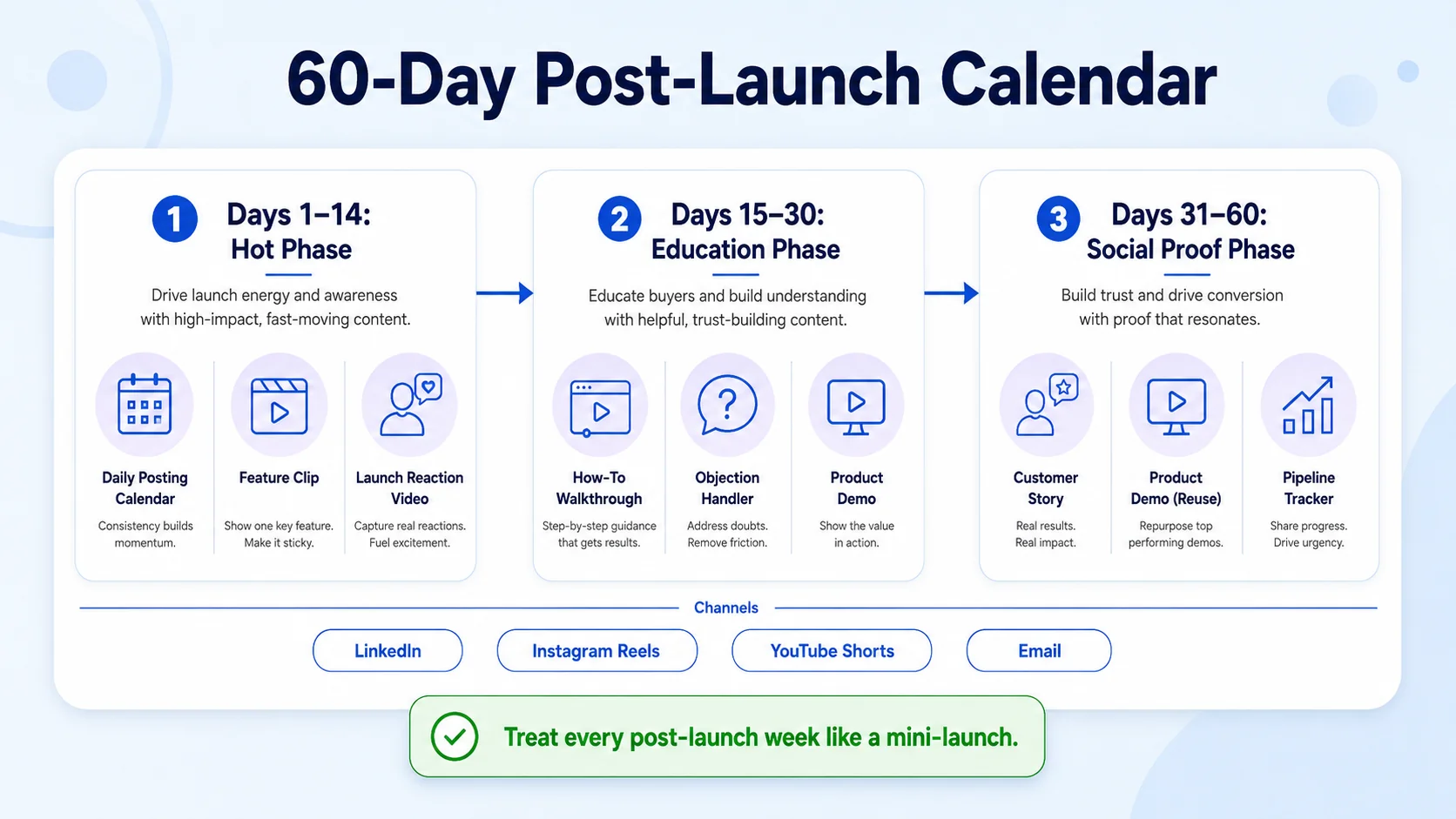
A 60-day post-launch content calendar should follow this structure:
- Days 1–14 (Hot phase): Daily posting across LinkedIn, Instagram Reels, and YouTube Shorts. Content mix: product feature highlights, launch reaction clips, early customer quotes, founder commentary.
- Days 15–30 (Education phase): Three to four posts per week. Content mix: how-to clips, use-case walkthroughs, objection-handling videos, comparison content. Push to video marketing channels at full volume.
- Days 31–60 (Social proof phase): Two to three posts per week. Content mix: customer outcome stories, UGC reposts, deep-dive product demos, thought leadership from the founding team.
TikTok has 1.6 billion users, YouTube Shorts sees 200 billion daily views, Instagram has 3 billion monthly users spending 50% of in-app time on Reels, and LinkedIn video views grew 36%. For SaaS teams running product launches, this is where your repurposed clips from the launch event deliver the highest reach per dollar spent. TikTok Marketing and Instagram Reels are not optional channels for reaching the next generation of B2B buyers. Buyers spend only 17% of their total buying time meeting with potential suppliers. The rest is spent on independent digital research, which means your video content and repurposed assets are doing sales work 83% of the time, whether or not you have a rep in the room.
Product Launch Follow-Up Tactics Most Teams Forget
These are the high-leverage moves that fall off most post-launch to-do lists:
- Activate your podcast as a launch channel. Your podcast production or guest appearances in the weeks post-launch are one of the most underused touchpoints in B2B. A 30-minute conversation about what problem the product solves and why now reaches buyers in a high-trust, distraction-free format. Clip it into short-form for social distribution.
- Run an email nurture sequence built around buyer objections. Most post-launch emails announce. The best ones educate. Map your five most common sales objections and build one email per objection, releasing them weekly over five weeks.
- Educational content series complement social proof by positioning brands as trusted authorities rather than mere vendors. HubSpot's educational email sequences have become the industry standard, moving marketing away from aggressive sales pitches toward value-driven content that guides prospects through the buyer's journey.
- Build a comparison or battle card asset. Buyers are actively comparing you to alternatives post-launch. A short video or page that directly addresses the comparison question, without being defensive, wins the consideration-stage buyer.
- Repurpose the launch webinar into an evergreen marketing asset. Edit it into a structured replay with chapters, key moment timestamps, and a clear CTA. Evergreen marketing means the webinar continues driving demo demand for six months after the event date, not just the 200 people who attended live. Check our webinar format at Komet Media for how we structure these for maximum post-event lifespan.
- Measure and iterate fast. Post-launch, track both leading indicators such as sign-ups and activation rates, and lagging indicators such as retention and revenue. Kill underperforming tactics quickly, double down on winners, and refresh the strategy narrative regularly.
Conclusion
Product launches do not fail because the product is wrong. They fail because the marketing system stops running. Here is what to lock in:
- Build your post-launch content calendar before launch day, not after the adrenaline wears off.
- Repurpose every launch asset into short-form video, email content, and social proof clips.
- Use email nurture sequences and community touchpoints to convert launch-day interest into pipeline over 30–60 days.
- Measure weekly, adjust fast, and treat every Thursday post-launch as a new opportunity to re-engage your audience.
The brands that win with product launches are the ones that treat day one as the opening move. Start building the post-launch system now at Komet Media.
Frequently Asked Questions
Q1: How long should post-launch marketing run after a product launch?
A minimum of 60 days. The first two weeks are the hot window for awareness. Days 15–30 should focus on buyer education through video and email. Days 31–60 shift to social proof and conversion content. Beyond 60 days, high-performing evergreen marketing assets from the launch should continue working passively.
Q2: What type of content performs best for sustaining product launch momentum?
Short-form video consistently outperforms all other formats for attention and reach. 78% of B2B marketers already use video, and over 50% plan to increase investment. Short-form video now delivers the strongest results for attention, recall, and re-engagement. Pair it with email nurture sequences for the best pipeline results.
Q3: How do we repurpose a launch webinar into ongoing content?
Edit the full recording into eight to twelve short clips organized by topic, a blog post from the transcript, an email sequence based on key takeaways, and a highlight reel for social. One 60-minute webinar should generate four to six weeks of scheduled content across your channels. Our video editing services handle exactly this workflow.
Q4: Should the founder be personally involved in post-launch content?
Yes, especially in B2B SaaS. Modern buying committees shape opinions early through short video, expert voices, and trusted content ecosystems long before they speak to a vendor. Founder-led LinkedIn clips and thought leadership posts are the highest-trust format available for reaching decision-makers.
Q5: What metrics should we track to measure post-launch marketing success?
Track demo requests, email open and click rates, video view-through rates, retargeting conversion rates, and inbound pipeline created within 60 days of launch. The product team must define the KPIs for the product launch and decide which metrics matter to gauge success. These metrics often include the number of users, retention rates, adoption rates, and active usage measurements.
Q6: How does content repurposing directly support the post-launch pipeline for SaaS?
Repurposed assets keep your product visible to buyers who were not ready on launch day. 70% of B2B buyers engage with video content during their purchasing journey. This highlights how critical video is throughout the B2B sales funnel, not just at the top. Each touchpoint builds the familiarity and trust that eventually converts a warm lead into a demo request.