
🪄 AI Summary
Heading 1
Heading 2
Heading 3
Heading 4
Heading 5
Heading 6
Lorem ipsum dolor sit amet, consectetur adipiscing elit, sed do eiusmod tempor incididunt ut labore et dolore magna aliqua. Ut enim ad minim veniam, quis nostrud exercitation ullamco laboris nisi ut aliquip ex ea commodo consequat. Duis aute irure dolor in reprehenderit in voluptate velit esse cillum dolore eu fugiat nulla pariatur.
Block quote
Ordered list
- Item 1
- Item 2
- Item 3
Unordered list
- Item A
- Item B
- Item C
Bold text
Emphasis
Superscript
Subscript
HR buyers are skeptical, committee-driven, and overwhelmed with vendor noise. For HR tech founders and marketing teams, that means written content alone won't move the pipeline. Video marketing for HR tech companies is how you collapse the trust gap, educate complex buying committees, and give buyers enough confidence to book a demo. This guide gives you the strategies, formats, and execution frameworks that actually drive results in 2026.
TL;DR
- Video is the highest-ROI format for HR tech SaaS, cutting through buyer fatigue faster than blog posts or whitepapers.
- Short-form video, explainer clips, and founder-led content are the three formats HR tech teams should prioritize now.
- LinkedIn video ads and YouTube SEO are the two highest-leverage distribution channels for reaching CHRO, VP People, and HR ops buyers.
- Repurposing webinars, demos, and podcast episodes into short clips is the most efficient way to build a video content library.
Why Video Marketing for HR Tech Companies Is Non-Negotiable in 2026
49% of marketers say short-form video delivers the best ROI of any format, and 91% of businesses now use video as a marketing tool. But in HR tech, the argument for video goes beyond general adoption numbers.
HR software is complex. Products like applicant tracking systems, ATS platforms, Workday integrations, and human capital management tools are difficult to explain in a paragraph. Buyers need to see the software work before they'll commit calendar time to a sales call. Video bridges that gap in a way written content cannot. The global HR tech market hit $42.5 billion in 2025, but buyer fatigue among CHROs and VP People roles has never been higher. HR tech purchases involve an average of 8+ stakeholders across HR, IT, Finance, and Legal.
A single blog post reaches one reader. A short video can be shared across a buying committee in a Slack message. 91% of SaaS businesses now use video as part of their marketing strategy, and video content delivers ROI 49% faster than text. For funded AI and HR tech startups under pressure to demonstrate pipeline momentum, that speed matters.
The core use case for video marketing for HR tech companies isn't brand awareness. It's buyer education. HR practitioners want to know: does this product solve my specific problem? Can I show this to my CFO and get budget approved? Video answers both questions faster than any other format. Explore Komet Media's video marketing services to see how we build these content systems for B2B SaaS teams.
Video Marketing Strategies for HR Tech Companies That Move Pipeline
The highest-performing HR tech video strategies are built around one principle: educate the buyer before the sales conversation happens. Here's how serious teams execute this.

Founder-led video content: HR buyers trust people more than brands. When your CEO or Head of Product shows up on LinkedIn explaining a compliance challenge or a hiring ops problem, it builds credibility that no ad campaign replicates. Thought-leadership posts see 2–3x higher engagement than standard brand posts and attract higher-intent leads, especially in niche or high-ticket markets like SaaS.
Webinar repurposing: Most HR tech teams run webinars and let the recording collect dust. That's a waste. Repurpose everything: clips for LinkedIn, transcript for an SEO blog, slides as a follow-up asset in cold outreach sequences. A single 45-minute webinar can generate 8–12 short-form clips, each targeting a different HR buyer persona.
Podcast-to-video: If your team hosts or guests on HR-focused podcasts, those conversations contain dense product positioning and thought leadership. Pulling the best 60-second segments into captioned vertical clips is one of the fastest ways to build a video library. See how Komet Media handles podcast editing and production as part of a broader content repurposing system.
Customer testimonial videos: HR buyers are deeply peer-influenced. They want to see themselves in your customer stories: same industry, same employee count range, same pain point. A two-minute CHRO testimonial on LinkedIn carries more weight than a written case study during late-stage deal cycles.
Product snapshot clips: 30–60 second clips showing one specific workflow, one outcome, one feature in context. Not feature tours. Outcome demonstrations. Each clip answers one buyer question. The underlying infrastructure is a content repurposing system, not a one-off production calendar. Teams that treat every long-form asset as a video source outproduce competitors that commission custom content each time.
How to Use Video Content to Generate Leads for HR Software
Video without a lead generation mechanism is content marketing without a destination. Here's how to wire video directly into your HR tech demand generation engine.
Gated demo videos via Vidyard or Wistia: Embed a short product walkthrough behind a lead form on your website. Serious buyers who want to see the product before booking a call will trade their email. Tools like Vidyard and Wistia also give you viewing analytics, so your sales team knows who watched, how much, and which sections they replayed.
LinkedIn video retargeting: LinkedIn's matched audiences feature lets you create audiences based on video engagement. You can target people who watched 25%, 50%, 75%, or 97% of your videos. This creates engagement-based audiences where people who watched significant portions demonstrated interest and are more likely to convert. Show your product demo ad to people who already watched your employer branding explainer. The sequence is warmer and cheaper than cold targeting.
YouTube SEO for bottom-funnel queries: HR ops leaders search for "how to automate onboarding" or "best ATS for mid-market companies" on YouTube, not just Google. A 3–5 minute walkthrough video optimized for those queries puts your product in front of an active evaluation audience with no paid spend. That's B2B content marketing that compounds.
Webinar-to-demo conversion: Attendee-to-meeting conversion for engaged webinar participants runs 15–25% within 48 hours of the event. Use video clips from past webinars as the hook to register for the next one, then convert that webinar audience into demo requests. Komet Media's webinar repurposing service is built exactly for this pipeline motion.
Video in sales sequences: A Loom walkthrough sent to a prospect who downloaded your pricing page performs differently than a templated email. It's personal, it's visual, and it directly addresses their specific use case.
A two-page written case study works for email nurture and sales enablement, but a two-minute video testimonial from a CHRO or VP of People carries weight on LinkedIn and in late-stage deal cycles.
What Types of Videos Work Best for HR Tech SaaS Companies
Not every video format serves every stage of the talent acquisition funnel or the buyer journey. Here's the format map:
Product demo and feature deep-dive videos follow one golden rule: show, don't tell. These videos let prospects see your software in action and typically showcase real workflows and solutions to problems.
For HR tech specifically, the formats with the highest leverage are explainer videos (for complex concepts like AI-driven candidate scoring or compliance automation) and customer testimonials (for peer validation). Employer branding videos also matter for HR tech companies that sell into companies with active recruiting challenges: showing that your platform improves the employee value proposition gives HR leaders a business case that extends beyond software features.
73% of B2B marketers say their highest-quality leads come from webinars, which makes recorded webinar content one of the highest-ROI video assets HR tech teams can build. Every webinar is essentially a product education session that can be repackaged indefinitely.
How to Create Explainer Videos for HR Technology Products
HR tech products carry inherent complexity. ATS workflows, payroll integrations, compliance modules, and human capital management dashboards are not self-explanatory. Explainer videos close that comprehension gap in under two minutes.
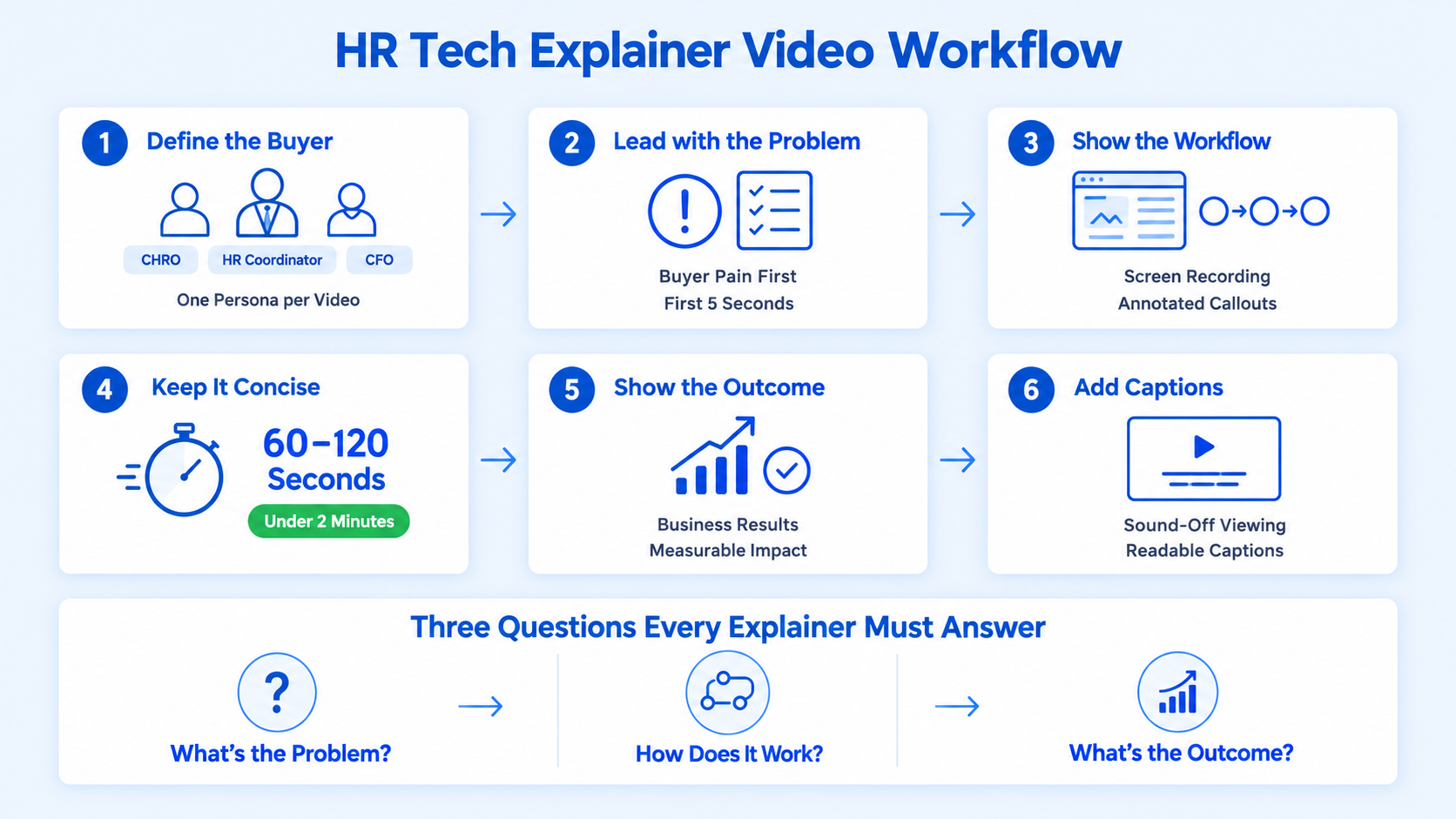
Here's the production process we use at Komet Media for HR tech explainer videos:
- Define one buyer persona per video: An explainer for a CHRO looks different from one for an HR coordinator or a CFO approving budget. Separate personas need separate hooks and outcome framing.
- Open with the problem, not the product: Name the pain in the first 5 seconds. "Manual onboarding takes 12 hours per new hire and half of it is avoidable" hits harder than "Introducing [Product Name]."
- Show the workflow, not just the feature: Screen recordings with annotated callouts showing a complete workflow (application to offer letters, for example) make the product tangible.
- Keep it under 2 minutes: Most effective SaaS product demo videos are concise, typically ranging from 60 to 120 seconds. HR buyers won't watch a 5-minute feature tour from a vendor they don't know yet.
- Script the outcome, not the software: End on a business result: "Teams using [Product] cut time-to-hire by 40%" beats "and that's the end of our workflow tour."
- Add captions: Most LinkedIn videos are watched without sound. Captions are non-negotiable for HR decision makers scrolling their feed between meetings.
A strong HR tech explainer video answers three questions in under 90 seconds: What's the problem? How does the product solve it? What does life look like after?
Komet Media's short-form video editing service produces these explainer assets as part of a scalable content system, not one-off productions.
How to Use LinkedIn Video Ads to Reach HR Decision Makers
LinkedIn is the only paid channel where HR tech teams can simultaneously target by job title (VP People, CHRO, HR Operations), seniority, company size, and industry, reaching decision makers while they're in a professional context. 71% of decision makers are now Gen Z and Millennials, and these audiences prefer video. 78% of B2B marketers are already using video, and 56% will increase their use of it in 2026. Paid video ads on LinkedIn grew 30% year over year, while video represented 31.72% of total LinkedIn ad budgets.
Here's the campaign architecture that works for HR tech video ads on LinkedIn:
- Top-of-funnel awareness: Run 30–60 second thought leadership clips from your founder or head of product. Target CHROs, VPs of People, and HR Directors at companies with 200–2,000 employees. Objective: Video Views.
- Mid-funnel retargeting: Retarget users who watched 50%+ of your awareness video with a product explainer or customer testimonial. Objective: Website Visits or Lead Gen Form.
- Bottom-funnel conversion: Serve a personalized demo invitation to your warmest video viewers. Short-form video (15–30 seconds) performs best for awareness, while longer formats (60–90 seconds) work for product demonstrations and case studies when targeting known, engaged audiences.
For creativity, lead with the problem your buyer is living inside. HR ops leaders scrolling LinkedIn at 8am aren't looking for software. They're looking for validation that someone else understands their hiring backlog, their compliance headache, or their onboarding failure rate. Match that energy before you show a single screen recording.
Pair LinkedIn video ads with Komet Media's video advertising services for a managed paid video system that doesn't require your in-house team to operate it.
The ROI of Video Marketing for HR Tech Startups vs Written Content
The debate between video and written content is a false choice for mature HR tech teams, but the ROI comparison informs where to invest first.
Video content CPL is $0.75 per qualified lead, versus $4.50 for PPC clicks. For HR tech teams spending heavily on paid search to capture "best ATS" or "HR software" queries, that efficiency gap is hard to ignore. Wyzowl's 2026 survey found 82% of video marketers say video has given them a good ROI. Short-form video remains the highest-ROI format for 49% of marketers, per HubSpot.
Written content still wins for SEO authority and long-tail demand capture. But for HR tech companies where the product is complex and the buying committee is large, video accelerates what written content can only initiate. A blog post gets someone to the website. A founder-led video clip on LinkedIn gets them to forward a demo link to their CHRO.
The sharpest SaaS marketing strategy in HR tech combines both: use written content for organic search traffic, video for trust-building and buyer education, and repurposing to make both engines feed each other. Video on landing pages increases conversions by 86%, with the effect strongest for complex products and services where video reduces cognitive load.
Conclusion
- Video marketing for HR tech companies works because it educates complex buying committees faster than any written format, builds trust with peer-influenced HR buyers, and creates reusable sales assets that compound over time.
- The highest-leverage move for most HR tech SaaS teams in 2026 is repurposing existing content (webinars, demos, podcasts) into short-form video rather than commissioning net-new productions.
- LinkedIn video ads with a retargeting architecture and YouTube SEO for evaluation-stage queries are the two distribution channels with the clearest ROI.
- If you're a funded HR tech startup without a systematic video content operation, the gap between you and competitors who do have one is widening every quarter.
Talk to Komet Media about building a video content system for your HR tech team.
Frequently Asked Questions
Q1: How long should an HR tech explainer video be?
Keep it between 60 and 120 seconds for top-of-funnel and mid-funnel explainers. For product demo videos targeting buyers already in evaluation, 2–4 minutes is acceptable. Anything longer requires an established relationship with the viewer before they'll commit the time.
Q2: What's the best video format for HR tech SaaS buyer education?
Customer testimonials and product walkthrough videos perform best for buyer education at the mid-to-late funnel stages. Founder-led thought leadership clips on LinkedIn are most effective for early awareness among HR decision makers who don't yet know your brand.
Q3: Should HR tech companies use Wistia or Vidyard for video hosting?
Both are strong choices for B2B video marketing. Wistia offers superior analytics for engagement tracking and brand control on your website. Vidyard integrates more deeply with CRM and sales tools, making it better for sales enablement use cases like personalized Loom-style outreach and deal-stage video sequences.
Q4: How many LinkedIn video ads should an HR tech startup run at once?
Run 2–3 creative variations per campaign objective, testing different hooks, problem framings, and CTAs. Rotate based on view-through rate and cost per video view. Avoid running a single creative for more than 4–6 weeks before refreshing, as LinkedIn audiences in narrow HR buyer segments saturate quickly.
Q5: Can short-form video work for complex HR software products?
Yes, when scoped correctly. Each short-form clip should answer exactly one question or demonstrate exactly one outcome. A 60-second clip showing how your onboarding module cuts new-hire time-to-productivity is more effective than a 60-second clip trying to explain your entire platform.
Q6: What's the first video asset an HR tech startup should produce?
A 90-second product explainer that opens with the buyer's core pain point, shows the key workflow solving it, and ends with a clear CTA to book a demo. This asset works on your homepage, in LinkedIn ads, in cold email sequences, and in sales follow-up. It's the single highest-leverage video investment at the early stage.