
🪄 AI Summary
Heading 1
Heading 2
Heading 3
Heading 4
Heading 5
Heading 6
Lorem ipsum dolor sit amet, consectetur adipiscing elit, sed do eiusmod tempor incididunt ut labore et dolore magna aliqua. Ut enim ad minim veniam, quis nostrud exercitation ullamco laboris nisi ut aliquip ex ea commodo consequat. Duis aute irure dolor in reprehenderit in voluptate velit esse cillum dolore eu fugiat nulla pariatur.
Block quote
Ordered list
- Item 1
- Item 2
- Item 3
Unordered list
- Item A
- Item B
- Item C
Bold text
Emphasis
Superscript
Subscript
If you run content for a SaaS brand, this question comes up constantly: should we build on long-form YouTube or invest in short-form clips? The answer shapes your production workflow, your pipeline contribution, and how fast buyers actually trust you. In 2026, the data is clearer than it's ever been. Long-Form YouTube vs Short-Form Clips serve different jobs in your video marketing funnel, and choosing only one leaves serious revenue and reach on the table. Here's exactly how to think about it.
TL;DR
- Short-form clips win on discovery speed; long-form wins on revenue, trust, and search.
- Channels combining Shorts and long-form grow 41% faster than single-format channels.
- For B2B and SaaS teams, long-form educates buyers; short-form earns the first click.
- The smartest content repurposing strategy turns every long-form asset into multiple clips.
Long-Form YouTube vs Short-Form Clips: Which Is Better in 2026?
There is no universal winner. The "better" format depends entirely on what you need the video to do. Here is a direct comparison of what each format actually delivers:
YouTube Shorts generate RPM between $0.03 and $0.08 per 1,000 views in 2026, while long-form videos in the same niches generate RPM between $1 and $10, a gap of roughly 20 to 30 times. That gap alone tells you something critical about what each format is built for. Shorts are a strong discovery engine, but long-form still wins for watch time, search, and revenue stability.
For B2B SaaS teams, where a single closed deal can be worth tens of thousands of dollars, long-form's ability to educate buyers and build product trust before a demo request is the higher-value outcome. Short-form clips are the handshake. Long-form is the full sales conversation. For B2B SaaS, long-form YouTube functions as an always-on sales asset. A 15-minute product walkthrough works in your pipeline 24/7. A 60-second clip earns the click that starts the journey.
The practical answer: use both, but know which one you're asking to do what job.
How Has the YouTube Algorithm Changed for Short vs Long Content in 2026?
The single biggest algorithm shift of the past 12 months is the formal separation of the two recommendation engines. As of late 2025, YouTube fully separated the Shorts recommendation engine from long-form. Shorts are ranked based on swipe-through rate, loop rate, shares, and engagement within the first few seconds.
What this means practically:
- Poor Shorts performance no longer drags down long-form recommendations.
- New Shorts retention thresholds, around 65% for sub-30-second Shorts and 50% for 30–60 second Shorts, decide whether you get pushed wider.
- Session contribution, how much your video extends the average YouTube session, is now the leading signal for long-form ranking, which is why playlists and series formats outperform single-shot uploads.
For long-form, the YouTube Watch Time Algorithm has also evolved. In February 2026, YouTube rolled out a Browse feed overhaul that switched personalization from broad topic categories to viewer watch history clusters, and the platform publicly confirmed that viewer satisfaction surveys now carry more weight than raw watch time.
The shift from watch time to satisfaction means you should focus on delivering value efficiently. A viewer who watches 100% of an 8-minute video and clicks "like" sends a stronger signal than a viewer who watches 40% of a 25-minute video and leaves.
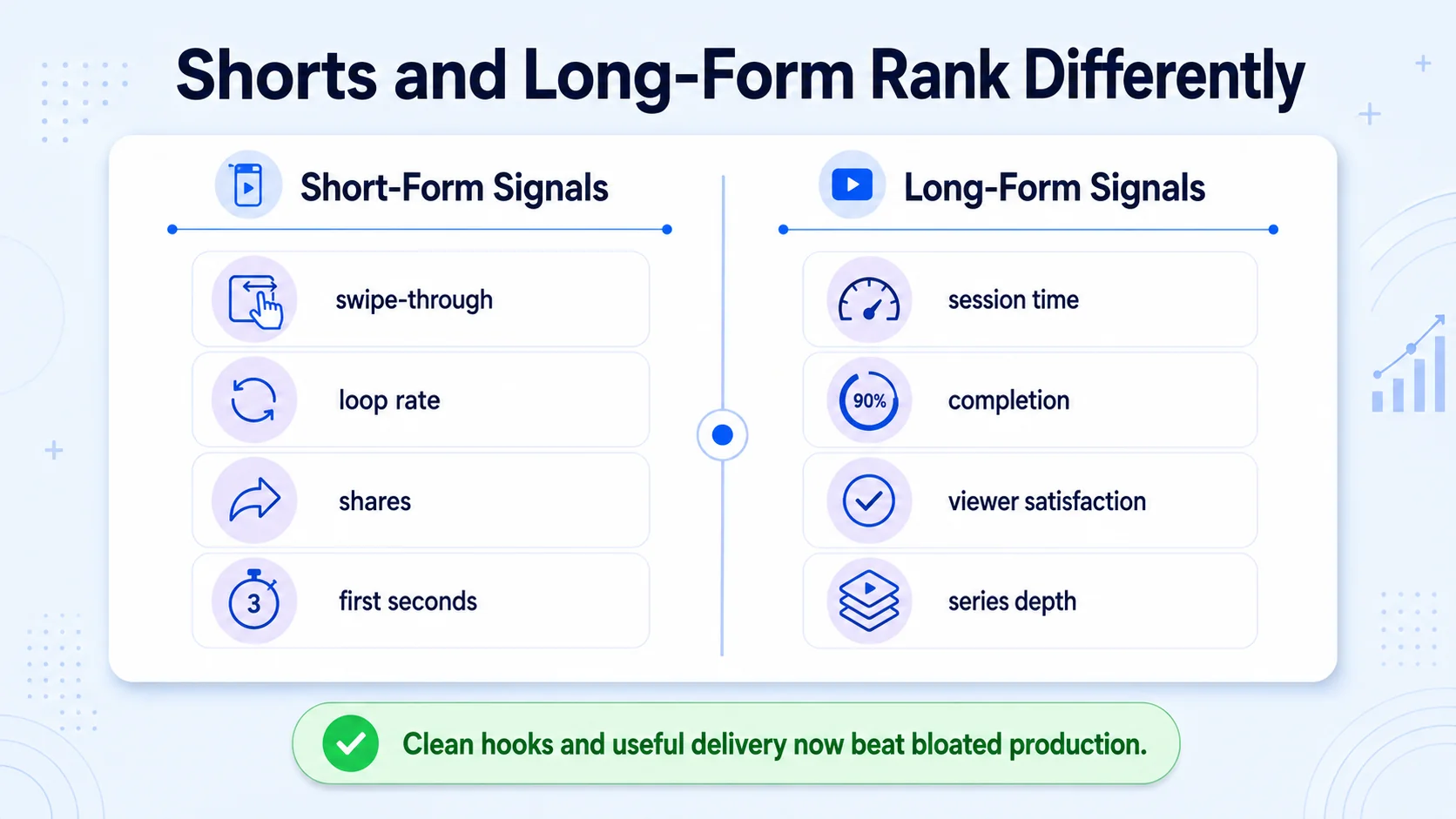
For B2B creators posting webinar clips, founder explainers, or product demos via our short-form video editing services, this algorithm change is a significant opportunity. Clean hooks, tight edits, and value-dense delivery now outperform bloated production on both formats.
What Gets More Views: Long YouTube Videos or Shorts?
Raw view count favors Shorts, but that metric alone misleads most teams into the wrong decision. Over 200 billion Shorts views happen every day on YouTube. 74% of Shorts views come from non-subscribers, making it YouTube's main discovery format. That is an enormous top-of-funnel reach advantage. However, views on Shorts and views on long-form content represent entirely different audience intent.
Audience Retention Metrics tell the fuller story:
- YouTube Shorts has a strong average viewer retention rate of 73%.
- For long-form content, maintaining 50%+ retention across the duration signals valuable content. For Shorts, the threshold is more aggressive: Shorts between 50–60 seconds show the highest average completion rate at 76%.
- Short-form videos get 2.5x more engagement than long-form on social platforms.
But engagement rate and pipeline influence are not the same thing. A buyer who spends 18 minutes watching your founder explain your product's architecture is far closer to booking a demo than someone who watched a 45-second clip. For a SaaS team with a 60-to-90-day sales cycle, Audience Retention Metrics on long-form content are the signal that tracks actual buyer progression.
The answer to "what gets more views" is Shorts. The answer to "what drives more pipeline" is almost certainly long-form, when executed well and tracked properly through YouTube Studio Analytics.
Is YouTube Shorts Killing Long-Form Content Creators?
No, and the data is unambiguous on this. By 2026, the most successful channels no longer treat these different types of content as a competition or a choice, but rather as two different tools in their growth plan. According to YouTube's 2026 internal data, creators posting both Shorts and long-form videos grow their subscriber base 3x faster than creators using only one format. Their total watch time increases 2.5x in the first year. The creators who are struggling are not being killed by Shorts. They are being killed by the algorithm's shift toward satisfaction signals and watch history clusters.
Post-February 2026, niche tech reviewers reported 40% impression gains from Browse clusters, while general vloggers saw 25% drops as they pivoted to series formats for better performance. Long-form content, particularly evergreen content with strong Video SEO Optimisation, is actually more defensible than ever. TikTok and Instagram reward fast, bite-sized novelty. YouTube focuses on session time and depth. It looks at whether viewers watch more than one video, move to related videos, and return later. That focus explains why long-form videos and evergreen content still perform well.
For B2B brands, this is excellent news. Evergreen Content Strategy built around product use cases, founder thinking, and buyer education does not expire. A well-produced YouTube video editing strategy built around searchable long-form content compounds over time in a way that a Shorts-only approach cannot.
Do Long YouTube Videos Still Make More Money Than Shorts?
Yes, by a significant margin, and understanding exactly why matters for anyone making format investment decisions. YouTube shares 55% of net ad revenue with creators on long-form videos. For Shorts, creators get 45% of a pooled revenue share, split based on their portion of total Shorts views in their region. Shorts revenue is pooled and shared across every eligible video in the feed, while long-form revenue is tied directly to the ads shown on your specific video.
A creator needs 1 million Shorts views to earn approximately $50. The same creator needs only 20,000 long-form views at a $2.50 RPM to earn the same amount. This math shapes how creators should think about each format: Shorts as audience growth, long-form as revenue engine.
For B2B SaaS teams specifically, the Social Media ROI conversation goes beyond AdSense entirely. YouTube Monetisation comes from multiple streams:
- Direct ad revenue: Long-form wins, always.
- Sponsorships and brand deals: Long-form commands higher rates due to deeper trust.
- Pipeline contribution: Long-form demos, webinar clips, and case study videos convert warm buyers.
- Inbound leads from search: Long-form content ranks in Google via the Google Knowledge Graph and YouTube Search; short clips rarely appear in search results for high-intent queries.
If your primary goal is building an audience you can monetize directly, long-form video builds the audience trust and loyalty that direct monetization requires. Memberships, merchandise, courses, and coaching all perform better with audiences built through sustained long-form engagement. For SaaS, substitute "courses" with "demos" and the logic holds identically.
How to Build a Hybrid Video Strategy That Uses Both Formats
The Content Repurposing Strategy that performs best in 2026 treats long-form as the source and short-form clips as the distribution layer. Here is the production system I recommend to every B2B team at Komet Media:
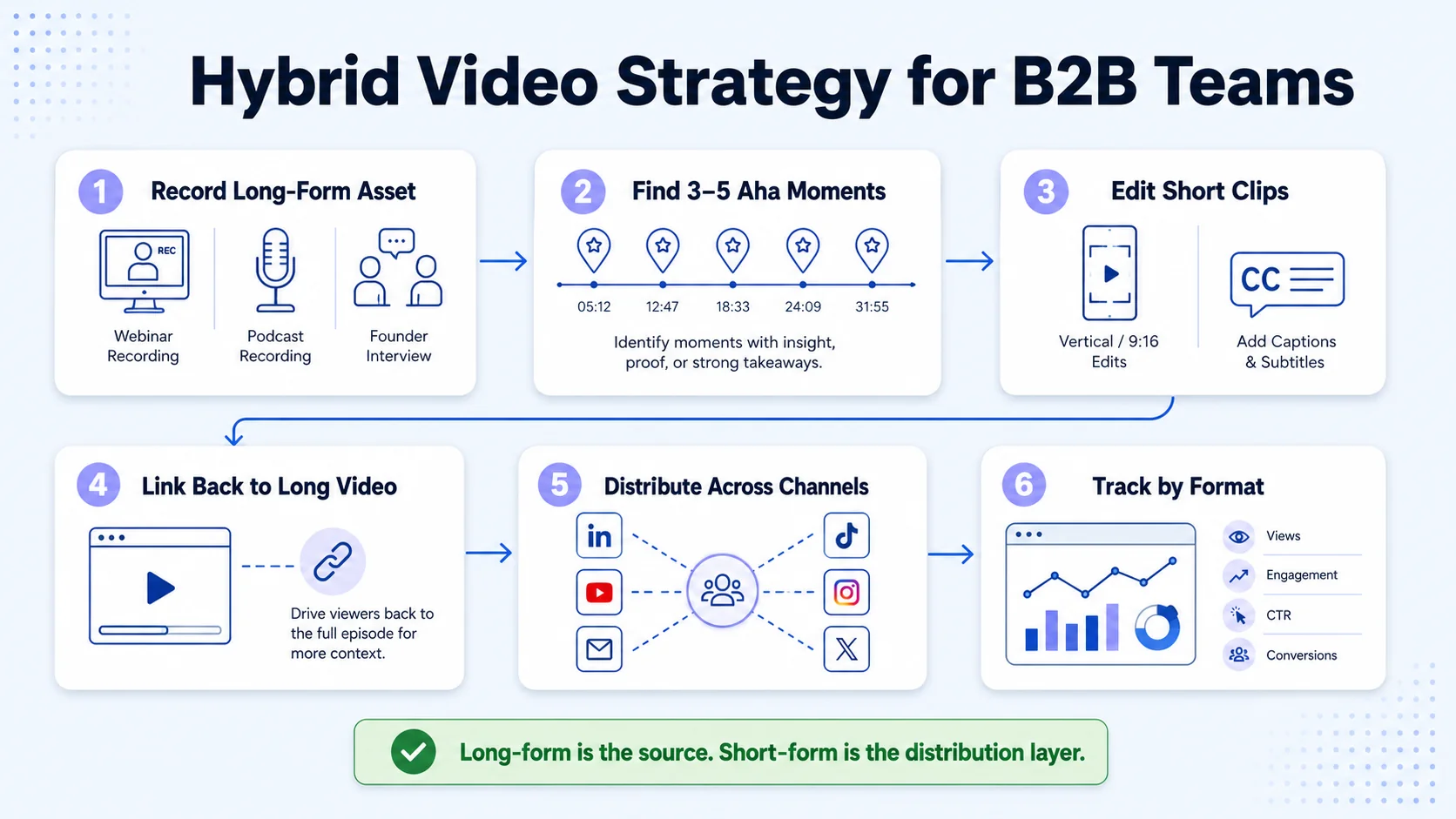
- Record your long-form asset first: A webinar, podcast, founder interview, product demo, or panel. This is your podcast production and video marketing foundation.
- Identify the 3–5 "aha moments": Pull the sharpest insight, the clearest product benefit, or the most counterintuitive claim. These become your Shorts.
- Edit each clip for the short-form format: Tight hook in the first 3 seconds, captions, vertical orientation. Shorts between 50–60 seconds show the highest average completion rate at 76%, so target that length window.
- Link the Short back to the long-form video: Use YouTube's related video link feature inside Shorts settings to create a direct conversion path.
- Distributed across platforms: Push clips to Instagram Reels, LinkedIn, and TikTok for omnichannel content distribution without additional recording.
- Track format performance separately in YouTube Studio Analytics: Monitor Click-Through Rate Optimisation, completion rate, and subscriber conversion per format to know what to scale.
Research demonstrates that every long-form video contains 10–15 high-performing Shorts waiting to be extracted. Data from 2025 shows that 65% of marketers report content repurposing is the most cost-effective strategy, and 48% report it's the best use of time compared to creating new content from scratch.
For lead generation, track conversion from video views to form fills or demo requests. For brand awareness, track reach and new-viewer percentage, not total views alone. For product education, track completion rate on long-form videos specifically, since a high view count on a tutorial nobody finishes is not helping your customers.
The goal of this system is Content Velocity without production bloat. One webinar or podcast episode should produce 5 to 8 short clips that run across platforms for weeks. That is Omnichannel Content Distribution at the scale a lean B2B team can actually sustain.
Conclusion
- Long-Form YouTube vs Short-Form Clips is not a choice between formats. It is a choice between jobs within the same video strategy.
- Short-form clips drive discovery, top-of-funnel awareness, and the Instagram Reels Engagement Rate signals that build platform reach quickly.
- Long-form YouTube drives buyer education, pipeline trust, searchable evergreen authority, and the revenue that compounds over time.
- The highest-performing B2B content teams in 2026 repurpose long-form into short clips systematically, rather than producing each format in isolation.
Frequently Asked Questions
Q1: What is the best video length for YouTube channel growth in 2026?
There is no single best length. For Shorts, target 50–60 seconds for the highest completion rates. For long-form, the algorithm rewards videos that maintain 50%+ retention across the full duration over any specific runtime. Match length to the depth of the topic, not an arbitrary target.
Q2: Why are creators switching from long-form to short-form video?
Most are not abandoning long-form entirely. They are adding shorts on top of it. Shorts are your best bet for getting in front of a big crowd fast and experimenting with new ideas. The lower production barrier and faster discovery make Shorts attractive for testing. The switch only hurts creators who stop long-form altogether and lose search visibility and revenue depth.
Q3: How do engagement rates compare between long-form and short-form content?
Short-form videos get 2.5x more engagement than long-form on social platforms. However, engagement rate measures surface interactions. Long-form generates deeper signals: watch time, subscriber conversion, and return visits, which translate more directly into B2B pipeline outcomes.
Q4: How should I decide between YouTube Shorts and full-length videos for my channel?
Map the format to the goal. If you need discovery and top-of-funnel reach, start with Shorts. If you need buyer trust, search visibility, and revenue, invest in long-form. Rather than declaring a single winner, it is more useful to map each format to the goals it serves most effectively in 2026. Most B2B teams need both simultaneously.
Q5: Can short-form clips hurt my long-form YouTube performance?
Not anymore. Shorts and long-form algorithms were formally separated. Bad Shorts no longer hurt long-form reach, and viral Shorts no longer automatically pull viewers to long-form. Each format is judged on its own merits. This separation is a significant operational advantage for teams running both formats.
Q6: How many Shorts should I post alongside long-form content?
Most brand accounts can sustain two to three Shorts per week alongside one long-form video every one to two weeks without straining a small team. If you are repurposing existing long-form content, each recording session should yield at least 3 to 5 short clips, making this cadence achievable without additional filming days.