
🪄 AI Summary
Heading 1
Heading 2
Heading 3
Heading 4
Heading 5
Heading 6
Lorem ipsum dolor sit amet, consectetur adipiscing elit, sed do eiusmod tempor incididunt ut labore et dolore magna aliqua. Ut enim ad minim veniam, quis nostrud exercitation ullamco laboris nisi ut aliquip ex ea commodo consequat. Duis aute irure dolor in reprehenderit in voluptate velit esse cillum dolore eu fugiat nulla pariatur.
Block quote
Ordered list
- Item 1
- Item 2
- Item 3
Unordered list
- Item A
- Item B
- Item C
Bold text
Emphasis
Superscript
Subscript
Vertical SaaS companies have an advantage most software brands would envy. Their podcasts feature operators from one industry talking about problems everyone in that industry recognizes. Podcast repurposing turns those conversations into clips, posts, and sales assets that sound like the market, not like a software vendor. The mistake I see most often is treating a vertical show like a generic SaaS podcast. This guide covers how I select moments, package them for industry buyers, and distribute them where those buyers actually spend time.
Quick Answer
Podcast repurposing for vertical SaaS means turning industry episodes into clips and assets your market recognizes as its own. It works when you use the industry's language, feature real operators, and distribute through the channels that industry already trusts.
Why Vertical SaaS Podcasts Have Unusual Leverage
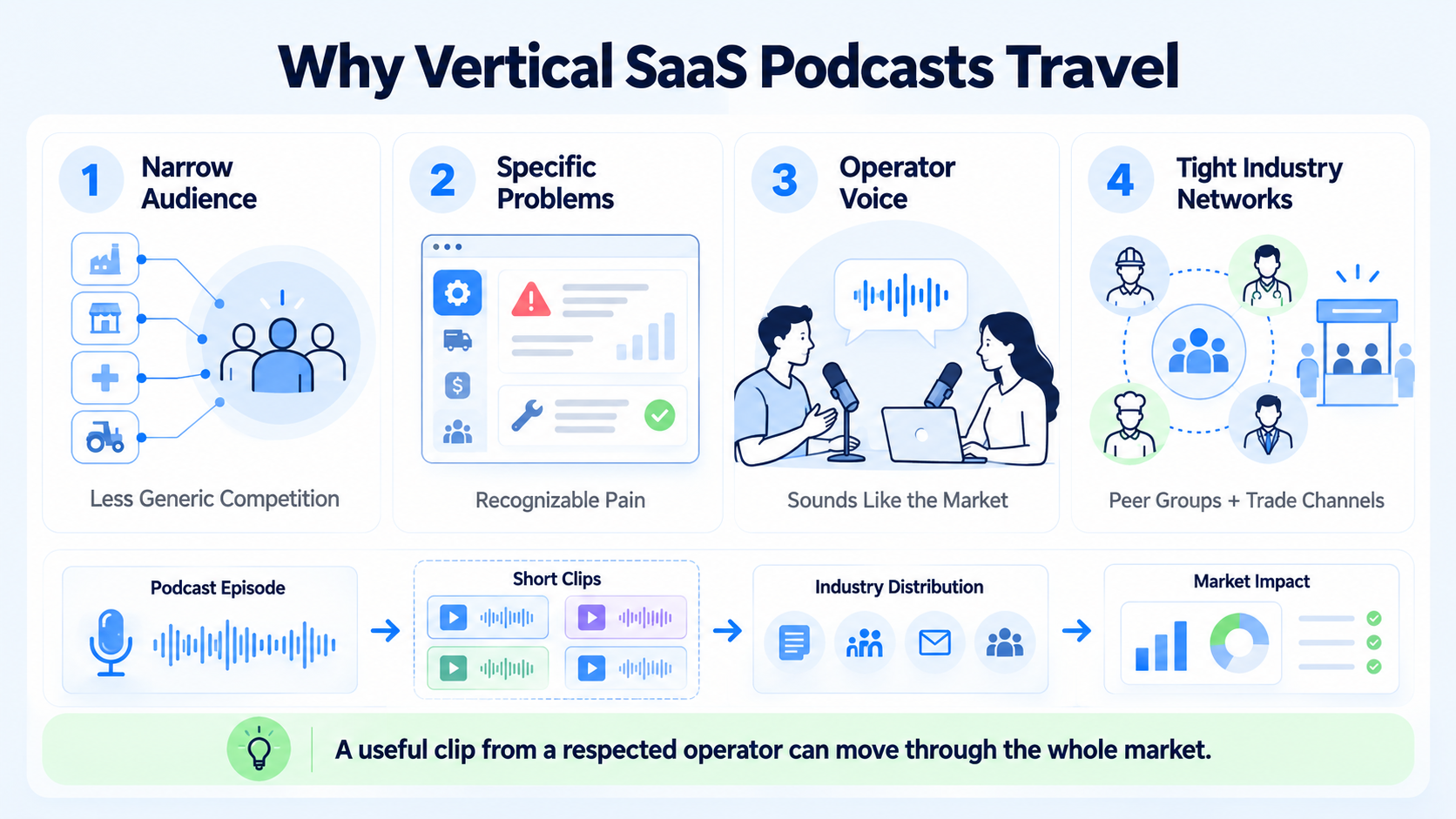
A horizontal SaaS podcast competes for attention with thousands of shows about growth, leadership, and productivity. A vertical SaaS podcast competes with far fewer. A show about running a multi-location dental group, managing construction subcontractors, or operating a freight brokerage speaks to a narrow audience with very specific problems.
That narrowness is the advantage. When a guest describes a problem in the exact words your buyers use, the clip feels like it came from inside the industry. Generic marketing rarely achieves that.
Investors who focus on the category see it the same way. In its Vertical SaaS 50 for 2025, Headline, together with Avid and Bain Capital Ventures, argued that the most valuable platforms will win through industry-specific workflows, active user communities, and strong go-to-market execution. A podcast that features your customers and industry peers supports both the community and the go-to-market side.
The format itself is mainstream. The Infinite Dial 2026 from Edison Research at SSRS found that 58% of Americans age 12 and older consumed a podcast in the last month, and 57% have both listened to and watched one. These are general population figures, not industry-specific data, but they show that video clips from podcasts are a familiar format for most professionals, including those outside the tech world.
This is also why podcast repurposing tends to suit vertical markets. Word travels fast in tight industries. A useful clip shared by one respected operator can move through peer groups, association newsletters, and trade events in a way broad B2B content rarely does.
Speak the Industry's Language, Not the Software Industry's
The most common mistake I see with vertical SaaS clips is accidental translation into tech language. A construction superintendent says "my subs keep showing up without the right drawings." The marketing team writes a caption about "improving cross-stakeholder document workflows." The clip instantly loses the voice that made it valuable.
Your buyers are operators first. A practice manager, fleet owner, or property manager does not think in SaaS vocabulary. They think in their own terms, and they trust people who use those terms correctly.
Here is how I keep clips grounded:
- Use the guest's words in captions and titles. If the guest says "no-shows," do not rewrite it as "appointment attrition."
- Lead with the operational pain. Start with the problem the operator faces on a normal day, not with the product.
- Feature operators over executives. A shop owner explaining a fix often lands better than your CEO explaining the vision.
- Keep the setting visible. Footage or photos from a real job site, clinic, or warehouse can add authenticity, provided you have permission to use them.
- Check jargon both ways. Remove tech jargon your buyers do not use, and keep the industry terms they do.
Here is a simple comparison I use with teams:
These are illustrative examples, not quotes from specific customers. The point is to show the difference in tone.
Choosing the Right Moments from Vertical Episodes
The best moment in a vertical SaaS episode is rarely the product mention. It is usually the moment a guest describes a problem so precisely that other operators nod along.
I sort moments into five buckets:
- Shared-pain moments. A guest describing a frustration nearly everyone in the industry has. These build recognition.
- How-we-fixed-it moments. A practical change the guest made, with or without your product. These build credibility.
- Industry-shift moments. A guest explaining a regulation, labor trend, or market change affecting the sector. These build authority.
- Objection moments. A customer explaining why they hesitated to switch software and what changed their mind. These help sales directly.
- Peer-advice moments. A seasoned operator giving advice to someone newer in the industry. These travel well inside communities.
One mistake I see repeatedly is choosing only moments where a customer praises the product. Those clips have a place in sales follow-up, but they rarely earn attention on their own. Industry audiences trust content that helps them, then become curious about who made it.
Customer guests also need care. Confirm before recording what the guest can say about their business, their numbers, and their own customers. Many operators are comfortable talking about problems but not about revenue or specific clients. Clear expectations prevent clips from being pulled after editing.
For a list of the selection errors I see most often, our guide to podcast clip mistakes to avoid covers them in more detail.
A Podcast Repurposing Workflow for Vertical SaaS Teams
Most podcast repurposing fails before editing starts. The team has not decided which segment of the industry each episode is for or where the clips will go. Vertical SaaS adds another wrinkle: many markets have sub-segments with different priorities, such as small independent operators versus large multi-site groups.
The cycle I recommend:
- Define the segment and goal. Which part of the industry is this episode for, and what should they think or do afterward?
- Brief the guest. Confirm what they can share about their business and that clips will be published.
- Record clean audio and video. Many operator guests record from job sites or offices, so plan for noise and lighting.
- Create a transcript and check industry terms. Automatic tools often misspell trade vocabulary and product names.
- Mark and score moments. I score on clarity, industry relevance, whether it stands alone, and approval risk.
- Confirm sensitive moments with the guest. Especially anything involving numbers, clients, or competitors.
- Edit the master episode.
- Cut clips with captions in the industry's language.
- Adapt for each platform.
- Final check and archive.
- Schedule distribution, including partner and association channels.
- Review performance and feed lessons into the next recording.
Small teams can combine steps 4 and 5 and use one template for all short formats. I would not skip the guest brief or the terminology check. In a vertical market, one wrong term can undo the trust the clip was meant to build.
Here is what one strong episode can usually become:
These are planning ranges, not promises. An operator with strong opinions and concrete stories produces more usable moments than a polite overview. I would rather produce six strong clips than fifteen weak ones.
Plan around the industry calendar too. Many vertical markets have busy seasons, trade shows, and regulatory deadlines. Schedule clips about preparation before the busy season and clips about lessons learned after it. Matching the calendar makes content feel timely without chasing trends.
Distribution: Go Where the Industry Already Gathers
A polished clip with no distribution plan is still an underused asset. In vertical markets, distribution needs more thought than in horizontal SaaS, because many buyers do not live on the usual B2B channels.
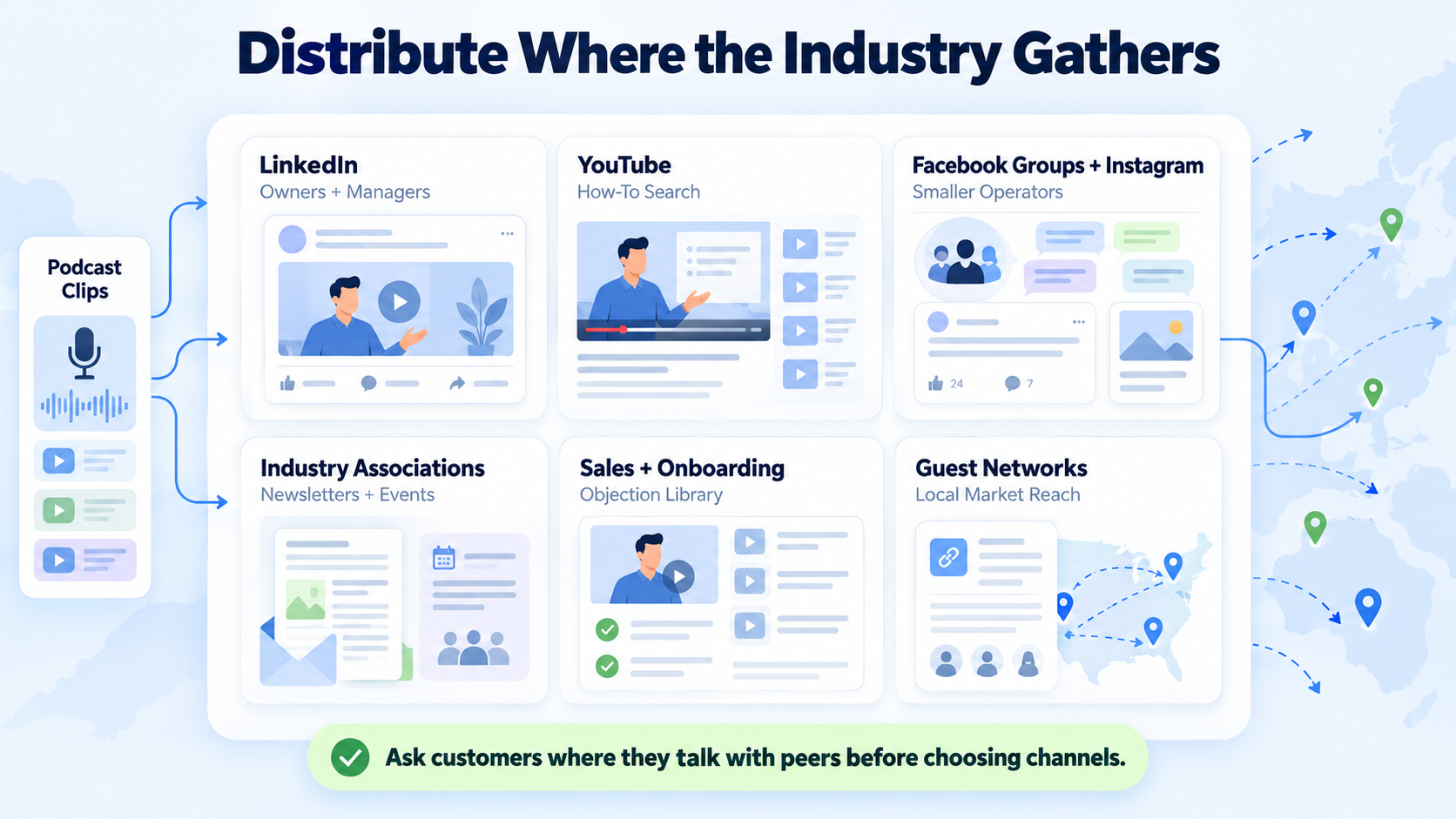
LinkedIn works well when your buyers are owners, executives, or managers at mid-size and larger companies. LinkedIn has also become stronger for video: Digiday reported that total video viewership on LinkedIn increased 36% year over year for the period from October 30, 2024, to January 29, 2025, based on company figures. Our guide to LinkedIn video for vertical SaaS companies covers formats in more depth.
YouTube matters in many trades and service industries, where operators search for how-to answers. YouTube reported more than 1 billion monthly active viewers of podcast content as of January 2025. That is a platform-wide figure, but it supports publishing full episodes there with titles that match how operators search.
Facebook groups and Instagram can matter more than LinkedIn in some industries, especially where owners run smaller businesses. Before you commit, ask a few customers where they talk with peers. Their answers often change the channel plan.
Industry associations and trade media are distribution partners, not just sponsors. Many associations run newsletters, member communities, and events. A useful clip featuring a respected member can fit naturally into those channels.
Sales and onboarding should have a clip library organized by objection, segment, and role. A clip of a peer operator explaining how they switched software can calm a nervous prospect more than a feature list.
Guests often know everyone in their local market. Send them their clips with suggested captions. In tight industries, a guest share can reach a large share of your buyers.
The overall B2B case for this kind of content is strong. The 2025 Edelman and LinkedIn B2B Thought Leadership Impact Report, based on a survey of nearly 2,000 management-level professionals, found that more than 40% of B2B deals stall because of internal misalignment inside buying groups. In vertical markets, that group may include an owner, an office manager, and a field lead. Clips aimed at each of them help keep the decision moving.
How to Measure What the Podcast Is Doing for the Business
Do not judge clips only by views. In a vertical market, the total audience is smaller by design. A clip watched by 500 operators in your exact segment can be more valuable than one with ten times the reach in a broad audience.
That last row matters in vertical SaaS. When operators start asking to be guests, the podcast has become part of the industry conversation. That is a strong sign the content is working.
Attribution will always be imperfect. Add a "how did you hear about us" field to your demo form, ask sales to log podcast mentions, and review results monthly. Over time, podcast repurposing should guide what you record next: more of the topics and guest types that start real conversations, less of what gets polite silence.
Conclusion
Vertical SaaS brands have a natural advantage in content. Their podcasts can sound like the industry itself, featuring real operators describing real problems in their own words. The opportunity is to get those voices in front of everyone who influences a buying decision, not just the few who listen to every episode.
The decision that matters is to run podcast repurposing as an industry-first system. Protect the market's language, choose moments that help operators, and distribute through the channels where that industry already gathers. When that is in place, each conversation keeps working long after it is recorded.
FAQ
What is podcast repurposing for a vertical SaaS company?
It is the process of turning podcast episodes into shorter assets such as clips, quote cards, show notes, and sales follow-up videos. For vertical SaaS, it also means keeping the industry's language intact and distributing through channels that industry trusts.
How much does it cost?
Freelancers usually charge per clip or per hour, subscription services charge a flat monthly fee for editing volume, and agencies price by scope. At Komet Media, engagements typically fall in the range of about $2,500 to $5,000, depending on whether you need content created from scratch or repurposed from existing episodes, as well as clip count, motion graphics, turnaround, and distribution support.
How long does it take to turn an episode into clips?
It depends on episode length, clip count, and how quickly guests confirm sensitive moments. Teams that brief guests before recording and confirm moments before editing usually publish faster than teams that send finished clips for approval.
What deliverables should we expect from one episode?
A typical plan includes full video creation from scratch or a full edited episode from existing footage, several short clips, one or two objection-handling clips for sales, quote cards or carousels, and show notes. The mix should follow where your industry spends time.
Should we hire a freelancer or an agency?
A skilled freelancer can handle editing at low volume. An agency is a better fit when you need end-to-end video creation from scratch, moment selection, platform adaptation, partner distribution, and reporting handled together. Ask any partner how they learn an industry's language before they start cutting.
Can our internal team handle it?
Yes, if someone owns it every week and has editing skills. Vertical SaaS marketing teams are often small, so the risk is consistency. The podcast tends to slow down during busy seasons in the industry, which is often when buyers are paying the most attention.
Which platforms matter most for vertical SaaS clips?
It depends on the industry. LinkedIn works well for owners and managers at larger companies, YouTube suits industries where people search for how-to answers, and Facebook groups or associations can matter more for smaller operators. Ask your customers where they talk with peers.
How does Komet Media work with vertical SaaS brands?
We handle moment selection, editing, captions in your industry's language, platform adaptation, and distribution support. We can also create original video from scratch or help you launch a podcast if you do not have one yet. If you want to talk through your show, you can book a call with our team.