
🪄 AI Summary
Heading 1
Heading 2
Heading 3
Heading 4
Heading 5
Heading 6
Lorem ipsum dolor sit amet, consectetur adipiscing elit, sed do eiusmod tempor incididunt ut labore et dolore magna aliqua. Ut enim ad minim veniam, quis nostrud exercitation ullamco laboris nisi ut aliquip ex ea commodo consequat. Duis aute irure dolor in reprehenderit in voluptate velit esse cillum dolore eu fugiat nulla pariatur.
Block quote
Ordered list
- Item 1
- Item 2
- Item 3
Unordered list
- Item A
- Item B
- Item C
Bold text
Emphasis
Superscript
Subscript
Lawyers are trained to read closely, question claims, and notice what is missing. That makes them one of the hardest audiences in B2B. Legaltech podcasts help because they let practitioners hear peers explain how tools actually work in a practice. Podcast repurposing turns those conversations into clips that reach partners, in-house counsel, and legal operations teams. The catch is that legal content carries extra risk: client confidentiality, professional conduct rules, and claims about AI accuracy. This guide covers how I select moments, protect accuracy, and distribute clips for legaltech brands—as well as how Komet Media produces original podcasts and videos from scratch.
Quick Answer
Podcast repurposing and original content creation (like launching new podcasts or producing original video from scratch) help legaltech brands reach legal buyers with precise, well-reviewed assets. It works when you protect client confidentiality, keep claims about accuracy grounded, and match each piece of content to the right stakeholder.
Why Legal Buyers Listen to Peers, Not Vendors
Legal technology decisions are rarely made by one person. A law firm purchase might involve managing partners, practice group leaders, IT, knowledge management, and finance. In-house legal departments add procurement, security, and the general counsel. Each person has a different concern, and most of them will never watch a product demo end to end.

Peer voices carry unusual weight in law. A partner explaining how her team cut document review time, with the safeguards they used, will be taken more seriously than any brochure. A podcast is one of the few formats that captures that kind of candid, detailed conversation.
AI has made this even more important. The ABA's 2024 Legal Technology Survey Report, released in 2025 and summarized by the ABA Journal, found that 30% of responding lawyers use AI, with adoption highest in large firms. The same coverage reported that the biggest barrier is the belief that AI is not fully accurate. The survey drew responses from 512 private-practice attorneys, so it is a useful signal rather than a census. Still, it shows why legal buyers want to hear how peers handle accuracy before they commit.
The B2B case is about alignment. The 2025 Edelman and LinkedIn B2B Thought Leadership Impact Report, based on a survey of nearly 2,000 management-level professionals, found that more than 40% of B2B deals stall because of internal misalignment within buying groups. Short clips aimed at partners, IT, and finance can help each of them see their own concern addressed.
Law firms and in-house teams also buy differently. Firms often weigh client service and billing models, while corporate legal departments focus on cost control and alignment with the business. A single episode can speak to both, but rarely in the same clip. Podcast repurposing lets you separate those angles and send each one to the audience that cares about it.
The Three Review Points in Legal Content
Legal audiences notice mistakes quickly. In my experience, the edit is rarely the only problem. Most legaltech clips that cause trouble fail on one of three review points that nobody planned for.
Client confidentiality
Lawyers who guest on podcasts naturally reference matters they worked on. Even without names, details like industry, deal size, jurisdiction, or timing can identify a client. Professional conduct rules on confidentiality are serious, and states adopt their own versions. I am not a lawyer, and your guests and legal team decide what is appropriate. My job as a producer is to make sure nothing reaches the edit that the guest would not want published.
Practical rules we follow:
- Brief lawyer guests before recording to keep matter references general.
- Flag any mention of a client, case, deal, or court proceeding for guest review.
- Never show product screens with real matter data or client documents.
- Let guests approve clips that discuss their own practice before publishing.
Claims about accuracy and outcomes
A guest might say an AI tool "finds every relevant clause" or "never misses a deadline." Trimmed for pace, a careful statement can become an absolute claim. In a market where accuracy is the top concern, overstated clips damage trust quickly.
Keep qualifiers attached. If a guest says "in our testing on standard commercial leases," that phrase is the truth of the claim. Remove it, and the clip becomes a promise nobody can keep.
How lawyers describe their own services
Lawyers who appear as guests are also subject to rules about how they communicate about their own legal services. A clip that makes a guest sound like they are promising client results can put them in an awkward position. Many firms have marketing review policies for exactly this reason. Ask early whether the guest's firm needs to approve clips.
Choosing Moments That Legal Buyers Will Watch
The best moment in a legaltech episode is rarely the big-picture view on the future of law. It is usually a specific, honest account of how a team changed a workflow and what they learned.
I sort moments by audience:
The example angles above illustrate framing. They are not quotes from real episodes.
One mistake I see repeatedly is building every clip around the product. Legal audiences respond better to clips that teach something useful, such as how to structure an AI review policy or how to measure matter cycle time. Product interest tends to follow useful content.
Tone matters too. Legal audiences prefer calm, precise editing. Fast cuts and dramatic sound effects undermine credibility. Clean edits, accurate captions, and lower thirds with name, title, and firm or company usually work best.
Captions deserve extra care. Legal terms, case names, and abbreviations are easy for automatic transcription to get wrong. A misspelled term in a caption tells a lawyer that nobody checked the work.
A Podcast Repurposing Workflow for Legaltech Teams
Most content production and podcast repurposing fails before editing starts. The team has not decided who each episode serves, and nobody owns guest and firm approvals. In legal, approvals can easily become the longest step whether launching a podcast from scratch or repurposing existing content.
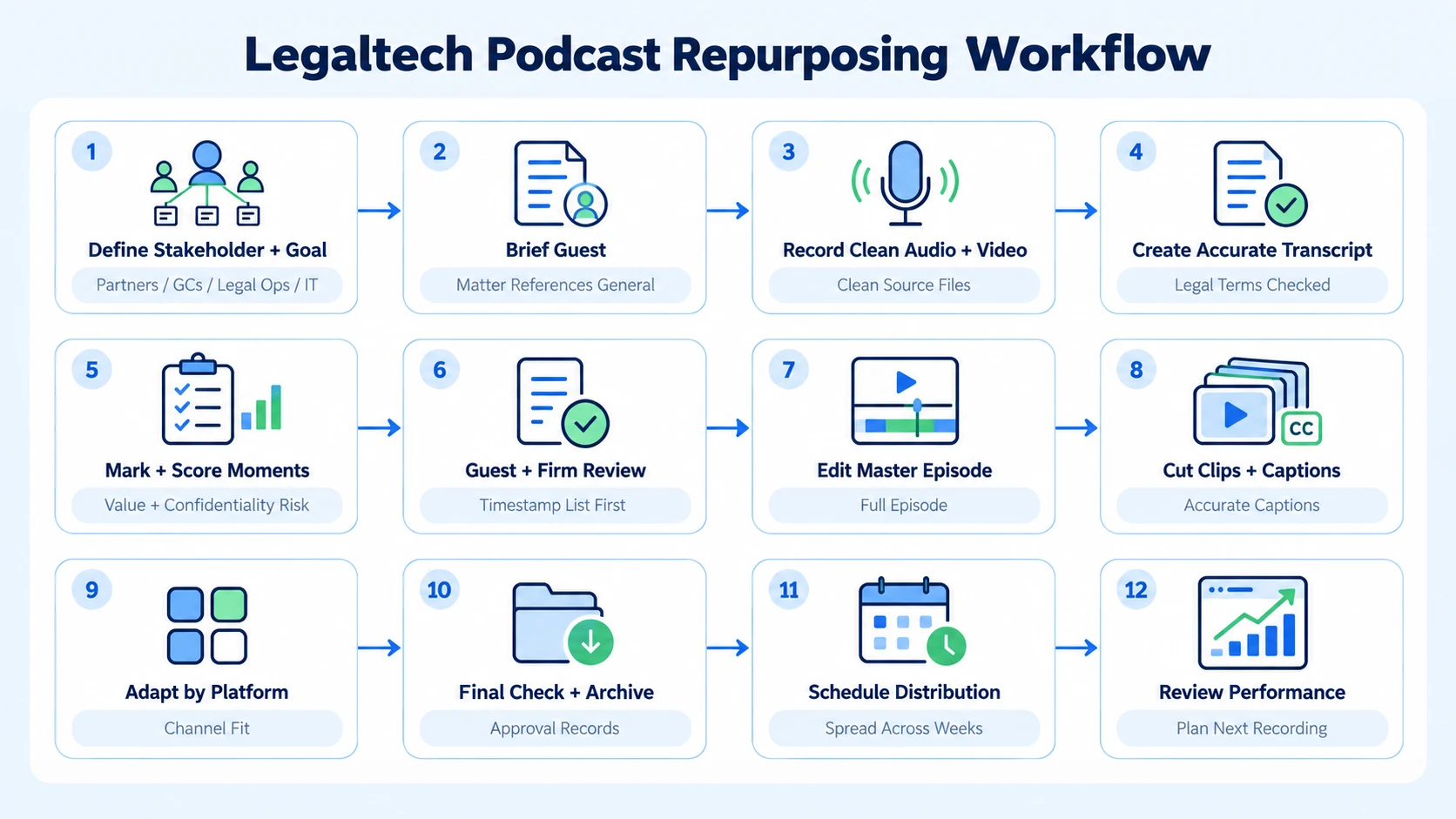
This is the cycle I recommend:
- Define the stakeholder and goal. Partners, in-house counsel, legal ops, or IT?
- Brief the guest. Explain where clips will appear, keep matter references general, and ask whether their firm requires marketing review.
- Record clean audio and video.
- Create an accurate transcript. Legal terms and names need a manual check.
- Mark and score moments. I score on clarity, stakeholder value, whether it stands alone, and confidentiality or claims risk.
- Send the moment list for guest and firm review. Resolve concerns before editing.
- Edit the master episode.
- Cut clips and add accurate captions.
- Adapt for each platform.
- Final check and archive. Keep approval records with the final files.
- Schedule distribution.
- Review performance and feed lessons into the next recording.
Small teams can combine steps 4 and 5. I would not skip the guest brief or the moment-list review. Sending a firm twenty finished clips for approval is much slower than sending one list of timestamps and transcript excerpts.
A few recording habits help too. Ask one question at a time. After any general answer, ask for a concrete example the guest is comfortable sharing. Close by asking for their single most practical piece of advice, which often becomes the strongest opening clip.
Batching helps lean teams. Review a full episode's moment list in one session, get approvals in one pass, and spread clips across several weeks. That rhythm is far easier to sustain than chasing approval for each clip separately.
What one strong episode can usually become:
These are planning ranges, not promises. A candid guest with specific examples produces far more usable moments than one who speaks only in generalities.
For a list of the selection errors I see most often, our guide to podcast clip mistakes to avoid covers them in detail.
Distribution: Reaching Legal Professionals Where They Read
A polished clip with no distribution plan is still an underused asset. Legal professionals are concentrated on a few channels, and they respond to substance over style.
LinkedIn is the main channel for most legaltech brands. Partners, general counsel, and legal ops leaders follow industry voices there. Video consumption has grown on the platform: Digiday reported that total video viewership on LinkedIn rose 36% year over year for the period from October 30, 2024, to January 29, 2025, based on company figures. Our guide to LinkedIn video for legaltech companies covers formats in more depth.
YouTube gives full episodes a long shelf life and supports searches for topics like contract lifecycle management or e-discovery workflows. YouTube reported more than 1 billion monthly active viewers of podcast content as of January 2025. That is a platform-wide figure, but it supports publishing full episodes there with precise titles.
Bar associations, legal ops communities, and conferences are major channels in this market. Clips featuring respected practitioners fit naturally into association newsletters, community discussions, and event follow-ups.
Email newsletters remain a trusted format for lawyers. A short monthly email with two clips and one written takeaway gives busy practitioners an easy way to follow the show.
Sales enablement should have a clip library organized by stakeholder and objection: accuracy, confidentiality, integration, training, and cost. A partner explaining how her firm handled AI review policies can be more persuasive than any feature list.
Guests often have influential networks within their practice areas. Send them their approved clips with suggested captions. Our guide to short-form video for legaltech companies covers clip formats for each stage.
How to Measure Results in Long Legal Sales Cycles
Do not judge legaltech clips only by views. A clip watched by a few hundred legal ops leaders at target firms can matter more than one with broad reach among law students.
Attribution in legal is difficult because purchases often follow budget cycles and committee reviews. Add a "how did you hear about us" field to your demo form, ask sales to log podcast mentions, and review results monthly.
Over time, podcast repurposing should guide your guest list and question plan. If clips about AI governance consistently start discussions, book more guests who can speak to it. If product-heavy clips fade, shift toward practical workflow topics.
Comments are an underrated signal with legal audiences. When practitioners debate a guest's point or share how their own team handles the issue, that topic usually deserves a follow-up episode. It also tells you which guests your audience trusts most.
Conclusion
Legaltech brands have access to something legal buyers value highly: candid conversations with practitioners who have already tested new tools in real practice. The opportunity is to get those conversations in front of every stakeholder in the decision, whether through launching a new podcast from scratch or repurposing existing episodes.
The decision that matters is to run podcast repurposing as a precise, approval-aware system. Protect client confidentiality, keep accuracy claims grounded, choose moments that teach, and distribute through the channels where legal professionals already read. That is how one conversation earns trust from a careful audience.
FAQ
1) What is podcast repurposing for a legaltech company?
It is the process of turning podcast episodes into shorter assets such as clips, quote cards, show notes, and sales follow-up videos. At Komet Media, we also produce content from scratch, including launching new podcast shows and creating original video content for legaltech brands. Across all formats, we prioritize protecting client confidentiality, keeping claims accurate, and building guest approvals into the workflow.
2) How much does it cost?
Freelancers usually charge per clip or per hour, subscription services charge a flat monthly fee for editing volume, and agencies price by scope. At Komet Media, engagements typically fall in the range of about $2,500 to $5,000, depending on episode volume, clip count, review needs, turnaround, and distribution support.
3) How long does it take to turn one episode into clips?
Editing is rarely the slowest step. Guest and firm approvals often set the timeline. Sending a moment list for review before editing usually saves time compared with reviewing finished clips.
4) What deliverables should we expect from one episode?
A typical plan includes the full edited episode, several short clips, one or two objection-handling clips, quote cards or carousels, and show notes. The mix should follow your stakeholders and channels.
5) Should we hire a freelancer or an agency?
A skilled freelancer can handle editing at low volume. An agency is usually a better fit when you need moment selection, approval coordination, platform adaptation, and distribution support handled together. Ask any partner how they handle confidentiality and guest review.
6) Can our internal team handle this?
Yes, if someone has editing skills and owns the work every week. Legaltech marketing teams often get stretched during product launches and conference season, which is when consistency matters most.
7) Do lawyer guests need their firm's approval?
Often, yes. Many firms have marketing review policies for external content featuring their lawyers. Ask before recording so approvals do not delay publishing.
8) How does Komet Media work with legaltech brands?
We handle moment selection, editing, accurate captions, platform adaptation, and distribution support, with confidentiality and approval steps built into the workflow. We can also create original video from scratch or help you launch a podcast if you do not have one yet. If you want to talk through your show, you can book a call with our team.