
🪄 AI Summary
Heading 1
Heading 2
Heading 3
Heading 4
Heading 5
Heading 6
Lorem ipsum dolor sit amet, consectetur adipiscing elit, sed do eiusmod tempor incididunt ut labore et dolore magna aliqua. Ut enim ad minim veniam, quis nostrud exercitation ullamco laboris nisi ut aliquip ex ea commodo consequat. Duis aute irure dolor in reprehenderit in voluptate velit esse cillum dolore eu fugiat nulla pariatur.
Block quote
Ordered list
- Item 1
- Item 2
- Item 3
Unordered list
- Item A
- Item B
- Item C
Bold text
Emphasis
Superscript
Subscript
HR tech companies often host podcasts with CHROs, talent leaders, and people-ops practitioners. These conversations are full of honest lessons about hiring, retention, performance, and culture. Then the episode is published, and most of that insight disappears. Podcast repurposing turns those conversations into clips and assets that reach HR buyers, finance approvers, and IT reviewers. Whether you already have a show or need full podcast production and original video creation from scratch, Komet Media helps turn people-leader conversations into pipelines. HR content carries its own risks, though: employee privacy, sensitive workplace stories, and claims about fairness in hiring tools. This guide covers how I handle selection, review, and distribution for HR tech shows.
Quick Answer
Podcast repurposing for HR tech brands means turning episodes into clips and assets that help people leaders decide. It works when you protect employee privacy, keep hiring-tool claims accurate, and reach each member of the buying committee.
Why HR Buyers Respond to Peer Conversations
HR leaders make decisions that affect every employee in a company. They are cautious buyers for good reason. A new performance system or recruiting tool can change how people are hired, paid, and promoted.
That caution makes peer voices powerful. A CHRO explaining how her team rolled out a new review process carries more weight than any product page. People leaders want to hear from others who faced the same constraints: limited budget, skeptical managers, and employees who dislike change.
The buying committee is also wide. An HR tech purchase can involve the CHRO, talent acquisition, HR operations, IT security, legal, and finance. The 2025 Edelman and LinkedIn B2B Thought Leadership Impact Report, based on a survey of nearly 2,000 management-level professionals, found that more than 40% of B2B deals stall because of internal misalignment within buying groups. Short clips can address each stakeholder's concern without asking them to sit through a full episode.
The format has broad reach. The Infinite Dial 2026 from Edison Research at SSRS found that 58% of Americans age 12 and older consumed a podcast in the last month, and 68% of 35 to 54 year olds did. These are general population figures, not HR-specific data, but they confirm that long conversations are a familiar format for working professionals.
HR tech has a natural fit with employee voices, too. In its B2B Content and Marketing Trends: Insights for 2026 research, the Content Marketing Institute reported that 96% of B2B marketers say their organization creates thought leadership, yet in many companies fewer than 5% of employees contribute. A podcast is one practical way to widen that circle. Your customer success leads, implementation specialists, and in-house people experts can all become guests, and podcast repurposing turns their knowledge into clips without asking them to write posts.
The Sensitive Side of HR Content
HR conversations involve people. That is what makes them compelling, and it is also what makes them risky to clip carelessly. I see two kinds of risk come up repeatedly.
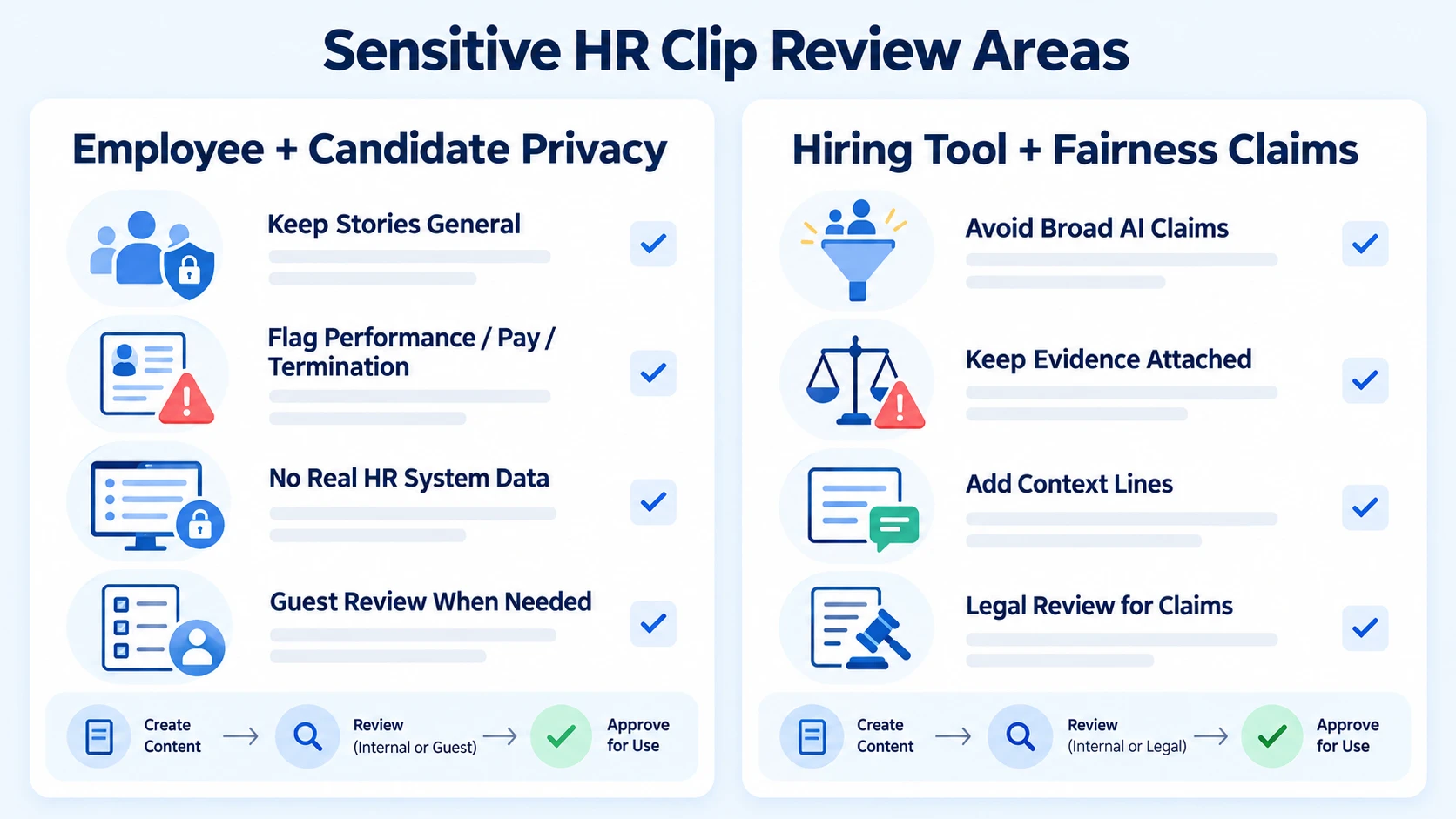
Employee and candidate privacy
Guests naturally tell stories about specific employees, difficult terminations, or candidates who struggled in an interview. Even without names, details like role, location, team size, and timing can make a person identifiable to colleagues.
Practical rules we follow:
- Brief guests before recording to keep employee stories general.
- Flag any story about a specific person's performance, health, pay, or termination for review.
- Never show internal HR systems with real employee data in demos or screen shares.
- Let guests review clips that discuss their own organization before publishing.
Many guests also need approval from their own communications or legal team. Ask early, so approvals do not delay publishing.
Claims about hiring tools and fairness
HR tech increasingly uses AI in screening, matching, and assessment. Claims about these tools attract scrutiny. In New York City, for example, the Department of Consumer and Worker Protection enforces Local Law 144, which regulates automated employment decision tools. According to the DCWP's published FAQ, the law prohibits employers and employment agencies from using these tools unless certain bias audit and notice requirements are met, and a bias audit can only be relied on for one year.
I am not a lawyer, and your legal team decides what applies to you and your customers. The production lesson is that a clipped sentence such as "our AI removes bias from hiring" can create problems that the full conversation never intended. Keep fairness and accuracy claims tied to the evidence and context the guest actually gave.
Choosing Moments That Help People Leaders
The best moment in an HR tech episode is rarely the guest's broad view on the future of work. It is usually a specific, honest account of what changed inside their organization.
I sort moments into five buckets:
- Rollout moments. How a team introduced a new process or tool, including what went wrong. These address the biggest fear HR buyers have: adoption.
- Manager moments. How a guest got skeptical managers to change behavior. These resonate widely because every HR leader faces this.
- Metric moments. How a team measured retention, time to hire, or engagement, with context. These help HR leaders build a business case.
- Employee experience moments. What changed for employees, told without identifying details. These build emotional connection.
- Executive alignment moments. How a CHRO won budget or support from the CEO and CFO. These reach senior buyers directly.
One mistake I see repeatedly is choosing only moments where a customer praises the product. Those clips have a place in sales follow-up. On social channels, though, HR audiences engage more with clips that help them do their jobs better.
Tone matters as well. HR audiences respond to calm, respectful editing. Fast cuts and dramatic sound effects can make serious topics like layoffs or burnout feel trivial. Clean edits, clear captions, and simple lower thirds with name and title usually work best.
For a deeper look at clipping customer conversations, our guide to turning customer interviews into clips covers selection and permissions in more detail.
Captions deserve care as well. HR leaders often watch during the workday with the sound off, so the caption carries the message. Check every job title, company name, and HR term, and keep on-screen text focused on one idea per clip.
A Podcast Repurposing Workflow for HR Tech Teams
Most podcast repurposing fails before editing starts. The team has not decided who each episode is for, and nobody owns the review of sensitive stories. A clear workflow handles both.
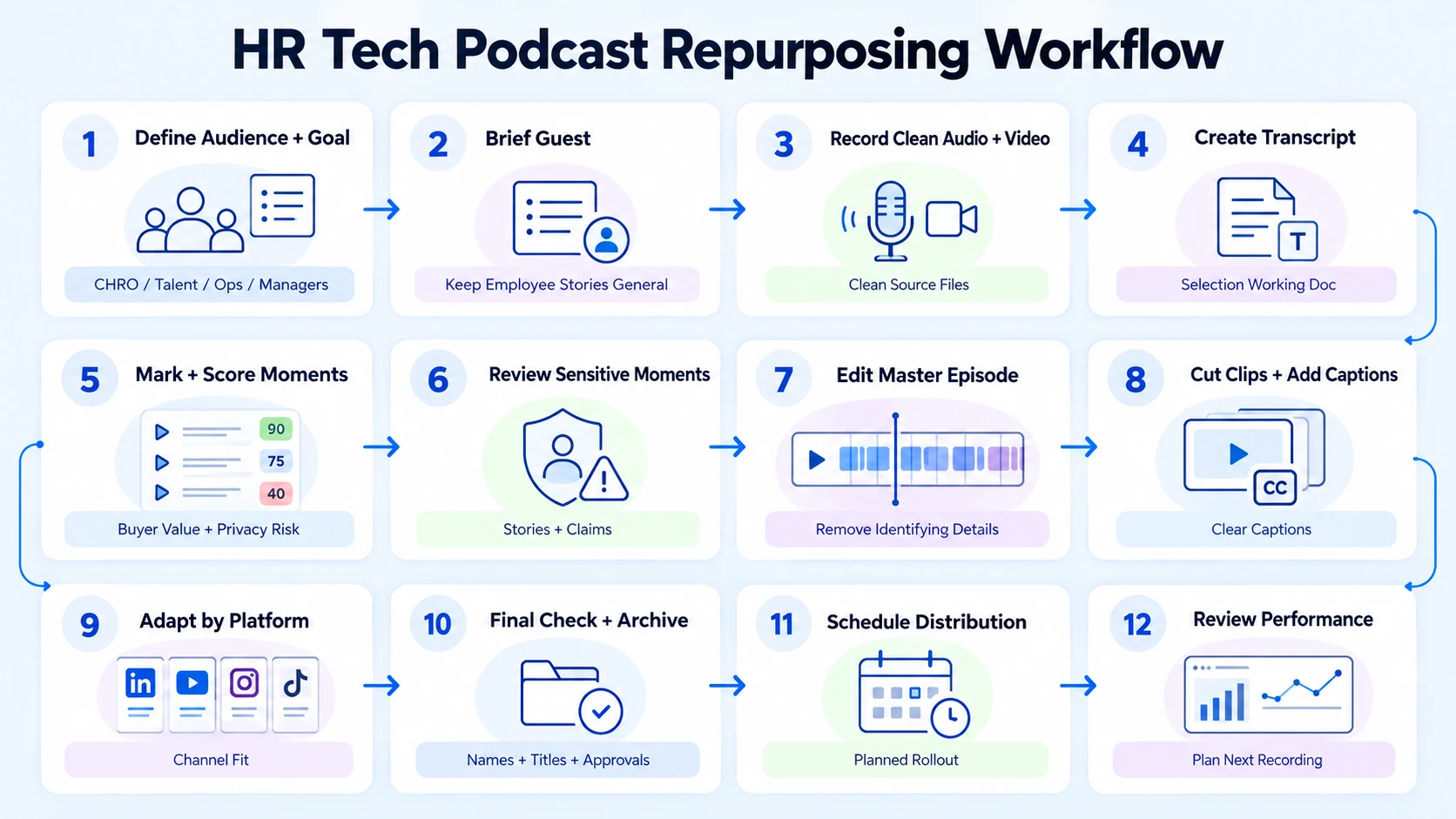
This is the cycle I recommend:
- Define the audience and goal. CHROs, talent acquisition leaders, HR operations, or managers?
- Brief the guest. Explain where clips will appear, ask them to keep employee stories general, and confirm what they can share about their organization.
- Record clean audio and video.
- Create a transcript. This becomes the shared document for selection and review.
- Mark and score moments. I score on clarity, buyer value, whether it stands alone, and privacy or claims risk.
- Review sensitive moments. Your team and, where needed, the guest's organization confirm employee stories and product claims.
- Edit the master episode. Remove identifying details if the review asks for it.
- Cut clips and add captions.
- Adapt for each platform.
- Final check and archive. Confirm names, titles, and approvals.
- Schedule distribution.
- Review performance and feed lessons into the next recording.
A few recording habits make clipping easier. Ask one question at a time. After any general answer, ask the guest for a recent, specific example. Close each episode by asking for their most practical piece of advice in two sentences. That summary often becomes the strongest opening clip.
Small teams can combine steps 4 and 5 and use one template for all short formats. I would not skip the guest brief or the sensitive-moment review. In HR, one careless clip can undo the trust that ten good clips built.
If you are weighing whether to bring in outside help, our breakdown of what is included in a repurposing retainer explains the typical scope.
What one strong episode can usually become:
These are planning ranges, not promises. A candid guest with specific stories produces more usable moments than one who stays at a high level.
Distribution: Reaching HR Leaders and Their Stakeholders
A polished clip with no distribution plan is still an underused asset. HR buyers are concentrated on a few channels, and each one needs a slightly different approach.
LinkedIn is the main channel for HR tech. People leaders, recruiters, and HR operations professionals are highly active there. LinkedIn video consumption has also grown: Digiday reported that total video viewership on LinkedIn rose 36% year over year for the period from October 30, 2024, to January 29, 2025, based on figures shared by the company.
YouTube works for full episodes and how-to topics such as structuring performance reviews or building interview scorecards. YouTube reported more than 1 billion monthly active viewers of podcast content as of January 2025. That is a platform-wide figure, but it supports publishing full episodes there with titles that match how HR leaders search.
Instagram Reels can support employer-brand themes and founder visibility. It is usually secondary for enterprise HR platforms, but it can work for tools aimed at small businesses or hourly workforces.
HR communities and associations are important. Many people leaders learn from peer groups, newsletters, and conferences. Clips that teach something practical fit naturally into those spaces when shared by guests or partners.
Sales and customer success should have a clip library organized by objection: adoption, integration, data security, manager buy-in, and cost. A peer CHRO explaining how they handled manager resistance can be more persuasive than any feature list. Our guide to short-form video for HR tech companies covers formats in more depth.
Employer brand content is a bonus channel. HR tech companies hire people who care about workplace culture, and clips of your own leaders discussing how they run teams can support recruiting as well as sales. One honest clip about how your company handles feedback can serve both audiences.
Guests often have strong networks among HR leaders. Send them their clips with suggested captions. A respected people leader sharing your clip can reach buyers your brand page never will.
How to Measure Results Without Chasing Vanity Metrics
Do not judge HR clips only by views. A clip watched by a few hundred HR directors at mid-size companies can matter more than one with broad reach among job seekers.
Attribution in HR tech is messy because sales cycles are long and often tied to budget years. A buyer might watch clips for months before an evaluation begins. Ask sales to log podcast mentions, add a "how did you hear about us" field to your demo form, and review results monthly.
Comments are an underrated signal. When HR leaders share their own experiences under a clip, that topic usually deserves a follow-up episode. Over time, podcast repurposing should guide your guest list and question plan, not just your posting calendar.
Conclusion
HR tech brands have access to something many B2B companies lack: honest conversations with people leaders who have faced the same challenges your buyers face. The opportunity is to get those stories in front of every stakeholder in the decision, not just the few who listen to every episode.
The decision that matters is to run podcast repurposing as a careful, repeatable system. Protect employee privacy, keep claims about hiring tools grounded, choose moments that help people leaders, and give every clip a clear destination. That is how one conversation keeps building trust long after it is published.
FAQ
What is podcast repurposing for an HR tech company?
It is the process of turning podcast episodes into shorter assets such as clips, carousels, show notes, and sales follow-up videos. For HR tech, it also means protecting employee and candidate privacy and keeping claims about hiring tools accurate.
How much does it cost?
Freelancers often charge per clip or per hour, subscriptions charge a flat monthly fee for editing volume, and agencies price by scope. At Komet Media, engagements typically fall in the range of about $2,500 to $5,000, depending on whether you need full podcast production and original video creation from scratch, episode volume, clip count, review needs, turnaround, and distribution support.
How long does it take to turn one episode into clips?
Editing is rarely the slowest step. Guest and legal approvals often set the timeline. Teams that brief guests before recording and review a list of moments before editing usually publish faster.
What deliverables should we expect from one episode?
A typical plan includes the full edited episode, several short clips, one or two sales-ready clips, quote cards or carousels, and show notes. The mix should follow your buyers and channels.
Should we hire a freelancer or an agency?
A skilled freelancer can handle editing at low volume. An agency is usually a better fit when you need moment selection, review coordination, platform adaptation, and distribution support handled together. Ask any partner how they handle sensitive employee stories.
Can our internal team handle this?
Yes, if someone has editing skills and owns the work every week. HR tech marketing teams are often small, so consistency is the common risk during launches and conference season.
Do guests need their company's approval before clips go live?
Often, yes. Many organizations require communications or legal review for external content featuring their leaders. Confirm this before recording so approvals do not delay publishing.
How does Komet Media work with HR tech brands?
We handle moment selection, editing, captions, platform adaptation, and distribution support, with review steps for sensitive stories built into the workflow. We can also create original videos from scratch or help you launch a podcast if you do not have one yet. If you want to talk through your show, you can book a call with our team.