
🪄 AI Summary
Heading 1
Heading 2
Heading 3
Heading 4
Heading 5
Heading 6
Lorem ipsum dolor sit amet, consectetur adipiscing elit, sed do eiusmod tempor incididunt ut labore et dolore magna aliqua. Ut enim ad minim veniam, quis nostrud exercitation ullamco laboris nisi ut aliquip ex ea commodo consequat. Duis aute irure dolor in reprehenderit in voluptate velit esse cillum dolore eu fugiat nulla pariatur.
Block quote
Ordered list
- Item 1
- Item 2
- Item 3
Unordered list
- Item A
- Item B
- Item C
Bold text
Emphasis
Superscript
Subscript
Most SaaS marketing teams sit on hours of recorded customer interviews and never extract a single usable asset from them. That's a pipeline problem disguised as a content problem. Turning customer interviews into clips is one of the highest-leverage moves a B2B marketing or sales team can make, because your customers already said the thing that convinces other buyers. You just need to cut it, format it, and put it where decisions happen.
TL;DR
- Approximately 92% of B2B customers watch testimonials before buying, your interview footage is decision-stage fuel, not archive content.
- The right clip is 45–90 seconds, outcome-focused, and built around a single buyer pain point.
- AI tools now handle transcript scanning and highlight extraction, human editors still own the final cut.
- Distribution beats production volume: one interview should yield 5–8 distinct clips across channels.
Why Customer Interview Clips Move B2B Pipeline in 2026
Your buyers don't trust your copy. They trust other buyers. 70% of people trust reviews from complete strangers, while only 33% trust brand messaging. When a prospect is evaluating your product, no amount of feature language closes that trust gap faster than a customer who looks like them, describes a problem they recognise, and explains the result they got. The numbers back this up directly.
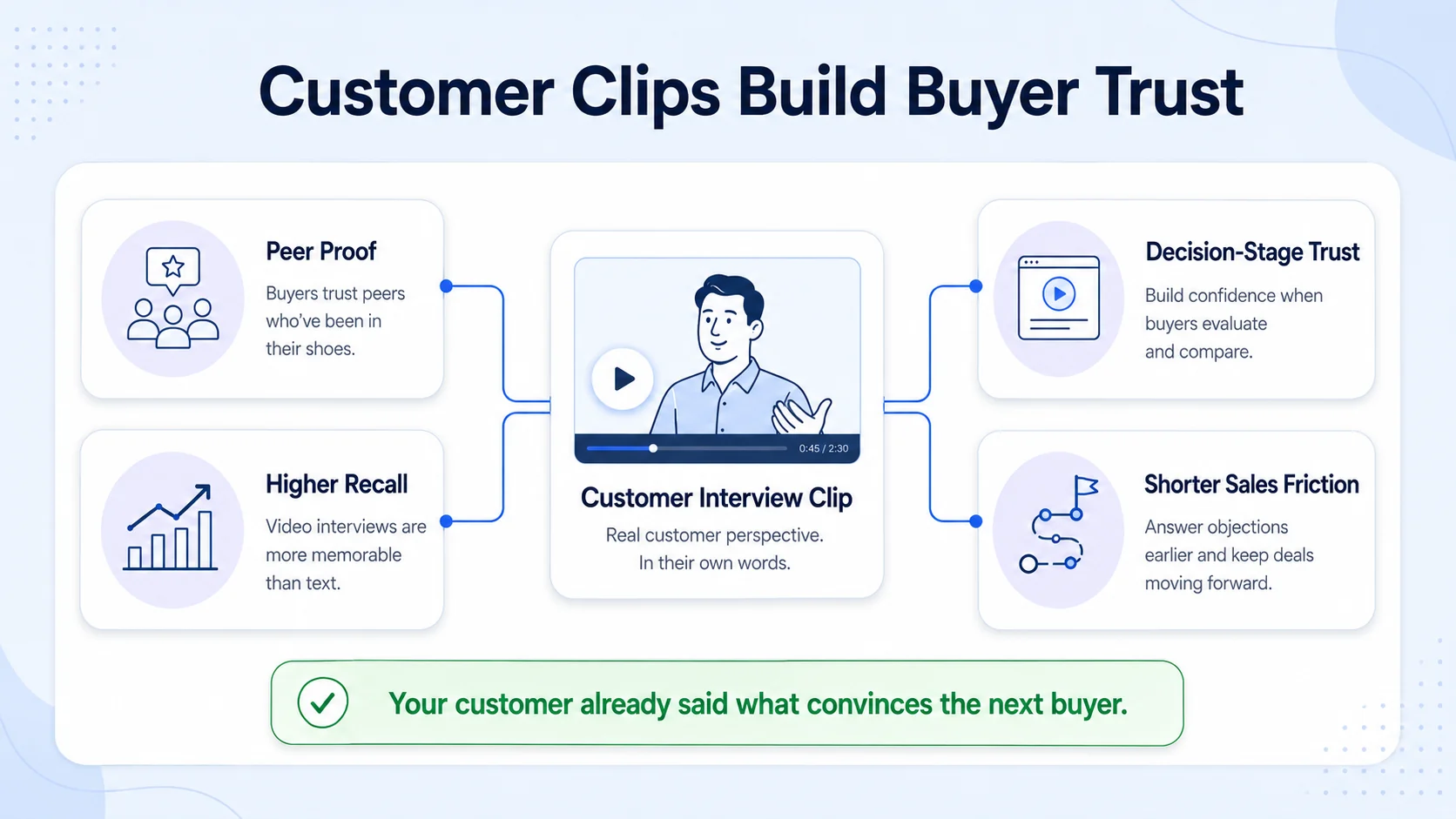
Viewers remember 95% of a video message versus 10% of text, and videos featuring testimonials have a 44% higher conversion rate at the decision stage. For SaaS teams running demo-led or sales-assisted motions, that's not a marketing metric, it's a revenue metric. 92% of B2B buyers are more likely to purchase after watching a trusted testimonial video, 84% of businesses say video helped them generate qualified leads, and landing pages with testimonial videos often convert at twice the rate of those without. The format preference matters too.
53% of B2B buyers prefer video case studies over written testimonials. And 59% of executives opt to watch rather than read about a topic. Your buyer committee, the people approving the budget, are skewing toward video at every stage. Turning customer interviews into clips isn't a content repurposing tactic. It's a trust infrastructure play for teams that want to shorten sales cycles.
Customer interviews, founder updates, and short webinar clips tend to perform best in B2B video formats. Snackable webinar clips can double LinkedIn engagement versus static posts, because they show real outcomes and real people instead of abstract claims. This is exactly where Komet Media's short-form video editing and content repurposing services operate, turning existing interview footage into pipeline-ready clips without requiring your team to become video producers.
How to Identify the Best Moments in a Customer Interview to Clip
Not every minute of a customer interview deserves to become a clip. The goal is to find moments that do one specific job: make a prospect recognise their own situation and lean forward.
These are the six moment types worth extracting:
- The pain statement: The customer articulates the specific problem they had before your product, in their language, not yours. This is your most powerful top-of-funnel hook.
- The before/after contrast: Any sentence that contains both a "before" state and an "after" result. "We used to spend three hours a week on X. Now it's fifteen minutes."
- The metric: A specific number, percentage improvement, time saved, revenue impact. Specificity builds credibility that generic praise cannot.
- The objection overcome: The customer describes why they were hesitant to buy and what changed their mind. This is gold for late-stage sales enablement.
- The surprise moment: Something your product did that the customer didn't expect. These clips create curiosity and drive shares.
- The peer validation statement: When the customer says they've already recommended you to others in their network.
The most effective testimonial videos tell a story, not just praise your product. Structuring the narrative using a Challenge–Solution–Outcome framework keeps the story focused, emotional, and relatable. When reviewing raw footage, scan the transcript first. Look for the words: "before," "used to," "now," "actually," "surprised," "I told my team," and any specific numbers. Those words almost always bracket a clip-worthy moment. The sweet spot for B2B testimonial video length is 45 to 90 seconds, with a 74% completion rate compared to 49% for videos over two minutes. Trim ruthlessly toward that window.
The Video Editing Workflow for Turning Customer Interviews into Clips
A repeatable workflow is what separates teams that consistently extract value from interview footage from teams that let recordings collect dust. Here's the production sequence I use at Komet Media:
- Ingest and transcribe: Upload the raw interview file to your editing tool of choice. Auto-transcription turns a 60-minute interview into a searchable document in minutes.
- Highlight pass: Read the transcript and mark timestamps for each of the six moment types above. Aim to identify 8–12 candidate clips before any editing begins.
- Priority ranking: Score each clip by funnel stage (awareness, consideration, decision) and buyer persona. This determines where each clip goes, not just whether it gets made.
- Rough cut: Extract each clip from the timeline, starting 2–3 seconds before the key statement and ending 2–3 seconds after. Never cut mid-breath.
- Caption and format: Add captions, state the main outcome in the first three seconds, keep videos between 30 and 90 seconds for ad use, and always include captions for mobile viewers.
- Aspect ratio export: Export 9:16 for LinkedIn/Instagram Reels, 1:1 for feed posts, and 16:9 for website embeds and sales decks.
- QA pass: Watch each clip without sound. If the message is unclear from captions alone, rework the caption layer.
- Distribute with intent: Match each clip to a specific channel and placement, LinkedIn post, email sequence, demo follow-up, pricing page embed.
Komet Media's video editing services are built around this exact workflow for B2B SaaS teams that need clips at scale without building an internal production team.
Best Tools for Clipping Customer Interviews into Highlights (2026)
The tooling landscape for turning customer interviews into clips has matured significantly. Here's how the leading options compare for B2B marketing teams:
The best AI clipping tools in 2025 include OpusClip, Descript, and VEED among the top options. Descript approaches clipping through text-based editing, users remove or extract sections by editing the transcript, making it powerful for talking-head interview content. Riverside is a recording platform first, capturing studio-quality audio and video with separate tracks for each participant. Magic Clips is the AI clipping feature built on top, after you finish recording, the AI scans your transcript to find the best moments and turns them into short clips with captions and platform-ready formatting.
For B2B SaaS teams running high volume, Reap is the only tool with both an API and a native MCP server, meaning you can call it from your own code or hand it to an AI agent to run unattended. Modern tools are much better at identifying hooks, strong quotes, and high-retention moments than they were a year ago. But human review still matters because context, brand tone, and narrative payoff are not always obvious to an algorithm.
What Makes a Good Customer Interview Clip for SaaS Marketing
A technically clean clip is not the same as a high-performing clip. The difference is in what the clip does for a specific buyer at a specific moment.
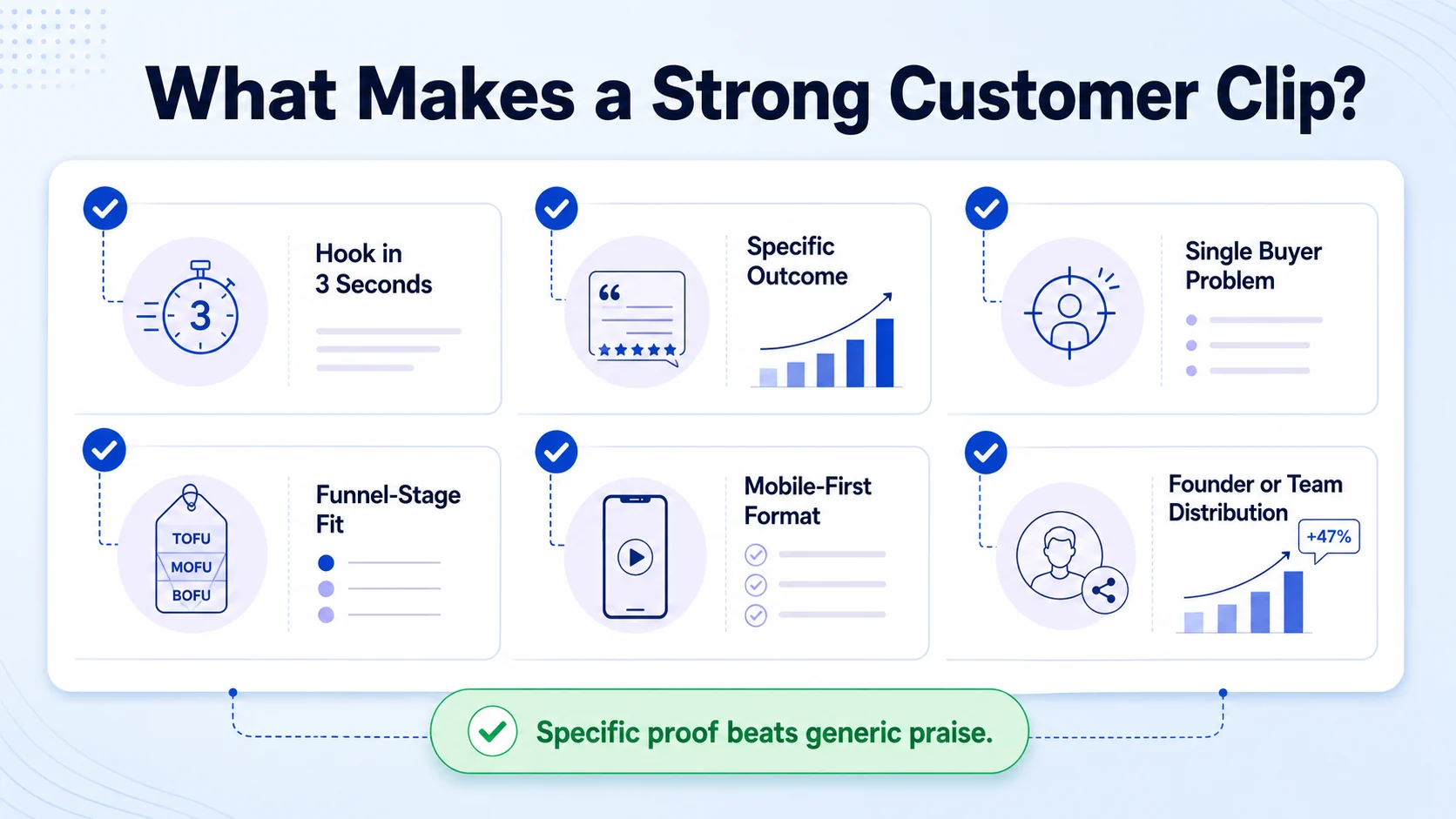
The hook must land in 3 seconds. Not every strong segment is a good clip. A strong clip has a hook that makes someone stop scrolling, not necessarily loud or dramatic, but signalling within the first few seconds why the viewer should care. A strong hook might be a surprising claim, a useful tip, a customer pain point, a sharp opinion, or a relatable problem.
Specificity wins over sentiment. "They were amazing to work with" is not a clip. "We closed 40% more deals in Q2 after switching" is. The difference between a useful testimonial and a forgettable one is usually specificity, "they were great" does not help a buyer make a decision, but a specific outcome, challenge, or measurable result does.
Match the clip to the funnel stage. Top-of-funnel content usually benefits from shorter edits, a 15 to 30-second quote works well in paid social, retargeting, or email. Decision-stage content can support more depth, especially when the customer explains the problem, evaluation process, and outcome.
Format for mobile first. 81% of testimonial views are projected to be on mobile by 2026, and vertical or square edits drive 44% more engagement than horizontal versions.
Deploy clips on founder and employee profiles. Posts from individual profiles receive 8x the engagement of identical content from company pages, and this gap is widening. When founders or account executives share customer clips directly, reach compounds in ways a brand page cannot replicate.
How to Distribute Customer Interview Clips Across the Buyer Journey
Turning customer interviews into clips is half the work. Distribution strategy determines whether those clips actually influence the pipeline.
A single 60-minute customer interview should generate the following asset map:
- LinkedIn (founder/AE profile): 2–3 clips posted as native video with outcome-focused caption copy. Native video posts generate 3x more engagement than text-only posts, and short-form video under 60 seconds achieves 1.4x more reach than longer formats.
- Paid social (LinkedIn/Meta): 1–2 clips used in retargeting campaigns targeting demo-intent audiences. Video demos drive 5x engagement on LinkedIn with 30–90 second clips that show value quickly and fuel retargeting.
- Sales enablement: 1 clip per objection type, shared in follow-up emails or proposals. A single client interview can be transformed into a 90-second hero video for the homepage, 15-second snippets for LinkedIn, or short clips for paid ads and email campaigns.
- Website embeds: Pricing page, case study page, and homepage, wherever hesitation is highest.
- Email sequences: Placing "Video" in an email subject line boosts open rates by 19%, click-through rates by 65%, and reduces unsubscribe rates by 26%.
Integrate testimonial videos throughout the buyer journey, homepage for instant credibility, and case study and pricing pages to reinforce value during evaluation. For SaaS teams running webinar or podcast content alongside customer interviews, the same distribution logic applies. Clips from live sessions consistently outperform produced brand content because they carry the weight of real conversation. You can see how Komet Media approaches this across video marketing services built specifically for B2B growth teams. The teams that win treat turning customer interviews into clips as a system, not a one-off project. One interview. Eight clips. Multiple placements. Measured against demo requests, not just views.
Conclusion
Turning customer interviews into clips is the highest signal-to-effort content move available to B2B SaaS marketing teams right now. The proof is already recorded. The buyer language is already there. The trust is already built, you just need to extract and deploy it.
Key takeaways:
- Lead with the customer's outcome, not your product's features.
- 45–90 seconds is your target clip length for maximum completion rate.
- Distribute from founder and team profiles, not just the company page.
- Use AI tools to surface candidates; use human editors to make the final call.
- One interview should generate 5–8 clips across funnel stages and channels.
Start turning your existing interview footage into a pipeline, Komet Media builds this system for funded SaaS and B2B tech teams.
Frequently Asked Questions
Q1: How long should a customer interview clip be for B2B SaaS marketing?
The proven sweet spot is 45 to 90 seconds. At this length, completion rates reach 74%, compared to 49% for videos over two minutes. For paid social and email, 15–30 seconds is effective. For decision-stage sales use, clips can extend to 90 seconds when the customer walks through their problem, evaluation, and result.
Q2: How many clips can I realistically get from one customer interview?
A 45–60 minute interview typically yields 5–8 usable clips when you systematically scan for pain statements, outcome moments, objection overrides, specific metrics, and peer validation. Most teams stop at one or two because they lack a clip extraction workflow. Build the system and the yield multiplies immediately.
Q3: Do I need professional video production equipment to make good interview clips?
Not necessarily. Audio quality matters more than camera quality in B2B video. A clean recording with minimal background noise, recorded in a quiet space, can be edited into credible clips. Remote interviews recorded through Riverside or Zoom at high quality are entirely sufficient. Production value helps at enterprise level, but specificity of message matters more than visual polish.
Q4: Where should customer interview clips be placed for the most pipeline impact?
Pricing pages, case study pages, and demo follow-up emails are the three highest-leverage placements. These are the moments in the buyer journey where doubt is highest. Clips that address specific objections or show a measurable ROI at these touchpoints directly reduce friction and accelerate close velocity.
Q5: What's the difference between a customer interview clip and a testimonial video?
A testimonial video is typically a produced, scripted, or semi-scripted piece recorded specifically for marketing. A customer interview clip is extracted from a longer, naturally occurring conversation, which often makes it more credible. Buyers can sense the difference. Unscripted, conversational clips frequently outperform polished testimonials because authenticity is the signal buyers are actually looking for.
Q6: Should our founder be sharing customer clips on LinkedIn instead of the company page?
Yes, strongly. Personal profiles generate 8x more engagement than company pages on LinkedIn, and that gap is growing. When a founder or account executive shares a customer clip directly, especially with a short, genuine comment about why that customer's story resonates, the organic reach and trust signal is substantially higher than the same content posted from a brand account.