
What Is Included in a Podcast Repurposing Retainer: Step-by-Step
If your podcast is producing zero pipeline, the problem isn't the content, it's the system. Most B2B founders record great conversations, then let them collect dust. A podcast repurposing retainer fixes that by turning every episode into a full content engine. This guide breaks down what is included in a podcast repurposing retainer, how the workflow runs month-to-month, what it costs, and how to know whether a retainer is the right structure for your team right now.
TL;DR
- A podcast repurposing retainer converts each episode into short-form video clips, show notes, transcripts, social posts, and email content on a recurring monthly cadence.
- Core deliverables span video (YouTube Shorts, Instagram Reels, TikTok), written (SEO blog posts, show notes, newsletter), and distribution (social scheduling, content calendar).
- Retainer pricing typically spans $3,000–$25,000/month depending on episode volume, strategic services, and scope.
- Retainers beat one-time projects for teams publishing consistently and building long-term pipelines.
What Is Included in a Podcast Repurposing Retainer: The Core Deliverables
A well-structured podcast repurposing retainer isn't a list of tasks, it's an operating system. Here's what every serious retainer should deliver each month per episode.
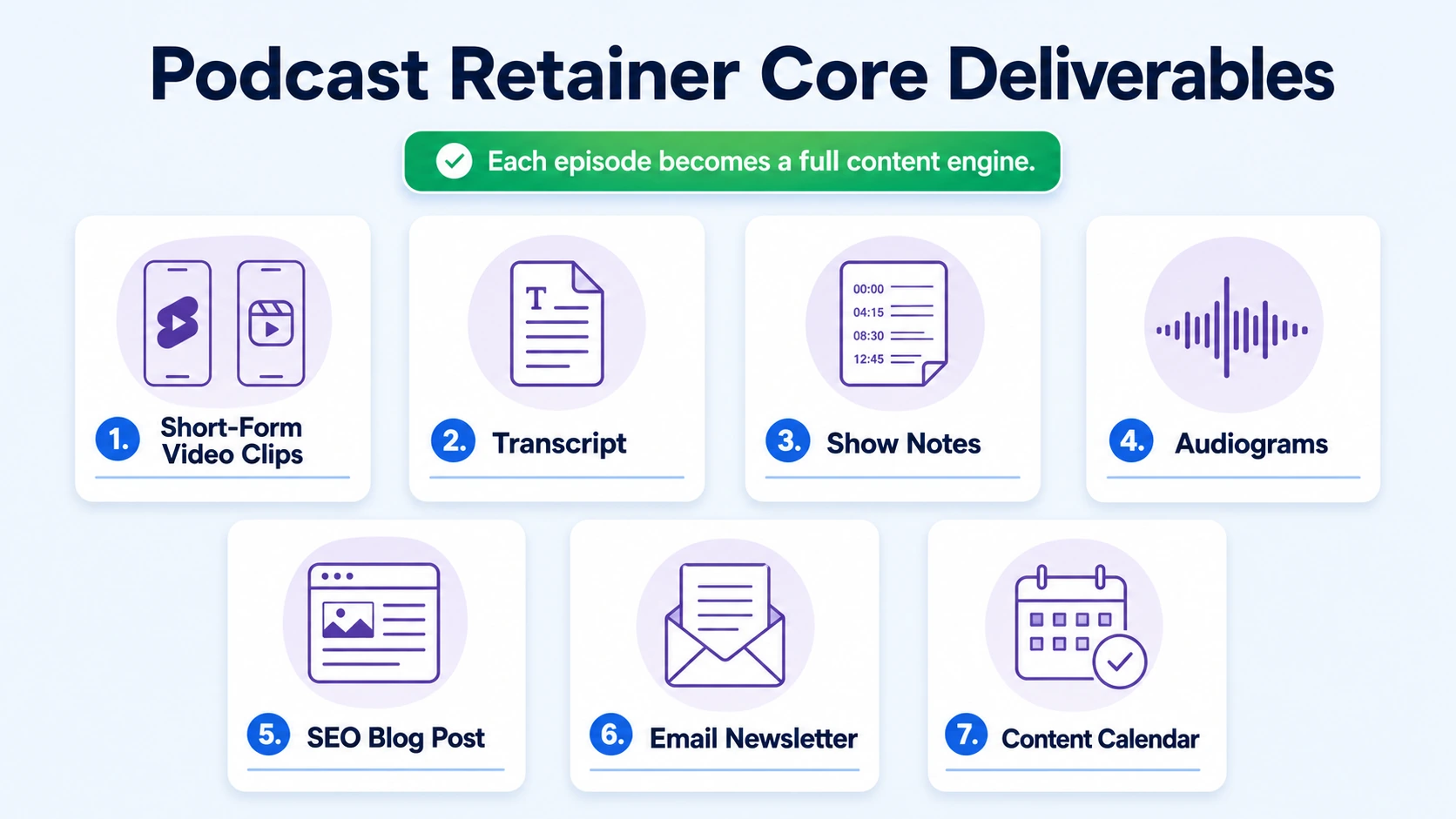
Short-form video clips: The highest-leverage deliverable. We pull 3–5 punchy moments per episode, the insight, the counterintuitive take, the buyer-relevant hook, and edit them into branded clips for YouTube Shorts, Instagram Reels, and TikTok. Each clip gets captions, B-roll or motion graphics, and an opening hook frame optimized for autoplay.
Transcript generation: Every episode gets a clean, time-stamped transcript produced through tools like Descript or Riverside.fm. A clean episode transcript supports accessibility, SEO, and content repurposing, AI transcription tools like Descript and Riverside typically run $15–$30 per episode in platform costs.
Show notes: Structured, SEO-optimized show notes that cover the episode summary, key timestamps, guest links, and a call to action. Show notes optimization, RSS feed setup, directory submission, and podcast analytics review should all be included or clearly priced as add-ons.
Audiograms: Branded static or animated audio waveform clips, a staple for LinkedIn and Twitter promotion. Short-form clips from podcast episodes extend distribution and fuel social media; producing 3–5 audiogram clips per episode via a tool like Headliner or Wavve runs $30–$100 per episode in platform fees or contractor time.
SEO blog post: A long-form article repurposed from the episode transcript, structured around the topic's search demand. Not a transcript dump, a real article written to rank and educate buyers.
Email newsletter: A 200–400 word episode summary formatted for your list, with a clip embed and a CTA to the full episode or a relevant service page.
Content calendar: Every asset mapped to a publishing schedule across platforms, built in Notion, Airtable, or a shared Google Sheet, and updated weekly. Content strategy and analytics are included in all monthly packages at agencies running proper retainers. If a retainer you're evaluating doesn't include strategy, it's a production service, not a growth system.
How Does a Podcast Repurposing Retainer Work Month-to-Month?
You're buying continuity, that usually means recurring planning, calendar management, production coordination, publishing, and some level of promotion or reporting.
Here's how a clean retainer workflow runs:
- Episode submission: You record and deliver the raw file (audio or video) via a shared Dropbox, Google Drive, or directly through Riverside.fm. Turnaround clock starts on receipt.
- Transcript + raw edit: The episode is transcribed using Descript or a human-reviewed workflow, then the full edit is completed with audio cleanup, intro/outro, and music.
- Clip selection: Our team reviews the transcript and flags 3–5 high-value moments, insights that will resonate with your ICP on short-form platforms.
- Asset production: Clips are edited into branded short-form videos with captions. Show notes, the blog post, audiograms, and the email newsletter are written in parallel.
- Client review: All assets go into a shared review folder. You have one round of revision across all formats.
- Social scheduling: Approved assets are scheduled through your social media scheduling tool, typically Buffer, Later, or Publer, aligned to the content calendar.
- Reporting: A monthly performance summary covers clip views, reach, and engagement across YouTube Shorts, Instagram Reels, TikTok, and LinkedIn.
Teams that publish on a weekly or recurring series benefit from a standing workflow; the agency can shape content and execution over time, and repurposing, guest coordination, and distribution live better inside a system than as add-ons.
What Deliverables Are Included Across Different Retainer Tiers?
Not all retainers are built the same. Here's how scope typically breaks down across tiers:
Most full-service podcast production companies include audio/video editing, audio mastering, show notes optimization, RSS feed distribution, and episode scheduling, and premium tiers add video clip creation, audiograms, podcast analytics reporting, and a dedicated producer for strategy and workflow management.
Podcast Repurposing Retainer vs. One-Time Project: Which Is Better?
The honest answer: it depends on what the podcast needs to do for your business. A one-time project makes sense when you have a specific goal with a hard end date, a product launch, a conference series, or a backlog of 20 episodes you want turned into clips before a fundraise. If you're preparing for a launch, extended time off, or a business pivot, a one-off content repurposing project might be what you're looking for.
A retainer is the right structure when:
- You publish on a weekly or biweekly cadence and need a repeatable workflow
- Your goal is ongoing pipeline, buyer education, or founder visibility, not a one-time spike
- You want your content system to compound, not reset every month
- Your team doesn't have the internal bandwidth to manage clip production, scheduling, and distribution
Project pricing fits limited runs and defined deliverables, branded mini-series, internal comms podcasts, launch packages, pilot seasons, or event-based content. For B2B SaaS and funded tech teams, the retainer wins. Your buyers need repeated exposure to your product thinking before they'll book a demo. One great clip isn't enough. A system that publishes 15–20 assets per month from a single recording session is what moves the pipeline.
Most serious B2B podcast production operates on monthly retainers rather than per-episode pricing, because outcomes compound, and a one-time project doesn't build that. A retainer doesn't just save editing time. It builds a content moat, one that your competitors can't replicate with a one-time sprint.
How Much Does a Podcast Repurposing Retainer Cost in 2026?
Monthly retainer pricing typically runs: Basic (editing + show notes, one episode per week) at $1,500–$2,500 per month; Premium (multiple episodes, video production, content repurposing) at $4,000–$7,000+ per month. For context on the full market range, retainer ranges typically span $3,000–$25,000/month depending on episode volume, strategic services, and guest booking support.
What drives price up or down:
- Episode volume: Weekly publishing costs roughly 2x a biweekly cadence in ongoing production costs.
- Video scope: Video adds 30–50% to production costs compared to audio-only packages.
- Repurposing depth: Shows that convert each episode into blog posts, newsletter content, and LinkedIn posts carry additional writing costs or AI tool overhead.
- Guest booking: Professional guest booking adds $1,000–$3,000 monthly but can replace massive opportunity costs.
What you should never do: shop retainers on price alone. The key mistake marketing leaders make is shopping podcast production services as if they're buying identical outputs, in practice, they're choosing between a technical execution partner and a strategic operating partner.
At Komet Media, our podcast repurposing and short-form video retainers are built specifically for B2B SaaS and funded tech teams. The goal isn't polished audio, it's clips that educate your buyers and move the pipeline.
What a Podcast Content Agency Does Each Month (Inside the Workflow)
Most teams underestimate how much operational surface a good agency covers. Beyond the deliverables, a full-service retainer includes:
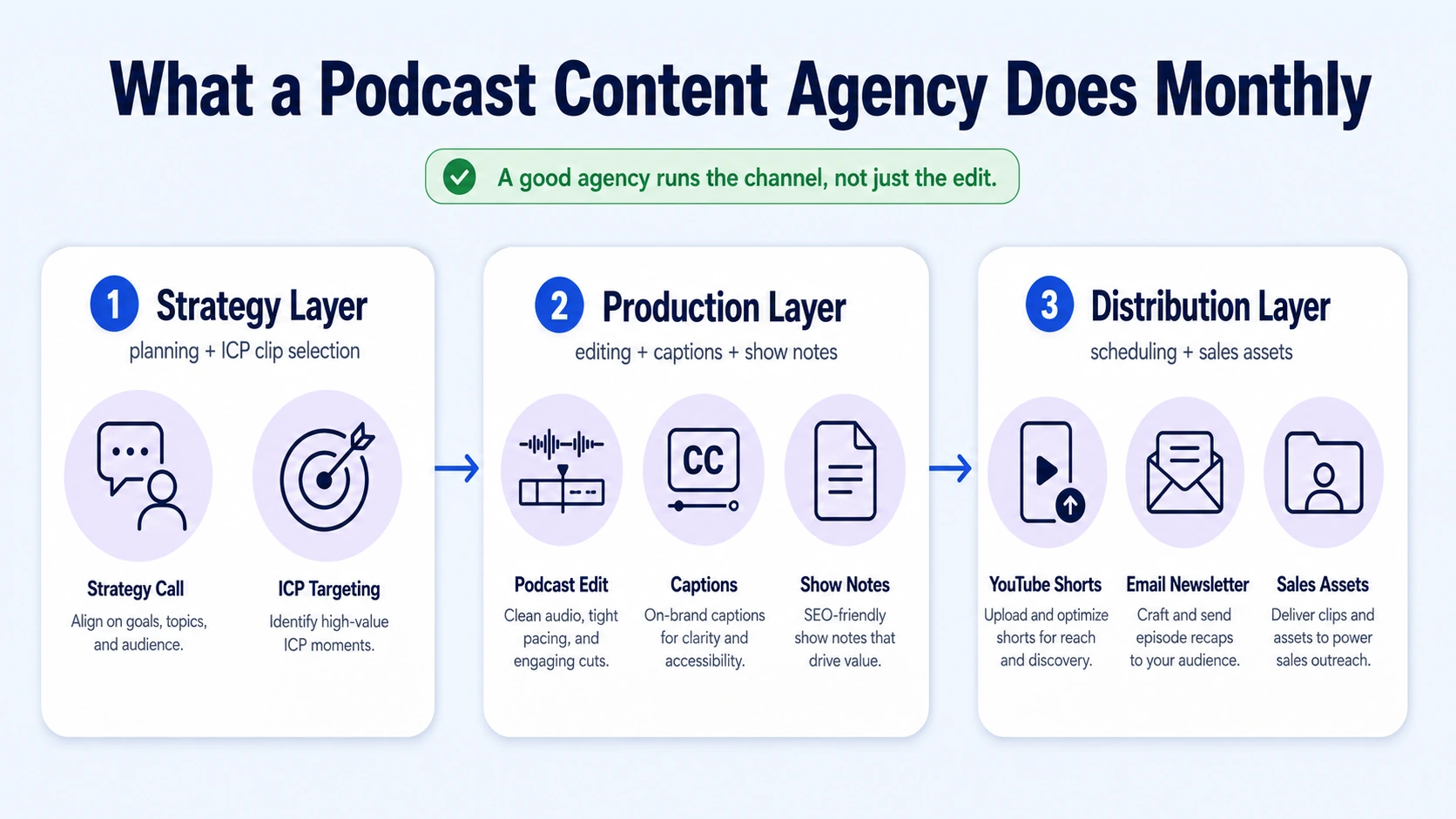
Strategy layer:
- Monthly content planning call to align episode topics with pipeline priorities
- ICP-aligned clip selection, we choose moments your buyers care about, not moments that sound impressive
- Platform-specific formatting strategy for Instagram Reels, YouTube Shorts, and TikTok Content Strategy
Production layer:
- Full podcast editing and audio mastering
- Branded short-form video editing with captions, motion graphics, and hook frames via Canva templates or After Effects
- Podcast transcription and show notes written to rank
Distribution layer:
- Social media scheduling across all platforms
- YouTube Shorts publishing with SEO-optimized titles and descriptions
- Email newsletter delivery to your list
- Internal distribution to sales teams as sales enablement assets
Komet Media is a B2B video growth agency, not just an audio shop, your podcast becomes one input into a broader content system where clips, short-form video, show notes, and social assets all come out of the same recorded conversation. This is the difference between a vendor who delivers files and a partner who runs your content channel. The latter helps you run a channel that supports brand authority, audience development, executive visibility, content repurposing, and in some cases pipeline creation.
Evergreen content compounding is the long-game benefit most teams miss. A clip published today from an episode recorded six months ago still generates inbound demand, because the insight is timeless, even if the recording date isn't.
Conclusion
- A podcast repurposing retainer converts every episode into short-form clips, show notes, transcripts, SEO blog posts, audiograms, email newsletters, and a scheduled content calendar.
- Retainers beat one-time projects for B2B teams publishing consistently and targeting pipeline, demo demand, and buyer education.
- Monthly investment ranges from $1,500 for basic editing-plus-notes to $7,000+ for full video repurposing and distribution.
- The right agency acts as a strategic operating partner, not just a production vendor, choosing one that aligns deliverables to your ICP and pipeline goals.
Explore Komet Media's podcast and short-form video services or book a call to scope your retainer.
Frequently Asked Questions
Q1: What is a podcast repurposing retainer?
A podcast repurposing retainer is a monthly service agreement where an agency converts your podcast episodes into multiple content formats, short-form video clips, show notes, transcripts, SEO blog posts, audiograms, and email newsletters, on a recurring basis aligned to your publishing schedule.
Q2: How many assets does a podcast repurposing retainer produce per episode?
A growth-tier retainer typically produces 5 short-form video clips, 1 SEO blog post, 2–3 audiograms, show notes, and 1 email newsletter per episode. Starter tiers produce fewer formats; full-system tiers can yield 15–20 individual assets from a single recording.
Q3: How long does it take to turn around a repurposed episode?
Most agencies deliver a full asset suite within 3–5 business days of receiving the raw recording. Rush turnarounds of 24–48 hours are available at most agencies for an additional fee.
Q4: What tools does a podcast repurposing agency typically use?
Common production tools include Descript and Riverside.fm for transcription and editing, Canva for branded clip templates, and Buffer or Later for social media scheduling. Your content calendar is usually managed in Notion or Airtable.
Q5: Is a podcast repurposing retainer worth it for B2B SaaS companies?
Yes, if your podcast addresses topics your buyers care about. Short-form clips from founder or expert conversations are among the highest-trust formats for educating buyers before a demo. A retainer systemizes that output without adding internal headcount.
Q6: What's the difference between a podcast editing service and a podcast repurposing retainer?
A podcast editing service delivers a clean, published audio file. A repurposing retainer takes that same episode and multiplies it into clips, written content, and scheduled social posts, turning one recording into a full month of buyer-facing content.

