
🪄 AI Summary
Heading 1
Heading 2
Heading 3
Heading 4
Heading 5
Heading 6
Lorem ipsum dolor sit amet, consectetur adipiscing elit, sed do eiusmod tempor incididunt ut labore et dolore magna aliqua. Ut enim ad minim veniam, quis nostrud exercitation ullamco laboris nisi ut aliquip ex ea commodo consequat. Duis aute irure dolor in reprehenderit in voluptate velit esse cillum dolore eu fugiat nulla pariatur.
Block quote
Ordered list
- Item 1
- Item 2
- Item 3
Unordered list
- Item A
- Item B
- Item C
Bold text
Emphasis
Superscript
Subscript
I'm Rajan Soni, founder at Komet Media. Every week I work with B2B SaaS founders and funded AI teams who are sitting on gold, recording demos, podcasts, webinars, sales calls, and converting almost none of it into pipeline. Video editing for founders & CEOs: what to know usually boils down to one question: should I be doing this myself, or building a system around it? This guide gives you the full answer.
TL;DR
- Founder video on LinkedIn builds buyer trust faster than any cold outbound motion, but only when it's consistent and edited well.
- DIY editing is a time trap, the real cost is strategic attention pulled from revenue work.
- A workflow built around repurposing existing content (demos, podcasts, webinars) or creating fresh content from scratch is the highest-leverage starting point.
- Outsourcing to a B2B-focused short-form video editing partner beats both freelancers and DIY for most funded teams.
How Should a Founder Approach Video Content Creation?
Most founders think about video the wrong way. They treat it as a production problem when it's actually a positioning problem. The question isn't "how do I make videos?", it's "what do I need buyers to believe before they take a demo?" Start there. Map your buyer's objections and knowledge gaps, then work backwards into content. A 60-second talking head video that kills one common sales objection is worth more than a polished brand film that says nothing specific.
Founder-led content, direct-to-camera, unscripted, expert-driven, is more than a social media trend. It's a mechanism for building trust, showcasing passion, and fostering loyalty. For B2B SaaS specifically, that translates directly to pipeline. Inbound outreach, where a prospect messages a founder after consuming their content, converts at roughly 14.6% to discovery call versus 1.7% for outbound prospecting.
Here's the framework I use with every new client:
- Identify your three buyer objections: Price, trust, and "does this actually work for my use case?" Video should address each one.
- Choose your primary content source: Repurposing existing recordings (demos, podcasts, webinars) is the fastest starting point, or you can opt for producing fresh, original content from scratch.
- Pick one format and one platform: For B2B, LinkedIn video is the non-negotiable starting point. 62% of B2B marketers say LinkedIn is their most effective platform for video distribution.
- Set a publishing cadence before you set a production standard: Two videos per week, consistently, beats one perfect video per month every time.
- Repurpose relentlessly: One 45-minute webinar becomes 8 to 12 short clips. That's the asset leverage most SaaS teams leave completely untapped.
The biggest mistake I see founders make is conflating starting with perfecting. Get the first five videos out. Refine from there.
What Executives Need to Know About Video Editing: The Technical Essentials
You don't need to master the craft of editing to make smart decisions about it. But you do need to understand the variables that separate forgettable content from content that actually builds pipeline.
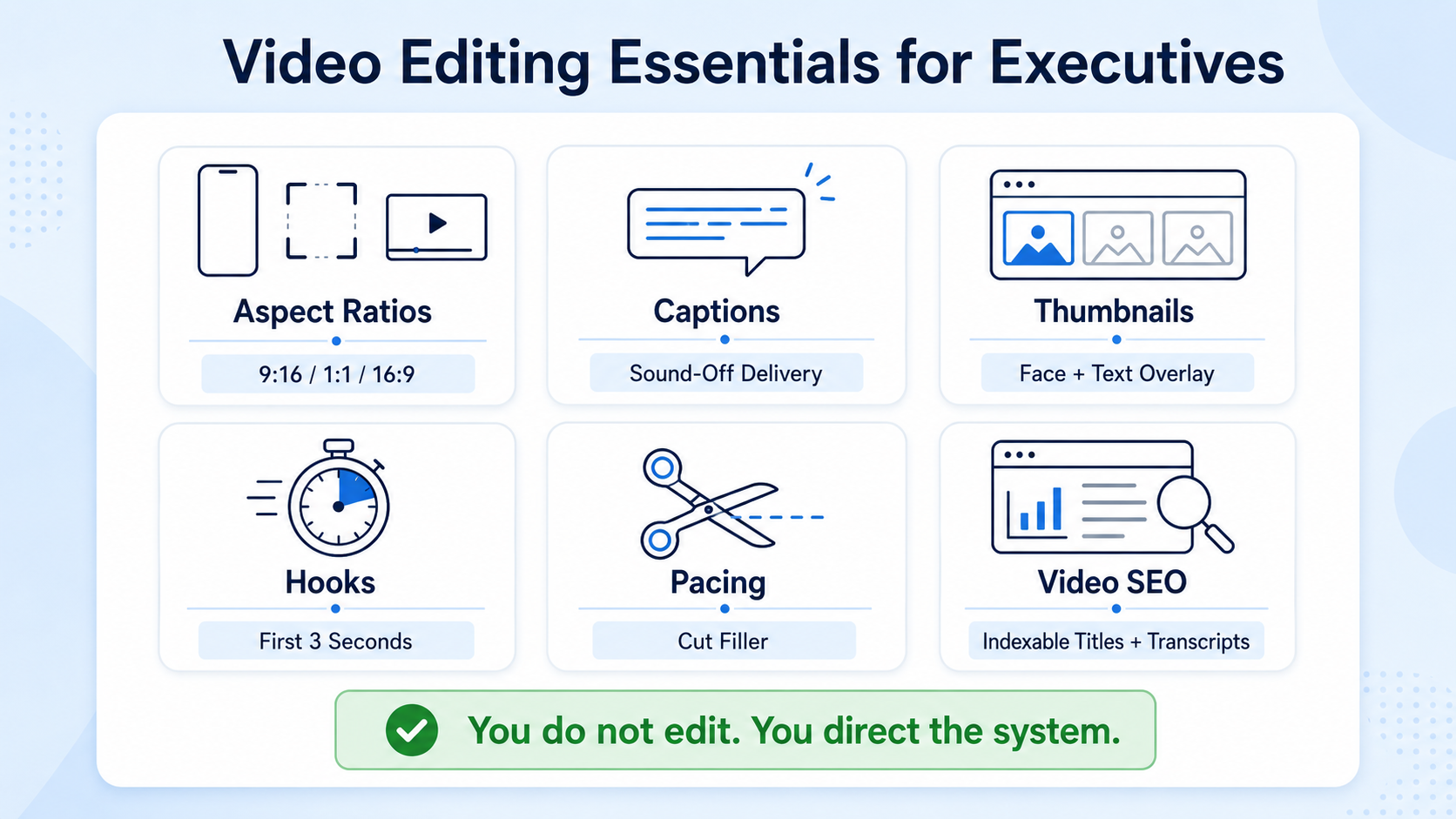
Aspect ratio formats: Vertical video (9:16) is non-negotiable for LinkedIn mobile, Instagram Reels, and YouTube Shorts. Square (1:1) works across placements. Horizontal (16:9) is for YouTube long-form and embedded site video. Ship all three from a single recording when possible.
Captions and subtitles optimization: Most LinkedIn videos are watched without sound. Captions are not optional, they are the message delivery system. Word-by-word animated captions hold attention longer than static subtitle blocks.
Video thumbnails: Custom thumbnails on YouTube and LinkedIn significantly affect click-through rates. A clean face shot with a bold text overlay outperforms abstract imagery for B2B talking head videos.
Hooks: The first three seconds of any short-form video determine whether the rest gets watched at all. A strong hook names a specific problem the viewer has, not a generic benefit you offer.
Pacing and cuts: B2B buyers are not passive audiences. Cut every unnecessary pause, filler word, and redundant sentence. Creative decisions drive 73% of video completions, and only 7% of B2B video ads LinkedIn analyzed contained any human emotion. That gap between what performs and what most brands produce is where founder video has its edge.
Video SEO: Titles, descriptions, and transcripts on platforms like Wistia and YouTube are indexable. A well-titled thought leadership video becomes a search asset that compounds over time, not just a social post that disappears in 48 hours.
Executive takeaway: You don't edit. You direct. Know what makes a good video, brief it clearly, and let a professional execute.
Best Video Editing Software for Non-Technical Founders (and When to Skip It)
If you're going to touch editing at all, match the tool to your actual use case, not to what a professional editor would use.
In 2025 and 2026, Adobe has doubled down on AI with Firefly-powered features, bringing text-based editing, AI-generated B-roll suggestions, and improved auto-captioning directly into the timeline. That makes Premiere Pro more accessible than it used to be, but the learning curve is still steep for a founder with a full calendar.
For most founders, Descript is the gateway tool. It lets you edit video by editing a text transcript, delete a sentence, and the clip disappears. It's purpose-built for talking head content and podcast editing, which maps directly to the founder video format.
Adobe Premiere Pro is ideal for professionals, DaVinci Resolve for color grading, Final Cut Pro for Mac users, and CapCut for social media creators. CapCut, iMovie, and Wondershare Filmora are beginner-friendly tools with simple interfaces and prebuilt effects.
The honest answer: if you're producing more than four to six videos per month, the time cost of DIY editing exceeds the cost of outsourcing. At that point, the software question becomes irrelevant.
Should CEOs Edit Their Own Videos, or Hire Someone?
The short answer: record, don't edit. Your time is worth too much to spend it in a timeline.
Founders who tried editing their own videos after hours, marketers who missed product launch deadlines because the raw footage sat untouched, and teams who rotated editing responsibilities like a hot potato, the result is usually burnout, inconsistency, and growth left on the table. Here's how to think about the build vs. buy decision:
Edit yourself if:
- You're pre-revenue and have zero budget
- You're producing one video per week or fewer
- You're using Descript and it takes under 30 minutes per video
Outsource if:
- You're producing more than four videos per month
- Your content library includes webinars, demos, or podcasts that need repurposing
- Your sales cycle involves multiple buyer touches and video is a sales enablement asset, not just a branding play
- You need high-quality, original content produced from scratch to fill specific strategic gaps
On cost: hourly rates for video editing fluctuate between $20 and $150 per hour. A dedicated subscription model through a B2B-focused agency gives you predictable output, consistent brand standards, and an editor who understands your ICP, which a generalist freelancer almost never does. An in-house hire in the U.S. costs $48,000 to $85,000 per year in salary alone, plus software licenses, equipment, benefits, and management time.
For most funded SaaS teams producing 10 to 25 videos per month, a specialist video editing service wins on both cost and output quality. At Komet Media, we build production systems around your existing content or produce new, high-impact content for you from scratch.
What Makes a Good Founder Video on LinkedIn?
Between 2024 and 2025, video posting on LinkedIn increased 13.77%, while video impressions rose 73.39% and video views rose 52.17%, suggesting distribution and viewing are growing faster than publishing. The platform is rewarding video more than ever, but not all video equally. A good founder video on LinkedIn has these characteristics:
- Strong hook in frame one: Open mid-thought or mid-problem. Never open with your name or company.
- Captions burned in: Assume zero sound. Animated word-by-word captions, not a static block at the bottom.
- Vertical or square format: 9:16 or 1:1. Horizontal video is penalized in the LinkedIn mobile feed.
- 60 to 90 seconds for thought leadership: Long enough to deliver a complete idea, short enough to hold attention. Product demos and educational content can run to three minutes.
- One idea per video: Founders frequently try to pack three talking points into 90 seconds. The result is a video that says nothing memorable.
- A text hook in the caption: The first line of the LinkedIn post caption carries as much weight as the video hook itself.
- A clear signal of expertise: The viewer should leave knowing exactly what you do, who you help, and why you're credible, without you ever saying "I'm an expert in X."
LinkedIn video engagement rate reached 6.00% in 2025, up from 5.60% the previous year. That upward trend rewards founders who invest in production quality and consistency now, before the feed gets more competitive. The formats that work best for B2B SaaS founders: unpacked objections ("Why buyers tell us X, and why they're wrong"), process walk-throughs, product truth videos, and podcast clips trimmed to the sharpest insight.
Common Video Editing Mistakes Founders Make, and How to Fix Them
These are the patterns I see repeatedly across B2B SaaS and AI startup teams:
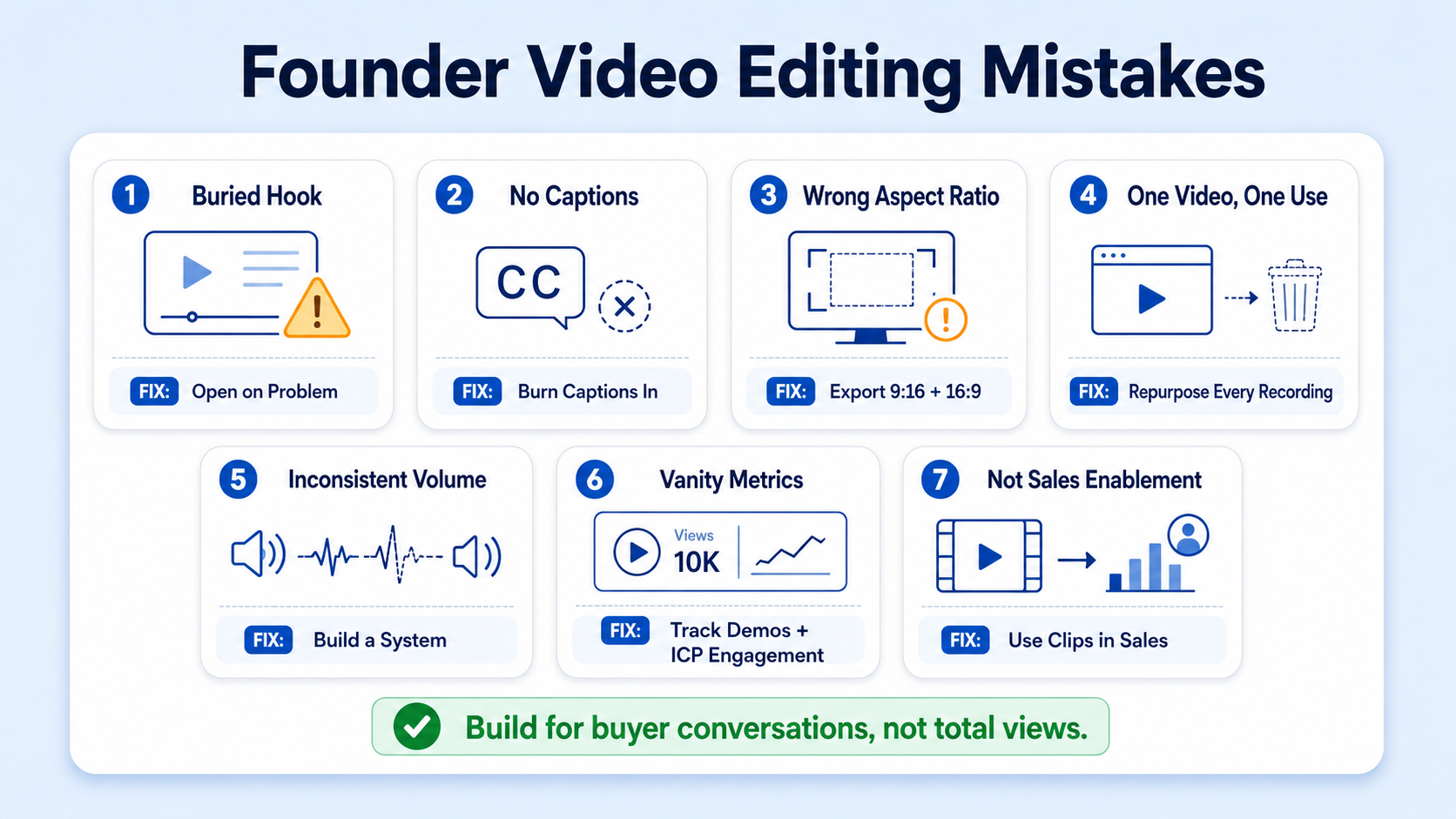
Mistake 1: Burying the hook. The first five seconds are slow, safe, and generic. Fix: Open on the problem, not the introduction.
Mistake 2: No captions. The majority of LinkedIn video is consumed silently. No captions means lost reach and lost message. Fix: Always burn in captions before publishing.
Mistake 3: Wrong aspect ratio. Uploading a 16:9 horizontal video to a vertical-first feed. Fix: Always export 9:16 for social-first distribution, 16:9 for YouTube and embedded video.
Mistake 4: One video, one use. Recording one demo and posting it once. Fix: One recording should produce clips for LinkedIn, a short-form asset for the sales team, a highlight for the website, and a YouTube version. That's a content repurposing strategy in practice.
Mistake 5: Inconsistent volume. Three videos in week one, silence for two weeks. Fix: Build a production system, not a production sprint. Without a capture habit and a pipeline, even motivated founders go quiet within six weeks.
Mistake 6: Vanity metrics over pipeline metrics. Optimizing for views instead of demo requests and qualified conversations. Fix: Track engagement from your ICP specifically, not total impressions. Measurable pipeline from founder content typically appears at nine to twelve weeks, in the form of sourced demos.
Mistake 7: Treating video as marketing, not sales enablement. Your edited clips belong in your sales sequences, proposal emails, and onboarding flows, not just your LinkedIn feed. A well-edited product truth video sent before a discovery call can cut the time spent on basic qualification questions by half.
Conclusion
Video editing for founders & CEOs: what to know comes down to three non-negotiable principles.
- Record more, edit less yourself. Your job is to capture thinking on camera, everything downstream can and should be systematized.
- Repurpose or create from scratch. While webinars, demos, and podcast episodes are excellent assets to mine first, creating targeted new content from scratch is equally vital for specific positioning.
- Build for pipeline, not for views. Every video should move a buyer closer to a conversation, or it's not earning its place in the system.
If you're ready to stop leaving content on the table, Komet Media's video editing and content repurposing services are built specifically for B2B SaaS and AI teams who need a system, not just a service.
Frequently Asked Questions
Q1: How long should a founder video be on LinkedIn?
For thought leadership and talking-head content, 60 to 90 seconds performs best. Product explanations and educational content can run up to three minutes. Anything longer needs a compelling narrative hook to hold a B2B buyer's attention in a feed environment.
Q2: Do I need professional camera equipment to start?
No. A modern smartphone with a ring light, a clean background, and a lapel mic produces footage that edits well. The editing, captions, pacing, format, matters more than camera hardware. Start with what you have and upgrade once your system is running.
Q3: How much does it cost to outsource video editing for a startup?
Hourly rates for video editing fluctuate between $20 and $150 per hour , depending on complexity. Subscription-based agency models typically range from a few hundred to several thousand dollars per month. For most funded SaaS teams, a specialist agency beats a generalist freelancer on consistency, brand alignment, and B2B context.
Q4: What if I don't have existing content to repurpose?
If you don't have a library of webinars or demos yet, Komet Media handles from-scratch production to build your initial asset base. We can also help you identify the three to five key moments from any future sales calls or recordings to begin a repurposing cycle alongside your new original content.
Q5: Should I hire a video editor or use an AI editing tool?
AI tools like Descript and CapCut for Business handle transcription, rough cuts, and captions well. They're best for founders producing one to two videos per week with simple formats. For consistent, branded, multi-format output at volume, with B2B-specific positioning built in, a specialist editor or agency produces better results at lower total time cost.
Q6: How soon will founder video content generate pipeline?
Expect three to six weeks for first signals such as inbound DMs and impression growth, nine to twelve weeks for measurable pipeline in the form of sourced demos, and twelve to eighteen weeks for compounding effects on CAC. Consistency across that window is the only variable fully within your control.