
🪄 AI Summary
Heading 1
Heading 2
Heading 3
Heading 4
Heading 5
Heading 6
Lorem ipsum dolor sit amet, consectetur adipiscing elit, sed do eiusmod tempor incididunt ut labore et dolore magna aliqua. Ut enim ad minim veniam, quis nostrud exercitation ullamco laboris nisi ut aliquip ex ea commodo consequat. Duis aute irure dolor in reprehenderit in voluptate velit esse cillum dolore eu fugiat nulla pariatur.
Block quote
Ordered list
- Item 1
- Item 2
- Item 3
Unordered list
- Item A
- Item B
- Item C
Bold text
Emphasis
Superscript
Subscript
If your B2B video gets impressions but no traction, the hook rate is where to look first. Most marketing teams obsess over completion rate, CTR, and pipeline metrics while ignoring the number that gates all of them. Understanding what is a good hook rate for B2B video, how to calculate it, and what to do when it underperforms is the difference between video that drives demand and video that drains budget. Here's the complete breakdown.
TL;DR
- A B2B video hook rate of 25% is average, 30%+ is strong, and 40%+ is elite across major platforms.
- Hook rate = 3-second video views ÷ total impressions × 100.
- On LinkedIn, a view rate above 25% signals strong creative resonance.
- Low hook rate is almost always a first-frame problem, not a targeting problem.
What Does Hook Rate Mean in Video Analytics?
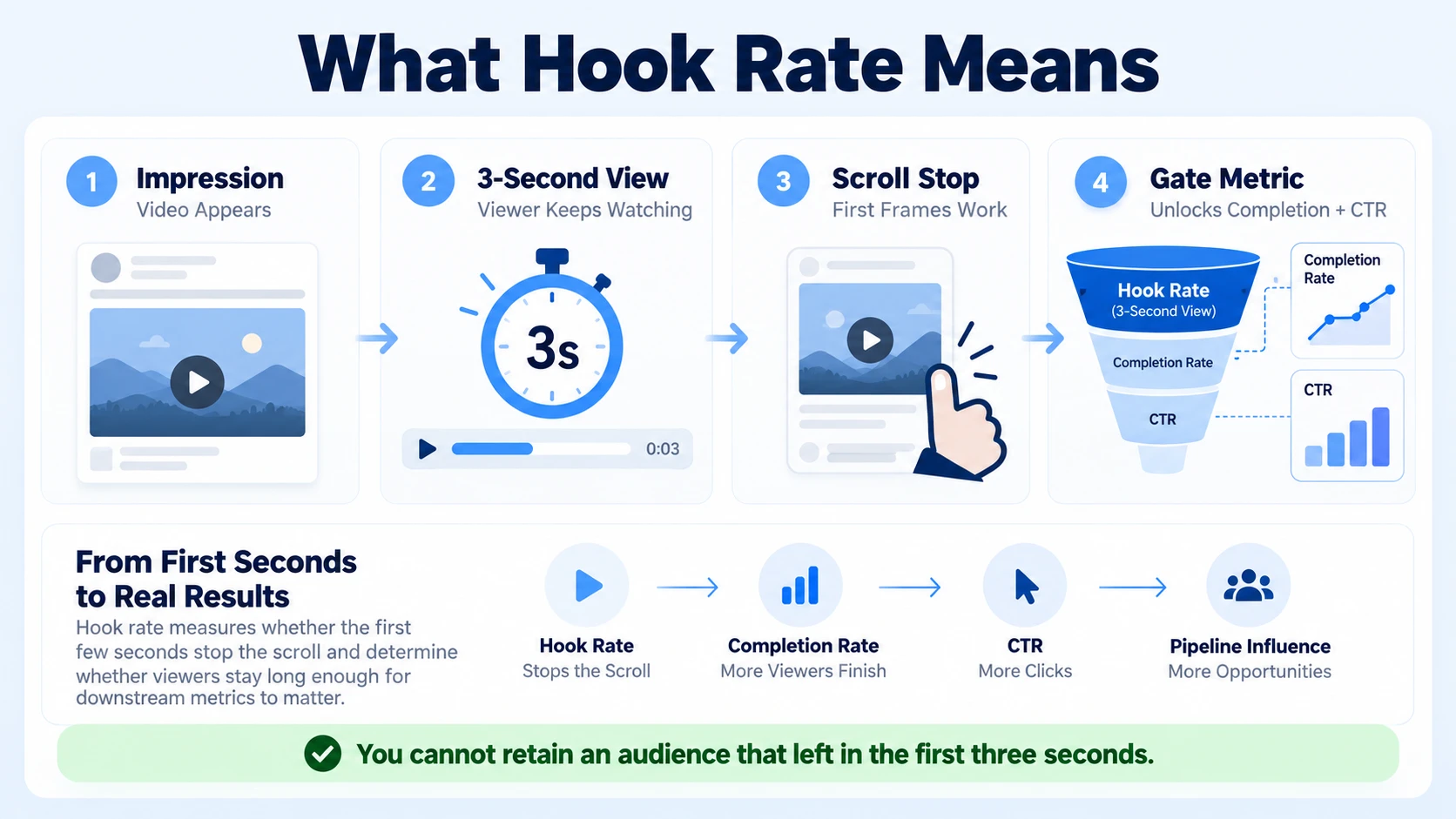
Hook rate is the percentage of ad impressions where the viewer kept watching a video past the 3-second mark. It measures how well your first frames stop the scroll. In the attention economy, those three seconds are the only window you have before a buyer moves on. Hook rate is the clearest leading indicator of video ad performance because no amount of compelling storytelling, strong offers, or sharp CTAs matters if viewers scroll past before any of it plays.
For B2B teams running short-form video strategy on LinkedIn, Meta, or TikTok for Business, it is the first number to audit. The metric goes by a few names, hook rate, thumb-stop rate, and video hook rate are used interchangeably across the industry.
Platform reporting varies slightly: Meta uses a 3-second threshold while TikTok uses 2 or 6 seconds depending on the metric. That matters because you should never compare across platforms. A 2-second bar is easier to clear than a 3-second bar, so TikTok hook rates structurally read higher than Meta hook rates for identical creative.
Hook rate also sits upstream of every other video engagement metric. Vidyard and Wistia both track completion rate and video retention rate as core B2B audience engagement metrics, but neither number is valid if the hook rate is broken. You cannot retain an audience that left in the first three seconds. Hook rate is a gate metric. If it fails, downstream metrics like completion rate, click-through, and pipeline influence never get the chance to fire.
For B2B SaaS teams running founder-led content, product demos, or repurposed webinar clips, this is especially important. The B2B buyer journey is longer than B2C. Buyers need multiple exposures before they request a demo. If your video fails the three-second threshold repeatedly, you are burning impressions without building any buyer trust or thought leadership content recognition.
How to Calculate Hook Rate for LinkedIn Video Ads
The formula is straightforward. Hook rate = (3-second video views / total impressions) × 100.
Here is how to build it inside the platforms your team is likely using:
On LinkedIn Campaign Manager:
- Open your campaign and navigate to the reporting columns.
- Add the "Video Views" metric (LinkedIn counts a view at 3 seconds of continuous play).
- Divide video views by impressions and multiply by 100.
- Anything above 25% indicates strong creative resonance. Below 15% suggests your hook needs work or targeting requires refinement.
On Meta Ads Manager:
- Open Ads Manager and go to Columns > Customize Columns.
- Name it "Hook Rate." In the formula builder, enter 3-Second Video Plays ÷ Impressions. Set the format to Percentage.
- One gotcha: the percentage format multiplies by 100 for you. If you add ×100 to the formula as well, your column will read 2,700% instead of 27%.
- Share the metric with everyone on the ad account so your whole team reads the same number, then save the column set as a preset.
A worked example: 100,000 impressions and 27,000 3-second plays is a 27% hook rate. That's average-to-good by every published benchmark.
One important note on LinkedIn specifically: if your videos are not captioned, you are losing the majority of LinkedIn viewers in the first 3 seconds regardless of how good the hook is. LinkedIn is almost exclusively a silent-autoplay environment, making captions a non-negotiable first step before any hook rate optimization.
B2B Video Hook Rate Benchmarks 2026: Good vs. Bad
Here are the current benchmarks for what is a good hook rate for B2B video across the platforms most relevant to SaaS and tech teams:
The cross-industry Meta average in H1 2026 was 25.44%, up from 24.42% the previous half. For B2B specifically, Business and Industrial reached a 33.03% hook rate in March 2026, and the Services category rose nearly 7 points between February and May.
On Meta, a hook rate above 25% is table stakes. Above 30% is good. Above 40% is elite, the point where the algorithm starts treating your creative as genuinely relevant and rewards it with lower CPMs and broader distribution.
For scaling decisions specifically, one benchmark for scaling a B2B video ad is a 30%+ hook rate combined with a watch-through rate above 20% at the 15-second mark. Warm retargeting audiences show thumbstop rates of 30 to 45% (median ~36%) versus cold prospecting at 18 to 28% (median ~22%). Factor that into how you read your numbers, cold outreach to new ICP accounts will always read lower than retargeting a warmed list.
Why Is My B2B Video Hook Rate So Low?
Low hook rate is almost always a creative problem, not a targeting problem. Under 20% is a first-frame problem, and no amount of budget or audience surgery fixes a first frame. The most common causes for B2B video in the SaaS and tech space:
- Logo-first opening: Starting with a brand animation or title card is the fastest way to signal "ad" to a scrolling buyer. If the first frame is a brand logo or a black title card, the ad starts dead. Open on a human face, a product in motion, or a high-contrast scene.
- No motion in frame one: Even half a second of camera move, subject motion, or graphic animation signals "video, not ad" to the viewer's pattern recognition.
- Wrong format: Letterboxed 16:9 video padded to fit a vertical surface loses 5 to 12 hook-rate points versus native 9:16 builds. If your team is repurposing webinar recordings without reformatting them for vertical, this alone will tank the metric.
- No captions: The single most impactful editorial decision for LinkedIn retention is captioning. LinkedIn's own data suggests that captioned videos see significantly higher completion rates than uncaptioned ones.
- Audience mismatch: If hook rate is low, fix the first 3 seconds first. Check the first frame, product visibility, on-screen text, motion, placement crop, and audience match before rewriting the whole ad.
For founder-led growth content and product demos specifically, the hook also fails when the opening is too abstract. B2B buyers respond to specificity. "We help companies grow faster" loses to "Your demo-to-close rate is probably 15%. Here's why." Lead with the problem, not the solution.
How to Improve Hook Rate on B2B LinkedIn Video Ads
These are the changes that move the needle fastest for SaaS and funded tech teams, ordered by impact:
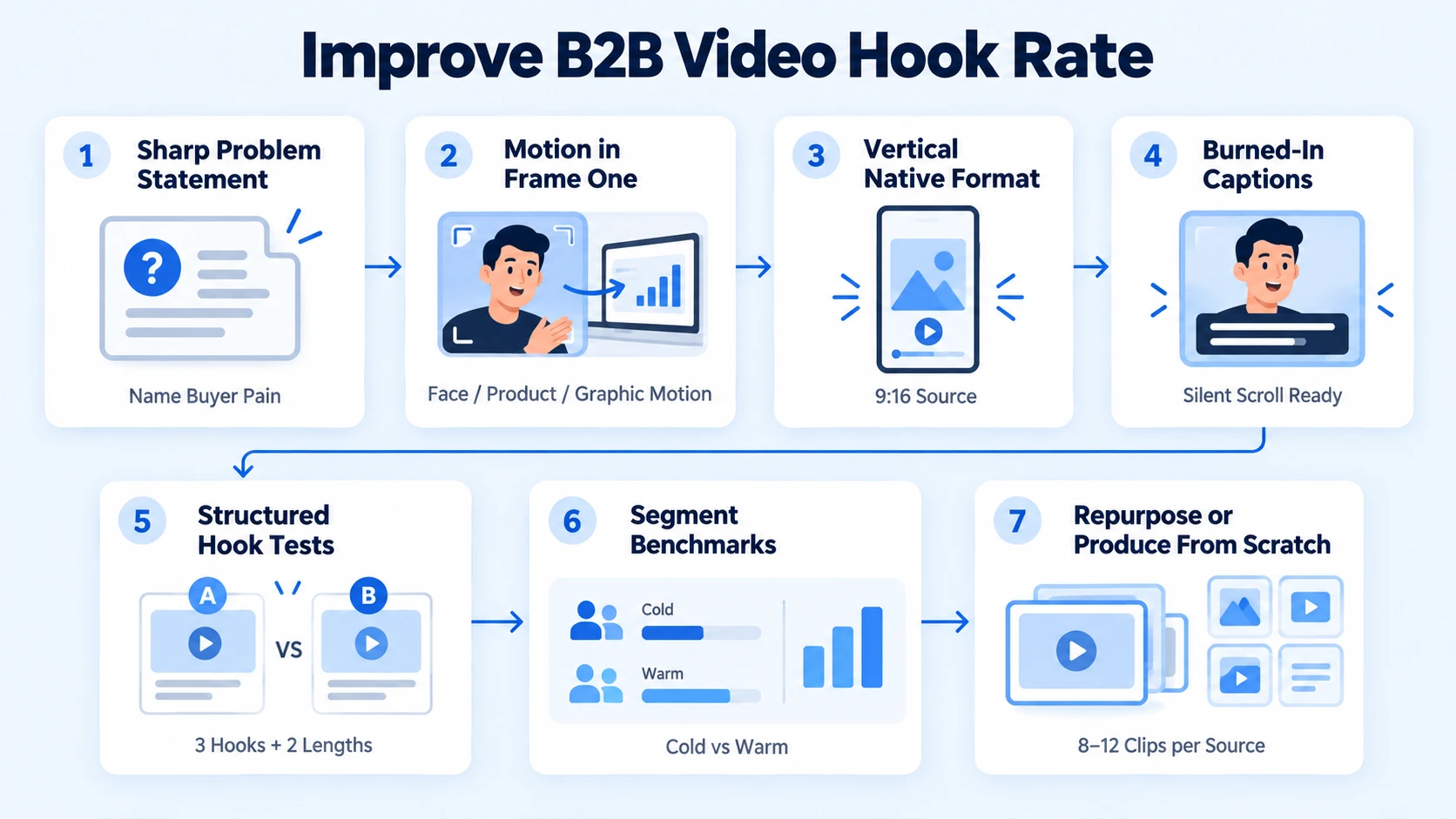
- Open with a sharp problem statement: Name the buyer's exact pain in the first three seconds. Thought leadership content that opens with "If you're a Series A SaaS team struggling to turn demo requests into pipeline..." outperforms any brand-first opener.
- Put motion in frame one: Faces with direct eye contact lift hook rate 4 to 8 points across tested accounts. A founder speaking directly to camera with captions is the highest-performing format for B2B buyer education.
- Go vertical native: Build 9:16 from the source, not by cropping a 16:9 recording. This applies to repurposed podcast clips, webinar excerpts, and product demos alike.
- Add burned-in captions: Captions serve both the silent-scroll environment and platform algorithm optimization. LinkedIn prioritizes content that keeps viewers engaged.
- Run structured hook tests: Test 3 hooks, 2 lengths, and 2 calls to action per topic, then scale only the winners.
- Segment your benchmarks: Warm retargeting audiences reach medians around 36% while cold prospecting sits closer to 22%. Don't compare the two pools in one report.
- Build a content repurposing framework or produce from scratch: A single founder interview, webinar, or podcast episode can yield 8–12 short-form clips with different hooks, each tested independently. For teams starting from zero, Komet Media also builds video ad libraries entirely from scratch—handling buyer research, scripting, recording guidance, editing, and platform-specific formatting end-to-end for B2B SaaS, AI, and tech startups & teams. This allows B2B brands to scale video performance without adding internal headcount or contracting local crews. Explore the options at Komet Media.
A strong hook in the first 3 seconds increases average retention by 23% , which means fixing the hook is not just about the hook rate metric itself. It cascades into video retention rate, completion rate, and eventually pipeline influence.
B2B Video Marketing Benchmarks: Hook Rate, Completion Rate, and the Full Picture
Hook rate is one signal inside a larger video performance benchmark stack. Here is how the key metrics relate for B2B demand generation:
LinkedIn videos under 30 seconds see up to a 200% lift in view completion rates compared to longer formats, which means keeping your short-form video strategy tight directly improves multiple metrics simultaneously. The Content Marketing Institute and HubSpot both consistently highlight short-form video as the highest-ROI format for B2B buyer education, and the data on completion rates supports that.
For B2B video marketing services tailored for B2B SaaS, AI, and tech startups & teams focused on pipeline and demo demand, hook rate and completion rate should be reviewed together. A high hook rate with a low completion rate means the opening is working but the middle is losing the buyer. A low hook rate with high completion rate means the targeting is tight but the creative is not stopping the scroll.
Judge hook rate with CTR, hold rate, CPC, and CPA together. A high hook rate means people paused, not that they bought. The goal for demand generation is to move buyers into the next stage of the B2B buyer journey, and hook rate is just the first gate.
If your team is running video advertising and using Vidyard or Wistia for gated content, layer in those platform-specific retention metrics alongside your paid social hook rate data. Together they give you a complete picture of how buyers engage with your content across the funnel.
Conclusion
Here is what to take away and act on:
- Know your number: Calculate hook rate as 3-second views ÷ impressions × 100 for every video ad you run.
- Use the right target: 25% is average, 30%+ is strong, and 40%+ is elite for B2B video on Meta and LinkedIn in 2026.
- Fix the first frame first: Logo openers, static shots, and missing captions are the most common causes of low hook rate, not audience targeting.
- Connect it to the pipeline: Hook rate is the entry gate. Pair it with completion rate and CTR to understand the full buyer journey from scroll to demo.
Understanding what is a good hook rate for B2B video is just the start. The real leverage is in building a repeatable system that tests hooks, repurposes existing footage or creates new videos from scratch through full-service research, scripting, and post-production, and ties performance directly to pipeline. That is the work we do for B2B SaaS, AI, and tech startups & teams at Komet Media.
Frequently Asked Questions
Q1: What is a good hook rate for B2B video in 2026?
A good hook rate for B2B video is 30%+ on Meta and LinkedIn feed placements. The cross-industry average sits at 25.44% in H1 2026. For Business and Industrial categories specifically, 30–33% is the competitive range. Anything under 20% signals a first-frame problem that needs immediate creative attention.
Q2: What percentage of viewers should watch the first 3 seconds of a B2B video?
At minimum, 25% of viewers should watch past the 3-second mark before you consider scaling spend. Strong B2B campaigns targeting warm audiences typically reach 30–36%. Cold prospecting to new ICP accounts usually lands between 18–28% even with solid creative.
Q3: How do I calculate hook rate for LinkedIn video ads?
Divide your 3-second video views by total impressions and multiply by 100. LinkedIn Campaign Manager reports video views natively. A view rate above 25% indicates strong creative resonance; below 15% means your hook or targeting needs work before you increase budget.
Q4: Why is hook rate more important than CTR for B2B video?
CTR only fires after a viewer watches enough to act. Hook rate tells you whether the creative is stopping the scroll at all. A low hook rate with decent CTR just means a small, self-selected audience is clicking. Fix hook rate first to scale reach, then optimize for CTR downstream.
Q5: Does hook rate differ between organic LinkedIn video and paid ads?
Yes. Paid video hook rate is calculated against impressions and tracked in Ads Manager. For organic LinkedIn video, there is no direct hook rate metric. The closest proxy is saves-to-views ratio, which correlates strongly with completion behavior and signals algorithmic distribution.
Q6: How many hook variations should I test per B2B video concept?
Test at least 3 hook variations per concept before drawing conclusions. Different opening lines, visual approaches, and problem statements will perform differently with the same audience. Running structured hook tests is the most cost-efficient way to improve what is a good hook rate for B2B video in your specific account.