🪄 AI Summary
Heading 1
Heading 2
Heading 3
Heading 4
Heading 5
Heading 6
Lorem ipsum dolor sit amet, consectetur adipiscing elit, sed do eiusmod tempor incididunt ut labore et dolore magna aliqua. Ut enim ad minim veniam, quis nostrud exercitation ullamco laboris nisi ut aliquip ex ea commodo consequat. Duis aute irure dolor in reprehenderit in voluptate velit esse cillum dolore eu fugiat nulla pariatur.
Block quote
Ordered list
- Item 1
- Item 2
- Item 3
Unordered list
- Item A
- Item B
- Item C
Bold text
Emphasis
Superscript
Subscript
Most B2B buyers have already shortlisted their vendor before your sales team sends the first email. Your company page won't get you on that list. Your voice will. Building a Founder Personal-Brand Engine is the strategic process of turning your knowledge, story, and distribution into a compounding asset that earns trust before any demo is booked. This guide breaks down exactly how to build that engine from scratch, what to avoid, and how to make it scale without turning content creation into a second full-time job.
TL;DR
- Buyers complete 61% of their decision before speaking to any provider, and around 80% of deals go to the provider already on the Day One shortlist.
- A founder personal brand engine works by converting your existing thinking and content into consistent visibility across the channels your buyers use.
- Short-form video, LinkedIn thought leadership, and content repurposing are the three core mechanics of a scalable engine.
- The goal is not follower count. It is a pipeline: demos requested, trust built, and deals influenced.
What Is a Founder Personal-Brand Engine and How Does It Work?
A Founder Personal-Brand Engine is not a posting schedule. It is a system: one that takes your raw expertise and transforms it into distributed content assets that attract, educate, and convert buyers over time. Think of it as a content flywheel with three rotating parts: capture, produce, distribute.
Most founders produce nothing because the bar feels impossibly high. The engine lowers that bar by separating input from output. Your input is thinking, a voice memo, a point of view from a sales call, a lesson from a product failure. The output is multiple content assets built by a system around that thinking.
A single voice memo can produce a LinkedIn post, a newsletter paragraph, an X thread, a short video script, and a sales deck pull quote. One capture becomes five assets. The founder's time investment: five minutes for the voice memo and ten minutes to approve the draft.
This is the architecture that separates a one-off content experiment from a scalable brand machine. Founders like Gary Vaynerchuk built early authority by documenting everything; Alex Hormozi built inbound demand by teaching the market at scale. Both are operating the same underlying system: high-volume idea capture, structured narrative architecture, and aggressive content distribution channels.
The engine has three gears:
- Narrative Architecture: Define your thesis, your positioning, and the one problem you own in your market.
- Production System: Turn founder input into formatted content assets via a repeatable process.
- Distribution Layer: Push content through LinkedIn, short-form video, and owned channels systematically.
If a founder talks about 10 different things in 10 posts, people remember none. The most impactful founder-led marketing aligns all content around a unified message: one challenge, one response, and one guiding principle.
At Komet Media, we build this exact engine for B2B SaaS, AI Native companies, funded tech teams, PE and VC Firms, Founders and C-Suite executives The output is not just content, it is a trust-building pipeline asset.
How to Build a Founder Personal Brand Strategy From Scratch
The foundation is not your LinkedIn bio. It is your point of view. Every piece of content you produce is either reinforcing a position or creating noise. Start with position, then build outward.
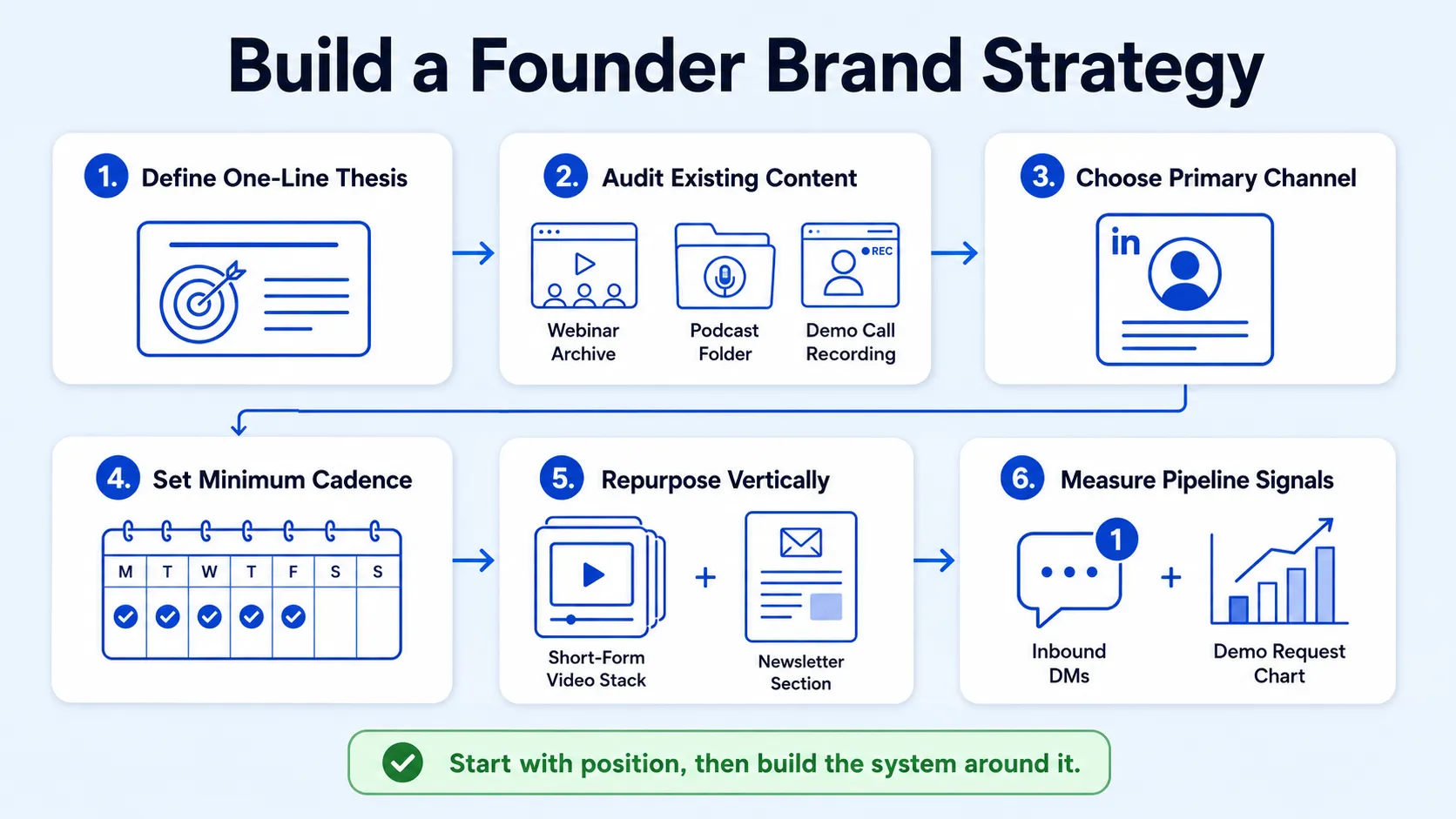
Step 1: Define your one-line thesis. What do you believe about your market that most of your peers do not? This single conviction should govern every post, every video, every webinar.
Step 2: Audit your existing content. Webinars, podcasts, demo calls, sales decks, this is your raw material library. Most founders have months of high-quality thinking locked inside formats no buyer ever sees.
Step 3: Choose your primary channel. LinkedIn is where categories get formed, vendors get evaluated, and trust gets established before any sales conversation begins, nothing else combines the professional context, the decision-maker density, and the current algorithmic environment as effectively in 2026.
Step 4: Build a minimum viable content cadence. A minimum viable engine of one blog post, one newsletter, and three LinkedIn posts per week is sustainable without a full marketing team and produces compounding results within six months.
Step 5: Repurpose vertically. Each LinkedIn post becomes a short video clip. Each webinar becomes five clips. Each podcast episode becomes show notes, a newsletter section, and three quotes. This is a content repurposing strategy working the way it was designed to.
Step 6: Measure pipeline signals, not vanity metrics. Track demo requests sourced from content, inbound DMs from ICP accounts, and sales cycle length for deals where the prospect consumed your content before booking. Typically, it takes 6–12 months to see meaningful results from founder-led content.
That timeline shortens significantly when you build a system rather than trying to create from scratch every week. Beyond our editing services, Komet Media provides end-to-end production support—from strategy and scripting to recording guidance—to make every step of the process frictionless for busy SaaS and Tech founders.
LinkedIn Optimization: How Startup Founders Build Thought Leadership Online
LinkedIn's algorithm prioritizes content from personal profiles 5x more than company page posts. Personal profiles generate about 8x more engagement than company pages, and employee-shared content drives roughly 5x more leads. For founders not investing in their personal LinkedIn presence, these numbers represent a direct revenue cost.
Here is what LinkedIn optimization actually means for B2B founders in 2026:
- Profile headline: Your headline should state who you help and what outcome you create, not your job title.
- About section: Lead with the problem you solve, not your résumé. Buyers scan this to determine whether you understand their world.
- Content format mix: Video creation on LinkedIn is growing at 2x the rate of other formats. Prioritize short-form video alongside text posts.
- Posting frequency: Publish 2–3 posts per week on LinkedIn, consistency outperforms volume every time.
- Comment strategy: Spend 15 minutes per day commenting with genuine insight on posts from ICP accounts. This extends your organic reach beyond your follower base.
- Engagement signals: 76% of buyers prefer to connect with people who share relevant industry insights rather than product-focused content.
58% of decision-makers say thought leadership influenced who they awarded business to (Edelman-LinkedIn, 2024). That means thought leadership is not brand awareness, it is a direct revenue variable. The founders winning on LinkedIn in 2026 are the ones treating it as a buyer education channel, not a personal diary.
Our video marketing services are built to help founders produce LinkedIn video content consistently without it consuming their calendar.
How Founders Use Content to Attract Investors and Customers
Founder-led content does two commercially distinct jobs simultaneously: it pulls customers toward your product and it signals competence to investors. Both audiences are looking for the same thing, evidence that you understand your market deeply and can communicate that understanding clearly.
In 2025, 98.2% of buyers reported being influenced by the leadership team's expertise when selecting a service provider. When a prospect sees your content in their feed for 90 days before a demo, they already trust your judgment. They walk in warm. 70% of B2B buyers review video content while making a purchase decision. 74% of B2B buyers prefer short, simple video formats that immediately convey benefits. This is why turning a 45-minute product webinar into six 60-second clips is not content marketing, it is sales enablement.
For investors, the dynamic is equally direct. Founder-led content builds trust quickly, humanizes your brand, and accelerates customer acquisition, it clearly communicates your startup's vision, establishes credibility with investors, and strengthens your sales pipeline early.
The content types that pull both audiences hardest:
- Product thinking posts that reveal how you see the problem space
- Customer outcome stories with specific, measurable results
- Contrarian takes on the category that demonstrate market depth
- Behind-the-build narratives that show resilience and judgment
- Short-form video demos of your product solving a real buyer problem
B2B organizations using video report 27% higher marketing-qualified lead rates than those that do not. For a funded SaaS team tracking MQL costs, that difference is not a rounding error. You can use Komet Media's full-service production to not only repurpose existing long-form sessions but to also develop new content "from scratch" through dedicated strategy, scripting, and recording guidance.
Founder Personal Branding Mistakes to Avoid
Most founders do not fail at personal branding from lack of effort. They fail from lack of architecture. Most founders mistake output for identity. They create without anchoring their message to a clear thesis. The result is a feed of disconnected posts that generates impressions but no positioning. A brand is what people consistently associate with you. If your message changes weekly, your authority resets weekly.
The six most expensive mistakes founders make:
- No positioning thesis: Posting about growth, culture, product, hiring, and motivation in the same week means owning none of it.
- Company page dependency: Hiding behind a company page limits influence, it is one of the personal branding mistakes that quietly cost founders work without them realizing it.
- Treating content as a sprint: Founders post for three weeks, get distracted by a product fire, and stop. The compound effect requires continuity.
- Optimizing for virality over authority: Posting daily is not branding. Going viral is not authority.
- Producing without repurposing: Recording a webinar and never using it again is a wasted capital asset. One long-form session should produce 8–12 derivative pieces.
- No pipeline measurement: Tracking likes instead of demo-sourced-from-content means you will never know what is working.
One of the most common mistakes in personal branding is confusing transparency with relevance, the assumption that sharing more of yourself builds connection. What builds connection is sharing insight that makes your buyer's job easier or their decision clearer. The fix for all of these is the same: build a system before you build a following.
What Makes a Founder Personal-Brand Engine Scalable?
Scalability in building a founder's personal-brand engine comes from one thing: decoupling the founder's thinking from the founder's production time. The engine scales when the system does the production, not the founder. The trick is finding the right balance between your personal involvement and automation: stay hands-on with strategy, brand voice, and high-impact content, while letting AI handle repetitive tasks like scheduling, managing email campaigns, or repurposing content.
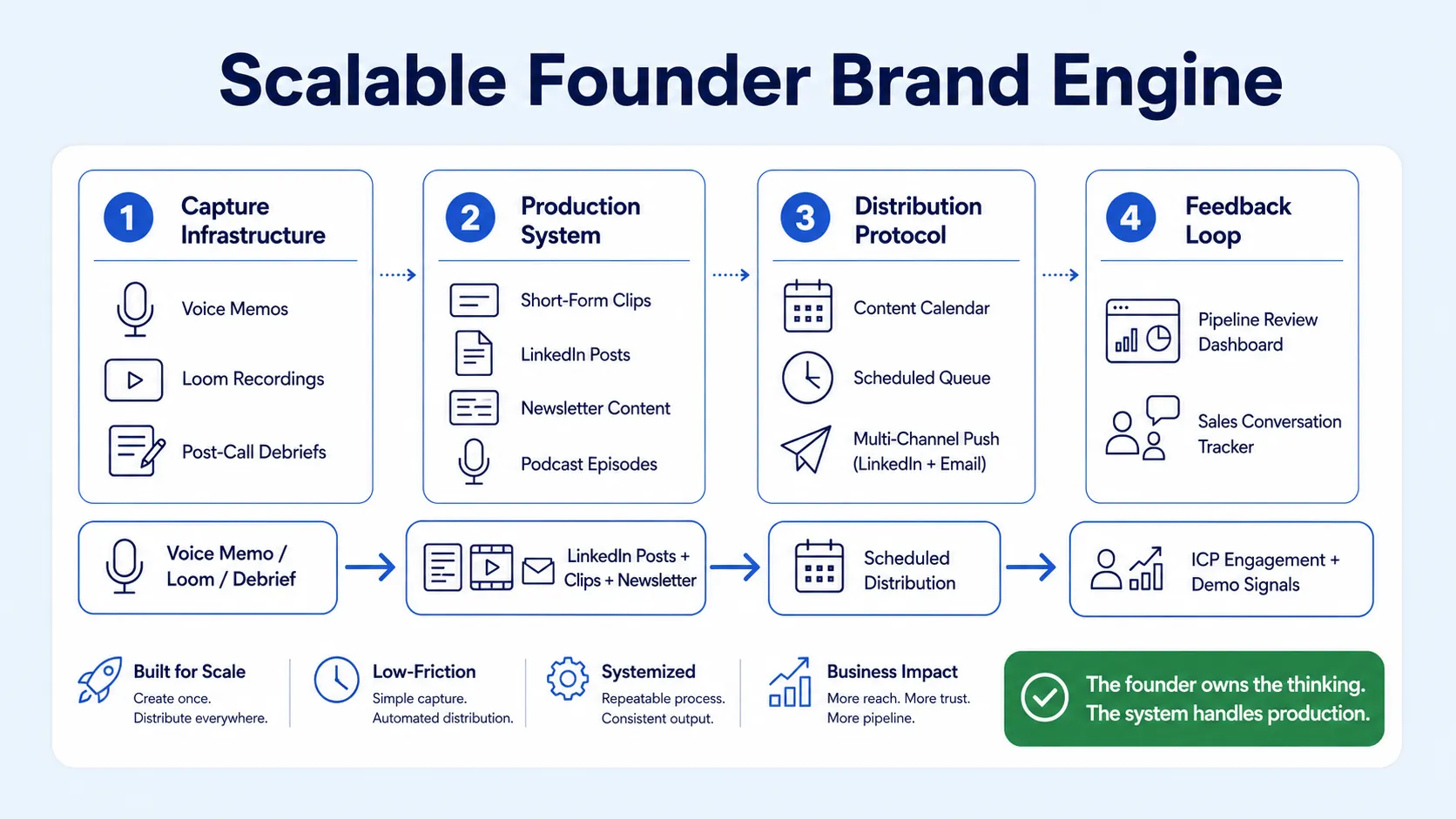
The scalable engine has four components:
- Capture infrastructure: A low-friction way to capture raw founder thinking, voice memos, Loom recordings, post-call debriefs. If capture is hard, nothing else works.
- Production system: A team or agency that takes capture output and formats it into LinkedIn posts, short-form video clips, newsletter sections, and podcast episodes. This is where Komet Media's model lives, providing "from scratch" production services including strategy, scripting, and recording guidance alongside expert editing.
- Distribution protocol: Defined rules for where each asset goes, when it gets posted, and how it gets cross-promoted.
- Feedback loop: Monthly review of which content types drove ICP engagement, demo requests, or sales conversations. Iterate the content mix based on pipeline signals, not engagement rate.
Videos under one minute achieve a 65% completion rate among B2B viewers, while videos over 20 minutes drop to 20%. This is why the production system should be biased toward short-form output from long-form input, not the other way around. 55% of B2B marketers are partnering with creators, subject-matter experts and industry voices, signaling a shift away from generic brand messaging toward credible, human-led storytelling. The founders running scalable personal brand engines in 2026 are partnering with production teams the same way, owning the thinking, outsourcing the execution.
Our podcast production and short-form video services are built specifically for this model, offering comprehensive "from scratch" production—including content strategy, scripting, and recording guidance—to ensure you can record with ease while we build the engine around it.
Conclusion
Building a Founder Personal-Brand Engine is not a marketing experiment, it is infrastructure. The key takeaways:
- Around 80% of deals go to the provider already on the Day One shortlist, your brand determines whether you are on that list before a single sales call.
- A scalable engine decouples founder thinking from founder production time through capture, repurposing, and distribution systems.
- LinkedIn and short-form video are the highest-leverage channels for B2B SaaS founders in 2026; treat them as pipeline assets, not social media.
- Measure demos, inbound DMs, and sales cycle velocity, not likes or impressions.
Book a strategy call with Komet Media if you are ready to turn your existing content and thinking into a founder brand engine that drives real pipeline.
Frequently Asked Questions
Q1: How long does it take for a founder's personal brand to generate a pipeline?
Typically, it takes 6–12 months to see meaningful results from founder-led content. Founders with an existing content library or repurposing system in place often see inbound signals in the 3–4 month range. Consistency and positioning clarity are the biggest accelerators.
Q2: Do I need a large LinkedIn following to make a founder's personal brand work?
No. Follower count is a lagging indicator. Personal profiles reach roughly 62% of what users see versus about 5% for company pages, so even a smaller audience reached through a personal profile consistently outperforms a company page with 10,000 followers. Niche relevance beats broad reach.
Q3: What content formats work best for B2B SaaS founders in 2026?
74% of B2B buyers prefer short, simple video formats that immediately convey benefits. Pair short-form video clips with text-based LinkedIn posts and a bi-weekly newsletter. These three formats, run consistently, cover awareness, education, and retention across the buying cycle.
Q4: How do I turn my webinars and podcasts into a personal brand engine?
Each long-form session should produce: three to five short video clips, one LinkedIn post per major insight, one newsletter section, and a pull quote for your sales deck. One capture becomes five assets. Use Komet Media's podcast editing and webinar repurposing workflows to operationalize this.
Q5: Is founder personal branding only relevant for early-stage startups?
No. The rise of founder-led and thought leadership content is one of the most significant LinkedIn marketing shifts in 2026, personal accounts consistently outperform company pages, and the gap is widening. Series B and C founders benefit as much as pre-seed founders, particularly for enterprise deal velocity and investor relations.
Q6: What is the single biggest mistake founders make when building their personal brand?
Producing without a positioning thesis. Branding in 2026 is no longer about visibility, it is about positioning depth, message precision, and long-term trust architecture. Without a clear thesis that all content reinforces, output generates noise rather than authority, and authority is the only thing that shortens sales cycles.