
🪄 AI Summary
Heading 1
Heading 2
Heading 3
Heading 4
Heading 5
Heading 6
Lorem ipsum dolor sit amet, consectetur adipiscing elit, sed do eiusmod tempor incididunt ut labore et dolore magna aliqua. Ut enim ad minim veniam, quis nostrud exercitation ullamco laboris nisi ut aliquip ex ea commodo consequat. Duis aute irure dolor in reprehenderit in voluptate velit esse cillum dolore eu fugiat nulla pariatur.
Block quote
Ordered list
- Item 1
- Item 2
- Item 3
Unordered list
- Item A
- Item B
- Item C
Bold text
Emphasis
Superscript
Subscript
Most B2B teams produce short-form video, watch the views roll in, and call it marketing. Then leadership asks what it's driving for the pipeline, and the room goes quiet. Measuring ROI on short-form video is the real work, and most SaaS and funded tech teams skip it entirely. This guide gives you a practical, step-by-step framework to connect short-form video directly to pipeline, demo demand, and revenue, not just impressions.
TL;DR
- Short-form video generated the highest ROI among all content formats, with 48.6% of marketers ranking it among their top-performing assets (HubSpot, 2026).
- Vanity metrics (views, likes) don't prove pipeline impact, you need a measurement layer tied to your CRM and GA4.
- Attribution is the hardest part: multi-touch models and intent data are your best tools for B2B video.
- Without a measurement framework, you're spending on content you can't defend to leadership.
What Metrics Actually Matter for B2B Short-Form Video in 2026
The default instinct is to open LinkedIn Video Analytics or a platform dashboard and look at views. Views are a starting point, not a result. The metrics that matter for B2B short-form video fall into three tiers:
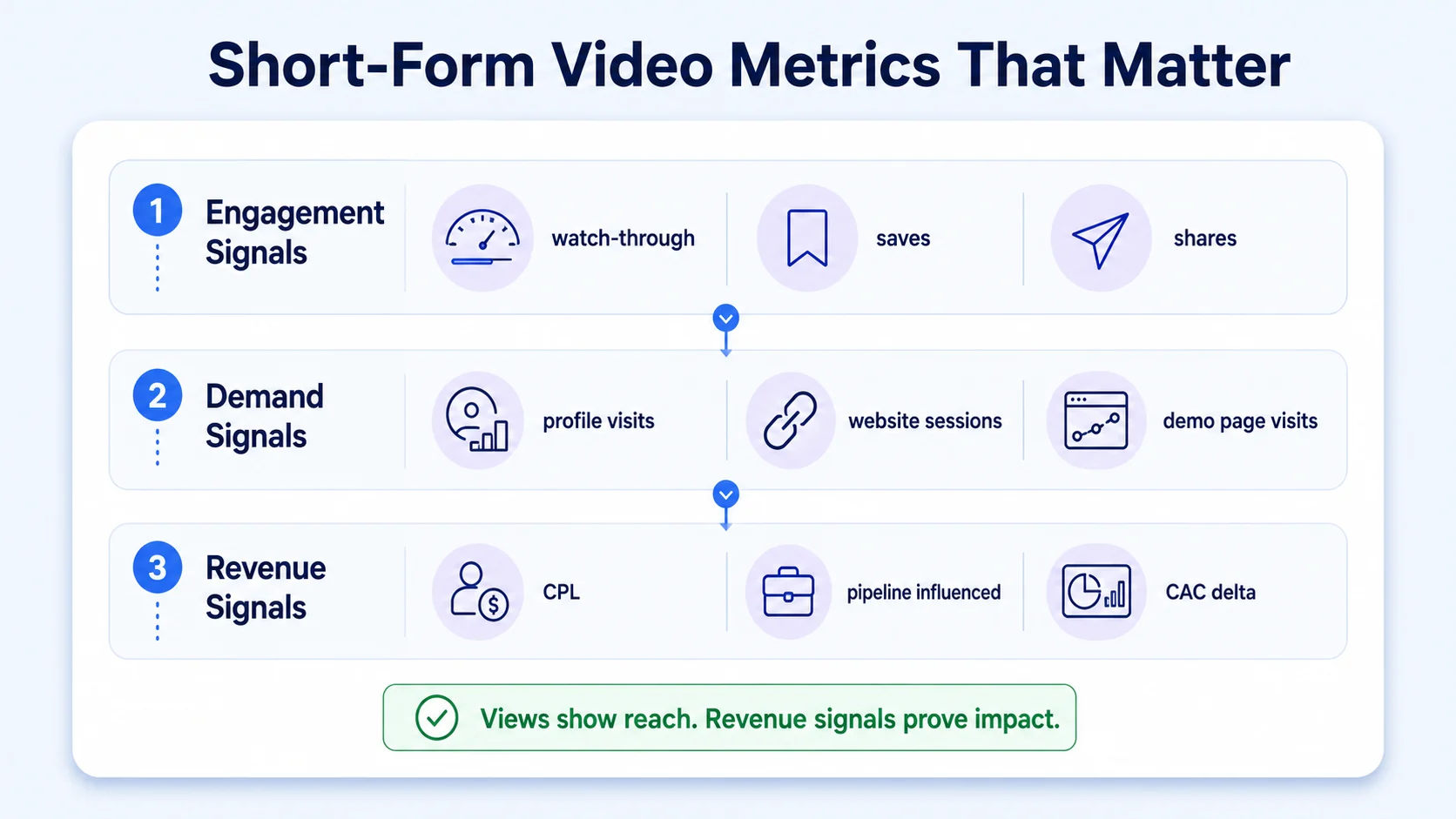
Tier 1: Engagement signals (video health)
- Video engagement rate: Native LinkedIn videos average a 5.60% engagement rate by impressions, based on Socialinsider's benchmark of 1 million posts. Use this as your floor, not your ceiling.
- Watch-through rate: Completion rates are highest for videos under 60 seconds, with 65% of viewers watching to the end. If your B2B SaaS video is 90 seconds and dropping at the 20-second mark, the hook is the problem.
- Saves and shares on LinkedIn: These signal intent and category interest, far more predictive of pipeline than a passive like.
Tier 2: Demand signals (pipeline indicators)
- Profile visits and connection requests following video posts, the cleanest organic intent signal on LinkedIn.
- Website sessions from social (tracked via GA4 with UTM parameters on every link in your bio or caption).
- Demo page visits attributed to video-driven traffic sessions.
Tier 3: Revenue signals (the board-level metrics)
- Cost Per Lead (CPL) from video-driven campaigns vs. other channels.
- Pipeline influenced by accounts that consumed video before a sales conversation.
- Customer Acquisition Cost (CAC) delta between accounts that engaged with video versus those that did not.
60% of video marketers list engagement rate as a top KPI, while 56% list conversion rate and 52% list click-through rate. All three matter, but only Tier 3 metrics close budget conversations with leadership.
The gap that kills most B2B video programs: 67% of video marketers quantify ROI through video views, and views remain the most common measurement metric. The gap between view tracking and revenue attribution is a persistent challenge.
A Short-Form Video ROI Measurement Framework for B2B Marketers
Here is the framework I use with clients at Komet Media to connect short-form video to real pipeline outcomes. It runs in four stages.
1. Define your conversion event before you publish. What counts as a conversion for a given video? For a product explainer repurposed from a webinar, the conversion might be a demo booking. For a founder-led thought leadership clip, it might be a profile visit or a newsletter signup. Map this before distribution.
2. Tag every distribution asset with UTM parameters. Every link in a LinkedIn post caption, bio, or email sequence that references a video must carry a UTM source, medium, and campaign tag. Without this, GA4 cannot separate video-driven sessions from organic direct traffic.
3. Connect platform data to your CRM.
Vidyard integration with HubSpot provides individual viewer engagement data on CRM records, workflow triggers based on percentage watched, and lead scoring based on video engagement patterns, essential for proving video ROI to leadership.
For teams on HubSpot CRM Integration natively, YouTube video embeds can be published and tracked directly through Marketing Hub Professional and Enterprise.
4. Assign pipeline influence scores. Pull all accounts that touched a video asset in the 30–60 days before an opportunity was created. That's your video-influenced pipeline number. It is not perfect attribution, nothing in B2B is, but it is defensible to a CFO.
5. Calculate your ROI formula: Video ROI = (Pipeline Influenced by Video − Cost of Video Production) ÷ Cost of Video Production × 100
6. Run a 90-day reporting cadence. Monthly is too noisy for B2B sales cycles. Quarterly lets pipeline influence data mature before you pull conclusions.
Short-Form Video Attribution Models for B2B Marketing
Attribution is where B2B measuring ROI on short-form video gets complicated, and where most teams give up. The B2B buyer journey is rarely linear. A founder sees your 60-second LinkedIn clip on a Tuesday, searches your product name on Thursday, attends a webinar two weeks later, and books a demo after a sales email.
Which touchpoint gets credit?
For SaaS teams with sales cycles longer than 30 days, multi-touch attribution or a W-shaped model is the most accurate. Dreamdata's 2025 benchmarks report that LinkedIn Conversions API users see about 20% lower CPA and a 31% increase in attributed conversions compared to non-integrated users. That is a direct argument for wiring your LinkedIn Video Analytics data into a proper attribution layer.
Dark social is the attribution blind spot no one wants to admit. When a buyer screenshots your LinkedIn clip and shares it in a Slack channel, that pipeline influence is invisible in your data. The fix: always ask new leads "how did you first hear about us?" and track the qualitative signal alongside your hard data.
Forrester research shows that 92% of B2B buyers begin their journey with at least one vendor in mind, and 41% already have a preferred vendor before evaluation begins. Short-form video is what builds that early preference, which means first-touch attribution will always undercount its true impact.
How to Calculate ROI on LinkedIn Short-Form Video Campaigns
LinkedIn is the primary channel for B2B short-form video ROI measurement because it is where your buyers actually spend professional attention. LinkedIn video drives 80% of all B2B social media leads, with a 5.60% average engagement rate. Here is how to run the numbers.
Step 1: Pull your LinkedIn Video Analytics baseline. Export impressions, views, watch time, click-through rate, and follower demographics for each video. LinkedIn video viewership is rising, with 154 billion video views reported in 2024, and video impressions rising 73.39% year over year. Your benchmark for organic LinkedIn video engagement is 5.60%.
Step 2: Segment by content type. A product demo clip, a founder thought leadership video, and a customer social proof story serve different funnel stages. Measure them separately.
Step 3: Track profile-to-pipeline conversion. For every 1,000 views on a LinkedIn short-form video, monitor how many viewers clicked through to your profile, visited your website (via UTM), and subsequently appeared in your CRM as a new contact or opportunity.
Step 4: Calculate Cost Per Engaged View. Take your total video production cost, divide by the number of views that crossed your watch-through threshold (e.g., watched more than 50%). That is your true CPL for the video, not the platform's CPM figure.
Step 5: Map to pipeline. Dreamdata's 2025 LinkedIn Ads Benchmarks highlights that LinkedIn generated the highest ROAS among major networks in their dataset, with LinkedIn at 113% ROAS compared to Google Search at 78%. The organic video equivalent compounds this over time as content continues to surface in feeds and search.
B2B companies that delay adopting short-form video face 12% to 18% higher customer acquisition costs, a real number to put in front of a skeptical CFO.
Is Short-Form Video Worth It for B2B? Short-Form vs. Long-Form ROI Compared
The honest answer: yes, but not in the way most teams expect. Short-form video ROI is front-loaded on awareness and trust, and it compounds over time as buyer familiarity grows.
The strategic answer for B2B SaaS is not short-form or long-form. It is using long-form assets (webinars, podcasts, demos, product deep-dives) as the source material and repurposing them into short-form clips that do the distribution and awareness work. 70% of B2B buyers watch video content during their purchase decision process.
The short clip earns the attention; the long-form asset closes the information gap. 41% of B2B marketers say short-form drives the highest ROI of all video formats, per the LinkedIn B2B Marketing Benchmark. That share rises when short-form is treated as a demand generation system rather than a content calendar obligation.
How to Prove Short-Form Video ROI to Leadership
Leadership does not care about engagement rate. They care about pipeline, CAC, and whether the budget is working. Here is how to translate your video data into that language.
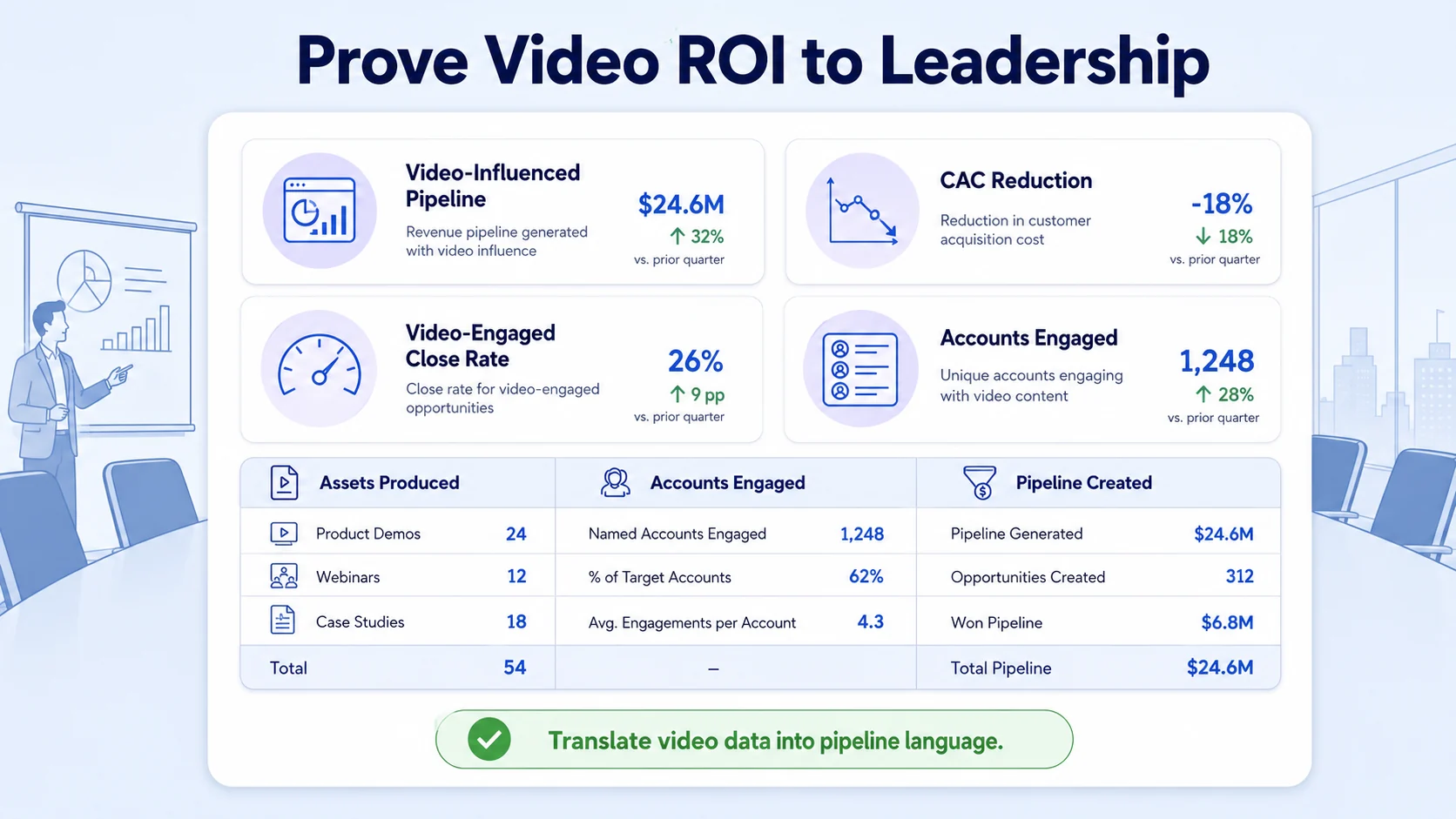
Build a video-influenced pipeline report. In HubSpot or your CRM, create a contact property: "Consumed video before opportunity creation, Yes/No." Pull this against all closed-won and active pipeline deals quarterly. The delta in close rate between video-engaged and non-video-engaged accounts is your clearest ROI signal for leadership.
Show CAC reduction over time. 82% of businesses say video increased web traffic, 85% report it generated leads, and 83% say it directly boosted sales. As your short-form video content builds organic reach and inbound demand, your blended CAC should drop. Track this month over month and present the trend, not just a single data point.
Use intent data to close the dark social gap. Tools like G2, Bombora, and LinkedIn's own intent signals surface which accounts are researching your category. Cross-reference these signals with your video-viewing audience (if you use Vidyard or Wistia with CRM integration) to identify in-market accounts who have consumed your content without converting yet. This is your warmest pipeline, and video is what warmed it.
Present a content attribution model slide. For the services that Komet Media provides, I always recommend a simple three-column report: (1) video assets produced, (2) accounts that are engaged, (3) pipeline created or influenced within 90 days. It is not perfect, B2B attribution never is, but it is honest, defensible, and shows leadership that measurement is real.
LinkedIn's 2025 B2B Marketing Benchmark reveals that nearly all marketers surveyed (94%) agree that trust is the key to success in B2B, shaping every deal, every decision, and every long-term relationship. Short-form video is how you build that trust at scale. Measuring it is how you keep the budget to keep doing it.
Founder-led content gets a 4x engagement multiplier on LinkedIn, making it one of the highest-leverage inputs for any B2B measuring ROI on short-form video programs. If your founder is not on camera, that is the first gap to close.
Conclusion
Measuring ROI on short-form video is a system problem, not a metrics problem. Most B2B teams have the data, they just haven't connected it.
Key takeaways:
- Move beyond views. Pipeline influence, CAC delta, and video-engaged close rates are the metrics leadership responds to.
- Tag everything with UTMs, wire LinkedIn Video Analytics into your CRM, and run multi-touch attribution for sales cycles over 30 days.
- Use short-form as the awareness and trust layer; use repurposed long-form content as the proof layer.
- Run a 90-day reporting cadence, it gives pipeline data time to mature.
If you want a video system built for pipeline, not just impressions, Komet Media's short-form video and repurposing services are built specifically for B2B SaaS and funded tech teams.
Frequently Asked Questions
Q1: What counts as a conversion for B2B short-form video?
A conversion depends on the video's funnel stage. For awareness clips, it is a profile visit or website session. For consideration-stage videos, it is a demo booking, newsletter signup, or gated asset download. Define the conversion event before publishing, not after reviewing the analytics.
Q2: How long does it take to see ROI from B2B short-form video?
Expect 60–90 days before pipeline influence data is meaningful. Engagement signals (views, saves, profile visits) appear within days. Pipeline attribution requires your CRM to capture contacts, advance opportunities, and close deals, all of which take time in B2B sales cycles.
Q3: Which attribution model should B2B SaaS teams use for short-form video?
For sales cycles over 30 days, use a W-shaped multi-touch model that credits first touch, lead creation, and close equally. For shorter cycles or paid campaigns, time-decay attribution is more accurate. Avoid last-touch attribution, it consistently undervalues awareness content like short-form video.
Q4: How do I measure short-form video ROI on LinkedIn specifically?
Pull LinkedIn Video Analytics for engagement rate (benchmark: 5.60%), watch-through rate, and click-throughs. Layer UTM-tagged links to track downstream website sessions in GA4. Then cross-reference CRM records to identify accounts that engaged with LinkedIn video before creating an opportunity.
Q5: Is measuring ROI on short-form video different for founder-led content?
Yes. Founder-led content typically drives higher engagement but converts through relationship and trust rather than direct CTA clicks. Track profile visits, inbound connection requests from ICP accounts, and "how did you hear about us?" survey data. These qualitative signals complement your hard attribution data.
Q6: What tools do I need to measure B2B short-form video ROI end to end?
A working stack includes: LinkedIn Video Analytics (platform data), Google Analytics 4 with UTM tracking (session attribution), HubSpot CRM Integration or equivalent (pipeline influence), and Vidyard or Wistia (individual viewer-level engagement tied to CRM records). Intent data tools like Bombora or G2 Buyer Intent layer on top for dark social coverage.