
🪄 AI Summary
Heading 1
Heading 2
Heading 3
Heading 4
Heading 5
Heading 6
Lorem ipsum dolor sit amet, consectetur adipiscing elit, sed do eiusmod tempor incididunt ut labore et dolore magna aliqua. Ut enim ad minim veniam, quis nostrud exercitation ullamco laboris nisi ut aliquip ex ea commodo consequat. Duis aute irure dolor in reprehenderit in voluptate velit esse cillum dolore eu fugiat nulla pariatur.
Block quote
Ordered list
- Item 1
- Item 2
- Item 3
Unordered list
- Item A
- Item B
- Item C
Bold text
Emphasis
Superscript
Subscript
Most B2B SaaS, AI, and tech startup teams are sitting on a goldmine, customer stories buried in G2 reviews, Slack messages, email threads, or long-form case studies, and doing nothing with them in paid social. Learning to repurpose a testimonial into a video ad is one of the highest-leverage moves available to B2B SaaS, AI, and tech teams right now. No new filming. No expensive production. Just smart editing and a repeatable workflow that turns existing proof into a pipeline.
TL;DR
- Testimonial video ads consistently outperform polished brand ads because buyers trust other buyers.
- A single written or recorded testimonial can be turned into multiple short-form video ad formats without new filming.
- The winning structure is Hook → Problem → Outcome → CTA, under 60 seconds.
- Match aspect ratio and length to each platform before distributing.
Why Testimonial Video Ads Work (and Why Most Teams Under-Deploy Them)
Before getting into the how, you need to understand why this format converts so reliably, because once you do, you'll stop treating your customer stories as afterthoughts and start treating them as paid media fuel. Compared to written reviews, video testimonials generate 2.7x more purchase decisions. That gap is why converting a static review into a video ad is not an optional upgrade, it's a meaningful revenue lever.
Video testimonials outperform traditional channels by significant margins when comparing equivalent investments. Testimonials outperform paid search by 2.8x, social media advertising by 3.2x, and display advertising by 4.7x in revenue generated per dollar.
For B2B specifically, testimonial videos boosted landing page conversions by 39% in B2B campaigns. And testimonial videos featuring clients in the same industry improved lead quality by 42% for B2B. That last number matters for B2B SaaS, AI, and tech teams: showing a buyer from their own vertical is not a nice-to-have, it's the difference between a scroll-past and a demo request. Yet most growth teams post testimonials to a hidden "Customer Stories" page and call it done.
Most marketers have good content, they just haven't broken it down into the right formats. A long interview is a great raw asset, but it's not the finish line. It's the starting point. If you're not repackaging your stories for the way people actually consume content today, you're missing the opportunity. This is the gap we close at Komet Media. Whether you need from-scratch video ad creation or want to build a video ad system around the proof you already have, we handle the full production process.
How to Turn a Customer Testimonial into a Video Ad: The Full Workflow
This is the exact process I run with B2B SaaS, AI, and tech startup clients. Follow it sequentially, skipping steps creates weak ads.
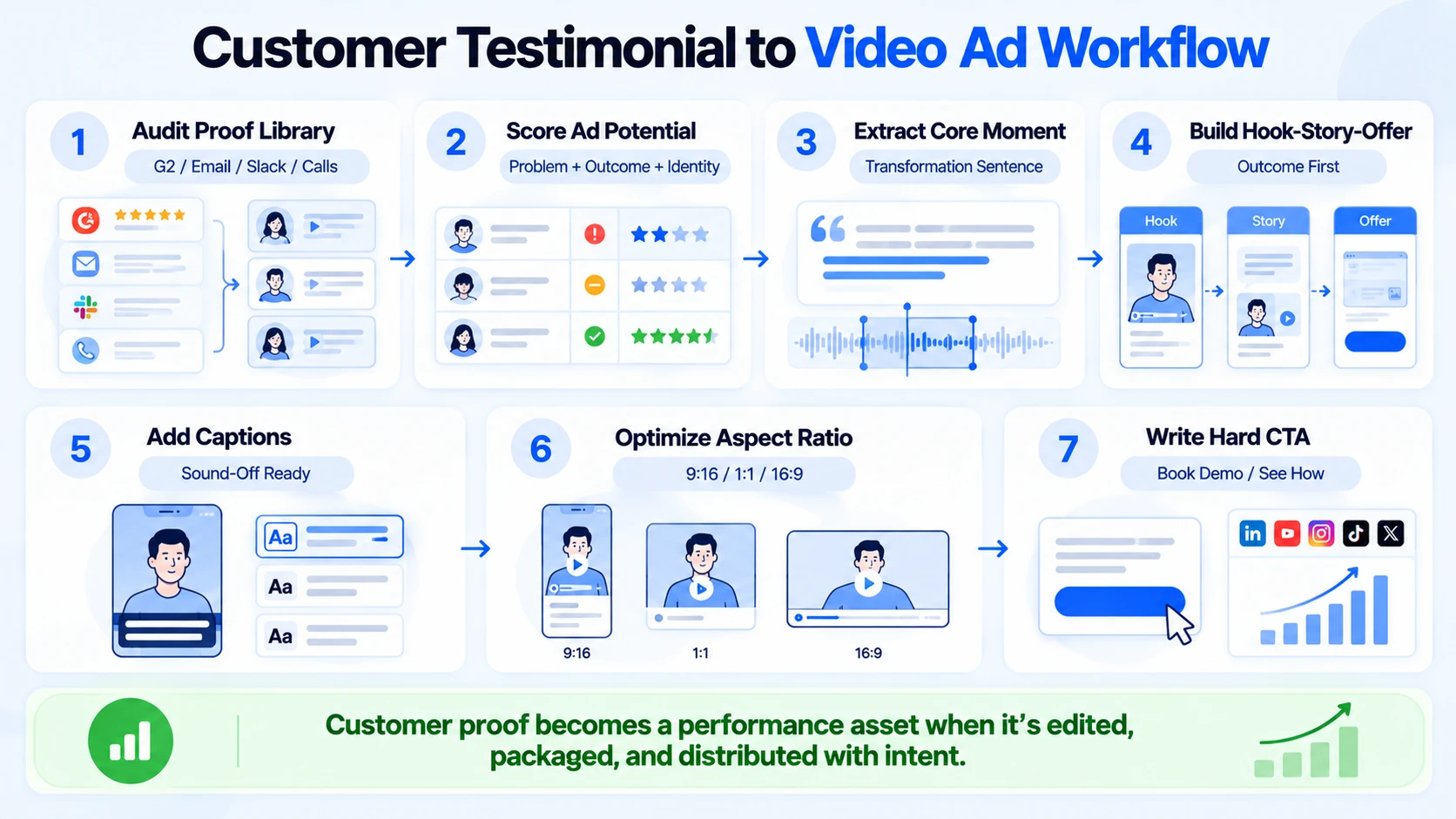
- Audit your testimonial library: Pull every customer mention across G2, Capterra, email, Slack, interview recordings, webinars, and demo calls. Tag each by pain point, persona, and outcome.
- Score for ad potential: A testimonial ready for paid social needs three things, a named problem, a clear outcome, and a real customer identity (name, role, company type). If all three are present, it's viable.
- Extract the core moment: In a written review, find the single sentence that contains the transformation ("We cut onboarding time by 60%"). In a video recording, timestamp the 10–30 second window where the customer states their outcome most directly.
- Build the Hook-Story-Offer structure: Open with the outcome (hook), let the customer explain the before-state briefly (story), then bridge to your offer. Never open with a company name or logo, testimonials that begin with customer credentials or company name introductions see 34% higher early abandonment.
- Add closed captions: Accessibility and autoplay silence are both real on every platform. Captions are non-negotiable for paid social.
- Apply aspect ratio optimization: 9:16 for Instagram Reels and TikTok, 1:1 for Meta feed, 16:9 for YouTube. Never run a letterboxed vertical video in a horizontal placement, it signals amateur production to buyers.
- Write a hard CTA: The last frame tells viewers exactly what to do: "Book a demo," "See how it works," or "Watch the full case study." Vague closes waste spend.
Repurpose a Written Testimonial into a Video Ad (No Filming Required)
You do not need a recorded customer to repurpose a testimonial into a video ad. Written reviews can become compelling short-form video ads with this approach.
Option A, Kinetic Text Ad: Animate the most powerful quote from the review against a clean brand background. Layer in motion graphics, a music bed, and a logo. The entire ad lives in the text itself. Keep it under 20 words on screen at any one time.
Option B, AI Voiceover + Screenshots: Convert the written review into a narrated ad by pairing an AI voiceover (or a contracted voice-over artist) with product UI screenshots, G2 review card graphics, and a results callout. This format works particularly well for video advertising campaigns on YouTube pre-roll.
Option C, Screen-Recorded Social Proof Stack: Capture a scrolling screenshot of the original G2 or Capterra review page, zoom to the key quote, then transition to a product demo clip. This "found footage" style reads as authentic because it is.
Instead of creating one-off assets, this strategy involves capturing a core testimonial and repurposing it across video, text, and audio formats. This ensures brand messaging is consistent, cohesive, and present wherever the target audience is.
For B2B SaaS, AI, and tech startups without a content library yet, these no-filming formats are often the fastest path to running proof-based paid social within a week. I've built this system for funded teams that had dozens of G2 reviews they'd never touched.
What Makes a Testimonial Video Ad Actually Convert
Structure is everything. The vast majority of testimonial ads that underperform do so because they open too slowly, bury the outcome, or forget to close with a CTA. Here is what the data says about each element.
The hook window is 10 seconds. The first 10 seconds prove decisive. Ninety-one percent of viewers who remain past this threshold complete the entire testimonial. Effective openings feature immediate problem identification or outcome revelation. Open with the result, not the preamble.
Instagram Reels in the 20–30 second range achieve 70–80% completion. TikTok testimonials perform best at 15–30 seconds. YouTube Shorts can extend to 60 seconds without significant completion penalties.
Peer relevance beats polish. 55% of shoppers said they were more likely to purchase when the testimonial came from someone they felt was "just like them," compared to 33% for generic or brand-produced videos. For B2B, this means showing the customer's title, company size, and industry on screen, not just their face.
Demonstration format holds attention. Wistia's 2025 Video Benchmark Report found that demonstration-format testimonial ads have 37% higher average watch time than talking-head testimonials. Where possible, cut in product screenshots or screen recordings alongside the customer quote.
Captions are not optional. Most mobile users scroll with sound off. Burned-in captions (not auto-generated subtitles) keep message retention high regardless of sound environment.
How to Distribute and Test Testimonial Video Ads Across Paid Social
Creating the asset is only half the job. Distributing it intelligently across Meta Ads Manager, YouTube Advertising, and TikTok for Business is where B2B SaaS, AI, and tech teams leave the most pipeline on the table.
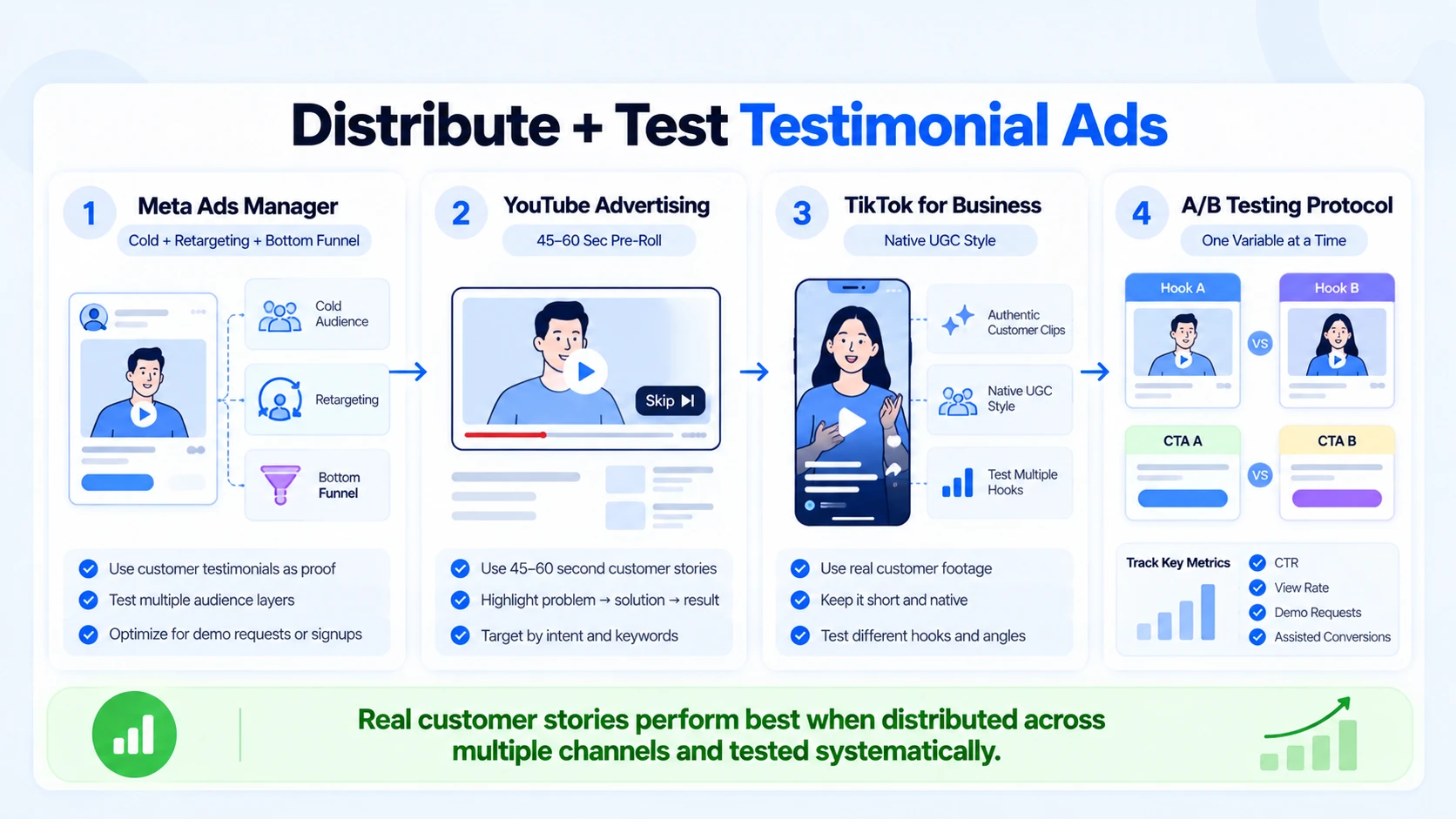
Meta Ads Manager: Use testimonial video ads for three distinct stages. Run persona-matched testimonials to cold lookalike audiences. Retarget website visitors and trial drop-offs with outcome-specific clips. Deploy objection-busting testimonials at the bottom of the funnel to accelerate demo-to-close. Trim a 20-second objection-busting clip for retargeting ads. Grab a 30-second emotional story for your nurture emails.
YouTube Advertising: Longer testimonials (45–60 seconds) work as pre-roll for in-market audiences. Pair with a hard CTA card at the 5-second mark so viewers who skip still register the outcome claim.
TikTok for Business: The UGC video strategy native to TikTok rewards low-production authenticity. A customer talking directly to camera on their phone, with captions and a punchy opener, often outperforms agency-produced content. Use the platform's native text overlays and keep branding subtle until the final 3 seconds.
A/B testing protocol: Test one variable at a time, hook line, opening visual, CTA text. Track performance with on-site conversion rates, assisted conversions, and A/B tests so you can double down on the specific clips, angles, and placements that reliably close more. Video testimonials are a popular tool in social advertising, with 54% of marketing professionals using them in their paid social media ads. That number also means 46% of your competitors are not. Paid social testimonial ads are still an underused format in most B2B SaaS, AI, and tech categories.
Tools and Production Workflow to Repurpose Testimonials at Scale
You do not need an in-house team or a massive budget. Here is the lean stack for teams looking to build a repeatable video production workflow:
Sourcing and transcription tools:
- Rev or Otter.ai for transcribing long-form recordings and pulling quotable moments fast.
- G2 and Capterra review scrapers for surfacing written proof at volume.
Editing tools:
- CapCut (free) or Adobe Premiere Pro for editing video testimonial clips and adding captions.
- Canva or Adobe Express for kinetic text and quote card formats from written reviews.
- Descript for transcript-based editing, cut by removing words from the text, not scrubbing the timeline.
Distribution and testing:
- Meta Ads Manager for multi-format upload and split testing.
- TikTok Ads Manager with Spark Ads for boosting organic-style testimonial content.
- YouTube Studio for pre-roll and in-feed distribution.
The repeatable system:
- Collect raw testimonials (recorded or written).
- Transcribe and tag by pain point, persona, outcome.
- Extract the core 15–30 second quote or clip.
- Edit to platform spec (aspect ratio, captions, CTA).
- Build three variants: Hook A, Hook B, Hook C.
- Launch, measure, kill under-performers on day 7.
- Scale winning variant to broader audience.
For teams at the services level where speed matters, a done-for-you partner handles everything—from creating brand new video ads from scratch to running repurposing workflows. That's the leverage model. Whether starting fresh or using a strong customer story, you produce scalable ad-ready assets without burning team bandwidth.
Conclusion
Knowing how to repurpose a testimonial into a video ad is now a core competency for any B2B SaaS, AI, or tech startup serious about pipeline. The proof already exists in your reviews, recordings, and customer conversations, the workflow is what's missing.
Key takeaways:
- Open every testimonial ad with the outcome, not the intro.
- Match length and aspect ratio to each platform before publishing.
- Written reviews convert into video ads, no filming required.
- One testimonial, when edited correctly, produces multiple paid social assets that support pipeline across every funnel stage.
Frequently Asked Questions
Q1: How long should a testimonial video ad be?
Platform determines length. Instagram Reels and TikTok perform best at 15–30 seconds. YouTube Shorts can run up to 60 seconds. For Meta feed placements, 30–45 seconds is the sweet spot. Always prioritise getting to the outcome claim within the first 10 seconds regardless of platform.
Q2: Can I use a written review to create a Facebook video ad?
Yes. Kinetic text ads, AI voiceover paired with product screenshots, and animated quote cards all convert written reviews into paid social assets without filming. Secure the customer's permission before using their review in paid media, that step is non-negotiable from both a legal and trust standpoint.
Q3: Do I need the customer's permission to repurpose their testimonial?
Always. For organic posting, most platform terms of service and basic consent norms require it. For paid promotion specifically, you need explicit written permission to use someone's words or likeness in an ad. A short email confirmation is sufficient for most use cases.
Q4: What makes a B2B testimonial video ad different from a B2C one?
B2B buyers want peer-level specificity: role, company size, industry vertical, and a measurable outcome. Generic enthusiasm does not move B2B buyers the way a CFO at a 50-person SaaS company saying "we closed 40% faster" does. Always display the customer's title and company type on screen.
Q5: How many ad variations should I create from one testimonial?
Aim for three to six variations per testimonial. Test different hook lines (outcome-first, problem-first, question-based), two aspect ratios (9:16 and 1:1), and at least two CTA options. Run for seven days, cut the bottom performers, and scale the winner.
Q6: What is the biggest mistake teams make when trying to repurpose a testimonial into a video ad?
Opening with the brand name or logo. Data consistently shows this causes early drop-off because viewers need a relevance signal before an identity signal. Lead with the customer's pain point or result in the first three seconds, then introduce your brand at the close.