
The opening lines of a script set the pace for the whole episode, so how to start off a podcast script is worth practising. A good opening gets attention, tells the listener what the episode is about, and moves into the content without a long preamble. This guide gives a step-by-step method with tables and hypothetical sample openings for solo and interview episodes.
Quick Answer to Starting Off a Podcast Script
Open with a hook, welcome the listener in one line, state what the episode covers, introduce the guest briefly, and move into the first question or point.
The Podcast Scripting Plan at a Glance
| Step | Action | Output |
|---|---|---|
| 1 | Decide the episode's single point | One sentence |
| 2 | Write the hook | One or two lines |
| 3 | Write the welcome | One line |
| 4 | Write the roadmap | What the listener will get |
| 5 | Introduce the guest or topic | A short intro |
| 6 | Move into the first point | A clean hand-off |
| 7 | Read aloud and trim | A final opening |
Who This Podcast Scripting Guide Is For
| Reader | Situation | Where to start |
|---|---|---|
| New host | Writing a first script | Steps 1 to 4 |
| Solo host | Needs a steady opening format | Steps 2 to 6 |
| Interviewer | Prepares guest openings | Steps 4 to 6 |
| Producer | Edits scripts for a show | Steps 6, 7 |
Whichever you are, the plan for how to start off a podcast script starts with one clear point for the episode.
Step 1: Decide the Episode's Single Point
- Write one sentence saying what the listener will learn or feel.
- Check that the whole episode serves it.
- Cut anything that does not.
| Episode type | Single point (hypothetical) |
|---|---|
| Interview | "How one operations leader cut approval time." |
| Solo | "Why most onboarding plans fail in week two." |
| Panel | "Where three experts disagree on hiring." |
| Case study | "What changed after we dropped a feature." |
Anyone working on how to start off a podcast script should write this sentence first. The opening lines flow from it.
Step 2: Write the Hook for Your Podcast Script
| Hook type | Example (hypothetical) | Best for |
|---|---|---|
| Surprising fact or claim | "We deleted our best-selling feature, and revenue rose." | Solo and case study |
| Question | "What would you do if your biggest customer left today?" | Any |
| Mini story | "At 9 a.m. on a Monday, the dashboard went dark." | Story and interview |
| Guest line | A strong quote from the episode | Interview |
| Promise | "By the end, you will have a three-step checklist." | Educational |
Choose a hook you can support. A hook the episode cannot deliver damages trust.
Step 3: Write the Welcome Line
Keep it to one line.
| Element | Example (hypothetical) |
|---|---|
| Show name | "Welcome to The Operations Brief." |
| Host | "I'm Dana." |
| Optional promise | "One fix that worked, every week." |
Avoid a long list of thanks, housekeeping, or sponsor details before the content. Those can come later.
Step 4: Write the Podcast Script Roadmap
A roadmap tells the listener what they will get.
| Roadmap element | Example (hypothetical) |
|---|---|
| The topic | "Today, how teams roll out new tools without disruption." |
| The payoff | "You will leave with three questions to ask before any rollout." |
| The guest | "My guest led the rollout at a 200-person company." |
| The length | "It takes about 30 minutes." |
- Say what, why, and who in two or three sentences.
- Do not list every point you will cover.
- Avoid promises you do not keep.
Step 5: Introduce the Guest or Topic
| Element | Guidance |
|---|---|
| Name and role | One sentence |
| Why they are here | The specific experience that matters |
| Credentials | Only what the listener needs |
| Tone | Warm and brief |
Ask the guest in advance how they want to be introduced, and use the wording they approve. Do not add claims you cannot support.
A useful rule for how to start off a podcast script: the guest introduction should be shorter than the first answer.
Step 6: Move Into the First Point
| Hand-off | Example (hypothetical) |
|---|---|
| First question | "Let's start at the beginning. What went wrong?" |
| First point | "The first step is to define the problem in one sentence." |
| Story start | "Here is what happened." |
Move straight in. A clean hand-off keeps the energy of the hook.
Step 7: Read Aloud and Trim Your Podcast Intro
- Read the opening aloud at natural pace.
- Mark anywhere you stumble and rewrite it.
- Cut every word that does not earn its place.
- Time it. Most openings can be short.
- Record it and listen back.
Scripts are written for the ear, so use short sentences and everyday words. See our short-form video scripting template and video script example.
Two Sample Podcast Script Openings
These are illustrations, not real episodes.
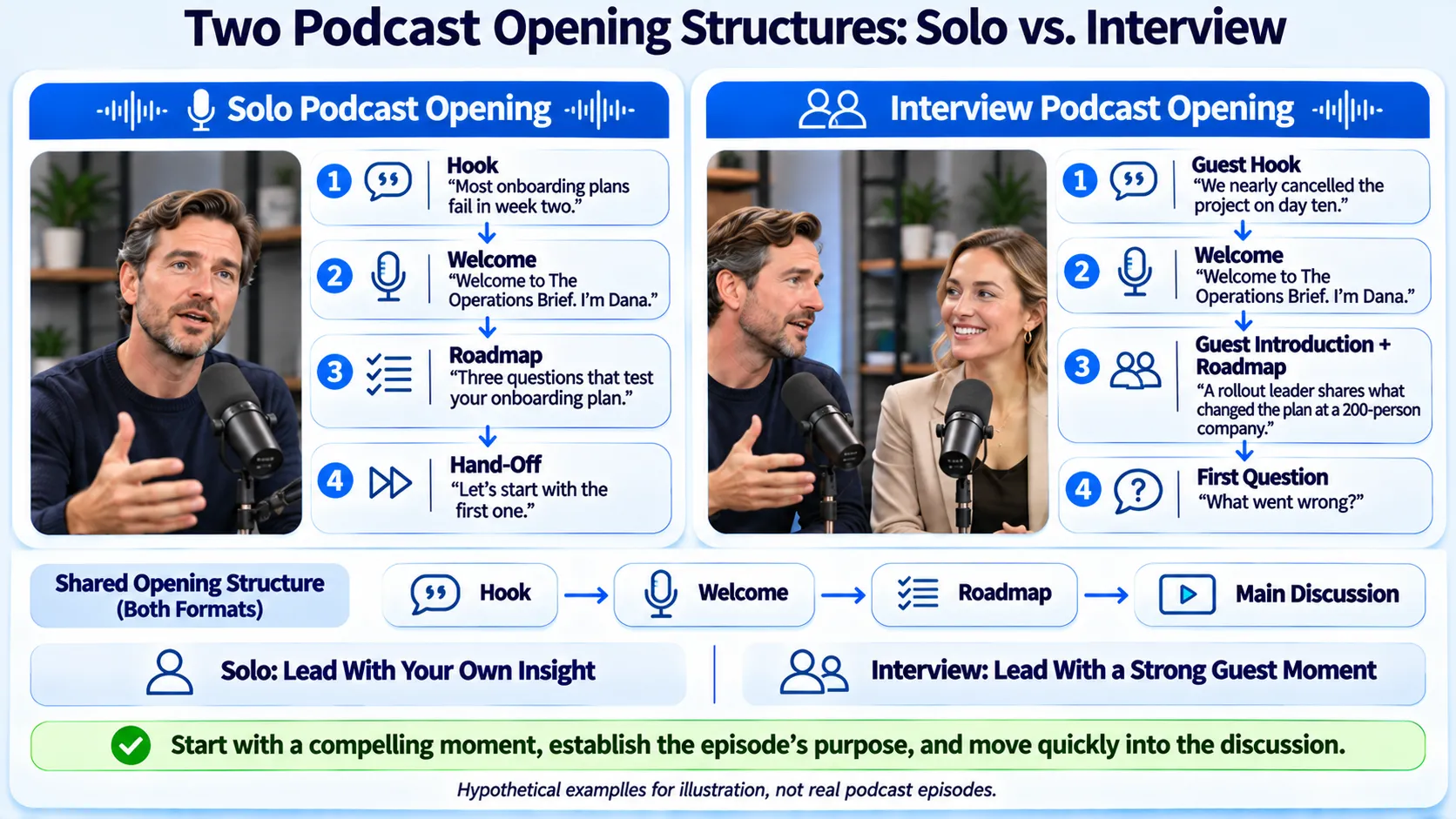
Solo episode
- "Most onboarding plans fail in week two." (hook)
- "Welcome to The Operations Brief. I'm Dana." (welcome)
- "Today, three questions that show whether your plan will survive." (roadmap)
- "Let's start with the first one." (hand-off)
Interview episode
- "We nearly cancelled the project on day ten." (guest line as hook)
- "Welcome to The Operations Brief. I'm Dana." (welcome)
- "My guest led a rollout at a 200-person company, and she will share what changed their plan." (roadmap and introduction)
- "First question: what went wrong?" (hand-off)
If you plan to share clips, see podcast to clips framework for B2B and titling podcast episodes.
How Komet Media Supports Podcast Scripting
Komet Media supports the full podcasting lifecycle, from creating shows from scratch to post-production editing and distribution. See podcast editing, podcast production, and B2B podcast repurposing.
Komet Media's typical retainers run around $2,500 to $5,000, depending on scope, volume, production difficulty, turnaround, and distribution needs. That is a working range, not a fixed package. Editing creates the asset. Distribution gives the asset a chance to produce business value.
Common Podcast Scripting Mistakes
- A long welcome before any content.
- A hook the episode cannot deliver.
- Reading a script in a flat voice.
- Listing every point in the roadmap.
- Over-long guest introductions.
- Skipping the read-aloud test.
- Starting with housekeeping.
A Short Checklist for Starting Off a Podcast Script
- The episode has one stated point.
- The hook is true and specific.
- The welcome is one line.
- The roadmap states topic and payoff.
- The guest introduction is short and approved.
- The opening is read aloud and trimmed, which completes how to start off a podcast script.
Conclusion
The practical answer to how to start off a podcast script is one clear point, a true hook, a short welcome, a brief roadmap, and a clean move into the first question. Revisit your approach to how to start off a podcast script after every ten episodes. If you want to talk through a plan, you can book a call.
Frequently Asked Questions
What is the best answer to how to start off a podcast script?
Decide the single point, write a true hook, add a one-line welcome, give a short roadmap, introduce the guest briefly, move into the first point, and read it aloud.
How long should the opening be?
Short enough to get into the content quickly. There is no single correct length, so test it with listeners.
Should I script the whole episode?
It depends on the format. Many hosts script the opening and outline the rest, so the conversation stays natural.
Should I read a script or speak from notes?
Many hosts write the opening word for word and use notes after that. Choose what sounds natural to you.
Where do sponsor messages go?
Choose a placement that suits your show, and keep the opening free of long housekeeping.
Can I reuse the same opening every episode?
Keep the welcome consistent and change the hook for each episode.
Does the opening matter for clips?
Yes. A clip should start on its own hook, with captions, and not rely on the full opening.
Does Komet Media help with podcasts?
Yes. We help launch and create podcasts from scratch, edit episodes, and turn content into clips for distribution. See podcast editing FAQ.
Written by
Founder & Director of Video - Komet Media
Rajan is the founder and Director of Video at Komet Media, where he builds video content systems that help B2B businesses grow visibility and trust. With 8+ years across video editing, short-form content, Instagram growth, and podcast production, he helps brands drive reach, engagement, and authority.
He writes regularly on short-form video strategy, Instagram growth, podcast repurposing, and building consistent video systems for founders and B2B teams.

